CCSD Code C1540: Surgical correction of trichiasis and upper lid entropion
CCSD Code C1540: Definition and official descriptor CCSD Code C1540 is the Clini...

Last Updated: Nov 16, 2026
44310 is the CPT code for ileostomy or jejunostomy, non-tube. It covers creating a new loop or end stoma from the small intestine through an open approach.
Coders see 44310 most often on claims for Crohn's disease, ulcerative colitis, colorectal cancer, and intestinal obstruction. It sits in the enterostomy range, 44300 to 44346, beside codes that are easy to confuse with it. Revising an existing stoma is 44312 (simple) or 44314 (complicated), and a continent Kock pouch is 44316. The operative note decides between them: creation supports 44310, while revision supports 44312 or 44314.
Let Pabau's smart automation suggest the right codes, reduce claim denials, and keep your practice compliant—effortlessly.
Automate repetitive tasks and focus on what matters most—your patients.
Reduce coding errors and ensure compliance with the latest regulations.
Clean claims, fewer denials, and faster reimbursements.
Powerful insights and reporting to help your practice thrive.
HIPAA compliant SOC 2 certified GDPR-compliant Trusted by 4,000+ clinics worldwide

CPT code 44310 covers creation of a non-tube ileostomy or jejunostomy, loop or end, through an open approach.
Revision of an existing stoma is 44312 or 44314, and a continent Kock pouch is 44316, so neither belongs on a 44310 claim.
The 90-day global surgery period applies under Medicare, so the operating surgeon’s related post-op care is bundled into the allowable.
Pairing 44310 with a nonspecific ICD-10-CM diagnosis is the leading medical necessity denial cause for this code.
Pabau tracks prior authorization on the patient’s case, warns when one is missing, and sends claims electronically through Claim.MD.
CPT code 44310 is the code for “Ileostomy or jejunostomy, non-tube,” the creation of a new stoma from the small intestine. In the AMA’s CPT code set, each Category I code carries a descriptor that matches one procedure. 44310 is the one for non-tube small-bowel stomas. The surgeon brings a segment of ileum or jejunum through the abdominal wall, so intestinal contents drain into an external pouch. Both loop and end ileostomy configurations are reported with this code.
The key phrase in the descriptor is “non-tube.” This distinguishes 44310 from tube-based enterostomy (44300) and from the continent Kock pouch (44316). The code describes the open procedure, and a laparoscopic non-tube ileostomy or jejunostomy is reported with 44187 instead.
No. Both loop ileostomy and end ileostomy are reported with 44310. The operative note should still document which configuration was created, as this detail supports medical necessity and helps differentiate from future revision procedures. The distinction matters for clinical continuity, not for code selection at the time of creation.
The table shows which work 44310 already pays for and which work belongs to a neighboring code. Billing a bundled component on its own line is an unbundling error that NCCI edits catch.
The enterostomy range, 44300 to 44346, holds several codes that describe stoma procedures. Choosing the wrong one is a frequent audit finding in colorectal surgery billing. The operative note decides which code applies, more than the diagnosis or the stoma type alone.
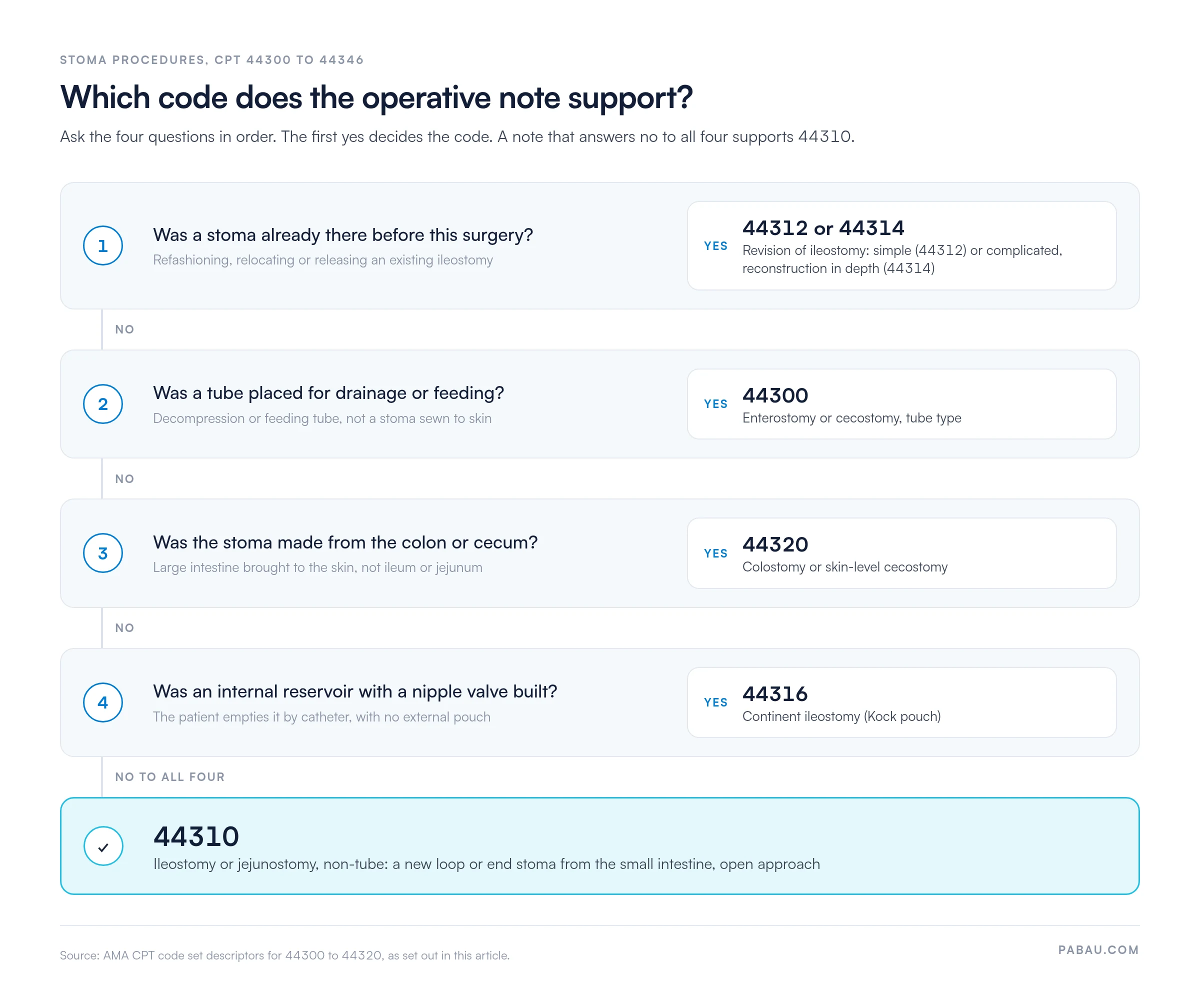
Read the operative note against four questions, in this order. The first yes settles the code, and a note that answers no to all four supports 44310. A stoma built from the colon or cecum moves the claim to 44320, whatever the diagnosis.
Critical distinction for coders: 44310 and a revision code cannot be billed on the same date of service without documentation of two separate intestinal sites. NCCI bundling edits pair these codes. Appending modifier 59 requires distinct-site documentation that most operative notes do not support. When auditors review colorectal claims, creation billed as revision (or the reverse) is a primary target.
Medical necessity for CPT code 44310 ileostomy creation hinges on the clinical indication documented in the operative note and the supporting medical record. Payers evaluate whether the ileostomy was required to address the underlying condition, not whether the surgeon preferred this approach.
Accepted indications include:
Medical necessity criteria vary by Medicare Administrative Contractor (MAC). Some MACs publish Local Coverage Determinations (LCDs) for intestinal surgery that set minimum pre-operative documentation. Check the applicable LCD before submitting the claim when the indication falls outside the main IBD and cancer diagnoses.
A specific ICD-10-CM diagnosis is the strongest defense against medical necessity denials on CPT code 44310 claims. Nonspecific codes such as K57.30 or K50.90 are the most frequent denial trigger for this procedure. Neither one names the complication that justified diversion.
Verify ICD-10-CM codes against the CDC/NCHS ICD-10-CM web tool each October 1 when codes update. Z93.2 is well-established, but K50 and K51 specificity codes change periodically and must be confirmed for the applicable fiscal year.
Always code the underlying condition at its highest specificity rather than defaulting to the .9 unspecified subcode. For Crohn’s disease and ulcerative colitis especially, payer claims systems cross-reference specificity against the submitted operative indication. An unspecified IBD code (K50.90, K51.90) on a 44310 claim draws automatic review in many MAC jurisdictions.
The operative report is the primary documentation vehicle for a CPT code 44310 ileostomy claim. Coders cannot assign the code from a discharge summary or procedure note alone. The operative report must state:
For clean claim submission, the billing team should confirm all five elements are present before coding. A missing approach or stoma type routinely triggers documentation requests from commercial payers. Each request can add 30 to 45 days to the payment cycle.
CPT code 44310 is a major surgical procedure with a 90-day global surgery period under Medicare. All post-operative care provided by the operating surgeon within that 90-day window is bundled into the global allowable, with exceptions for unrelated conditions. The CMS Physician Fee Schedule lookup tool provides current-year facility and non-facility rates by locality.
RVU values and payment rates change every year, so the table below shows the structure of the RVU breakdown. Rates also vary by geographic practice cost index (GPCI). Verify dollar amounts in the FastRVU 2026 lookup tool or the CMS PFS search before submitting claims or analyzing contracts.
Medicaid reimbursement varies widely by state. Some state programs pay a percentage of Medicare rates, while others use their own fee schedules. For revenue cycle management across Medicare and Medicaid patients, a payer-specific rate table beats estimating from Medicare data alone. An eligibility check before an elective case confirms the patient’s coverage is active on the surgery date.
Modifier selection for CPT code 44310 follows standard major surgical coding rules. These five modifiers come up most often on ileostomy claims.
Prior authorization requirements for CPT code 44310 ileostomy depend on the payer type and the clinical urgency of the procedure.
Medicare: Traditional Medicare does not require prior authorization for inpatient surgical procedures including 44310. Medicare Advantage plans are a different matter. Each MA plan sets its own prior authorization requirements, and many require pre-approval for major abdominal surgery. Always verify with the specific MA plan.
Commercial payers: Most commercial insurers require pre-authorization for CPT 44310. A standard request includes the clinical indication, diagnostic studies (imaging, endoscopy reports, pathology), a statement of medical necessity, and the planned approach. Following medical billing compliance protocols for that paperwork lowers the risk of post-service denials on approved claims.
Emergency bypass: When the ileostomy is an emergency procedure, such as for perforated bowel, ischemic small intestine, or trauma, prior authorization is typically waived. Code the claim with the emergency diagnosis, and make sure the operative note states the emergent nature of the surgery. Some payers still require notification within 24 to 48 hours. Check the emergency surgery policy in each provider agreement.
CPT code 44310 claims are denied for a predictable set of reasons. Most can be prevented before submission with structured denial management workflows and claim scrubbing.
For consistent denial code tracking across colorectal surgery claims, log each CO or PR code against its 44310 claim line. Grouping the denials by type shows where the cause sits: the operative note, coder training, or a payer policy worth a formal appeal.
Run a quarterly audit of all 44310 claims. Pull every claim that received CO-50, CO-57, or CO-4 in the last 90 days and trace each denial back to the operative note. If the same surgeon’s reports consistently lack the five required documentation elements, a targeted education session is faster and cheaper than processing individual appeals.
In many colorectal practices, the authorization number lives in an email and the 90-day global window lives in a spreadsheet. The claim is then built by hand days after surgery. Each handoff is a chance for the CO-15 and CO-97 denials in the table above.
Pabau, the practice management platform we build, keeps those details on the patient’s case. The prior authorization code, its dates and its sessions are tracked there, and Pabau warns your team when an authorization is missing. Its claims management software runs an eligibility check, then sends the 44310 claim electronically through Claim.MD as a CMS-1500/837P claim.
ERA remittances post back against the claim, and secondary claims go out from the same record. Your billing team can spend its time on the denials that need an appeal instead of chasing authorization numbers.
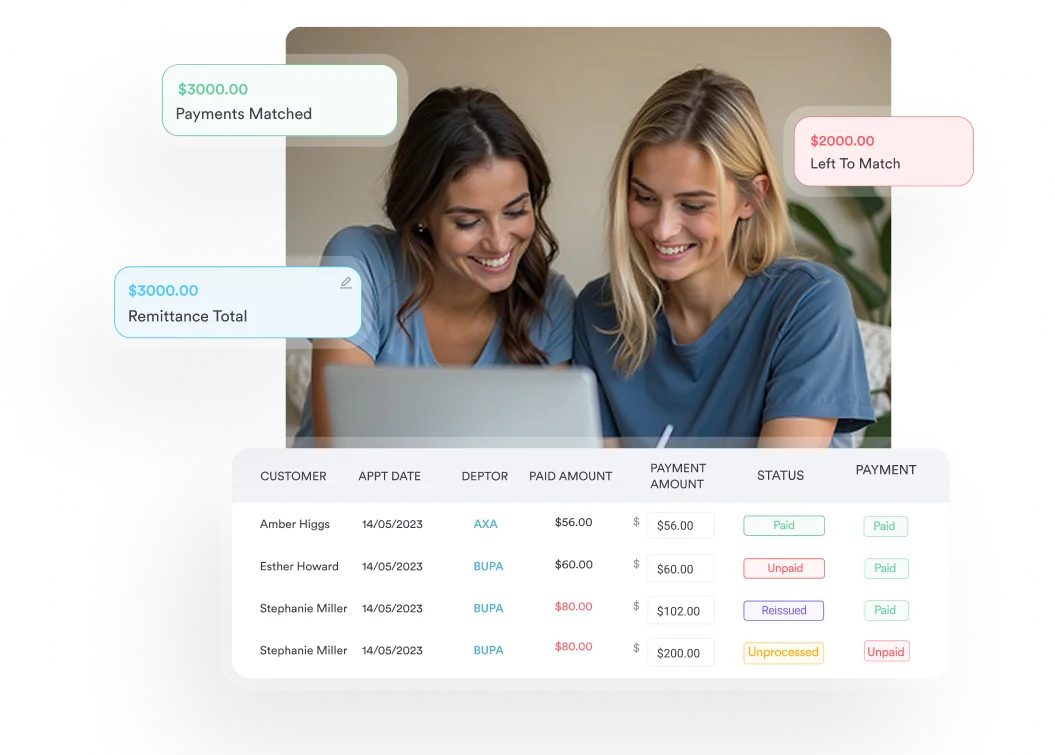

Pabau tracks the prior authorization on the patient’s case and warns you when one is missing. After an eligibility check, the 44310 claim goes out through Claim.MD as a CMS-1500/837P claim.

Most 44310 denials start in the operative note. When the note names the bowel segment, the stoma type, the approach, and the reason for diversion, the code choice holds up on first review.
Before your next elective case, check two habits. Your authorization workflow should catch a missing number before surgery, and your coders should read the note for creation versus revision. Those two checks cover the wrong-code and missing-authorization rows in the denial table.
To see how Pabau tracks authorizations and sends 44310 claims through Claim.MD for a colorectal practice, book a demo with our team.

Building the stoma from the colon instead? CPT code 44320 covers colostomy or skin-level cecostomy, the large-intestine counterpart to 44310.
Pairing the claim with a Crohn’s diagnosis? ICD-10 code K50.90 explains the unspecified Crohn’s code and when a more specific one fits.
Want to understand denial code patterns across your claims? Denial management in healthcare covers how to build a denial tracking and appeal workflow for surgical specialty practices.
Looking for a complete 837 claim submission guide? 837 file overview explains the transaction set used to submit professional and institutional claims electronically.
CPT code 44310 covers creation of a non-tube ileostomy or jejunostomy. A segment of small intestine is brought through the abdominal wall as a stoma. It includes both loop and end ileostomy configurations. It does not cover revision of an existing stoma (44312 or 44314) or a continent Kock pouch (44316). Colostomy or skin-level cecostomy (44320) and tube enterostomy (44300) are separate codes too.
CPT 44310 describes creating a new ileostomy where no stoma exists at that site. CPT 44314 describes a complicated revision of an existing ileostomy, with reconstruction in depth, and 44312 covers a simple revision. If the operative note says the surgeon created a stoma, use 44310. If the surgeon revised an existing one, use 44312 or 44314. These codes bundle under NCCI, so billing them together on one date needs modifier -59 and distinct-site documentation.
The most common pairings are K50.xx (Crohn’s disease) and K51.xx (ulcerative colitis), each with its complication subcode. C18.xx or C20 covers colorectal cancer, and K56.xx covers intestinal obstruction. Z93.2 (ileostomy status) is a secondary code on later encounters. It is not the principal diagnosis for the creation surgery.
CPT code 44310 carries a 90-day global surgery period (indicator 090) under Medicare. The operating surgeon’s related post-operative care within 90 days is bundled into the global allowable and cannot be billed separately. The one pre-operative day is also included. For an unrelated condition during the global period, append modifier -24 to the E/M service.
The most common modifiers are -22 for substantially increased work, which needs a cover letter, and -51 for multiple procedures. Modifier -59 marks a distinct procedural service and needs separate-site documentation. Modifier -62 covers co-surgery, and -80 covers an assistant surgeon. Payer acceptance of -62 and -80 varies, so verify before billing.
The most frequent reason is a nonspecific ICD-10-CM diagnosis, such as an unspecified .9 code instead of a complication-specific one. Wrong code selection is next, where a revision code is billed for a new stoma. Missing prior authorization for commercial payers also causes denials. So do NCCI bundling edits with a revision code and modifier -22 sent without a supporting cover letter.