ICD-10 Code Z86.73: Personal history of TIA
ICD-10 Code Z86.73: Definition, descriptor, and code hierarchy ICD-10 Code Z86.7...

Last Updated: Nov 20, 2026
Billable Code Specific Code
K57.92 is the billable ICD-10-CM code for diverticulitis of intestine, part unspecified, without perforation or abscess without bleeding.
It sits in Chapter 11 (Diseases of the digestive system, K00–K95). It applies when the treating physician confirms acute diverticulitis but the record does not identify the large or small intestine as the affected site. The record must also show no perforation or abscess and no bleeding. If either is present, a different K57 code applies. Denials are usually traced to undocumented bleeding status or an overlooked site-specific code (K57.32 or K57.12).
Let Pabau's smart automation suggest the right codes, reduce claim denials, and keep your practice compliant—effortlessly.
Automate repetitive tasks and focus on what matters most—your patients.
Reduce coding errors and ensure compliance with the latest regulations.
Clean claims, fewer denials, and faster reimbursements.
Powerful insights and reporting to help your practice thrive.
HIPAA compliant SOC 2 certified GDPR-compliant Trusted by 4,000+ clinics worldwide

K57.92 is a valid, billable ICD-10-CM code for uncomplicated diverticulitis when the record does not name the large or small intestine.
Both qualifiers must be negative: no perforation or abscess, and no bleeding. If either is documented, a different K57 code applies.
K57.93 applies when bleeding is present, while K57.32 and K57.12 apply when the record names the large or small intestine.
Pabau, our practice management platform, submits US claims through Claim.MD, so coders can review each K57.92 pairing before the claim goes out.
ICD-10 code K57.92 is a valid, billable ICD-10-CM code for diverticulitis of intestine, part unspecified, without perforation or abscess without bleeding. It is listed in CMS’s FY 2027 ICD-10-CM files, which cover patient encounters from October 1, 2026 through September 30, 2027. Use it when the physician confirms diverticulitis and the record shows no perforation, abscess or bleeding and names no bowel segment. The table below summarizes its reference details.
Coders can verify active code status and the official descriptor through the CDC/NCHS ICD-10-CM web tool, which is updated with each fiscal-year release. The CMS ICD-10 codes page provides the annual tabular list files and official guidelines used for Medicare billing. Neighboring diagnosis codes are in the ICD-10-CM code library.
K57.92 covers confirmed acute diverticulitis where the physician’s documentation does not specify whether the large intestine, small intestine, or both are involved. Four conditions must all apply at once:
Diverticulosis, the presence of diverticula without inflammation, is coded separately under K57.90. K57.92 needs documented acute inflammation, and without that physician narrative the code is not supported.
The two qualifiers in the K57.92 descriptor are independent, and both must be confirmed negative before the code is assigned. The decision path below shows the order in which the record settles each one, after the diagnosis and the site.
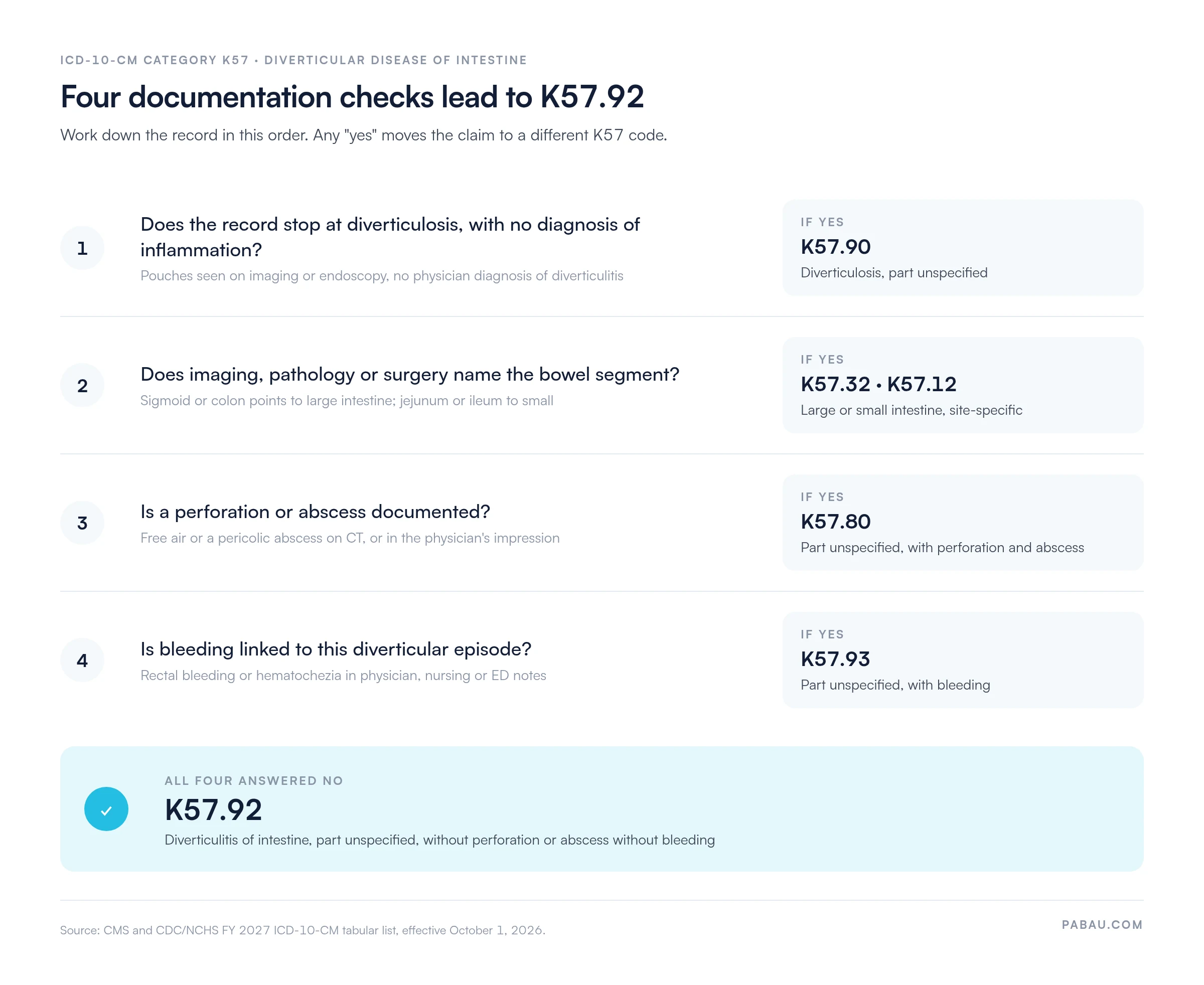
Perforation and abscess are complications that escalate the severity of diverticulitis and shift the code to a different subcategory entirely. If CT abdomen/pelvis (CPT 74177 or 74178) identifies a pericolic abscess or free air indicating perforation, K57.80 applies instead of K57.92. The physician’s impression section and imaging report must both be reviewed.
Rectal bleeding or hematochezia documented in the same encounter moves the code to K57.93. The bleeding qualifier is specifically about bleeding attributable to the diverticular disease episode, not incidental bleeding from an unrelated source. If the clinical note documents any bleeding and links it to the diverticular episode, query the physician before assigning K57.92. Never assume the bleeding is unrelated.
K57.93 is diverticulitis of intestine, part unspecified, without perforation or abscess but with bleeding. The only coding axis that separates K57.92 from K57.93 is the presence or absence of bleeding. Confusing these two codes is flagged during payer audits as a potential upcoding issue, since K57.93 may carry a higher-acuity DRG weight.
Sometimes bleeding is documented but its link to the diverticulitis episode is unclear. In that case, query the physician rather than assign K57.93 by assumption. Assigning K57.93 without documented physician attribution of bleeding to the diverticular episode creates a compliance risk.
K57.92 is the unspecified-site equivalent of K57.32 (large intestine) and K57.12 (small intestine). ICD-10-CM coding guidelines require coders to code to the highest degree of specificity supported by the documentation. K57.92 is correct only when no imaging, pathology, or surgical report identifies the affected intestinal segment.
In adults, diverticulitis most often involves the sigmoid colon. When CT abdomen/pelvis reports sigmoid involvement, K57.32 is the correct code. Defaulting to K57.92 when imaging clearly identifies the site is a specificity error and can trigger a payer query. If the physician’s documentation references the colon or sigmoid but no imaging was performed, query the physician before defaulting to the unspecified code.
The K57 code category covers all diverticular disease of the intestine. The family branches by three axes: Intestinal site (small, large, both, or unspecified), complication status (perforation/abscess present or absent), and bleeding status. The table below maps the most commonly used codes across all three axes.
Before selecting K57.92, check whether the CT abdomen/pelvis report names a specific bowel segment. Radiologists commonly reference the sigmoid colon or descending colon when describing diverticular inflammation. If a segment is named in the imaging report but the physician’s impression says ‘diverticulitis’ without specifying a site, send a physician query. A confirmed large-intestine site moves the code from K57.92 to K57.32, which is a more specific and defensible claim.
The K57 category carries two Excludes1 notes and one Excludes2 note. An Excludes1 note means the excluded condition generally cannot be reported together with K57.92. The exception is when the two conditions are unrelated to each other.
The subcategory K57.9 carries no excludes notes of its own, so the category-level notes are the ones to check. K57.90 does carry an inclusion term, “Diverticular disease of intestine NOS”. A note that says only “diverticular disease” therefore codes to K57.90, not K57.92. Reading an Excludes1 note as an Excludes2, or missing it, creates compliance exposure on review.
Payers validate K57.92 against the clinical record. Coders should confirm the elements below before assigning the code, because missing elements raise denial risk. Understanding medical billing fundamentals helps the practice capture the right documentation at each step.
For outpatient encounters, ICD-10-CM Official Guidelines Section IV.H prohibit coding “probable” or “suspected” diagnoses. The physician must have confirmed diverticulitis, not merely suspected it. Inpatient encounters follow different rules. There, uncertain diagnoses documented as such at discharge may be coded as if confirmed.
K57.92 is frequently submitted as the principal or secondary diagnosis code alongside procedure CPT codes. Pabau’s claims management software builds CMS-1500 claims, so the coder can review which diagnosis each procedure line points to before submission. The table below lists the most common CPT pairings.
Practices submitting K57.92 with CPT 45378 (colonoscopy) during the acute episode should expect medical necessity scrutiny. If the patient has a colostomy and the scope enters through the stoma, the colonoscopy is billed with code 44388 rather than 45378. Payers typically require documentation showing the colonoscopy was medically necessary during the acute phase rather than deferred to the standard 4-6 week post-resolution window. Review each pairing against the documentation before the claim is submitted through Claim.MD.
K57.92 denials cluster around four root causes, and each one needs a different correction. Good denial management workflows treat each category differently rather than resubmitting unchanged claims.
A clean claim for K57.92 has a consistent diagnosis, procedure, place of service and medical necessity record before it reaches the clearinghouse. A single inconsistency between the radiology report and the physician’s impression is enough to trigger a request for additional information from most MACs.
Medicare Local Coverage Determinations (LCDs) for gastrointestinal procedures often list K57.92 as a covered diagnosis for CT abdomen/pelvis and colonoscopy. Coverage still varies by MAC jurisdiction. National Medicare policy does not replace the LCD review, so check with the MAC that covers your practice’s area (such as CGS, Noridian or Palmetto).
Commercial payers align their diverticulitis coverage broadly with Medicare medical necessity principles but add their own prior authorization thresholds. Some commercial plans require prior authorization for elective colonoscopy following a diverticulitis episode. Confirm current payer-specific requirements before scheduling the procedure. Maintaining medical billing compliance across payer rules is especially important for practices that handle both Medicare and commercial gastrointestinal claims.
Diverticulosis means pouches in the bowel wall without inflammation. Diverticulitis means one or more of those pouches is inflamed, and only diverticulitis supports K57.92.
Take a patient admitted with acute abdominal pain who has incidental diverticula on CT. With no pericolonic stranding, inflammation markers or physician diagnosis of diverticulitis, the visit is coded for the presenting symptom, not K57.92. For left-sided pain, that is R10.32, left lower quadrant pain. Assigning K57.92 based on the incidental finding alone overstates the diagnosis.
Run a quarterly audit on your K57.90 and K57.92 coding distribution. If your K57.92 rate is unusually high relative to K57.90, review a sample of records. It may show that coders are defaulting to the diverticulitis code when the documentation supports only diverticulosis. The inverse pattern (high K57.90 with many symptomatic presentations) suggests undercoding of active inflammation.
K57.92 denials usually start before submission. The bleeding status sits in a nursing note, or the CT report names the sigmoid, and nobody checks it against the code.
In Pabau, the clinical notes, attached documents and the insurance claim sit on the same patient record. The coder can read the physician’s impression and the radiology report before choosing between K57.92, K57.93 and K57.32.
US claims go out through Claim.MD as CMS-1500/837P submissions, with eligibility checks and ERA remittances. When a remittance shows a denial, the coder works it from the same record that holds the documentation.

Pabau keeps clinical notes, documents and insurance claims on one patient record, and submits US claims through Claim.MD with eligibility checks and ERA remittances.

K57.92 is a defensible, billable code when both qualifiers are confirmed negative and the record names no intestinal site. The two common errors are coding K57.92 when imaging names the sigmoid, and missing bleeding recorded in nursing notes. A full read of the record before code selection catches both.
Build that read into the pre-submission step. Check the CT report for a named segment, search every note for bleeding, then review the diagnosis on each procedure line. After that, the claim goes out through Pabau’s Claim.MD clearinghouse workflow with fewer surprises in the remittance.
Book a demo to see how Pabau keeps the documentation and the claim on one record for gastrointestinal billing.

Want the full claims workflow around this code? What is revenue cycle management explains the end-to-end claims workflow and where coding errors typically surface.
Struggling with recurring claim denials across multiple codes? Denial codes in medical billing breaks down CARC and RARC denial reason codes and how to respond to each one.
Need to document a visit for out-of-network reimbursement? The superbill guide covers how superbill data maps to CMS-1500 fields and what payers validate at the claim level.
ICD-10 code K57.92 is the billable ICD-10-CM diagnosis code for diverticulitis of the intestine at an unspecified site, without perforation or abscess and without bleeding. It applies when a physician has confirmed acute diverticulitis but the record does not name the affected part of the intestine.
K57.93 is used when diverticulitis of the unspecified intestine occurs with bleeding, and K57.92 when no bleeding is present. Both codes share the same site (part unspecified) and complication status (no perforation or abscess). Bleeding is the only axis that separates them. Review the physician’s note and nursing documentation for hematochezia or rectal hemorrhage before assigning K57.92.
Use K57.32 when CT, colonoscopy or pathology confirms the large intestine (sigmoid or descending colon) as the affected site. Use K57.92 only when no workup has identified the bowel segment. Because adult diverticulitis most often affects the sigmoid colon, K57.92 should be uncommon where CT is routine. If the scan names a segment, K57.32 is the more specific code.
The record needs a confirmed physician diagnosis of diverticulitis, not diverticulosis or “possible diverticulitis” in an outpatient setting. It should show no perforation or abscess, no bleeding linked to the episode, and no named bowel segment. ICD-10-CM does not require imaging for K57.92. A CT report, when one exists, is supporting evidence rather than a coding prerequisite.
Diverticulosis (K57.90 at the unspecified site) is the presence of diverticula without active inflammation, often an incidental imaging finding. Diverticulitis (K57.92) needs a physician diagnosis of acute inflammation. Coding K57.92 from incidental diverticula alone is an upcoding error that exposes the practice to audit risk.
Four reasons account for most K57.92 denials. Imaging names a bowel site but K57.92 was submitted instead of K57.32. Bleeding appears in nursing notes but was missed at code selection. The CT report is missing from the record when the scan is billed. Or the outpatient physician wrote “probable” or “suspected” diverticulitis, which does not support a definitive code.