

HCPCS Code L0472: Hyperextension TLSO billing guide
HCPCS code L0472: Official descriptor and device definition HCPCS code L0472 des...

Last Updated: Nov 5, 2026
44188 is the CPT code for laparoscopy, surgical; colostomy or skin level cecostomy.
CPT code 44188 is the laparoscopic colostomy and skin-level cecostomy procedure code. Surgeons use it when they create a bowel diversion or cecostomy entirely through a minimally invasive laparoscopic approach. A case that starts open, or converts to open, is coded 44320 instead. Denials usually trace to one of three problems. The operative report doesn't state the laparoscopic approach, a conversion to open went uncoded, or the diagnosis doesn't meet the payer's medical necessity criteria.
Let Pabau's smart automation suggest the right codes, reduce claim denials, and keep your practice compliant—effortlessly.
Automate repetitive tasks and focus on what matters most—your patients.
Reduce coding errors and ensure compliance with the latest regulations.
Clean claims, fewer denials, and faster reimbursements.
Powerful insights and reporting to help your practice thrive.
HIPAA compliant SOC 2 certified GDPR-compliant Trusted by 4,000+ clinics worldwide

CPT code 44188 covers a laparoscopic colostomy or skin-level cecostomy, and the open approach is coded 44320 instead.
A case that starts laparoscopically but converts to open is billed with the open code, never 44188.
The code carries a 90-day global surgical period under Medicare, so related post-operative visits in that window are not billed separately.
Pairing 44188 with an unsupported ICD-10 diagnosis is a common cause of denial, so confirm K57.20, K63.1, C18 or the applicable code first.
In Pabau’s practice management software, claim validation checks each 44188 claim for missing or invalid details before it reaches Claim.MD, our US clearinghouse partner.
CPT code 44188 is the procedure code published by the American Medical Association (AMA) for a laparoscopic colostomy or skin-level cecostomy.
It sits in the laparoscopic intestine range (44180-44238) and applies only to procedures performed through a laparoscope. It does not cover open colostomies, which are coded 44320, or colostomy reversals.
The full AMA descriptor reads: “Laparoscopy, surgical; colostomy or skin level cecostomy.” Two procedure variants fall under this one code. The first is a laparoscopic end colostomy, which is the most common. The second is a laparoscopic skin-level cecostomy, where a tube or device is placed through the abdominal wall into the cecum to decompress the bowel.
The clinical indication differs between the two variants, even though the billing code is identical. As part of sound medical billing practice, coders should confirm which variant the surgeon performed before assigning 44188.
A laparoscopic colostomy begins with insufflation of the abdomen with carbon dioxide to create a pneumoperitoneum. The surgeon inserts trocars through small incisions, typically 5-12 mm ports, and introduces the laparoscope along with grasping and dissecting instruments.
The key intraoperative steps coders should look for in the operative report:
If the operative report does not explicitly confirm these laparoscopic steps, CPT 44188 cannot be supported. A procedure that converts to open laparotomy mid-case requires a code change to the open code, 44320, before the claim is submitted.
The table below summarizes the key billing parameters for CPT code 44188. Its relative value units (RVUs) reflect the 2026 Medicare Physician Fee Schedule (MPFS). The MPFS updates every January, so check current figures in the CMS Physician Fee Schedule lookup tool before submitting claims.
CPT code 44188 is medically necessary when the patient needs a permanent or temporary bowel diversion through a laparoscope. The payer validates that necessity through a linked ICD-10 diagnosis code. The table below lists the most common clinical indications with their corresponding ICD-10-CM codes.
Always code to the highest level of specificity the documentation supports. Pathology may confirm K57.20, with abscess and perforation, while the claim carries K57.30. That mismatch triggers a medical necessity review and can delay payment by several weeks.
The most common coding confusion for this procedure is submitting 44188 when the operative report describes an open approach. CPT 44320 covers an open colostomy or skin-level cecostomy. The incision is a laparotomy rather than trocar ports, and the work RVU, facility rate, and documentation requirements differ.
Keep 44143 out of this comparison. It describes a partial colectomy with end colostomy and closure of the distal segment, known as a Hartmann type procedure. That is a bowel resection, not a stoma-only procedure.
A procedure that begins laparoscopically but converts to open is a frequent billing error. The surgeon’s operative report must document the conversion and the reason for it. Bill 44320 for a converted colostomy or cecostomy. Never submit 44188 for a converted case, even if the laparoscope was used for part of the procedure.
Coders working in colorectal surgery should cross-check CPT code 44188 against these related codes before finalizing a claim. Each one describes a distinct procedure or approach, and a wrong pick can trip National Correct Coding Initiative (NCCI) edits. The AAPC Codify CPT lookup shows descriptor text and bundling edits for each code in this range.
When the operative report leaves you choosing between these codes, three questions settle it in the order shown below.
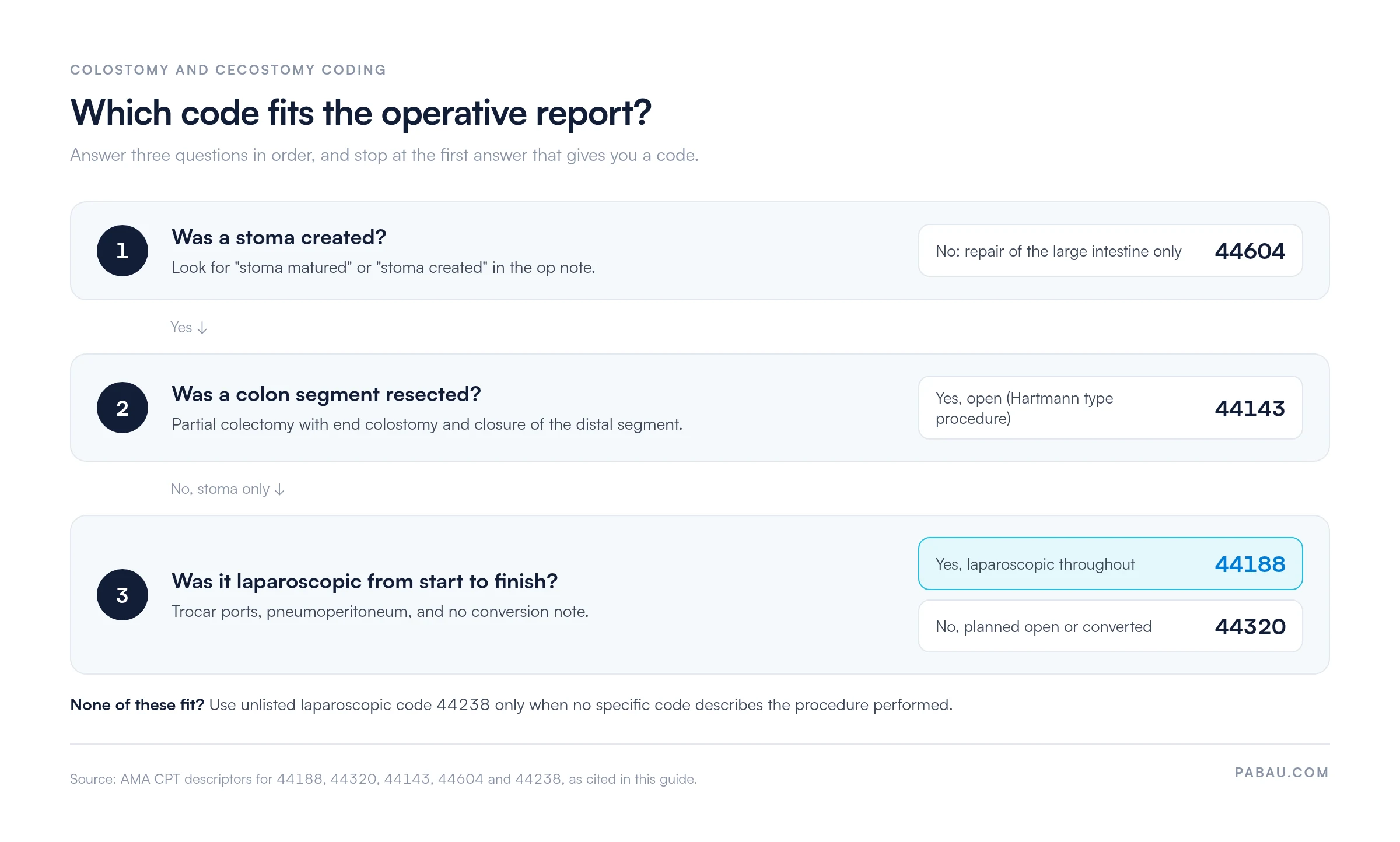
Before assigning CPT code 44188, read the operative report for two specific phrases: ‘laparoscopic approach’ and ‘stoma matured’ or ‘stoma created.’ If neither appears, contact the surgeon for clarification rather than assuming the code. An incorrect approach code is far harder to appeal than a coding query answered before submission.
CPT code 44188 claims survive audit when the operative note clearly supports each element of the laparoscopic approach. Meeting clean claim requirements for this code means the following must appear in the operative record:
Incomplete documentation is the second most common denial trigger after incorrect approach coding. A surgical note that says only “laparoscopic colostomy performed” without the supporting detail described above will not withstand a retrospective audit.
Prior authorization for CPT code 44188 depends on whether the procedure is elective or emergent. Most commercial payers require prior auth for elective laparoscopic colostomies. Emergency procedures, such as K63.1 intestinal perforation, acute obstruction or trauma, typically qualify for retrospective review instead. Check each payer’s authorization policy before scheduling the case.
Confirm auth requirements through the payer’s provider services line or the plan’s portal before each case. The guidance above describes general payer behavior, and individual plan policies override it. For Medicare, also check any local coverage determination (LCD) that applies to colorectal surgery in your jurisdiction.
Medicare reimbursement for CPT code 44188 is calculated with the Resource-Based Relative Value Scale (RBRVS). It multiplies the total RVU by an annual conversion factor set by CMS.
The figures below come from the CMS 2026 relative value file, at the CY2026 conversion factor of $33.40. Clinicians in a qualifying alternative payment model get a slightly higher factor of $33.57. Rates change each calendar year and vary by geographic locality.
Always verify current payment amounts in the CMS Physician Fee Schedule Search before quoting reimbursement to physicians or practice administrators.
CMS lists the non-facility practice expense for 44188 as NA. That means the code has no office-setting rate, so Medicare pays it only at the facility rate. It fits a 90-day major surgery that always takes place in a hospital.
Use the FastRVU lookup tool to retrieve locality-adjusted payment amounts for your specific geographic practice area.
CPT code 44188 denials cluster around five root causes. Most are preventable at submission. Those that reach the denial stage can often be overturned on first-level appeal when the supporting documentation is gathered correctly.
A denial management workflow for surgical codes needs faster action than one for evaluation and management (E/M) denials. The appeal window for inpatient facility claims is often 60-90 days.
A consistent pre-submission checklist reduces 44188 denials significantly. The practices below reflect guidance from the American Academy of Professional Coders (AAPC) and general CMS documentation standards for surgical claims.
Pabau’s automated claims management handles part of that checklist for you, scrubbing each claim for missing or invalid details before it leaves the system.
For practices using a superbill workflow, add a dedicated checkbox for ‘laparoscopic approach confirmed’ next to CPT 44188 on the surgical superbill. That single field prevents the most common denial pattern, which is submitting 44188 for a case that converted to open or was never laparoscopic.
Without a connected billing system, a 44188 claim depends on a coder cross-checking the op note, the payer’s auth rules and the diagnosis by hand. One missed detail, such as an unlinked ICD-10 code or a missing auth number, sends the claim back.
Pabau keeps those checks in one place. Eligibility verification runs through Claim.MD before the procedure. Each prior authorization is stored as a case that follows the appointment, so the auth number is already on the claim when it is built.
Claim validation then scrubs the claim for missing or invalid details before it leaves Pabau. Claim statuses and electronic remittance advice (ERA) files come back into the same system. Your team can spot a 44188 denial and fix it while the surgeon still remembers the case.

Pabau checks eligibility through Claim.MD, tracks prior authorizations as cases and scrubs each claim before it goes out. Your billing team spends less time reworking surgical denials.

The approach decides the code. If the op note shows trocar ports from first incision to closure and a matured stoma, 44188 is right. If the case went open at any point, 44320 is the code, and no appeal will rescue a 44188 claim.
The habit worth building is a query before submission rather than an appeal after denial. One question to the surgeon about a vague op note costs minutes. A first-level appeal on the same claim can run for weeks inside a 60-90 day window.
Pabau’s revenue cycle management tools follow each claim from eligibility check to ERA, next to the schedule and patient records. Book a demo to see how Pabau keeps surgical claims like 44188 clean on the first submission.

Need to understand clean claim requirements for surgical codes? Clean claim best practices covers every field that must be correct before a surgical claim reaches the payer.
Handling ERA reconciliation after a 44188 payment posts? Electronic remittance advice (ERA) workflows explains how to read and reconcile 835 files from Medicare and commercial payers.
CPT code 44188 describes a laparoscopic colostomy or skin-level cecostomy. The surgeon creates a colostomy, or places a tube-style stoma into the cecum, entirely through laparoscopic trocar ports. No open laparotomy incision is made.
CPT 44188 is a laparoscopic colostomy or skin-level cecostomy with no bowel resection. CPT 44143 is an open partial colectomy with end colostomy and closure of the distal segment, known as a Hartmann type procedure. If a laparoscopic colostomy converts to open, change the claim from 44188 to 44320, the open colostomy code.
The most common ICD-10 codes paired with CPT 44188 are K57.20 and K57.21, which cover large intestine diverticulitis with perforation and abscess. C18.x (colon cancer by segment) is next. K56.600-K56.609 (large bowel obstruction) and K63.1 (intestinal perforation) are also common. Always code the confirmed diagnosis to the highest level of specificity the documentation supports.
No. CPT 44188 is restricted to the laparoscopic approach. An open colostomy or skin-level cecostomy is coded 44320. Submitting 44188 for an open procedure misreports the service and will trigger a denial or, on audit, a recovery request from the payer.
CPT code 44188 carries a 90-day global surgical period under Medicare. Routine post-operative visits, related E/M services and standard wound checks in that window are included in the surgical payment. Services unrelated to the colostomy may be billed separately with modifier 24 and supporting documentation.
Five issues cause most CPT 44188 denials. The first two are an open approach coded as laparoscopic and a diagnosis that doesn’t establish medical necessity. The others are missing prior auth for an elective case, an op note without laparoscopic detail, and a bundled procedure billed without the right modifier. Check the claim adjustment reason codes on the ERA to see which applies before appealing.



