ICD-10 Code T86.852: Intestine transplant infection
ICD-10 Code T86.852: Definition and billable status ICD-10 Code T86.852 is the I...

Last Updated: Oct 16, 2026
Billable Code Specific Code
K63.1 is the billable ICD-10-CM code for perforation of intestine (nontraumatic).
Let Pabau's smart automation suggest the right codes, reduce claim denials, and keep your practice compliant—effortlessly.
Automate repetitive tasks and focus on what matters most—your patients.
Reduce coding errors and ensure compliance with the latest regulations.
Clean claims, fewer denials, and faster reimbursements.
Powerful insights and reporting to help your practice thrive.
HIPAA compliant SOC 2 certified GDPR-compliant Trusted by 4,000+ clinics worldwide

ICD-10 code K63.1 is the billable diagnosis code for perforation of the intestine (nontraumatic), valid for claims submitted on or after October 1, 2025 (FY2026).
K63.1 applies only to nontraumatic perforations: spontaneous, disease-related (diverticulitis, Crohn’s, malignancy, ischemia). Traumatic perforations require a different code.
Documentation must explicitly state the nontraumatic etiology, anatomical site, and any associated conditions such as peritonitis to avoid claim denials.
Pabau, an all-in-one practice management system, helps practices document ICD-10 codes like K63.1 accurately with built-in code search, structured clinical notes, and an audit trail that keeps documentation complete and ready for review.
Most claim denials for intestinal perforation trace back to a single documentation failure: the physician noted “perforated bowel” without specifying whether the cause was traumatic or nontraumatic. Notably, ICD-10 code K63.1 covers only the nontraumatic variety, and payers will reject a claim the moment that distinction is missing.
K63.1 is a billable/specific ICD-10-CM code, confirmed valid for fiscal year 2026 effective October 1, 2025. It sits within the digestive system chapter (K00-K95), under subcategory K55-K64 (Other diseases of intestines), inside parent category K63 (Other diseases of intestine).
According to the CDC/NCHS ICD-10-CM web tool, K63.1 carries a full billable/specific designation, meaning it can be used directly on claims for reimbursement without a more specific code.
The table below consolidates the core reference data for ICD-10 code K63.1 in one place.
Understanding where K63.1 sits within the ICD-10-CM structure helps coders navigate correctly and avoid selecting a parent or sibling code by mistake. The full hierarchy is:
Similarly, the sibling codes within K63 are important to know, because coders frequently confuse K63.0 and K63.1 when documentation is ambiguous. Browse the full ICD-10-CM code library for comparable hierarchy examples across other digestive-system categories.
A nontraumatic intestinal perforation is a full-thickness breach in the bowel wall arising from a pathological process rather than an external injury. Indeed, the distinction matters clinically and from a coding standpoint: the mechanism determines the code.
Common underlying causes include:
Clinicians working in functional medicine practice settings that evaluate complex GI pathology should note that the underlying disease process (Crohn’s, malignancy) is coded separately as a secondary or principal diagnosis alongside K63.1.
Select K63.1 when all three conditions are documented:
Do not use K63.1 when the perforation was caused by a traumatic injury (motor vehicle accident, stab wound, blunt abdominal trauma). In contrast, traumatic intestinal perforation is classified under injury codes in the S-code chapter (ICD-10-CM S36 series). As a result, choosing K63.1 for a traumatic case is a coding error with compliance implications.
Etiology specificity is what separates a clean K63.1 claim from a denied one, and the same principle applies across every ICD-10 diagnostic category.
Incomplete documentation is the leading cause of K63.1 claim denials. Generally. The physician’s note must address four elements:
According to the CMS ICD-10-CM Official Coding Guidelines, coders may not infer a nontraumatic etiology from the absence of a trauma history alone. Instead, the documentation must affirmatively state it.
Flag any operative or procedure note that documents perforation without stating the cause. Query the surgeon for clarification before coding. A queried and clarified note avoids a denial that typically takes 45-90 days to resolve through appeals.
K63.1 carries specific exclusion instructions that directly affect code selection. Indeed, misapplying these notes is one of the most common pitfalls in GI coding. Review the AAPC Codify ICD-10-CM reference for the full annotated exclusion list.
An Excludes1 note means the two conditions can never be coded together: if documentation describes diverticulitis with perforation, the matching K57 code already captures it, and K63.1 should not be added alongside it.
An Excludes2 note works differently: the excluded condition is not part of K63.1, but both codes can be reported when the physician documents two distinct findings, as with appendiceal perforation (K35.2-, K35.3-). Traumatic perforation of the intestine sits outside this note entirely; it is a different code by definition, since K63.1 only covers nontraumatic mechanisms.
K63.1 is rarely the only code on a claim. Specifically, the table below shows the codes most frequently reported alongside it, along with sequencing guidance. Furthermore, accurate secondary coding is essential for correct DRG assignment under CMS ICD code lists for inpatient claims.
Understanding co-coding logic in one specialty often clarifies the approach elsewhere. For a comparable example of Excludes-note handling.

Pabau helps your team capture structured clinical documentation, search ICD-10 codes directly in the client record, and keep an audit-ready trail across every patient encounter.

Legacy system users and researchers working with historical claims data need the ICD-9 equivalent. Based on the General Equivalence Mappings (GEMs) files referenced by the Research Data Assistance Center (ResDAC), K63.1 maps back to ICD-9-CM code 569.83 (Perforation of intestine). This is a backward (ICD-10-CM to ICD-9-CM) approximate mapping, with the nontraumatic qualifier added explicitly in ICD-10-CM to sharpen specificity.
Additionally, verify the full GEMs crosswalk against the official CMS files if using this mapping for research or audit purposes. However, approximate mappings may not capture every clinical nuance introduced in ICD-10-CM.
K63.1 is accepted by Medicare, Medicaid, and commercial payers as a billable diagnosis code. That said, three billing-specific factors commonly affect reimbursement outcomes. Practices that document nontraumatic etiology, anatomical site, and peritonitis status directly in the client record catch most of these issues before a claim is ever submitted. An authorization request approved for one code does not cover a different code billed on the day.
Four errors account for the majority of K63.1 coding failures. Therefore, knowing them in advance prevents the re-work.
The AAPC Codify lookup tool also lists the excludes notes and code-first guidance for K63.1, useful for validating secondary code combinations before submission.
Build a query template for intestinal perforation cases. When a coder flags K63.1, the template should prompt: (1) Was a secondary peritonitis code assessed? (2) Does a K57 diverticulitis code already capture the perforation? (3) Is the surgical site confirmed as intestine, not appendix or stomach? These three checks eliminate the most common errors in under ten seconds.
Accurate ICD-10 code K63.1 assignment depends on documentation quality at the point of care.
Pabau’s client record management system lets clinicians capture structured clinical notes with built-in ICD-10 code search, so the diagnosis is documented correctly before it ever reaches the billing team.
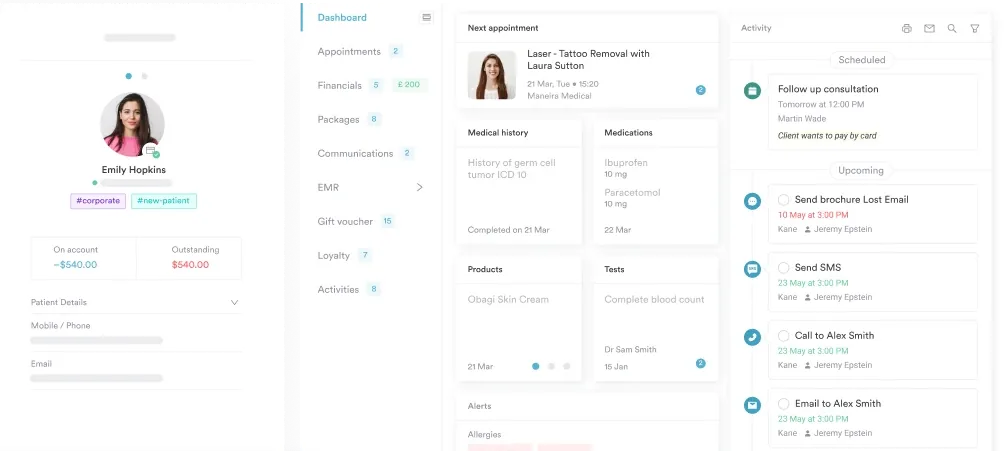
The platform’s digital clinical forms support custom documentation templates that prompt clinicians for the specific fields coders need: nontraumatic etiology, anatomical site, associated conditions, and peritonitis status. When these fields are completed at the point of care, downstream coding becomes a verification step rather than a reconstruction exercise.

For practices working across multiple specialties or locations, the compliance management module provides audit trail functionality that flags incomplete documentation before submission, catching missing fields while the record can still be corrected.
This is where the cost of a denied K63.1 claim, typically 45-90 days of rework, gets compressed to a single pre-submission check. Practices interested in seeing how EHR integration for practices can tighten this loop will find a detailed workflow breakdown in that resource.
ICD-10 code K63.1 is a straightforward code with significant documentation dependencies. The nontraumatic qualifier, secondary peritonitis assessment, and correct handling of the K57 diverticulitis overlap are where most coding errors originate. Get those three elements right at the point of documentation, and the billing workflow becomes routine.
Pabau’s structured clinical documentation and audit-trail tools ultimately give practices the infrastructure to embed these requirements into every encounter rather than chasing them down at billing time. Book a demo to see how Pabau handles ICD-10 documentation workflows end to end.

Coding another complication today? ICD-10 code O08.3 covers shock following ectopic and molar pregnancy, another diagnosis built around a narrow clinical qualifier.
Want another Excludes-note example? ICD-10 code N51 reports male genital disorders in diseases classified elsewhere.
Billing for a preventive screening? HCPCS code G0442 covers the annual alcohol misuse screening benefit.
Working on an anesthesia claim? CPT code 00862 covers anesthesia for extraperitoneal procedures.
Coding a hip socket disorder? ICD-10 Code M24.7 guide covers protrusio acetabuli and whether the note names a secondary cause.
K63.1 is the billable diagnosis code for nontraumatic perforation of the intestine, used to report spontaneous or disease-related bowel perforations (from diverticulitis, Crohn’s disease, malignancy, or ischemia) on claims. However, it excludes perforations caused by external trauma and is valid for FY2026 claims filed on or after October 1, 2025.
Yes. Specifically, K63.1 is a billable/specific ICD-10-CM code and can be used directly on claims for reimbursement without a more specific sub-code. It is confirmed billable for FY2026 by CDC/NCHS and CMS, and no further specificity codes exist below it.
Nontraumatic perforation comes from a disease process (diverticulitis, Crohn’s, cancer, ischemia) and is coded K63.1. By contrast, traumatic perforation results from external injury and is coded S36.490-S36.499. The cause must be documented by the physician; K63.1 only exists for nontraumatic perforations, so using it for a traumatic case is a coding error even though it is not a formal Excludes1 note.
K63.1 carries two Excludes1 notes – perforation (nontraumatic) of the duodenum (K26.-) and perforation (nontraumatic) of the intestine with diverticular disease (K57.0, K57.2, K57.4, K57.8) – meaning these can never be coded with K63.1. It also carries an Excludes2 note for perforation (nontraumatic) of the appendix (K35.2-, K35.3-), which means that code and K63.1 can be reported together when both are separately documented.
Add K65.0 (Generalized acute peritonitis) or K65.1 (Peritoneal abscess) as an additional diagnosis when the physician documents peritonitis as a complication. K63.1 stays the principal diagnosis when perforation is the reason for admission. As a result, omitting a documented peritonitis code can affect DRG assignment and reimbursement.
K63.1 maps back to ICD-9-CM code 569.83 (Perforation of intestine) via the CMS General Equivalence Mappings as a backward (ICD-10-CM to ICD-9-CM) approximate mapping. However, the main change in ICD-10-CM is the added nontraumatic qualifier, which had no distinct descriptor in ICD-9-CM.