

CCSD code G5100: Bypass of duodenum billing guide
CCSD code G5100 bills a bypass that leaves the duodenum in place CCSD code G5100...

Last Updated: Oct 16, 2026
31254 is the CPT code for nasal/sinus endoscopy, surgical; with ethmoidectomy, partial (anterior).
Partial ethmoidectomy means the surgeon removed anterior ethmoid cells only. If the posterior cells were also removed, the procedure is 31255. Billing 31254 for a total ethmoidectomy is a common mismatch in the functional endoscopic sinus surgery (FESS) code family. Documentation that fails to specify anatomical extent is a leading cause of denials on this code.
Let Pabau's smart automation suggest the right codes, reduce claim denials, and keep your practice compliant—effortlessly.
Automate repetitive tasks and focus on what matters most—your patients.
Reduce coding errors and ensure compliance with the latest regulations.
Clean claims, fewer denials, and faster reimbursements.
Powerful insights and reporting to help your practice thrive.
HIPAA compliant SOC 2 certified GDPR-compliant Trusted by 4,000+ clinics worldwide

CPT code 31254 covers endoscopic partial (anterior) ethmoidectomy only, not removal of the posterior ethmoid cells.
31254 differs from 31255 only in anatomical extent, so the operative note must say which cells were removed.
Modifier 50 triggers Medicare’s 150% bilateral payment rule when both sides are operated on in the same session.
31254 has a 000 global period, so visits on later dates are billed separately rather than bundled into the surgery.
Pabau’s claims tools check codes, modifiers and diagnosis links before a 31254 claim leaves the practice.
CPT code 31254 is a surgical endoscopy code describing nasal/sinus endoscopy with ethmoidectomy, partial (anterior). The code is part of the CPT code set published by the American Medical Association. It belongs to the 31231-31298 series covering endoscopic procedures of the nose and sinuses.
“Partial” in the descriptor means the anterior ethmoid cells were resected endoscopically. The posterior cells were not entered or removed.
The procedure itself is endoscopic. The surgeon passes a rigid nasal endoscope through the naris, identifies the anterior ethmoid cells, and removes them using microdebriders or forceps. The approach is entirely endoscopic, with no external incision, so 31254 is classed as an endoscopic surgical procedure. An open ethmoidectomy is reported with a different set of CPT codes.
The distinction between 31254 and 31255 is purely anatomical. 31254 covers partial (anterior) ethmoidectomy. 31255 covers total ethmoidectomy, which includes both the anterior and posterior ethmoid cells. Using the wrong one is a common coding error in this family.
The operative report must name the specific cells addressed. Phrases like “ethmoidectomy performed” without a qualifier give payers no basis to confirm 31254 over 31255 and invite a down-code or denial.
CPT code 31254 sits within a structured family of FESS codes. Understanding where each code starts and stops prevents both undercoding and unbundling errors during multi-procedure operative sessions.
When several FESS procedures are performed in one session, document each as a distinct procedure. Give each one its own anatomical location and operative steps. Reporting 31254 alongside 31267, for example, requires the operative note to clearly separate the ethmoidectomy from the antrostomy work. Adding CPT code 31276 works the same way, with the frontal sinus exploration documented separately.
Check the current NCCI procedure-to-procedure edit table before co-submitting any FESS code combination. CMS updates these tables quarterly, and an edit that allowed separate billing in Q1 may carry an indicator change by Q3. Always confirm against the version in effect on the date of service.
When ethmoidectomy is performed bilaterally, append modifier 50 to CPT code 31254. It tells the payer the procedure was carried out on both sides in the same session. Medicare then applies its bilateral surgery payment rule. The first side is paid at 100% of the fee schedule amount and the second at 50%. That makes a combined 150% of the unilateral rate.
The operative report must explicitly state that bilateral surgery was performed. “Left and right ethmoidectomy” or “bilateral anterior ethmoidectomy” is sufficient. Bilateral procedures submitted with modifier 50 are typically reported on a single claim line, though some payers prefer two lines with modifiers LT and RT.
Medicare payment for CPT code 31254 comes from the Medicare Physician Fee Schedule (MPFS). Its relative value units (RVUs) are multiplied by the annual conversion factor, then adjusted for geographic cost differences. Rates change each January with the new conversion factor and MPFS final rule.
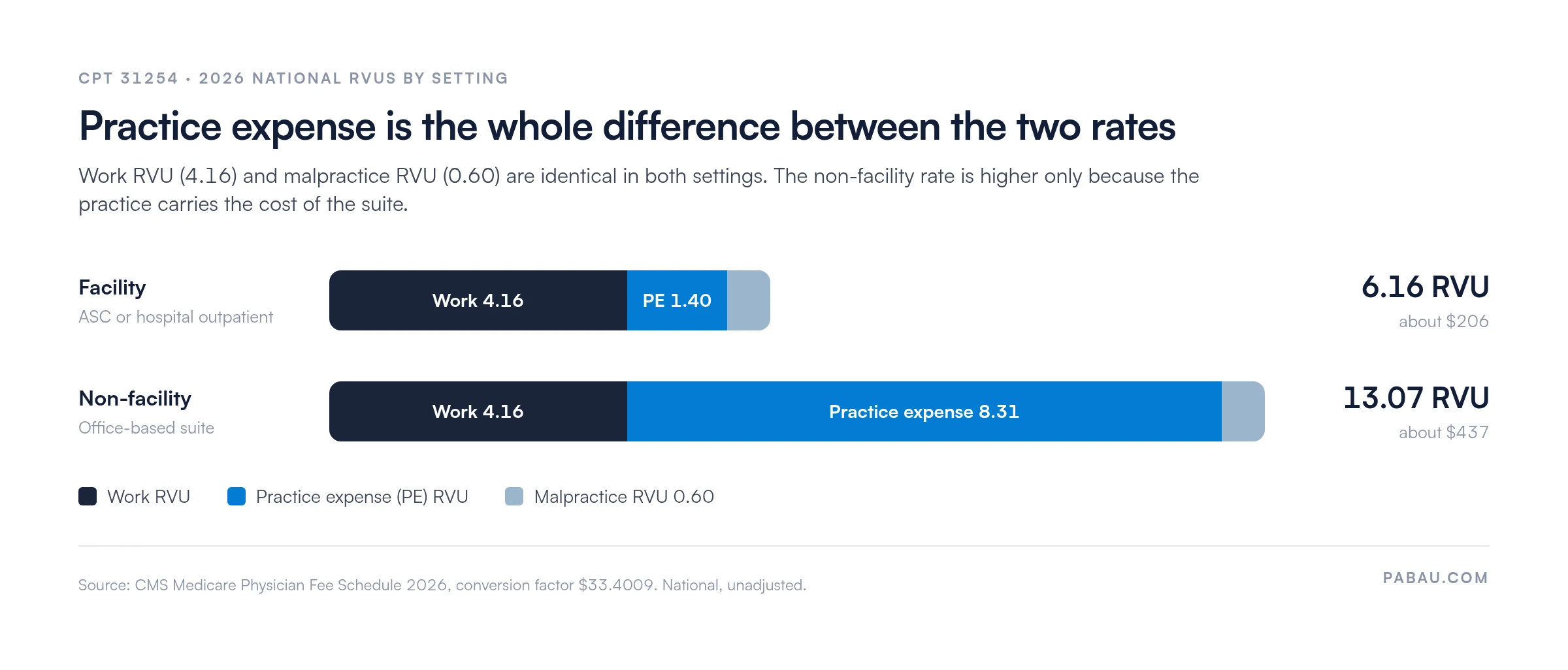
The table below shows the 2026 national rates at a conversion factor of $33.4009. Verify current figures with the CMS Physician Fee Schedule lookup tool, using the date of service and your MAC locality. FastRVU’s 2026 RVU lookup shows the same CMS data with geographic multipliers applied.
Commercial payer rates typically run 110-160% of Medicare, though this varies widely by contract and market. The non-facility rate applies when the procedure is performed in an office-based surgical suite. The facility rate applies in an ambulatory surgery center or hospital outpatient department, and the chart below shows where the difference comes from.
Medical necessity for CPT code 31254 ethmoidectomy is established through the paired ICD-10-CM diagnosis code. Payers apply their local coverage determinations (LCDs) to confirm the diagnosis supports surgical intervention. The most defensible pairings are chronic sinusitis codes, nasal polyp codes, and documented structural pathology.
Payers commonly require documentation of failed conservative therapy (at least 4-6 weeks of medical management) before approving surgical intervention. CT imaging confirming ethmoid disease is nearly universally required.
An incomplete operative report is the fastest route to a 31254 denial. The report must give an auditor enough detail to confirm the procedure matches the code submitted. Claims management software can flag missing documentation fields before a claim leaves the practice. The clinical record is still where the case is won or lost.
Operative report minimum elements:
Prior authorization: Most commercial payers and Medicare Advantage plans require prior authorization (PA) for 31254. Traditional Medicare (Parts A and B) does not require PA for outpatient FESS procedures at the time of writing, but policies change.
Insurance eligibility verification at the time of scheduling confirms PA requirements before the patient arrives. Prior auth requests should include the history of failed conservative treatment, CT imaging results, and the planned CPT codes for all procedures.
A superbill filled in on the day of surgery keeps the claim in step with the record. It captures every procedure code, modifier, diagnosis link and place of service. It also speeds up the PA cross-check when an insurer asks for records after submission.
Most 31254 denials trace back to five patterns, and each one has a fix you can apply before the claim goes out.
Effective denial management workflows should track 31254 denials over rolling 90-day periods, so a recurring documentation fault is caught before it spreads across claims. When a denial involves a bundling conflict, pull the current NCCI edit table from CMS and confirm whether a modifier exception applies. The medical claims clearinghouse used for submission should also run pre-submission edits that catch common FESS bundling errors before the claim reaches the payer.
Run a 90-day audit on all 31254 claims before your next payer contract renegotiation. Calculate your first-pass acceptance rate, average days to payment, and denial breakdown by reason code. Documented billing accuracy gives you evidence to bring to the negotiating table.
CPT code 31254 carries a 000 global period under the Medicare Physician Fee Schedule. The global package covers the day of the procedure only, so there is no post-operative bundling window.
Care on the day of surgery is paid within the 31254 fee. Visits and procedures on later dates fall outside the package and are reported with their own codes, subject to payer policy.
Included in the 31254 payment:
Billed separately:
Modifiers 24, 58, 78 and 79 are global-period modifiers. They rarely apply to 31254 itself, because its global window closes on the day of surgery. They still matter when 31254 is performed during another procedure’s global period.
On a busy FESS list, treat each follow-up visit as its own encounter. Document it, code it and bill it, rather than holding it back as part of the surgical fee.
On a FESS list, the billing team checks the operative note, the modifier and the paired diagnosis by hand before each claim goes out. A missed laterality or a stray 31231 only surfaces when the denial comes back weeks later.
Pabau, the practice software we build, keeps procedure codes, modifiers and diagnosis links on the same patient record as the operative note. Its claims tools flag missing fields before submission, so a 31254 claim leaves the practice complete.
Claims go out electronically through Pabau’s Claim.MD integration, and electronic remittance advice (ERA) comes back into the same system. You can compare each 31254 payment against the expected facility or non-facility rate without a separate spreadsheet.

Pabau’s claims management tools help ENT practices submit clean FESS claims and catch NCCI edit conflicts. You can also monitor CPT 31254 payments against expected rates.

CPT code 31254 is simple to choose and easy to lose on paper. The operative note decides whether the claim holds, so make “anterior only”, laterality and each separate procedure explicit before anyone codes it.
Recheck two details every January. The RVUs set your expected payment, and the 000 global period means every later visit is billable. Get both right and 31254 claims stop coming back for rework.
Book a demo to see how Pabau keeps FESS coding, documentation and claims on one patient record.

Coding the diagnostic scope on its own? CPT code 31231 covers diagnostic nasal endoscopy and when it is bundled into a surgical code.
Billing a polypectomy or debridement? CPT code 31237 explains the surgical endoscopy code for biopsy, polypectomy and debridement.
Want to reduce claim errors across all procedure codes? Submitting a clean claim covers the checklist every billing team should run before a claim leaves the practice.
Looking for a systematic approach to denied ENT claims? Electronic remittance advice explains how to read ERA codes and use them to categorize and appeal denials faster.
CPT code 31254 covers surgical nasal/sinus endoscopy with a partial (anterior) ethmoidectomy. The surgeon removes only the anterior ethmoid air cells, using an endoscopic approach. It does not include posterior ethmoid cell removal, which is reported under CPT 31255.
31254 is partial ethmoidectomy (anterior cells only) and 31255 is total ethmoidectomy (anterior and posterior cells combined). The operative note must explicitly document which cells were resected to support the code submitted.
Yes, modifier 50 is appropriate when bilateral ethmoidectomy is performed in the same session. Medicare pays 150% of the unilateral rate: 100% for the first side and 50% for the contralateral side. The operative note must document both sides individually.
Yes, provided the operative note documents each procedure as a distinct intervention at a distinct anatomical site. NCCI edits apply and must be checked in the current quarterly CMS table. Where a column-1/column-2 edit exists, a modifier may allow separate reporting if the procedures were independent.
J32.2 (chronic ethmoidal sinusitis) is the strongest medical necessity pairing for isolated anterior ethmoid disease. J33.0 (nasal polyp) is frequently added as a secondary code when polyposis is present. Avoid J32.9 (unspecified chronic sinusitis) without supporting imaging, as it provides weaker medical necessity justification.
CPT 31254 pays about $206 in a facility setting and about $437 in a non-facility setting at 2026 national Medicare rates. Those figures use the 2026 conversion factor of $33.4009, and payment varies by locality. Verify current rates with the CMS Physician Fee Schedule lookup tool, using the date of service and your MAC locality.
Yes, CPT 31254 is a functional endoscopic sinus surgery (FESS) code. It belongs to the 31231-31298 nasal/sinus endoscopy series and is one of the core FESS codes alongside 31255, 31267, and 31276.



