HCPCS Code G0163: Skilled nursing observation and assessment
What is HCPCS Code G0163? HCPCS Code G0163 is a deleted Level II code for skille...

Last Updated: Oct 15, 2026
35301 is the CPT code for thromboendarterectomy, including patch graft, if performed; carotid, vertebral, subclavian, by neck incision. It covers open removal of plaque from these arteries through a cervical incision.
The patch graft and any temporary shunt are bundled into 35301, and the global period runs 90 days. Endovascular repairs use other codes. TCAR maps to CPT 37215, the same code used for carotid artery stenting with embolic protection.
Let Pabau's smart automation suggest the right codes, reduce claim denials, and keep your practice compliant—effortlessly.
Automate repetitive tasks and focus on what matters most—your patients.
Reduce coding errors and ensure compliance with the latest regulations.
Clean claims, fewer denials, and faster reimbursements.
Powerful insights and reporting to help your practice thrive.
HIPAA compliant SOC 2 certified GDPR-compliant Trusted by 4,000+ clinics worldwide

CPT code 35301 covers open thromboendarterectomy through a neck incision at the carotid, vertebral, or subclavian artery. Endovascular repairs use other codes.
The patch graft and any temporary shunt are bundled into 35301 and must not be coded separately.
TCAR and carotid artery stenting with embolic protection are both billed with CPT 37215, not 35301.
Bilateral cases take LT/RT with modifier 58 when staged, or modifier 50 for same-session surgery, depending on payer rules.
In 2026, 35301 carries 30.71 facility RVUs, worth about $1,025.74 nationally before geographic adjustment.
CPT code 35301 describes thromboendarterectomy, including patch graft when performed, carotid, vertebral, or subclavian artery, by neck incision. The American Medical Association, which maintains the CPT code set, places 35301 in the Surgery section under Cardiovascular/Arteries and Veins, within the endarterectomy code range.
The approach requirement matters most in practice. The code applies only when the surgeon removes plaque through an open incision in the neck. Any catheter-based or endovascular approach maps to a different code family, whatever the vessel.
Three arterial sites are eligible under CPT code 35301, all accessed via the same cervical (neck) incision approach. Coders sometimes assume 35301 covers any endarterectomy performed near the neck, but it does not. The vessel and the approach must both match.
Patch graft bundling: When the surgeon closes the arteriotomy with a patch (bovine pericardial, Dacron, or saphenous vein), that service is included in 35301. No additional CPT code applies. The descriptor’s “including patch graft, if performed” wording sets this bundling rule, and payers enforce it.
Intraoperative shunting: Placement and removal of a temporary carotid shunt during CEA is also included in 35301. Shunting does not warrant a separate claim line.
CPT code 35301 excludes all endovascular approaches and all endarterectomies performed at sites outside the cervical vessels. These are among the most common miscoding sources in vascular surgery billing.
TCAR deserves special attention. It uses a neck incision, the same anatomical access as 35301, but the technique is endovascular. A stent is placed via catheter, with flow reversal for embolic protection. TCAR is therefore billed with CPT 37215, not 0075T or 35301. Submitting 35301 for a TCAR procedure is a frequent denial trigger in vascular coding.
Choosing between 35301 and its neighboring codes takes two checks: how the artery was treated, then which vessel. The diagram below runs those checks in order, and the table after it covers the codes coders confuse most often.
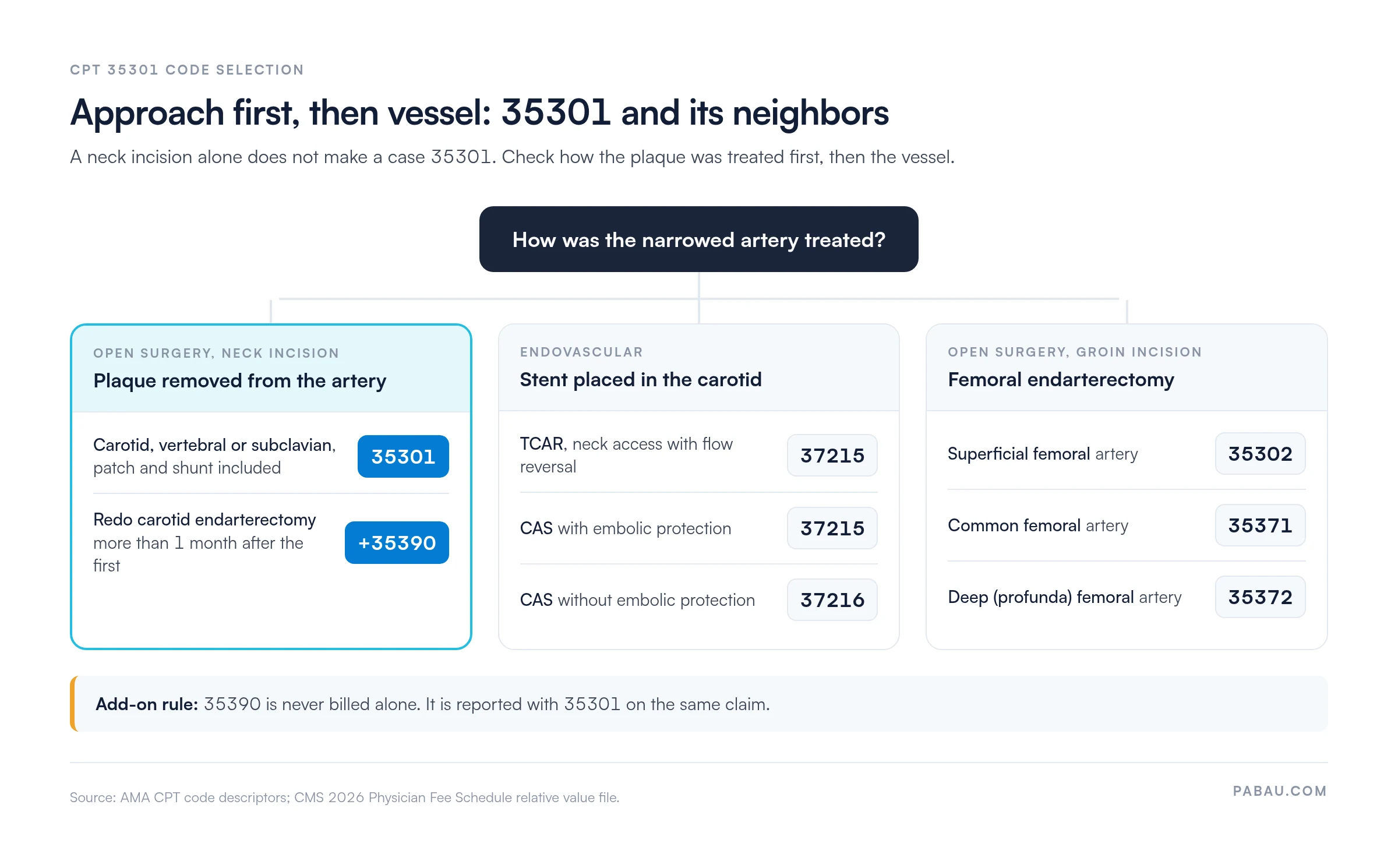
Coders working across the 35301-35390 range can check diagnosis pairings in a CPT-to-ICD-10 crosswalk. Read it alongside the operative report to confirm the vessel, the approach, and whether the reoperation add-on applies.
CPT code 35301 uses modifiers to capture laterality, bilateral procedures, staged surgeries, and increased complexity. Modifier selection drives many denials, particularly on bilateral CEA cases, where payer rules differ.
Bilateral CEA: Same-session bilateral carotid endarterectomy is rare, but when it happens, modifier 50 on 35301 signals the bilateral procedure. CMS assigns 35301 bilateral surgery indicator 1, so Medicare pays 150% of the single-procedure amount. That’s 100% for the first side and 50% for the second.
Commercial payers handle bilateral cases differently, so check each payer’s bilateral surgery policy before submitting. For staged procedures, where each side is done in a separate session within the global period, add modifier 58 to the second claim. It marks a planned staged procedure and opens a new global period.
Incomplete operative documentation is the leading cause of audit findings and downcoding on 35301 claims. The operative report must name the vessel, approach, technique, and graft use that support the code. A complete operative note is also what gets the claim paid on first submission.
Prior authorization for 35301 typically requires submission of the carotid duplex ultrasound or CTA/MRA report showing the degree of stenosis. Medicare and most commercial payers apply the NASCET methodology for stenosis measurement. Keep imaging reports in the billing file and attach them proactively to prior auth requests.
When contrast is contraindicated, the neck MRA in that file is a study without contrast, reported as 70547 by the imaging provider. Pre-surgical planning before carotid endarterectomy is a covered indication for that code, so the report supports your prior auth request.
Payers validate medical necessity for CPT code 35301 by checking the paired ICD-10-CM diagnosis code against local coverage determinations (LCDs). Pair 35301 only with the diagnosis code that reflects the documented operative indication, never one picked for billing convenience.
Asymptomatic stenosis: Medicare coverage for asymptomatic carotid stenosis typically requires stenosis of 60-70% or greater by NASCET methodology, per the MAC’s local coverage determination. Payers may also require a neurologist or vascular surgeon to attest that the risk/benefit analysis supports intervention. Coverage thresholds are jurisdiction-specific and change with annual updates. Check the applicable LCD and the patient’s eligibility before scheduling the procedure.
CPT code 35301 is reimbursed by Medicare under the Physician Fee Schedule (MPFS), which is updated annually by CMS. Rates vary by location through the Geographic Practice Cost Index (GPCI). The CY 2026 values below come from the CMS relative value file. Use the CMS Physician Fee Schedule lookup to retrieve current rates for a specific locality and setting.
At the 2026 conversion factor of $33.4009, the 30.71 facility RVUs work out to a national rate of about $1,025.74. Surgeons in a qualifying APM use the $33.5675 factor instead, which gives about $1,030.86. Because CEA is performed in a facility, the facility rate is the standard reference for surgeon billing.
The facility bills separately for hospital overhead, supplies, and staff costs. The GPCI adjustment matters too. A vascular surgeon in a high-cost metro area receives noticeably more than the national average for the same code.
The 90-day global surgical package means that standard follow-up E/M visits within 90 days of the procedure date are bundled into the 35301 payment. Visits for unrelated conditions, significant new problems, or complications requiring a return to the OR may still be billed separately with the appropriate modifier.
CPT code 35301 denials follow predictable patterns, and each one has a fix that happens before submission.
Our guide to medical billing denial codes lists the CARC reason codes payers typically attach to these denials. Appeal timelines vary by payer, so check your payer contract for deadlines.
For a medical necessity or documentation denial, attach the operative report, imaging, and prior auth documentation to the appeal. For coding errors, submit a corrected claim rather than an appeal where payer rules allow.
Before submitting a 35301 claim, run three checks. Confirm the operative note states ‘by neck incision’ explicitly. Confirm the ICD-10 code maps to a qualifying diagnosis in the applicable MAC LCD. Confirm prior authorization is on file if the payer requires it.
Many 35301 denials trace back to a claim assembled by hand. The coder reads the operative note in one system, keys the claim in another, and has to remember each payer’s modifier rules. A missing LT or RT modifier, or a TCAR case coded as 35301, slips through that handoff.
Practice management software like Pabau keeps the note, the codes, and the claim in one place. Its claims management software flags a missing modifier or an unsupported ICD-10 pairing before the claim leaves the practice. Clean claims then go out as 837 files through Pabau’s Claim.MD clearinghouse integration.
Payments come back as electronic remittance advice, so your team can match each 35301 payment against the expected facility rate. Denials are tracked by reason, so a repeat pattern points you to the operative note template instead of another round of appeals.


Pabau checks 35301 modifiers and diagnosis pairings before submission, then sends clean claims through its Claim.MD integration. Your team spends less time on vascular surgery rework and appeals.

A 35301 claim stands or falls on one line of the operative note: an open thromboendarterectomy through a neck incision. When that line is explicit and the vessel and side are named, the code holds up under audit.
The fixes worth making first are cheap. Add the approach, vessel, and patch material to your operative note template. Then route every TCAR and stenting case to 37215 before the claim form is opened.
The trade-off is a few extra fields for the surgeon to complete. Set against a facility payment of about $1,026 that one missing modifier can hold up for weeks, it pays for itself.
Book a demo to see how Pabau checks 35301 modifiers and diagnosis pairings before your vascular surgery claims go out.

Coding a TCAR or carotid stent instead? CPT code 37215 covers carotid artery stenting with embolic protection, including TCAR.
Need to understand how clearinghouse routing works for surgical codes? Medical claims clearinghouse guide explains how claims move from EHR to payer and where errors occur.
Want to reduce claim rework across your entire code set? Claim.MD clearinghouse overview covers the payer network, eligibility checks, and ERA processing Pabau uses.
Managing credentialing requirements alongside surgical billing? Getting credentialed with insurance companies covers the enrollment steps that unlock reimbursement for new vascular surgeons.
CPT code 35301 covers open thromboendarterectomy of the carotid, vertebral, or subclavian artery performed via a neck incision, including patch graft when applied. It applies only to open surgical removal of arterial plaque and does not cover any endovascular technique such as stenting or TCAR.
CPT 35301 is for open carotid endarterectomy through a cervical incision. TCAR (transcarotid artery revascularization) maps to CPT 37215, the same code used for carotid artery stenting with embolic protection. TCAR also uses a neck incision for arterial access, but the technique is endovascular. A stent is placed under flow reversal, so 35301 is the wrong code and a common denial trigger.
Yes. The official CPT descriptor states “including patch graft, if performed,” so any patch, whether bovine pericardial, Dacron, or saphenous vein, is bundled into 35301. It cannot be coded separately. Billing a separate code for the patch graft is a bundling violation and will be denied or recouped on audit.
LT and RT modifiers identify the side operated on and are required by most payers. Modifier 50 applies to same-session bilateral CEA (Medicare reimburses at approximately 150%). Modifier 58 covers a staged contralateral procedure within the global period. Modifier 22 supports increased complexity claims when documented in the operative report.
Medicare pays for CPT 35301 by multiplying its total RVUs by the annual conversion factor, then adjusting for the Geographic Practice Cost Index. In 2026, 35301 carries 30.71 facility RVUs, about $1,025.74 nationally before geographic adjustment. Use the CMS Physician Fee Schedule lookup tool for your locality’s rate.
The global period for CPT 35301 is 90 days. This includes one pre-operative day, the day of surgery, and 90 post-operative days. Standard follow-up E/M visits in this window are bundled into the 35301 payment. They can be billed separately only when they address an unrelated condition or a significant new problem.
The most common supporting diagnoses are I65.21 (right carotid stenosis), I65.22 (left carotid stenosis), I65.23 (bilateral carotid stenosis), G45.9 (TIA), and I63.x (cerebral infarction). Asymptomatic stenosis typically requires documented stenosis of 60-70% or greater by NASCET methodology per the applicable MAC LCD. Always pair the diagnosis code with the clinical indication documented by the operating surgeon.