CPT code 90473: Nasal and oral vaccine billing guide
CPT code 90473 covers one nasal or oral vaccine per visit CPT code 90473 reports...

Last Updated: Oct 16, 2026
69631 is the CPT code for tympanoplasty without mastoidectomy (including canalplasty, atticotomy and/or middle ear surgery), initial or revision, without ossicular chain reconstruction. It covers eardrum repair where the ossicles are left intact.
Most 69631 denials trace back to the operative note. If it doesn't state that the ossicular chain was inspected and not reconstructed, payers may query the claim as a possible 69632 or 69633. A silent note can lead to downcoding or denial.
Let Pabau's smart automation suggest the right codes, reduce claim denials, and keep your practice compliant—effortlessly.
Automate repetitive tasks and focus on what matters most—your patients.
Reduce coding errors and ensure compliance with the latest regulations.
Clean claims, fewer denials, and faster reimbursements.
Powerful insights and reporting to help your practice thrive.
HIPAA compliant SOC 2 certified GDPR-compliant Trusted by 4,000+ clinics worldwide

CPT code 69631 covers tympanoplasty without mastoidectomy and without ossicular chain reconstruction, for both initial and revision procedures.
The operative note must confirm no ossicular chain reconstruction and no mastoid work, or payers may deny or downcode the claim.
69631 is unilateral. Bilateral same-session surgery takes modifier 50, which Medicare pays at 150% of the single-ear rate.
In 2026, 69631 carries 23.93 total facility RVUs and a 90-day global period under the Medicare Physician Fee Schedule.
Pabau’s claims management software runs validation checks before each claim goes out and submits US claims through its Claim.MD integration.
CPT code 69631 describes tympanoplasty without mastoidectomy (including canalplasty, atticotomy and/or middle ear surgery), initial or revision, without ossicular chain reconstruction. The American Medical Association (AMA), which publishes and maintains the CPT code set, uses the same code for initial and revision encounters.
Three structural facts define the code’s scope:
Initial encounters (first-time repair) and revision encounters (repeat surgery on a repaired eardrum) both use 69631. The condition is that neither mastoid work nor ossicular chain reconstruction is performed.
A coder selecting between 69631, 69632, and 69633 needs to understand the surgical sequence, because the code selection pivot point occurs mid-procedure. The surgeon begins with tympanic membrane repair and decides intraoperatively whether ossicular chain work is necessary.
The operative steps a billing team should look for in the procedure note:
Step 5 is where 69631 notes most often fall short. Surgeons who inspect the ossicular chain but do not reconstruct it often omit the negative finding from their dictation. Without it, payers treating the claim as potentially upcoded to 69632 will request additional documentation or deny outright.
The three codes share one descriptor stem: tympanoplasty without mastoidectomy, initial or revision. They split on what happens to the ossicular chain. 69632 adds ossicular chain reconstruction, and 69633 adds reconstruction with a synthetic prosthesis such as a PORP or TORP.
Read the operative note in the order below, and the code follows from three answers.
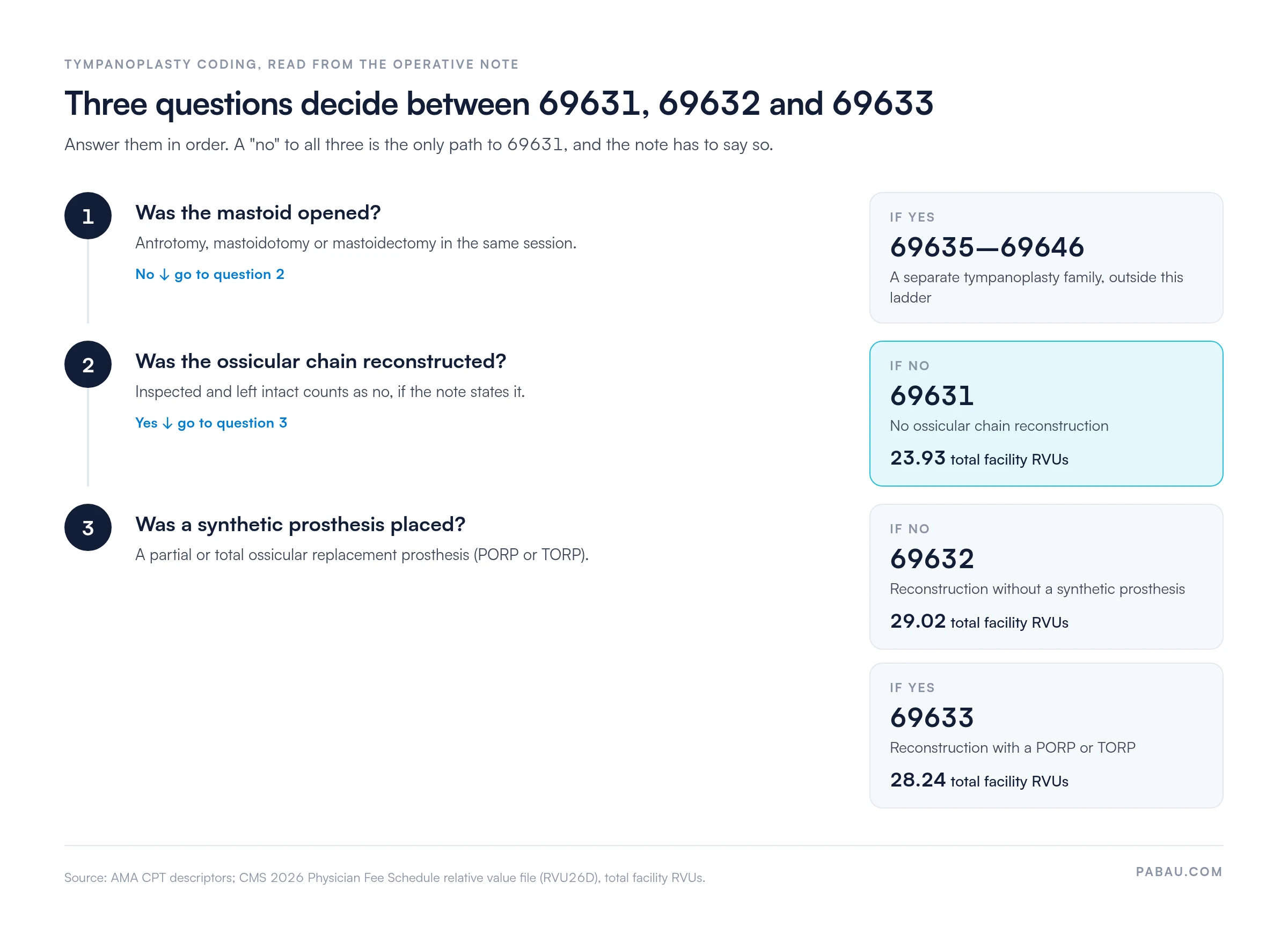
One detail in the 2026 fee schedule surprises coders. 69633 carries fewer total facility RVUs than 69632, at 28.24 against 29.02, so placing a prosthesis does not raise the payment. Mastoid work moves the case out of this ladder entirely, into codes 69635-69646.
Intraoperative upgrade scenario: If a surgeon begins a 69631 case and finds that ossicular chain damage needs reconstruction, the correct code becomes 69632. If a PORP or TORP is placed, it becomes 69633. The operative note must document the intraoperative finding that prompted the change.
Billing 69631 when the note describes ossicular reconstruction is undercoding. Billing 69632 or 69633 without documented reconstruction is upcoding, which exposes the practice to recoupment.
CPT 69610 covers myringoplasty, a procedure limited to patch repair of the tympanic membrane without entering the middle ear space. CPT 69631 involves full tympanoplasty, which includes middle ear exploration and graft placement that restores or reconstructs the tympanic membrane with middle ear access.
Billing 69610 when the note documents middle ear exploration and a fascia graft is undercoding. Billing 69631 when the note describes only a patch repair without middle ear entry is upcoding. Both errors generate payer recoupment risk.
Tympanic membrane perforation codes from the H72 series are the primary diagnoses paired with CPT 69631. Payers expect laterality, and an unspecified-ear code is a common medical necessity denial trigger.
Additional supporting diagnoses may include chronic otitis media (H65/H66 series) where persistent infection caused the perforation. Always code the underlying etiology when documented. Payers use it to confirm medical necessity for surgery over watchful waiting. Check payer-specific local coverage determination (LCD) requirements, as criteria vary.
A complete operative report for CPT code 69631 must contain six elements to withstand payer audit. Missing any one of them produces a documentation denial or opens the practice to recoupment under medical necessity review. Submitting a clean claim submission starts with a note that covers all six.
Structured operative note templates let ENT practices catch a missing element before the note is signed. A mandatory ossicular chain field on that template removes the most common reason 69631 notes fail review.
Build a 69631 checklist into your dictation template. Cover the approach, canalplasty and atticotomy extent, graft type and source, and mastoid status. Add the ossicular chain finding with an explicit ‘no reconstruction’ statement. Flag any unsigned note missing that statement before the claim batch runs.
CPT 69631 is a unilateral code by descriptor. Three modifiers apply in defined circumstances, and using any of them incorrectly generates either underpayment or a claim edit.
90-day global period: CPT 69631 carries a 90-day global surgical period under Medicare. Routine post-operative visits, dressing changes, and ear canal cleaning within 90 days are bundled into the surgical fee. Medicare does not pay separately for treating a complication that does not need a return to the operating room.
An E/M visit for an unrelated problem during those 90 days takes modifier 24, with the unrelated condition documented. Modifier 79 (unrelated procedure) applies when a new, unrelated procedure is performed on either ear during the global period.
Medicare reimburses CPT 69631 based on the 2026 Medicare Physician Fee Schedule (MPFS). Rates vary by geographic pricing locality. CMS prices 69631 in the facility setting only, so the figures below are national facility values and there is no non-facility rate. Always verify current payment amounts using the CMS Physician Fee Schedule lookup tool for your specific locality.
At the 2026 conversion factor of $33.4009, 23.93 RVUs works out to about $799 nationally before geographic adjustment. Qualifying participants in Advanced Alternative Payment Models (APMs) use a slightly higher factor of $33.5675.
The CMS relative value files carry the geographic practice cost index (GPCI) for each locality. ASC facility rates for CPT 69631 are published separately in the CMS ASC Payment System and differ from the physician rate. Verify the ASC rate if your practice performs tympanoplasty in an ambulatory surgery center setting.
Prior authorization requirements for tympanoplasty vary by payer type and individual plan. There is no universal rule. Treat each payer as a separate inquiry and verify before scheduling surgery.
Confirming insurance eligibility verification before the procedure date is the first step in catching plans that require pre-authorization. Pair this with attention to medical billing compliance requirements for ENT surgical procedures.
A prior authorization request should include audiometric testing results and the documented duration and conservative treatment of the perforation. Add the clinical rationale for surgery over continued observation. Payers use this to apply their medical necessity criteria, which may differ from AMA coding standards.
CPT 69631 denials cluster around five patterns. Each has a specific root cause and a fix that can be built into the billing workflow. Robust denial management workflows catch most of these before claims leave the practice.
Log the denial reason code on every 69631 appeal to see which pattern costs your practice most. Our guide to medical billing denial codes maps each claim adjustment reason code (CARC) back to these root causes.
Run a quarterly audit on all 69631 claims that were denied and subsequently paid on appeal. Calculate the average days to resolution. If appeal cycle time exceeds 45 days, the root cause is almost always missing documentation at time of original submission, not a payer coverage issue. Fix the note before the claim, not after.
In many ENT practices, a 69631 claim passes through three hands. The surgeon dictates the note, a coder picks the code, and a biller keys the claim into a clearinghouse or payer portal. Each handoff is a chance to lose a detail the payer needs.
Pabau, the practice management platform we build, includes claims management software that keeps those steps in one place. Add the patient’s insurer and policy to their record, and each invoice routes to the right payer automatically. Before a claim goes out, Pabau runs validation checks to confirm details like membership numbers and authorization codes are in place.
US claims go out through Pabau’s Claim.MD integration, which submits to thousands of payers. Real-time eligibility checks run from the client card, and Claim.MD supports them for over 400 payers, as our Claim.MD clearinghouse review explains. Every claim then sits on one dashboard as pending, submitted, processing, paid, or error, so a stalled 69631 claim gets noticed early.
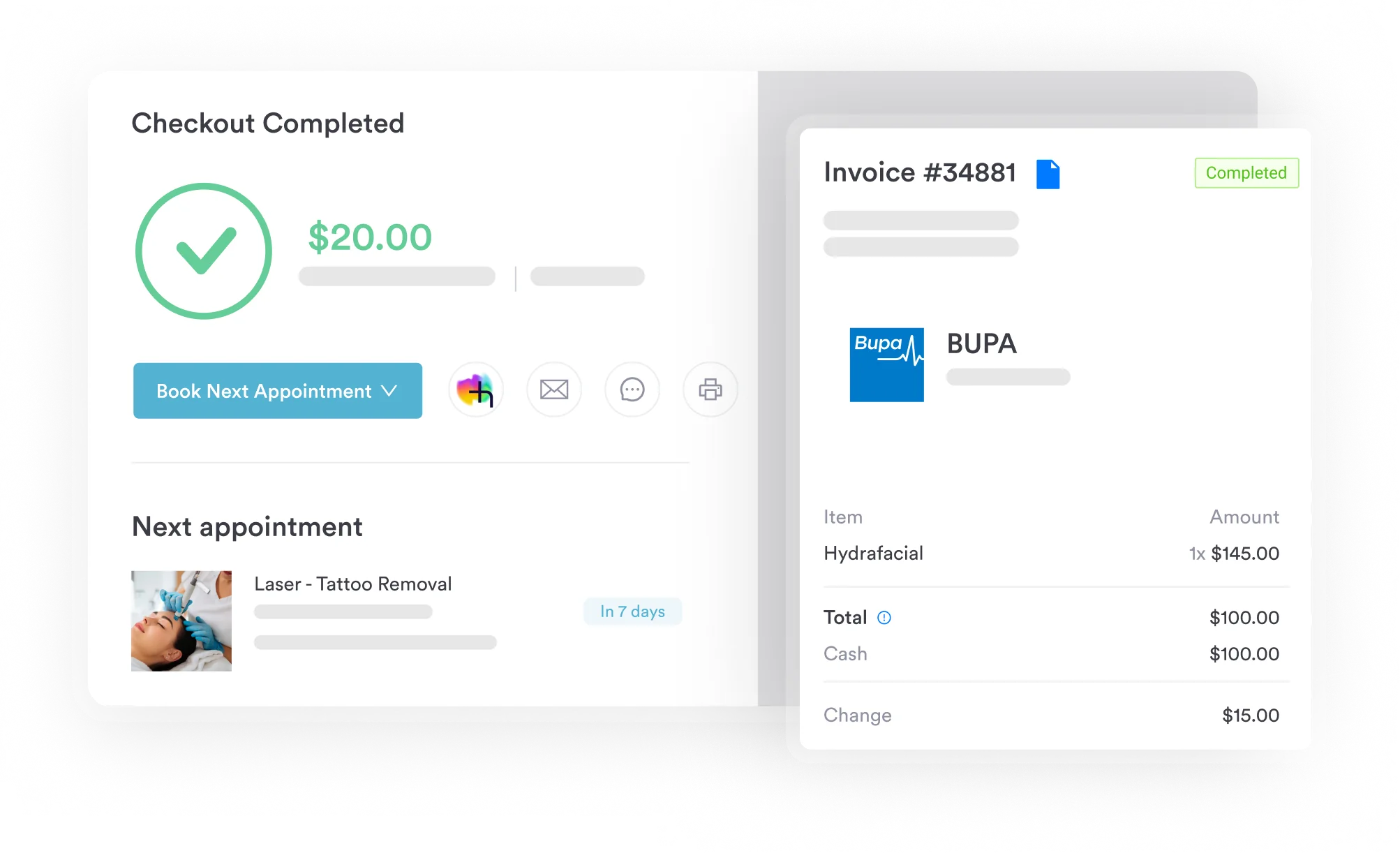

Pabau checks each claim for missing details like membership numbers and authorization codes before it goes out. It then submits through Claim.MD and tracks every claim until it’s paid.

A 69631 claim is only as strong as the sentence in the operative note that rules out ossicular reconstruction and mastoid work. Payers code from what the surgeon dictated, so a silent note invites a query even when the surgery matched 69631 exactly.
Start with the dictation template, then confirm prior authorization and laterality before the claim leaves. Those three checks address most of the denial patterns in this guide. Remember too that the prosthesis code, 69633, pays slightly less than 69632 in 2026, so the code should follow the note and nothing else.
Book a demo to see how Pabau validates, submits, and tracks your ENT claims from invoice to payment.

Want to reduce surgical claim denials before they happen? Clean claim submission guide covers the elements every surgical claim needs to pass payer edits on first submission.
CPT code 69631 is the procedure code for tympanoplasty without mastoidectomy and without ossicular chain reconstruction. It covers middle ear repair with or without canalplasty and atticotomy, for both initial and revision encounters. It is maintained by the American Medical Association and is billable for any payer that accepts CPT codes under HIPAA electronic transaction standards.
CPT 69631 is a unilateral code by descriptor. When tympanoplasty is performed on both ears in the same operative session, append modifier 50 (bilateral) to the single procedure line. Medicare pays bilateral 69631 at 150% of the single-ear allowed amount. Check with commercial payers, as some require two separate line items with RT and LT modifiers instead.
CPT 69632 includes ossicular chain reconstruction performed in the same surgical session as tympanoplasty, while 69631 does not. If the surgeon repairs the tympanic membrane and also reconstructs any part of the ossicular chain (malleus, incus, or stapes), the correct code is 69632. If the ossicular chain is inspected but left intact, use 69631, with the operative note explicitly documenting “no ossicular chain reconstruction performed.”
Yes. The AMA CPT descriptor for 69631 applies to both initial and revision tympanoplasty procedures, provided neither mastoidectomy nor ossicular chain reconstruction is performed. The operative note should document the prior surgery history and the indication for revision to support medical necessity review.
No. The AMA CPT descriptor for 69631 explicitly includes canalplasty and atticotomy as bundled components. Billing either one separately alongside 69631 triggers a CMS National Correct Coding Initiative (NCCI) edit. The separately billed line is then denied.
The operative report must document the surgical approach (transcanal, endaural, or postauricular), the graft type and source, and middle ear exploration findings. It must also confirm that neither ossicular chain reconstruction nor mastoidectomy was performed. Any canalplasty or atticotomy performed must be described to confirm they remained within the 69631 descriptor scope.