

CCSD code G5100: Bypass of duodenum billing guide
CCSD code G5100 bills a bypass that leaves the duodenum in place CCSD code G5100...

Last Updated: Oct 16, 2026
Billable Code Specific Code
K0050 is the HCPCS Level II code for a ratchet assembly, replacement only. It covers the ratcheting mechanism supplied as a replacement part for a manual wheelchair the payer already covers.
Medicare pays K0050 under the Part B DMEPOS benefit, and prices it from the DMEPOS fee schedule rather than the physician fee schedule. Suppliers bill it with a purchase modifier such as NU, and with KX when the documentation meets the applicable local coverage policy.
Let Pabau's smart automation suggest the right codes, reduce claim denials, and keep your practice compliant—effortlessly.
Automate repetitive tasks and focus on what matters most—your patients.
Reduce coding errors and ensure compliance with the latest regulations.
Clean claims, fewer denials, and faster reimbursements.
Powerful insights and reporting to help your practice thrive.
HIPAA compliant SOC 2 certified GDPR-compliant Trusted by 4,000+ clinics worldwide

HCPCS code K0050 describes a ratchet assembly, replacement only, for covered manual wheelchairs billed under Medicare Part B DMEPOS.
The KX modifier is required when documentation confirms the beneficiary meets medical necessity criteria. GA or GZ applies when necessity is disputed or not expected to be met.
2026 DMEPOS allowed amounts vary by jurisdiction, so check the current CMS DMEPOS fee schedule before billing.
Pabau’s claims management software supports HCPCS billing workflows, modifier tracking, and clean-claim submission for DME suppliers.
HCPCS code K0050 is a HCPCS Level II K-series code for a ratchet assembly, replacement only. The Centers for Medicare and Medicaid Services (CMS) maintains the K-series to classify durable medical equipment that no CPT code covers. It is active for the 2026 billing year, according to the CMS HCPCS Level II code system.
K-codes are temporary codes. CMS issues them when a permanent code does not yet exist for a supply or piece of equipment. K0050 falls under the Durable Medical Equipment category, specifically manual wheelchair replacement parts. Do not confuse K0050 with the manual wheelchair base codes K0001 through K0005. K0050 is a component-only replacement code, not a whole-chair code.
The ratchet assembly is the mechanical component on certain manual wheelchair frames. It locks and releases the seat angle or anti-tip mechanism in a stepped, ratcheting motion. When this component fails through normal wear, Medicare and qualifying payers cover its replacement as a billable DME supply, separate from the wheelchair frame itself. K0050 is a component-level code, so the replacement only qualifies when the payer already covers the wheelchair it belongs to.
K0050 applies only when the ratchet assembly belongs to a manual wheelchair that the beneficiary’s Medicare benefit itself covers. Billing K0050 for a power wheelchair component, or for a wheelchair that was never covered, is a coding error. The DMEPOS supplier must confirm the parent equipment’s coverage status before submitting.
Medicare Part B covers K0050 under the DMEPOS benefit when documentation establishes medical necessity and Medicare already covers the beneficiary’s existing manual wheelchair. Coverage is subject to Local Coverage Determinations (LCDs) issued by each Medicare Administrative Contractor (MAC), so the criteria can differ by jurisdiction. Checking the beneficiary’s eligibility before submission tells the biller which policy applies and what it covers.
Two DME MACs process DMEPOS claims, and each one serves two jurisdictions. Coverage policy for wheelchair accessories can differ between them, so read the applicable LCD before billing.
Medicare’s general coverage criteria for K0050 are:
Coverage is never automatic. Medical necessity documentation has to support each claim on its own.
CMS prices HCPCS code K0050 under the DMEPOS fee schedule it maintains. Allowed amounts vary by jurisdiction, and CMS updates them annually. The table below shows the general rate structure. Verify current figures against the CMS DMEPOS fee schedule before submitting claims, because rates change and CMS does not guarantee them as reimbursement amounts.
Always download the current-year CMS DMEPOS fee schedule file directly from CMS.gov rather than relying on third-party fee schedule databases. Third-party figures may lag behind CMS mid-year corrections and quarterly updates, which can result in overbilling or underbilling on K0050 claims.
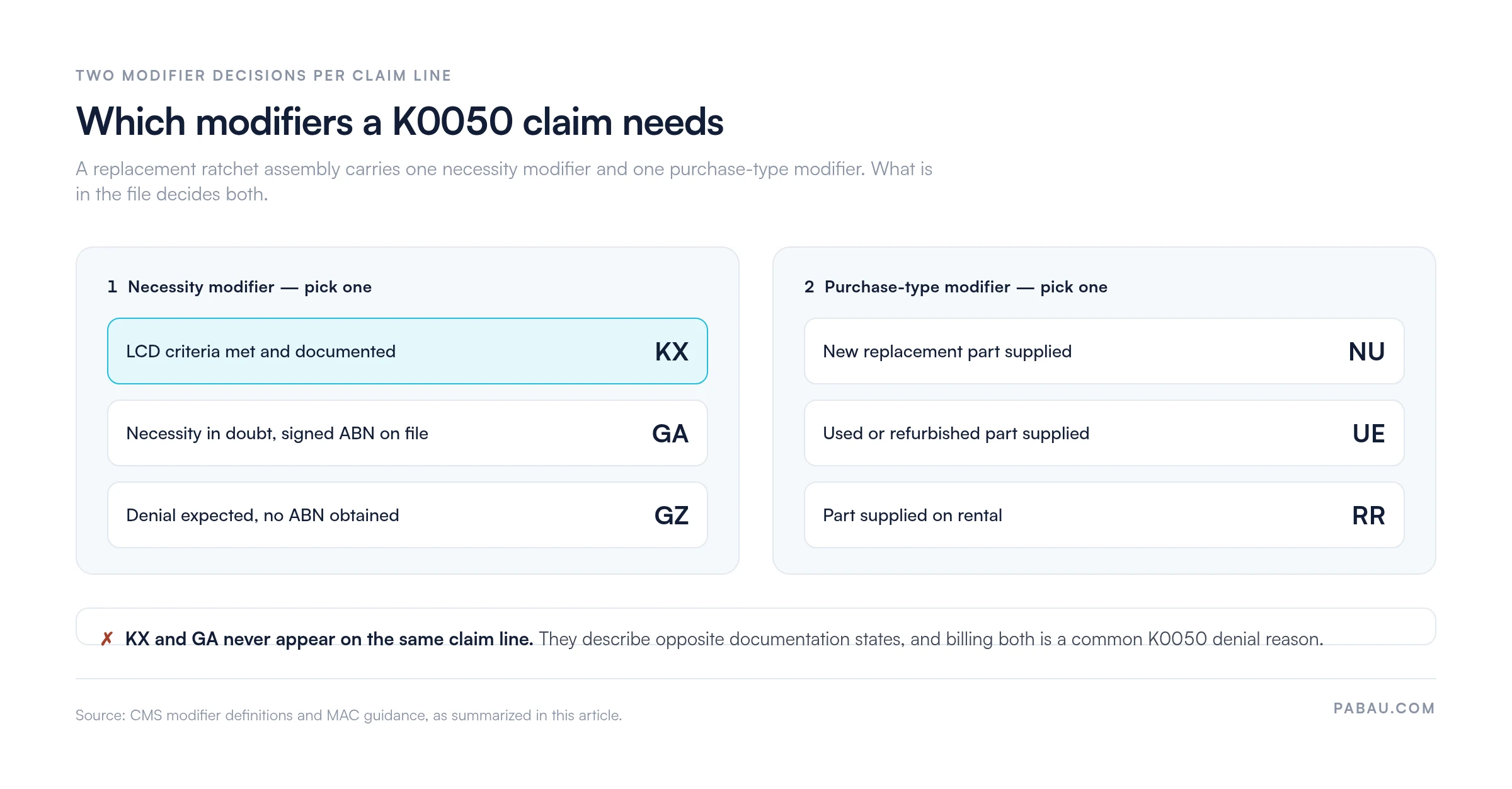
Most K0050 claims need modifiers to indicate the purchase type and the medical necessity status. One also records whether the supplier told the beneficiary about possible non-coverage. Using the wrong modifier, or omitting one entirely, is one of the most common reasons payers deny K0050 claims. The modifiers listed below apply to K0050. Cross-verify them against your MAC’s current LCD before billing, because requirements vary by jurisdiction.
Practical note: KX and GA are mutually exclusive. Append KX when medical necessity is fully documented. Append GA when an ABN is on file because necessity is in question. Never append both on the same claim line.
Every K0050 claim line carries two modifier decisions, and the documentation on file settles both of them.
CMS and MAC policies require specific documentation before a MAC can approve a K0050 claim. Missing items from the list below are the leading cause of post-payment audits and recoupments on wheelchair replacement part claims.
Keeping the physician order, the clinical note, and the delivery record on one patient file makes the packet easier to assemble at submission. Practice management software like Pabau stores those records against the patient rather than across separate folders. All of it has to be retained for the CMS-required period.
A claim line that cross-references the HCPCS code, the modifier, and the supporting diagnosis strengthens the trail for both primary and secondary payers. The mobility-impairment diagnosis comes from the ICD-10-CM code set, and the pointer on the claim must match the clinical notes.
The Integrated Outpatient Code Editor (IOCE) is CMS’s claim-editing system that validates HCPCS and CPT codes before payment in the outpatient setting. IOCE edits are less directly applicable to DME suppliers billing on the CMS-1500 form. Outpatient facilities and hospital-based DME programs that bill K0050 on a UB-04 should still know the relevant edit types.
For the most current IOCE edit data specific to K0050, use the AAPC HCPCS code lookup or the CMS IOCE specifications published on CMS.gov. IOCE data is updated quarterly, and the values on third-party reference pages may not reflect the most recent edits.
K0050 sits within the K-series manual wheelchair codes. The table below shows the most closely related codes. Billing K0050 when a whole-chair code applies is a coding error that can trigger an audit. Check descriptors against the CMS HCPCS quarterly update before billing, since wording changes between releases.
When the ratchet assembly failure stems from a broader structural problem with the wheelchair, reassess whether the whole frame needs replacing before defaulting to K0050. Billing a component code when the equipment itself is no longer serviceable may delay appropriate care and trigger a denial.
These mistakes account for most denied and recouped claims on wheelchair replacement part codes. The list below follows standard DMEPOS audit patterns and MAC denial data. Stronger denial management and a documentation review before submission prevent most of them. Each error maps to a specific fix.
Tracking denial root causes at the HCPCS code level shows billing managers which of these errors keeps recurring. Edit rules built around K0050 specifically, rather than generic claim scrubbing, cut denial rates further. Modifier rules and documentation checks that run before submission stop most of these errors at scale.
Run a quarterly audit on all K0050 claims paid in the previous 90 days. Compare the modifier used against the documentation in file for each claim. A KX claim with no medical necessity documentation behind it is the most common finding in DMEPOS post-payment audits. A pre-submission checklist prevents it.
Most DMEPOS suppliers keep modifier rules in a spreadsheet beside the billing system. The physician order sits in one folder, the delivery record in another, and whoever checks the claim has to open both before it goes out.
Pabau brings those pieces onto one patient record. Its claims management software holds the HCPCS code, the attached modifiers, and the payer response against the same claim line. The billing team reads one history instead of three.
When the remittance comes back, the paid amount posts against what the supplier submitted, so a short payment on a K0050 line surfaces the same day. The supporting forms stay on the patient file, which is where an audit request lands months later.

Pabau helps DME suppliers and practice billing teams manage HCPCS claims, track modifier requirements, and reconcile remittances in one place. See how it works in a live demo.

HCPCS code K0050 is narrow but audit-prone. Correct use depends on confirming the parent wheelchair’s coverage, attaching the right modifier, and keeping documentation that holds up to MAC review. Miss one of the three and a routine replacement part claim turns into a denial or a recoupment.
Put those checks in the billing workflow rather than in a reviewer’s memory, and the quarterly audit stops producing surprises. Book a demo to see how Pabau handles DMEPOS claims, modifier tracking, and remittance reconciliation in one place.

Need to understand how medical billing denials are classified? Denial codes in medical billing covers the remittance advice codes that appear when HCPCS claims are rejected.
Want to reduce claim errors before submission? Clean claim submission walks through the elements every DME claim needs to pass first-pass edits.
Looking to streamline DME supplier revenue workflows? Revenue cycle management fundamentals explains the end-to-end billing cycle from order to payment posting.
HCPCS code K0050 is a HCPCS Level II K-series code describing a ratchet assembly, replacement only. Suppliers use it to bill Medicare and qualifying payers for the replacement ratchet component on a covered manual wheelchair. CMS maintains it under the durable medical equipment category, and it is active for the 2026 billing year.
The primary modifiers for K0050 are KX, GA, GZ, NU, RR, and UE. KX confirms the medical necessity criteria were met and is required for Medicare payment. GA applies when a signed ABN is on file, and GZ when no ABN was obtained. NU, RR, and UE describe new, rented, and used equipment. KX and GA cannot be used together on the same claim line.
K0050 needs a signed physician order specifying the replacement and clinical notes supporting medical necessity. It also needs confirmation that the parent wheelchair is covered, plus DMEPOS supplier delivery records with the beneficiary’s signature. An Advance Beneficiary Notice is required when coverage is uncertain. MAC-specific LCD requirements may add further items.
Yes. Medicare Part B covers K0050 under the DMEPOS benefit when the beneficiary has a covered manual wheelchair and the ratchet assembly needs replacing. Medical necessity must be documented. Coverage is subject to each MAC’s Local Coverage Determination, so criteria vary by jurisdiction.
2026 DMEPOS allowed amounts for K0050 vary by MAC jurisdiction and are updated by CMS annually. Verify the current rate using the CMS DMEPOS fee schedule download at CMS.gov before billing, as third-party fee references may not reflect mid-year CMS corrections.
The most closely related codes are K0001 through K0005, which cover complete manual wheelchair frames at different weight and performance tiers. K0050 is a component replacement code and should not be billed in place of a whole-chair code when the frame itself requires replacement.



