

HCPCS code E0198: Water pressure pad billing guide
HCPCS code E0198 is a water pad for a standard mattress HCPCS code E0198 is the ...

Last Updated: Oct 13, 2026
60500 is the CPT code for parathyroidectomy or exploration of parathyroid(s). It covers the initial cervical operation, whether or not a gland is removed.
Three errors drive most denials on this code. The first is coding 60500 for a re-exploration (60502) or a mediastinal approach (60505). The second is an operative note that omits the intraoperative PTH results. The third is an NCCI edit that bundles 60500 into a thyroidectomy billed the same day.
Let Pabau's smart automation suggest the right codes, reduce claim denials, and keep your practice compliant—effortlessly.
Automate repetitive tasks and focus on what matters most—your patients.
Reduce coding errors and ensure compliance with the latest regulations.
Clean claims, fewer denials, and faster reimbursements.
Powerful insights and reporting to help your practice thrive.
HIPAA compliant SOC 2 certified GDPR-compliant Trusted by 4,000+ clinics worldwide

CPT code 60500 covers parathyroid exploration with or without gland removal, so exploration alone qualifies even when no gland is excised.
60500 is the initial cervical operation, while re-exploration is CPT 60502 and a mediastinal approach is CPT 60505.
Primary ICD-10 supports include E21.0 (primary hyperparathyroidism), E21.1 (secondary), and D35.1 (benign parathyroid neoplasm).
Medicare’s national payment for 60500 is about $891, built from 26.69 total RVUs before any geographic adjustment.
Pabau’s claims management software tracks denial reasons, supports clearinghouse submission via Claim.MD, and flags NCCI bundling conflicts before claims leave the practice.
CPT code 60500, as maintained by the American Medical Association, carries the official descriptor: “Parathyroidectomy or exploration of parathyroid(s).” It sits in the 60000-series endocrine surgery range. It applies to a first-time cervical exploration whether or not a gland comes out.
Two points trip up coders most often. First, gland removal is not required. A surgeon who explores the parathyroid field, confirms normal gland appearance, and closes without excising tissue still bills 60500. The operative report has to document that exploration.
Second, 60500 covers only the initial cervical operation. A re-exploration is coded 60502, and an approach through the mediastinum is coded 60505. Both of those are covered below.
The 60500-series sits alongside thyroid excision codes in the CPT endocrine surgery chapter. Coders frequently encounter CPT code 60500 on the same claim as thyroid codes (60240, 60252, 60260) when a combined procedure is performed. The table below maps the relevant code family.
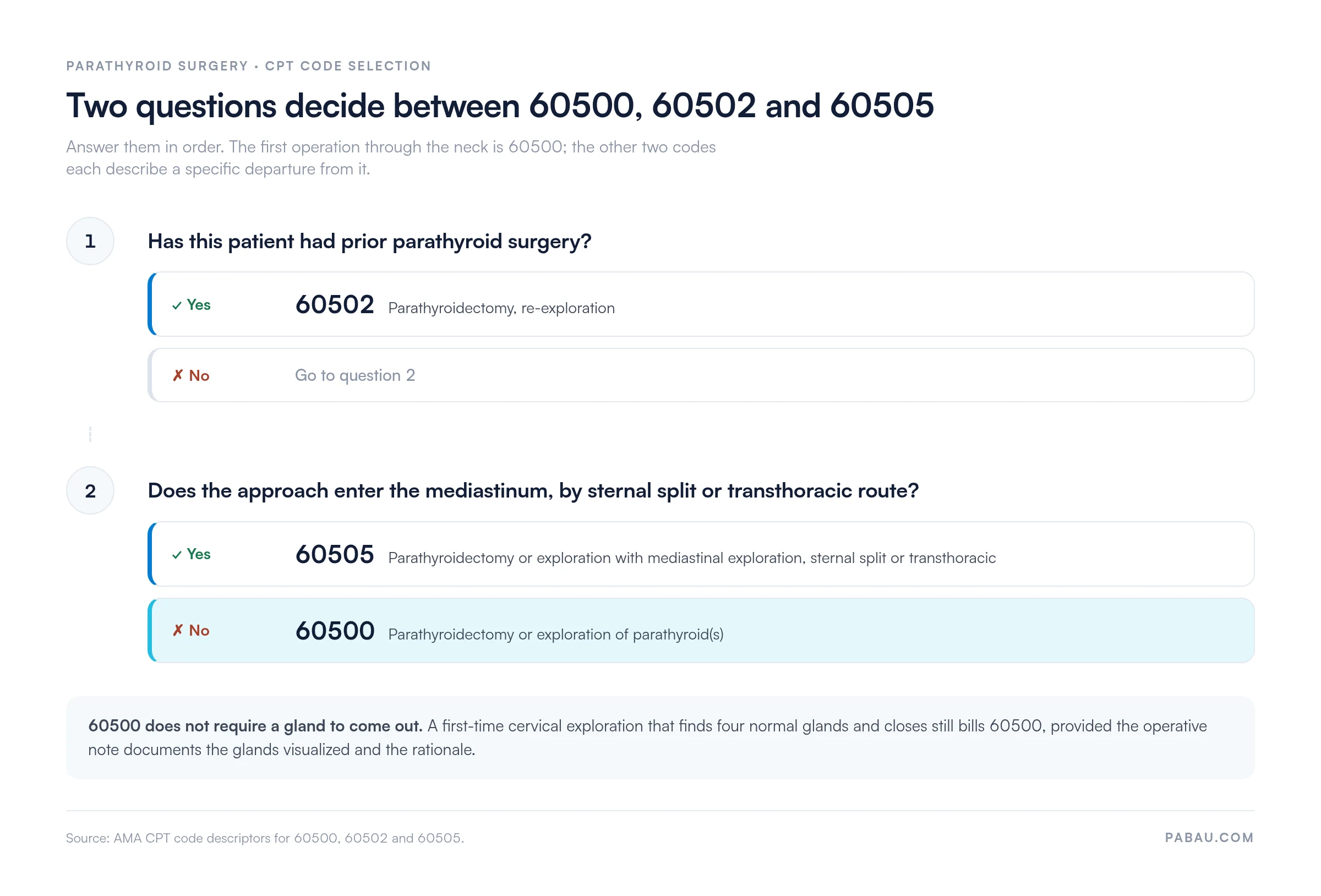
The 60500 family is where most parathyroidectomy coding errors start. 60500 applies to the first surgical attempt through a cervical (neck) incision, regardless of how many glands are removed. 60502 applies when the patient has had prior parathyroid surgery and the surgeon re-explores the neck.
60505 applies when the operation enters the mediastinum through a sternal split or a transthoracic route. Two questions asked in that order settle the choice on almost every case.
NCCI edits from the Centers for Medicare and Medicaid Services (CMS) govern how these codes interact with thyroidectomy codes billed on the same claim. The edits are updated quarterly, so verify the current edit status before billing combined procedures.
Every claim for CPT code 60500 must carry an ICD-10-CM diagnosis code that establishes medical necessity. The primary diagnoses for parathyroid surgery fall into three categories: Hyperparathyroidism variants, parathyroid neoplasm, and hypercalcemia-related conditions. Payers differ on which codes they accept without additional documentation. Check the applicable Local Coverage Determination (LCD) for the Medicare Administrative Contractor (MAC) serving the practice’s region.
When billing 60500 for secondary hyperparathyroidism (E21.1) in a dialysis patient, also code the underlying chronic kidney disease stage (N18.x) on the claim. Some MAC LCDs require the CKD code to appear before the E21.1 code in the diagnosis sequence to satisfy medical necessity review.
Modifier selection for CPT code 60500 directly affects payment and audit risk. The National Correct Coding Initiative (NCCI) edits, administered by CMS, flag certain code combinations as potentially unbundled unless a modifier demonstrates a separate, distinct service. Consult the AAPC Codify CPT lookup for current modifier indicators and MUE values.
Medicare pays CPT code 60500 from one national rate, then adjusts it by locality. Practice expense RVUs are the same in a facility and in an office for this code. The place of service therefore does not split the payment, as it does for many minor procedures.
Geographic Practice Cost Indices (GPCIs) adjust the rate by locality, so practices in high-cost areas receive more than the national figure below. Check the current figure for your own locality with the CMS Physician Fee Schedule lookup tool.
The figures above come from published CMS RVU data and sit before geographic adjustment. Private payers typically contract at a multiplier of the Medicare rate, ranging from 110% to 200% depending on the market and specialty. Track both the allowed amount and the payment actually posted, so an underpayment surfaces while the claim is still appealable.
Practices that bill through Pabau submit their claims via Claim.MD, our US clearinghouse partner. It validates codes against the CMS fee schedule and routes claims electronically to thousands of US payers.
Operative report completeness is the single biggest variable in whether a CPT code 60500 claim pays on first submission. Medical necessity denials on parathyroid cases almost always trace to an operative note missing one of the six elements below. A clean claim on a parathyroid case starts with the operative report, not the charge entry screen.
Practices using software for surgical billing can build operative note templates that pre-populate these required fields. That reduces the chance a surgeon’s dictation omits a reimbursement-critical element.
Prior authorization requirements for CPT code 60500 vary by payer type and plan year. Requirements also shift mid-year when payers update their medical policies. Confirm the authorization status for each patient’s specific plan before the procedure is scheduled.
Verify the patient’s plan and benefits level before the surgical date, not on the day of service. Missing a required authorization is a non-appealable denial in most commercial contracts.
Concurrent parathyroid and thyroid surgery on the same operative date creates NCCI bundling risk. CMS treats some parathyroid exploration work as included in the thyroidectomy code when both procedures share the same anatomical field. Verify the current edit status for each code pair against the CMS NCCI edits page before billing combined procedures.
The documentation defense for unbundling a 60500 and 60240 combination is an operative note that describes the parathyroid exploration as a separate decision. It needs its own indication, gland identification, and PTH confirmation, distinct from the thyroid dissection.
Most CPT code 60500 denials fall into four categories. Categorizing them at the CARC level makes the pattern visible across claims, rather than working each denial one at a time. The table below maps the most frequent denial types to their corrective action.
Every remittance carries a CARC and a RARC. The published denial codes in billing say what each one means and whether the denial can be appealed.
Set up a payer-specific denial dashboard that tracks 60500 denials by CARC code. If NCCI bundle violations cluster around a specific surgeon, that signals an operative dictation template issue, not a billing error. Fixing it at the documentation source prevents hundreds of individual reworks downstream.
A surgical practice usually learns that a 60500 claim was wrong weeks after the operation. The remittance arrives, a coder reads the CARC, and the case joins a rework queue. By then the operative note is closed and the surgeon has moved on to the next list.
Pabau is practice management software that holds charting, claims and payments in one patient record. Operative note templates carry the six elements a parathyroid claim needs, so the fields are prompted at dictation rather than chased afterwards. Charge entry reads from that note, and an NCCI conflict between 60500 and a same-day thyroidectomy code is flagged before submission.
Claims go out through Claim.MD, our US clearinghouse partner, and every remittance posts back against the claim it belongs to. Denials group by CARC and by surgeon. A dictation habit that keeps triggering bundle edits then shows up as a pattern rather than as a stack of individual reworks.

Pabau brings documentation workflows, claim submission, and denial tracking into one platform. See how surgical practices use Pabau to submit cleaner claims and recover faster from denials.

Three decisions made before the claim leaves the practice determine whether CPT code 60500 pays. Pick the right code from the 60500, 60502 and 60505 family. Pair it with a diagnosis the payer’s LCD accepts. Then make sure the operative report documents what a medical necessity reviewer will look for.
NCCI bundling with a concurrent thyroid code is the complication that costs the most. It is preventable with the right modifier and operative note language. The codes themselves are stable. What changes each year is the payment and the edit file, so build that check into the workflow rather than into someone’s memory.
Book a demo to see how Pabau handles endocrine surgery billing, from the operative note through to the remittance.

Need to understand how clearinghouse submission works for surgical codes? How Claim.MD clearinghouse works explains the electronic claim routing and validation process for US practices.
Tracking denial patterns across your surgical caseload? Electronic remittance advice explained covers how to read ERAs and CARC codes to identify correctable denial trends.
Want a clean claim checklist for surgical billing? Understanding the 837 file format shows how claim data is structured before it reaches the payer and where errors typically occur.
CPT code 60500 covers parathyroidectomy or exploration of the parathyroid gland(s) via a cervical (neck) approach during the initial operation. It applies whether or not a gland is removed. Exploration alone qualifies, provided the operative report documents the glands visualized and the surgical rationale.
60500 applies to a first-time cervical parathyroid exploration. A re-exploration after prior parathyroid surgery is CPT 60502. CPT 60505 covers an operation that reaches the parathyroid through the mediastinum, by sternal split or transthoracic approach. Billing 60500 for a re-exploration is a coding error and a common denial trigger.
The most common pairings are E21.0 (primary hyperparathyroidism), E21.1 (secondary hyperparathyroidism), E21.2 (other/tertiary hyperparathyroidism), and D35.1 (benign neoplasm of parathyroid gland). E83.52 (hypercalcemia) may be added as a secondary code but should not appear as the sole diagnosis code on the claim.
The parathyroid exploration CPT code is still 60500 even when no gland is excised. The AMA descriptor covers “exploration” as well as excision. What matters is a complete operative note documenting the surgical exploration, the glands visualized, and the clinical rationale for the procedure.
Yes, but an NCCI edit governs the combination. Where both procedures were distinct services on the same operative date, append modifier 59 or XS to 60500. The operative report must then document the parathyroid exploration as a decision separate from the thyroidectomy. Without that documentation, the payer bundles the two codes and pays only for 60240.
Medicare’s national payment for CPT code 60500 is approximately $891 before geographic adjustment, based on a total of 26.69 RVUs. Practice expense RVUs are the same in facility and non-facility settings for this code, so the place of service does not change the national rate. Check your locality’s figure with the CMS Physician Fee Schedule lookup tool.



