HCPCS Code V2629: Ocular prosthesis billing guide
HCPCS Code V2629: Definition, descriptor, and code attributes HCPCS Code V2629 i...

Last Updated: Nov 6, 2026
29530 is the CPT code for strapping; knee. It covers applying adhesive or elastic strapping to support or stabilize the knee joint after injury, with instability, or during post-procedure care.
Physical therapy, sports medicine and orthopedic practices bill it with an ICD-10-CM code that shows medical necessity. Medicare pays it only for a documented condition, never for preventive athletic taping, and treats the strapping supplies as bundled.
Let Pabau's smart automation suggest the right codes, reduce claim denials, and keep your practice compliant—effortlessly.
Automate repetitive tasks and focus on what matters most—your patients.
Reduce coding errors and ensure compliance with the latest regulations.
Clean claims, fewer denials, and faster reimbursements.
Powerful insights and reporting to help your practice thrive.
HIPAA compliant SOC 2 certified GDPR-compliant Trusted by 4,000+ clinics worldwide

CPT code 29530 covers adhesive or elastic strapping of the knee only, while hip and ankle strapping use 29520 and 29540.
The chart note needs the clinical indication, materials, anatomical site and technique, plus a separate procedure note when an E/M is billed that day.
Medicare covers 29530 only when strapping treats a documented condition, so check your MAC’s LCD and the NCCI edits before you submit.
Strapping supplies go on CPT 99070, which Medicare does not pay separately, so confirm each commercial payer’s supply policy.
Pabau, the practice software we build, submits 29530 claims through Claim.MD and tracks each one through to the remittance.
CPT code 29530 is “Strapping; knee,” the code for applying adhesive, elastic or non-elastic tape in overlapping strips to the knee joint. The strapping limits motion, reduces swelling or gives the joint structural support. The American Medical Association places 29530 in the Application of Casts and Strapping subsection (29000-29799) of the Surgery section. Lower extremity strapping runs from 29520 to 29584 within it, and 29530 covers the knee alone.
Clinically, knee strapping is performed for acute sprains, ligamentous instability, patellofemoral syndrome, and post-procedure support. The code does not specify the number of layers, tape type or technique. Any compliant strapping method an eligible provider applies to the knee qualifies. What matters for billing is that the procedure is medically necessary and documented as such.
The 29530 procedure covers the application of adhesive or elastic strapping directly to the knee. Any strapping technique that provides mechanical support or motion restriction to the tibiofemoral or patellofemoral joint qualifies, including kinesiotape applications coded under the strapping guidelines. The list below separates it from the neighboring codes.
The distinction between strapping and splinting matters for reimbursement. Splints and casts have their own CPT codes and carry different payer coverage rules. When in doubt, document the clinical intent: Stabilization or support of an injured or unstable structure qualifies as strapping; immobilization for fracture management does not.
Coding the wrong anatomical site is an easy error in the strapping family. Knee and ankle strapping look similar procedurally but use different codes. The table below covers each lower-limb neighbor.
A common scenario: A patient with combined knee and ankle instability treated in the same session. Bill 29530 for the knee strapping and 29540 for the ankle strapping, each on its own claim line. Both can be reported on the same date of service when each is clearly documented. The chart below maps each lower-limb site to its strapping code.
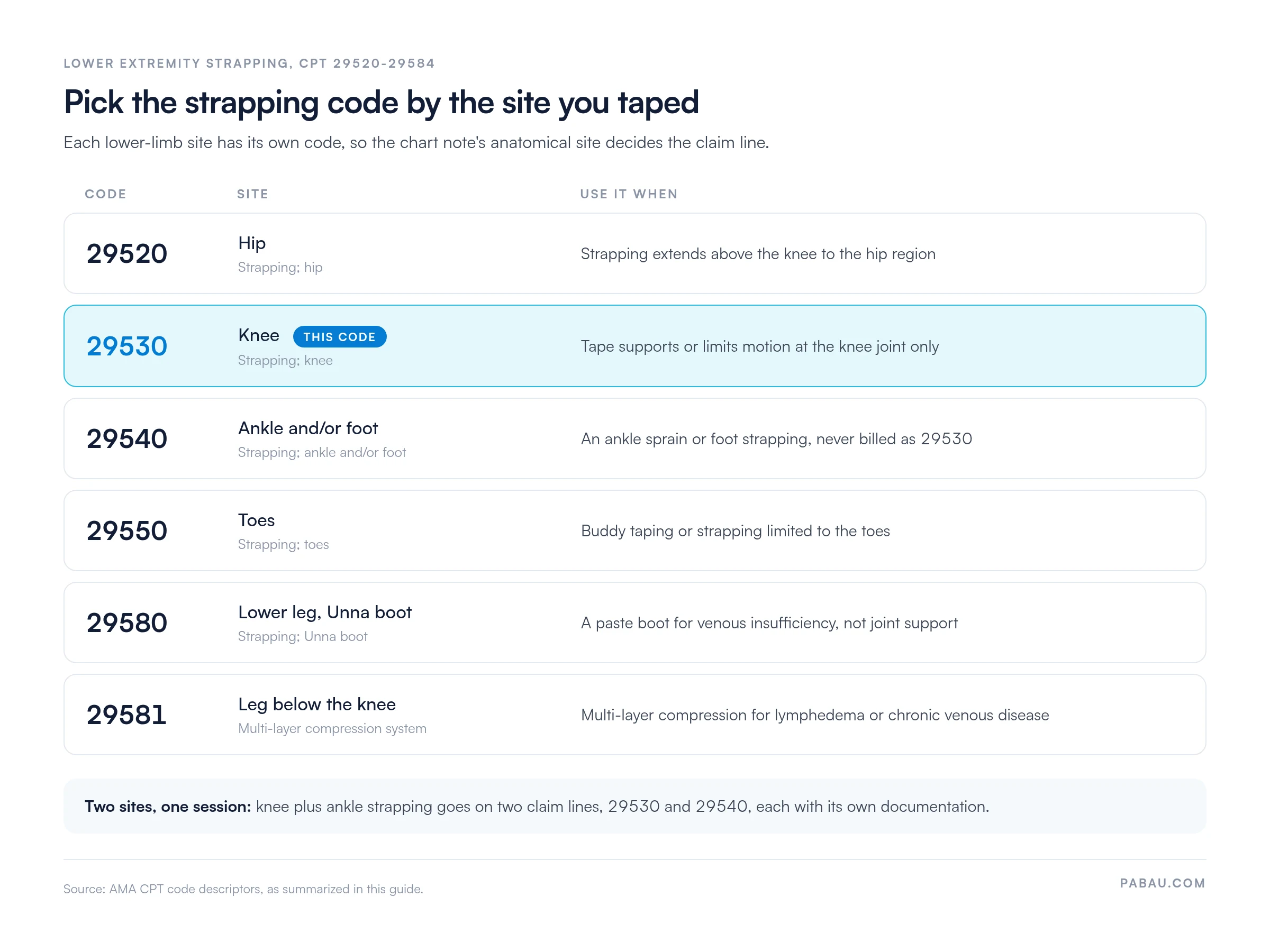
Incomplete documentation is a frequent cause of 29530 denials. Medical billing documentation for a strapping procedure requires specific clinical detail that generic SOAP notes do not always capture. Every chart note supporting a 29530 claim must include all of the following.
Practices billing 29530 often find that their charting templates do not capture materials and technique at the level payers require. A short structured strapping section in the note template heads off most documentation-based denials.
Payers require a supporting ICD-10-CM diagnosis code that demonstrates medical necessity for knee strapping. The diagnosis must reflect an active condition requiring mechanical support or stabilization. Routine athletic conditioning or preventive taping does not meet medical necessity under most payer policies.
Always code to the highest level of specificity. An S83 code requires 7th-character extensions for encounter type (A = initial encounter, D = subsequent, S = sequela). Use the correct extension every time, or the claim may reject on edit.
Medicare Part B covers CPT code 29530 when knee strapping is medically necessary. That means it treats a documented clinical condition rather than serving as elective athletic support. Coverage depends on the Local Coverage Determinations (LCDs) and billing guidance of the Medicare Administrative Contractor (MAC) for your jurisdiction. Novitas Solutions, NGS Medicare and CGS Administrators each publish guidance that may differ by region.
29530 is an untimed code, reported once per site per session, so the Medicare 8-minute rule for timed therapy codes does not apply to it.
For current Medicare reimbursement rates and LCD lookups, use the CMS Physician Fee Schedule lookup tool. Rates update annually on January 1 and vary by geographic practice cost index (GPCI). A rate from a prior year is not reliable for current billing.
Before submitting a 29530 claim to Medicare, search your MAC’s LCD database for ‘strapping’ or ‘knee strapping.’ If an LCD exists, document against its stated coverage criteria, and run the claim against current NCCI edits. Skipping the LCD check is one of the most avoidable causes of medical necessity denials for this code.
CPT code 29530 carries a relatively low work RVU (wRVU) value, reflecting the straightforward procedural nature of knee strapping compared to surgical codes. The national Medicare non-facility payment is typically in the range of $25-$45 depending on the geographic locality multiplier. Facility rates (when performed in a hospital outpatient department or ASC) are lower. Always verify current figures against the CMS fee schedule tool, as rates change each January.
When you bill 29530 through Pabau, claims go out through Claim.MD to thousands of US payers. Pabau’s claims management software pulls the record data into a pre-filled claim and tracks its status. Eligibility checks run before the visit, and ERA files post payments against expected reimbursement without manual matching. That matters on low-value codes like 29530, where a denial can cost more to appeal than the claim is worth.
Modifier selection for 29530 is where many billing errors happen. The modifiers that apply to this code serve different purposes and are not interchangeable. Using the wrong one, or leaving out a required one, leads to denial or compliance exposure.
Check the current NCCI procedure-to-procedure edits for active bundling edits that affect 29530. NCCI edits update quarterly, so a code pair that passed last year may be bundled now.
Provider-type eligibility for 29530 depends on the payer and the billing setting. When a payer does not recognize the provider type, the claim returns a CO-170 denial reason code. CO-170 means payment is denied when this type of provider performs or bills the service. Payers often treat it as a credentialing or compliance issue rather than a simple billing error.
Therapists who bill commercial plans as well as Medicare meet different credentialing rules at each payer. Our guide to insurance billing for therapists covers enrollment and claim setup payer by payer.
CPT code 29530 covers the application service only. The strapping materials may be separately reportable, depending on payer policy.
The usual supply code is CPT 99070, which covers supplies and materials provided over and above those usually included with the visit. List the 99070 line with a clear description of the supplies used, such as tape type and quantity. Record them on the superbill so your front desk captures them at the point of service.
Most 29530 denials fall into a handful of categories. The reason code on the remittance tells you which corrective action to take. Use denial management workflows that log each denial by reason code, so patterns surface early.
Separately, code each diagnosis to its highest level of specificity. An unspecified code where a more specific one exists invites edits and records requests.
For Medicare denials, appeal through the Redetermination process within 120 days of the remittance advice date. Include the relevant clinical notes, the LCD criteria checklist if applicable, and a cover letter citing the specific coverage provision the claim meets. Tracking appeals by reason code, and tightening clean claim submission, cuts the number of first-pass denials that need an appeal at all.
A 29530 claim depends on details captured at the visit. Someone has to confirm the knee was the site taped, note the materials and technique, and attach the right diagnosis. In a generic EHR, those details often live in three different places.
In Pabau, the strapping note, the invoice and the claim sit on the same patient record. The claim is pre-filled from that record and submitted through Claim.MD, Pabau’s US clearinghouse partner. Its status updates as the payer responds, and the ERA posts back against the invoice.
The result is less rekeying, and one place to see which 29530 claims were paid, denied or still pending.

Pabau helps physical therapy, sports medicine and orthopedic practices submit claims through Claim.MD, then track denials and remittances in one place. See how the claims workflow handles your musculoskeletal codes.

Getting paid for 29530 depends more on the chart note than on the code. When the note names the knee, the indication, the materials and the technique, the claim usually stands on its own.
So start with your note template rather than your denial queue. Add a structured strapping section, check your MAC’s LCD once, and confirm which payers pay 99070 separately. The trade-off is a minute more charting per visit, against appeals that can cost more than the claim pays.
Book a demo to see how Pabau keeps strapping notes, invoices and claims on one patient record for your practice.

Charging self-pay patients for strapping sessions? Therapy invoice template gives you a ready-made invoice layout for therapy visits.
Want to reduce claim rejection rates across your practice? Medical billing compliance outlines the audit-proofing steps that protect practices billing musculoskeletal codes.
Looking for a reference on electronic remittance advice and ERA posting? Electronic remittance advice explains how ERA files map payer decisions back to individual claim lines.
CPT code 29530 covers applying adhesive or elastic strapping to the knee to stabilize, support or restrict motion after injury or with instability. It does not include the strapping materials. Those may be separately reportable under CPT 99070, depending on the payer’s bundling policy, though Medicare does not pay 99070 separately.
Yes, 29530 can be billed on the same date of service as an evaluation and management (E/M) code. The E/M must carry modifier 25 to signal a significant, separately identifiable service beyond what is routine to the procedure. The clinical note must support both services independently.
Medicare Part B covers 29530 when knee strapping is medically necessary for a documented clinical condition. Preventive athletic taping without a clinical diagnosis is not covered. Check your MAC’s Local Coverage Determination and the current NCCI edits, and verify frequency limits with your regional MAC before submitting.
No, athletic trainers are not recognized Medicare providers and generally cannot bill Medicare directly for 29530. Services may be covered under incident-to billing when a Medicare-enrolled supervising physician is present in the suite. Strict supervision and documentation requirements apply. Many commercial payers do recognize ATCs, so confirm eligibility with each payer.