

HCPCS Code E0272: Foam rubber mattress billing guide
HCPCS Code E0272: official descriptor and code overview HCPCS Code E0272 is the ...

Last Updated: Nov 6, 2026
29445 is the CPT code for applying a rigid total contact cast to the lower leg. The cast is molded to the foot and shin and can't be removed, so it moves plantar pressure off an ulcer or Charcot deformity.
Most claims are for diabetic neuropathic foot ulcers, and each new cast on a new date of service bills again. Medicare pays about $132 nationally in an office setting in 2026. Claims usually fail on same-day debridement without separate notes, or a missing LT or RT modifier. Get the notes, modifiers and payer checks right, and the claim pays the first time.
Let Pabau's smart automation suggest the right codes, reduce claim denials, and keep your practice compliant—effortlessly.
Automate repetitive tasks and focus on what matters most—your patients.
Reduce coding errors and ensure compliance with the latest regulations.
Clean claims, fewer denials, and faster reimbursements.
Powerful insights and reporting to help your practice thrive.
HIPAA compliant SOC 2 certified GDPR-compliant Trusted by 4,000+ clinics worldwide

CPT code 29445 bills a rigid total contact leg cast, not a short leg walking cast (29425) or a standard short leg cast (29405).
Medicare covers 29445 under each MAC’s medical necessity rules, and no nationwide KX requirement applies, so check your MAC’s wound care policy first.
NCCI edits pair 29445 with same-session debridement codes, and modifier 59 or an X modifier supports separate payment only when each service is documented separately.
Medicare’s 2026 national rate is about $132 in an office and about $91 in a facility, before geographic adjustment.
Pabau’s claims management software supports 29445 billing with eligibility checks before the visit, through Claim.MD, and settles payments straight from ERA files.
CPT code 29445 is a musculoskeletal procedure code published by the American Medical Association. Its official descriptor reads: Application of rigid total contact leg cast. It sits in the Application of Casts and Strapping range (29000-29799) of the Musculoskeletal System section.
A total contact cast is a closely molded fiberglass or plaster shell that the patient can’t take off. It spreads plantar pressure across the whole sole, which takes the load off an ulcer or deformity. That rigid, non-removable design is what defines the code. Removable devices code differently.
With the definition settled, the next question is what the clinician physically does, because the note has to match it.
The clinician prepares the wound, pads the bony prominences, and molds a fiberglass or plaster shell tightly to the foot and lower leg. The cast runs from the toes to just below the knee. It’s sealed so the patient can’t remove it. Here’s the sequence coders should expect to see in the note.
The first cast usually stays on for five to seven days. Later changes follow every one to two weeks, depending on how the wound responds. Each new cast applied on a new date of service bills 29445 again. Medical necessity must be documented at each visit.
CPT code 29445 fits conditions where taking all pressure off the sole is the main treatment goal. Medicare MACs apply general medical necessity rules rather than a national 29445 policy. Commercial payers set their own covered diagnoses. Billing 29445 without a payer-covered diagnosis is the quickest route to a denial.
Excluded indications: Infected wounds with active osteomyelitis, critical limb ischemia (ABI below 0.5), and severe edema that rules out casting. Patients with documented non-compliance who need a removable device are excluded too. A 29445 claim for these patients is unlikely to pass medical necessity review.
Payers accept CPT code 29445 only alongside an ICD-10-CM diagnosis that establishes medical necessity. The most common pairing is E11.621 with an L97 code that names the ulcer site and depth.
The table maps the usual covered diagnoses to their clinical scenarios for FY 2026.
Check every diagnosis code against the date of service. CMS updates the ICD-10-CM code set each October 1, so a code valid in FY 2025 may change in FY 2026. Use the CMS ICD-10 code files and confirm the payer’s covered diagnoses before billing.
The most common coding error is swapping CPT code 29445 for a neighboring casting code. Each code in this range describes a different device, material, and clinical purpose.
Payers compare the billed code with the clinical note. When the documented device doesn’t match the descriptor, the claim is denied.
A gray area to watch: a clinician may wrap a removable cast walker in fiberglass so the patient can’t take it off. Some payers accept 29445 for that device, while others want the removable HCPCS code. Check the payer’s policy before billing. Either way, the note must state that the device was non-removable and applied in close contact.
Debriding the ulcer and then casting it at the same visit is routine in wound care. It’s also the most common NCCI bundling problem for CPT code 29445. NCCI edits pair 29445 with debridement codes such as 11042 and 97597. The column two code is denied unless a modifier shows the services were distinct.
Modifier 59 signals a distinct procedural service on the same day. Many payers prefer the more specific XS (separate structure) or XU (unusual non-overlapping service). It goes on the column two code of the edit pair. Check the current NCCI table for the exact pair and its modifier indicator.
Here’s how that looks in practice. A podiatrist debrides a plantar ulcer, then applies a total contact cast at the same visit. The debridement entry records wound measurements, tissue types removed, and surface area. The cast entry records wound status after debridement, materials used, and laterality. One combined note covering both services won’t survive an audit.
Modifiers and documentation are where most CPT code 29445 claims fail. Each modifier has its own usage rule. Applying the wrong one, or leaving out a required one, produces a predictable denial.
Build LT or RT into your 29445 billing template so laterality is never a manual step. Read your MAC’s wound care policy before you add KX or an ABN modifier.
Medicare pays CPT code 29445 from the Medicare Physician Fee Schedule (MPFS). The MPFS multiplies relative value units (RVUs) by the annual conversion factor, then adjusts for location.
The national figures below use 2026 RVU data, and your allowable will shift with your MAC locality. Check the CMS Physician Fee Schedule lookup tool before posting expected payments.
Casting supplies such as fiberglass rolls, stockinette, and padding are not included in the 29445 payment. Some payers reimburse them separately under HCPCS codes in the Q4001-Q4051 range.
Coverage varies, so check each payer’s policy before billing supplies. Location matters too, so a Manhattan practice will see a higher allowable than one in rural Oklahoma.
Coverage rules for CPT code 29445 depend on the payer. Traditional Medicare covers the service through your MAC under general reasonable-and-necessary rules, and no nationwide KX requirement applies.
MAC wound-care articles, such as Noridian’s A58565 (JE/JF), set payer-specific rules. Read the medical billing compliance rules for each payer in your mix before the first cast goes on.
Documentation decides whether a CPT code 29445 claim survives an audit. The note must hold every element your MAC’s policy and payer contract require, recorded at the time of service. Without it, you’re facing a medical necessity denial that’s hard to overturn on appeal.
A wound care note template that prompts for each field above stops missing details before the claim goes out. A clean claim starts with a complete note. Billing staff should review the note before submission, not after a denial arrives.
Run a quarterly audit of your 29445 documentation against the checklist above. Pull ten claims at random from the prior quarter, compare each note against the checklist, and track which fields are missing most often. Then add template prompts for the fields that fail most.
A 29445 claim passes through five checkpoints, and each one has its own way of stalling. The path below shows the check at every stage and the error that trips it up most often.
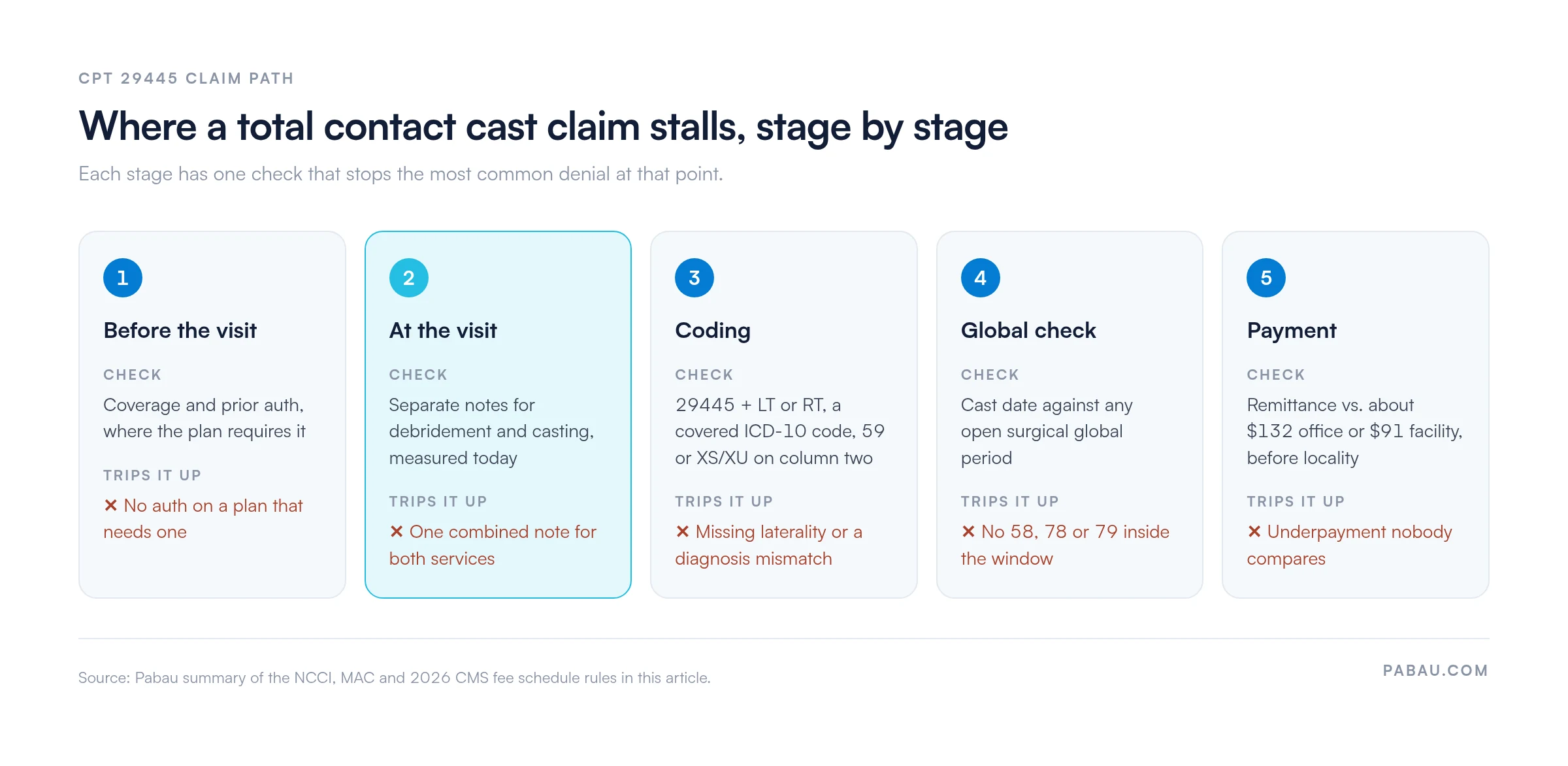
Two minutes with this list before the claim leaves saves weeks of rework afterward.
CPT code 29445 denials come from a short, predictable list of causes. The table pairs each one with its fix, based on NCCI policy and standard Medicare claims review. Catching them before submission beats denial management after the fact. For the reason codes printed on remittances, see the list of denial codes.
CPT code 29445 carries zero global days, so it never creates a surgical global period of its own. It can still be bundled into another procedure’s global period. That happens when a surgeon performs lower extremity surgery with a non-zero global period, then applies a TCC inside that window.
In that case the casting service is folded into the surgical payment. Only the right modifier makes it separately payable. Three modifiers cover this scenario.
State in the note whether the wound relates to the earlier surgery. A vague note that skips the connection won’t support separate payment. Check the cast date against the original procedure’s global window before you assign the modifier.
Many wound care practices still bill 29445 by hand. Staff check coverage by phone and key each claim into a payer portal. Then they match each electronic remittance advice (ERA) against expected allowables in a spreadsheet. Every manual step is a chance for a stale eligibility check or a missed laterality modifier.
Pabau, the practice management platform we build, moves those steps into one system. Its claims management software runs eligibility checks before the visit, through Claim.MD. CMS-1500 claims go out through the same clearinghouse to thousands of US payers, after a scrub for missing or invalid details. When payment arrives, Pabau lets you settle payments straight from ERA files.
If a payer rejects a claim, Pabau flags it as Needs action and shows the reason. Your team fixes the modifier or diagnosis and resubmits the same day. The result is fewer coverage surprises on casting day and faster reconciliation of each 29445 payment.

Pabau checks eligibility through Claim.MD, scrubs CMS-1500 claims before they go out, and settles payments from ERA files. Podiatry and wound care practices get each 29445 cast paid without re-keying.

CPT code 29445 rewards practices that treat it as a documentation code. The cast itself is simple to bill. Denials come from what surrounds it, such as same-day debridement without separate notes, an uncovered diagnosis, or a missing laterality modifier.
So start with the payer rules and build them into one note template. MAC wound-care articles, such as Noridian’s A58565 (JE/JF), set payer-specific rules, so never assume one MAC’s policy applies nationally. A note that records measurements, etiology, vascular status, and cast details at every visit will hold up on review.
Book a demo to see how Pabau checks eligibility and catches claim errors before your next 29445 claim goes out.

Want to understand how clearinghouse submission works for CPT claims? Medical claims clearinghouse guide covers how 837P transactions move from practice to payer and where they fail.
Billing selective debridement alongside the cast? CPT code 97597 explains how selective debridement is billed by wound surface area.
Need a reference for the revenue cycle from start to finish? What is revenue cycle management maps the full payment pathway from patient encounter through final payment posting.
Looking for guidance on eligibility verification before applying a TCC? Insurance eligibility verification explains how checking coverage before the visit reduces authorization and coverage denials.
About $132 nationally in a non-facility setting and about $91 in a facility, based on 2026 CMS values. Your locality adjustment moves that figure up or down. Casting supplies aren’t included in the payment.
Yes, when the visit addresses a significant, separately identifiable problem. Append modifier 25 to the E/M code and document it apart from the casting. The routine assessment before the cast goes on is part of 29445.
Once for each new cast applied on a new date of service. After the first five to seven days, changes usually follow every one to two weeks. Some MACs and payers cap applications per episode, so check before a long course.
It depends on the payer. An instant total contact cast is a removable walker wrapped in fiberglass so it can’t come off. Some payers accept 29445 for it, while others want the HCPCS walker code. Either way, the note must say the device was non-removable.
No. It carries zero global days, so follow-up visits aren’t bundled into it. A cast applied inside another surgery’s global window needs modifier 58, 78 or 79 to be paid separately.




