CPT code 85651: Erythrocyte sedimentation rate, non-automated
CPT code 85651: Definition, descriptor, and code summary CPT code 85651 is the p...

Last Updated: Nov 24, 2026
29450 is the CPT code for application of a clubfoot cast with molding or manipulation, long or short leg. It covers a thigh-to-toes or below-knee cast that holds a clubfoot in its manipulated position.
Most claims come from weekly Ponseti serial casting, and each cast change is billed again. Medicare pays about $146 in an office in 2026. Claims usually fail on a missing manipulation note, a diagnosis with no side, or the wrong bilateral modifier.
Let Pabau's smart automation suggest the right codes, reduce claim denials, and keep your practice compliant—effortlessly.
Automate repetitive tasks and focus on what matters most—your patients.
Reduce coding errors and ensure compliance with the latest regulations.
Clean claims, fewer denials, and faster reimbursements.
Powerful insights and reporting to help your practice thrive.
HIPAA compliant SOC 2 certified GDPR-compliant Trusted by 4,000+ clinics worldwide

CPT 29450 covers application of a clubfoot cast with molding or manipulation, and it applies to long-leg and short-leg casts alike.
Each weekly Ponseti cast change is a separate 29450 service, because the code carries a 0-day global period.
Pair it with Q66.01 for the right foot or Q66.02 for the left, and keep Q66.00 for notes that name no side.
Fracture and other non-clubfoot casts bill with 29345, 29405, a splint code such as 29505 or 29515, or a fracture-care code.
In 2026, Medicare pays about $146 in an office and about $100 in a facility, before geographic adjustment.
CPT code 29450 reports the application of a clubfoot cast with molding or manipulation, long or short leg. AAPC’s Podiatry Coding Alert quotes that descriptor and assigns 29450 to weekly clubfoot castings. The descriptor sets no single cast length, so a thigh-to-toes cast and a below-knee cast can both qualify.
What the code does require is clubfoot as the indication, plus molding or manipulation of the foot as the cast goes on. CMS lists the short descriptor as “Application clubfoot cast.”
Most 29450 claims come from Ponseti serial casting in pediatric orthopedics. The clinician manipulates the foot toward correction, then applies a cast to hold that position. Each weekly session is billed on its own date of service.
The American Medical Association (AMA) publishes the CPT code set, including this descriptor. Codes in the casting range describe the application service. Casting supplies are a separate line where the payer pays for them.
One 29450 service covers the manipulation or molding and the cast that holds the corrected position. The cast can run from thigh to toes or stop below the knee.
The Ponseti method usually uses long-leg casts. A short-leg clubfoot cast applied with manipulation is still 29450, though.
The Ponseti method is the standard treatment for congenital clubfoot. At each visit, the clinician removes the previous cast, manipulates the foot a little further, and applies a new cast. Each visit brings a new manipulation and a new cast, so each one is a separate 29450 claim.
Some commercial plans cap the number of casts per episode, or require prior authorization for the series. Check the plan’s policy before the first cast goes on.
Every CPT 29450 claim needs an ICD-10-CM diagnosis that shows clubfoot. The Q66.0 subcategory covers congenital talipes equinovarus, split by foot. Many payers question the unspecified code when the note names a side.
ICD-10-CM has no single bilateral code for talipes equinovarus. For bilateral clubfoot, report Q66.01 and Q66.02 together. On split -RT and -LT lines, link each foot’s code to its own line.
Treat Q66.89 as a stopgap. Once the clinician documents talipes equinovarus, move the claim to the matching Q66.0 code.
Record each foot by name in every casting note. A line such as ‘bilateral clubfoot, both legs casted’ leaves the coder to guess which foot got which correction. One line per foot, with its manipulation and cast, supports Q66.01, Q66.02 and the bilateral claim.
Two facts in the note decide whether 29450 applies. The indication must be clubfoot, and the foot must be molded or manipulated as the cast goes on. Once both hold, the code is 29450 whether the cast runs to the thigh or stops below the knee. Device and length only start to matter when the indication is something else.
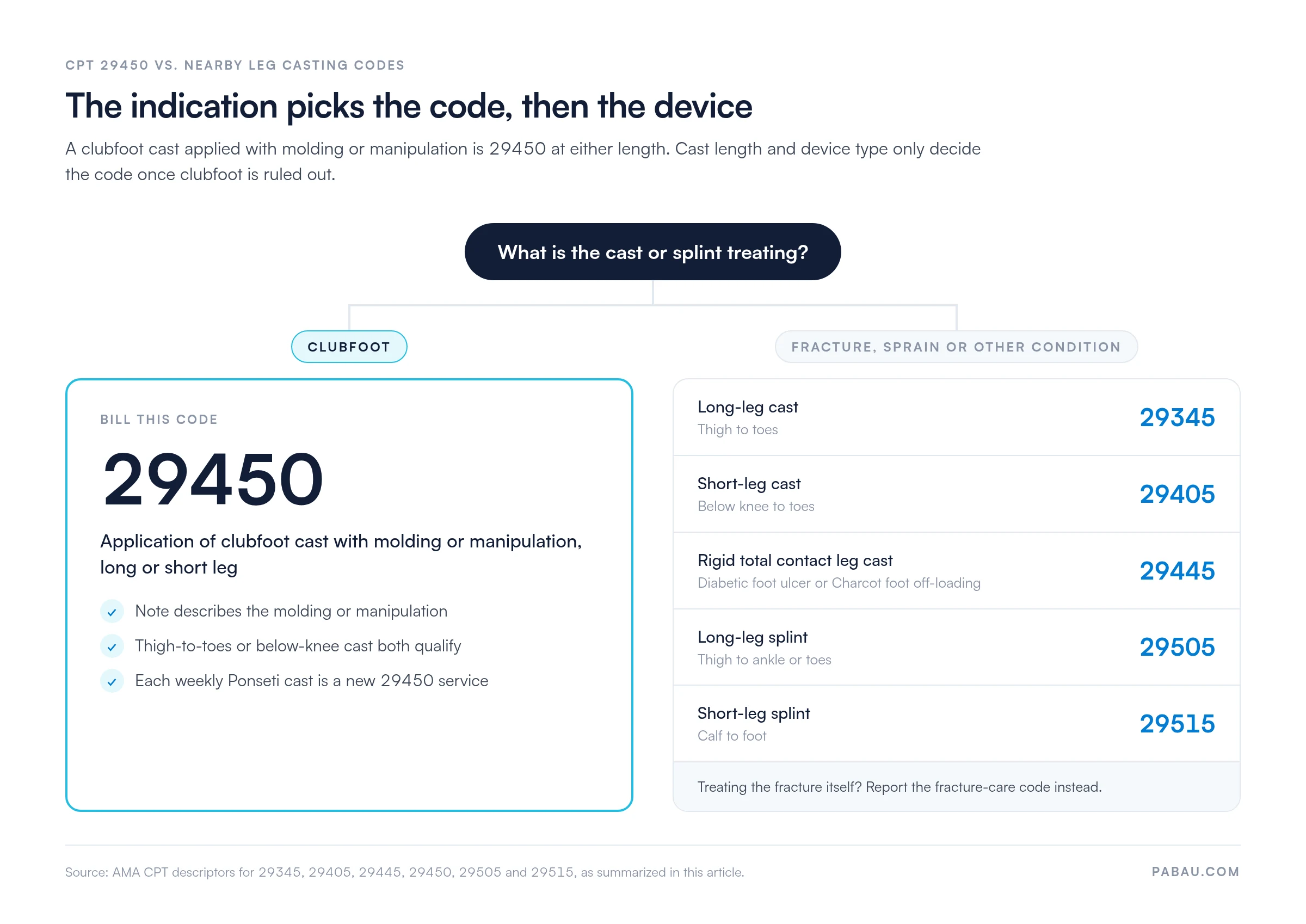
A cast for a fracture, a sprain, or any other non-clubfoot condition belongs to a different code. A total contact cast that off-loads a diabetic foot ulcer is 29445, even though it is molded to the leg. The table shows the neighbors coders most often confuse.
A child’s tibial fracture in a long-leg cast is not 29450. Report 29345, or the fracture-care code when the practice treats the fracture itself. A short-leg cast for an ankle sprain is 29405. A short-leg cast that holds a manipulated clubfoot is 29450.
A splint is not a cast, so it never takes 29450. Leg splints bill by extent, with 29505 for thigh to ankle or toes and 29515 for calf to foot.
Modifiers for CPT 29450 turn on laterality, and on what else happened on the cast date. The wrong choice on a bilateral claim is a frequent reason it underpays or denies.
Bilateral clubfoot is common, and payers differ on how they want it billed.
Under the 2026 Medicare Physician Fee Schedule, CPT 29450 pays about $146 in an office and about $100 in a facility. Those national amounts use the $33.4009 conversion factor, before geographic adjustment (GPCI). Check your locality in the CMS Physician Fee Schedule lookup tool.
The practice expense RVU drops in a facility, because the hospital or ASC carries the staff and supply costs. An office claim (POS 11) earns the non-facility rate. A hospital outpatient (POS 22) or ASC (POS 24) claim earns the facility rate. FastRVU’s CPT 29450 page lists the same 2026 components.
CPT 29450 carries a 0-day global period under the Medicare Physician Fee Schedule. No follow-up window bundles later visits into the casting payment.
That suits Ponseti serial casting, where each weekly manipulation and cast is its own service. Confirm the global indicator in the CMS fee schedule lookup each year, because CMS can change it in the annual rule.
Where the cast goes on sets the rate you receive. Most pediatric orthopedic practices apply 29450 in the office (POS 11). Hospital outpatient departments and ASCs see it too, often when a tenotomy and a cast fall on the same day.
Confirm the POS code with the facility before you submit. Billing POS 11 for a cast applied in a hospital outpatient department overstates the payment and is an audit risk. The AAPC entry for CPT 29450 is a quick check on the descriptor before the date of service.
A clean 29450 claim starts with a procedure note that answers each question a reviewer will ask. One missing element can turn a payable claim into a records request or a denial.
Once the note is complete, a medical claims clearinghouse carries the coded claim to the payer as an 837P file.
CPT 29450 denials follow predictable patterns, and most trace back to the note or the code choice. For what each adjustment code means, see our CARC denial codes reference. The denial management workflow guide walks through the appeal itself.
Check each claim in a Ponseti series against the one before it. Removing the previous cast is part of the new 29450 service, so never add a removal code for your own cast. A removal code such as 29705 belongs only on a cast another provider applied.
Ponseti casting creates a run of near-identical claims, one a week for each child. Many practices still check coverage by phone, key claims into payer portals, and match remittances in a spreadsheet. A stale eligibility check or a missing modifier then repeats across the whole series.
Pabau, a practice management platform, moves those steps into one system. Its claims management software checks eligibility before the visit and submits claims through Claim.MD. Pabau also tracks prior authorizations, so your team sees the approval status before the next weekly cast.
When payment arrives, Pabau posts it from the electronic remittance advice (ERA) file. Your team re-keys less, and each 29450 in the series is easier to reconcile.
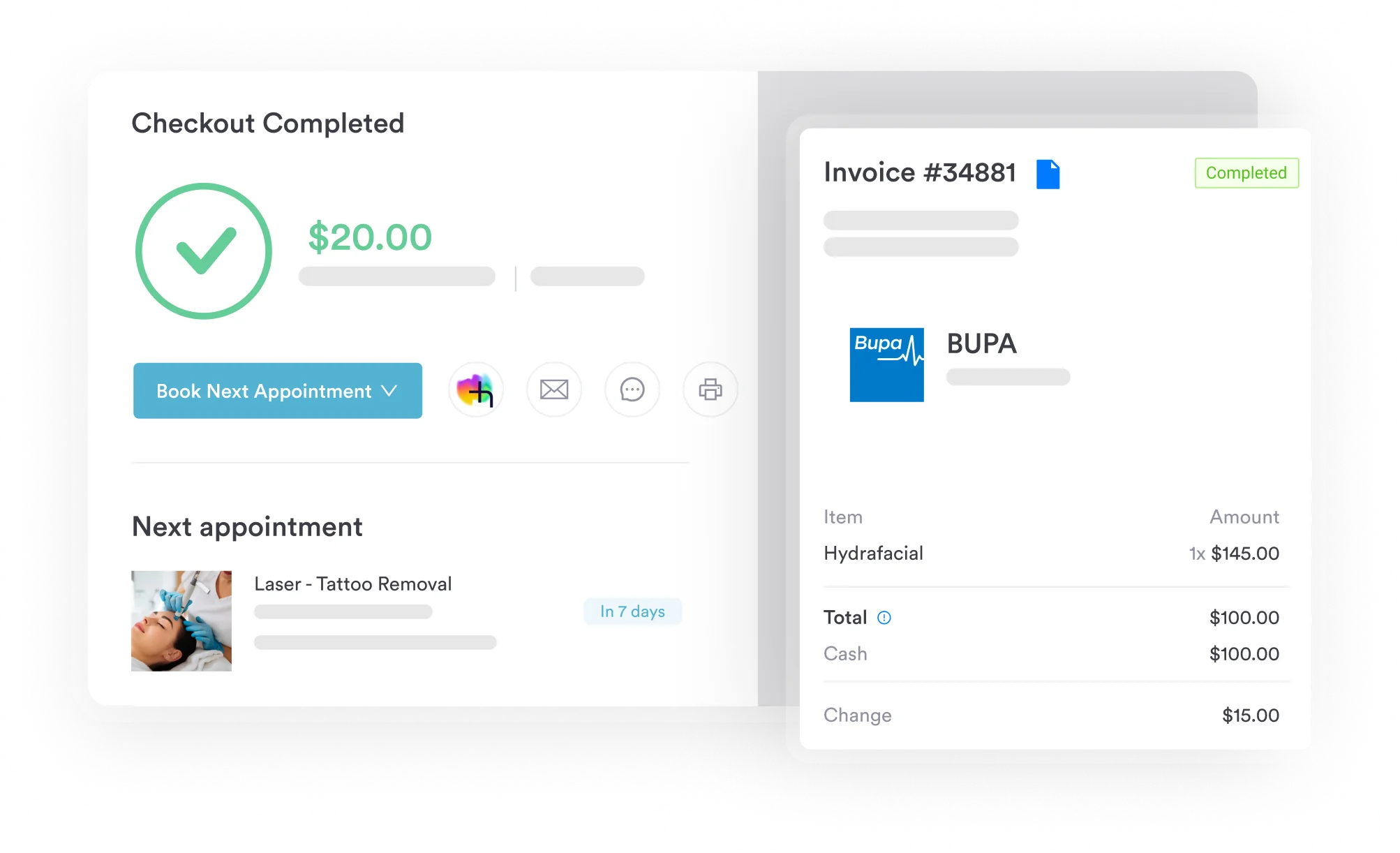

Pabau checks eligibility, submits claims through Claim.MD, tracks prior authorizations, and posts ERA remittances. Each 29450 in a casting series moves from visit to payment in one system.

Code CPT 29450 from the indication and the technique recorded in the note. A long-leg or short-leg cast qualifies when it treats clubfoot and the note shows molding or manipulation. A cast for any other condition belongs to 29345, 29405, a splint code, or fracture care.
The bigger risk is repetition. A Ponseti series repeats the same claim five to seven times, so one template error repeats with it. Fix the note template first, with each foot named, the manipulation described, and the cast type and session number recorded.
Book a demo to see how Pabau checks eligibility and tracks each claim in a Ponseti casting series.

Sending orthopedic claims electronically? Medical claims clearinghouse guide explains how 837P electronic claim submission works, from the practice to the payer.
Seeing recurring denials on musculoskeletal claims? Clean claim requirements covers the documentation and formatting standards payers check before they adjudicate a claim.
Want to understand the full revenue cycle behind casting claims? Revenue cycle management overview walks through the process from eligibility checks to payment posting.
CPT code 29450 covers application of a clubfoot cast with molding or manipulation, long or short leg. It includes the manipulation that sets the foot’s position before the cast goes on. Each Ponseti casting session is a separate 29450 service.
Yes. The descriptor covers long-leg and short-leg clubfoot casts alike, as long as the cast involves molding or manipulation. A short-leg cast for a fracture or sprain is 29405 instead.
In 2026, the Medicare national payment for CPT 29450 is about $146 non-facility and about $100 facility. Those figures come from 4.36 and 2.99 total RVUs at the $33.4009 conversion factor. GPCI adjusts them by locality, so check the CMS lookup for your area.
CPT 29450 carries 2.03 work RVUs in both settings. Practice expense is 2.12 non-facility and 0.75 facility, and malpractice is 0.21. Total RVUs are 4.36 non-facility and 2.99 facility for 2026.
Pair CPT 29450 with Q66.01 for the right foot or Q66.02 for the left foot. Q66.00 covers a clubfoot with no side recorded. Q66.89 applies only to congenital clubfoot NOS, when the record does not name the type.
Yes, when both feet are casted on the same date. Many payers accept 29450-50 on one line with one unit; confirm the bilateral indicator in the CMS lookup first. Some commercial payers want two lines instead, one with -RT and one with -LT. Check the payer’s bilateral policy before you submit.
CPT 29450 carries a 0-day global period under the Medicare Physician Fee Schedule. No post-procedure window bundles later visits into the casting payment. Each weekly Ponseti cast is therefore its own billable service.
The note must show the clubfoot diagnosis and the manipulation or molding performed. It must also record the cast type, long or short leg, plus laterality and cast material. Add the session number in the Ponseti plan and the clinician’s dated signature.