

CCSD Code D1010: Radical mastoidectomy including meatoplasty
CCSD Code D1010: Definition and clinical scope CCSD Code D1010 is the UK private...

Last Updated: Nov 25, 2026
CCSD code T6710 is the code for primary repair of an extensor tendon in the hand. Surgeons bill it after stitching a cut or torn extensor tendon. These tendons run along the back of the hand and straighten the fingers and thumb. Primary means the first repair of a fresh injury, often a cut from glass or a knife.
The code matters because the hand section holds several look-alikes. A delayed repair, a flexor repair and a scar release each have their own code. Pick the wrong one and the insurer is likely to query the claim. The sections below show how a T6710 claim moves, what the note needs and where claims go wrong.
Let Pabau's smart automation suggest the right codes, reduce claim denials, and keep your practice compliant—effortlessly.
Automate repetitive tasks and focus on what matters most—your patients.
Reduce coding errors and ensure compliance with the latest regulations.
Clean claims, fewer denials, and faster reimbursements.
Powerful insights and reporting to help your practice thrive.
HIPAA compliant SOC 2 certified GDPR-compliant Trusted by 4,000+ clinics worldwide

CCSD code T6710 is primary repair of an extensor tendon of the hand, a surgical procedure in Chapter 16.
Primary means the first repair after the injury, so a delayed repair or reconstruction belongs under T6820 instead.
Flexor repairs have their own codes, T6750 and T6752, so the note must name the tendon type.
The operative note should state the injury, the digit, the tendon and the fact that it was repaired.
Insurers tend to query a claim when the code doesn’t match the note or the authorization reference is missing.
CCSD code T6710 covers one operation: primary repair of extensor of hand. That wording comes from the CCSD schedule, where the full entry opens only for registered users. The code sits in Chapter 16, on bones, joints and connective tissue. Within it, T6710 falls under section 16.6.2, hand repair and reconstruction.
Extensor tendons run along the back of the hand. They pull the fingers and thumb straight. Because they sit close to the skin, a cut from glass, a knife or a tool can split one easily.
Two words in the descriptor do most of the work. “Primary” means this is the first repair of a fresh injury. “Extensor” rules out the tendons that bend the fingers. If either word doesn’t fit the operation, T6710 is the wrong code. A repair done after the acute phase, often with a graft, is a secondary repair, and the general code for it is T6800. For an extensor tendon in the hand or forearm, a secondary repair or reconstruction has its own code, CCSD code T6820. And when a working tendon is moved to replace a lost one, rather than repaired, the claim takes CCSD T6402.
The hand section holds several codes that look alike on a claim form. Each one answers a different question about the operation. Check the note against this table before you pick T6710.
Surgery on a ganglion over those tendons is not a tendon repair. A repeat excision of a ganglion that has come back is billed as code T6000. Tendon codes also cover sites below the knee, and a first open lengthening of the Achilles tendon is billed as T6722. For procedures outside the hand, browse our library of CCSD codes.
Notice the split on the flexor side. Flexor repair has two primary codes, T6750 for most of the hand and T6752 for Zone II. Staged flexor reconstruction adds two more, with the graft stage billed under the T6832 code. Extensor repair has a single primary code, so the injury zone doesn’t change the T6710 choice. Put together, the codes form a three-question path.
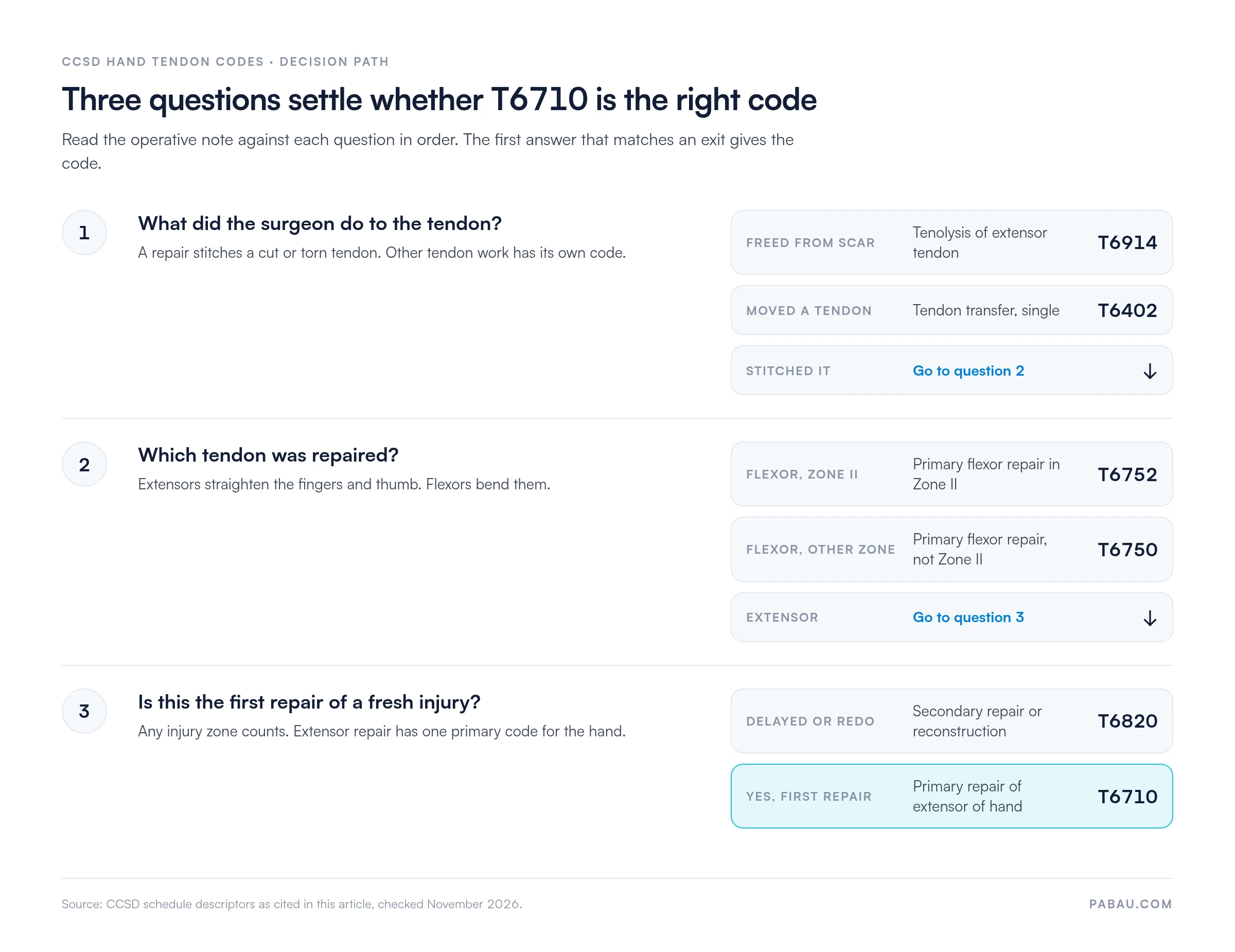
Most extensor repairs follow an injury, so the timeline is often tight. Here’s the usual path for a privately insured patient.
Fees for T6710 vary by insurer and change over time. Check the current figure in each insurer’s own fee schedule before you bill. For Bupa patients, our guide to the Bupa fee schedule explains how to look a code up.
The note is what the insurer reads when it checks your code. It should let a coder reach T6710 without guessing.
Run through these five checks before the claim leaves your system.
A “no” to any of these is worth a second look. It usually means a different code, or a note that needs the surgeon’s input.
Each of these errors tends to come back as an insurer query. The right-hand column shows the code or step that clears it.
Watch for under-coding too. If the surgeon also repaired a nerve or closed a complex wound, check whether that work needs its own code.
T6710 queries usually start when the note, the code and the authorization reference disagree. Kept in separate places, they get retyped by hand, and each retype is a chance for a mismatch.
Pabau, a practice management platform with built-in claims management software, keeps all three on the patient record. Your team builds the claim from that record and sends it to Healthcode electronically. You can then follow its status without chasing paper.
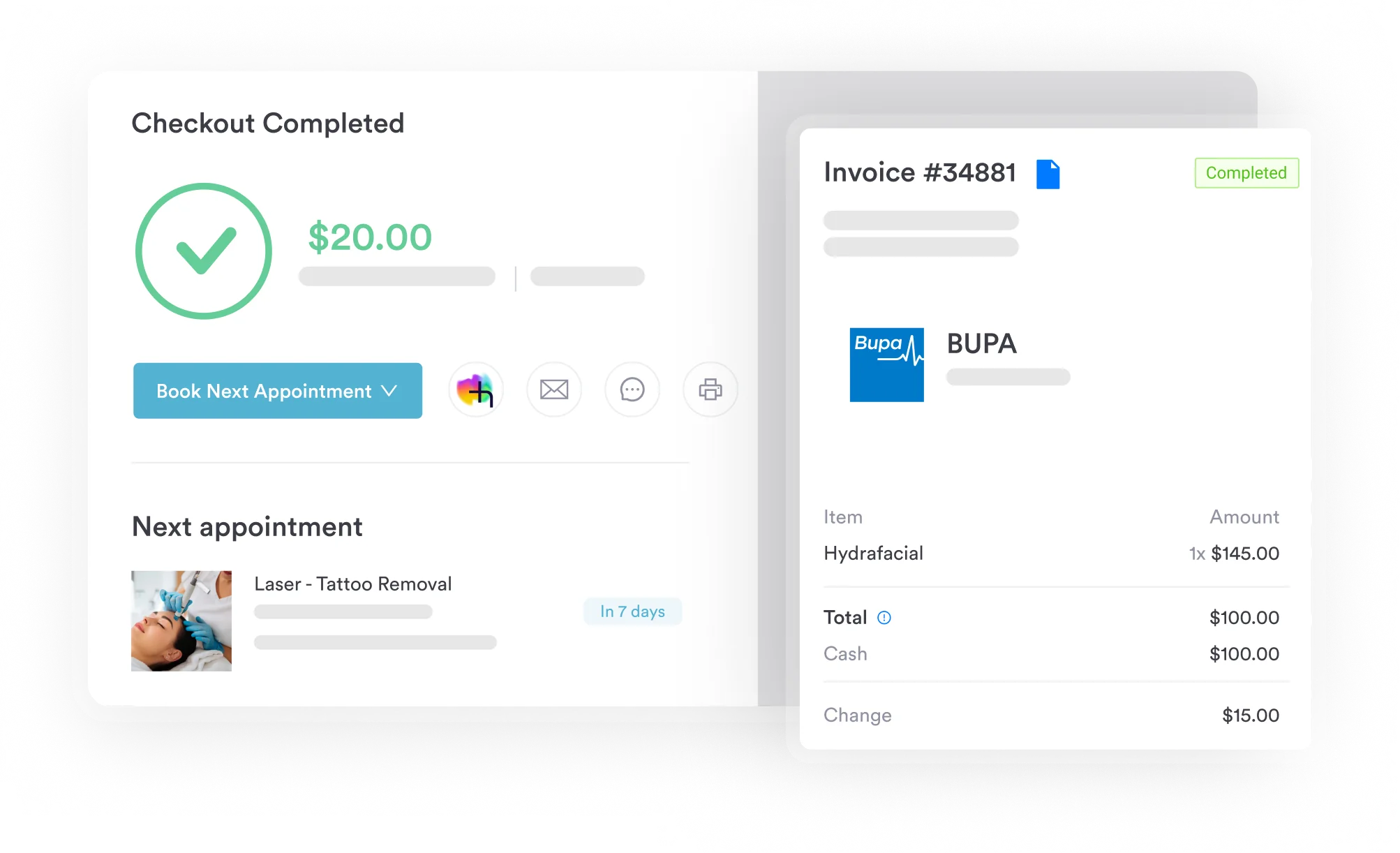

Build each claim from the patient record, with the code, note and authorization reference in one place. Then track every claim’s status without chasing paper.

T6710 is a narrow code, and that’s its strength. It fits one case: a first repair of an extensor tendon in the hand. Once the note says “primary”, “extensor” and “hand”, the choice is simple.
The risk sits in the neighbors. A late repair, a flexor tendon or a scar release each pulls the claim toward a different code. Settle that question before submission, and most queries never happen. Book a demo to see how your team can send CCSD claims from the patient record.

Coding a flexor injury in the middle of the finger? CCSD code T6752 covers primary flexor repair in Zone II.
Staging a flexor reconstruction? CCSD code T6830 explains secondary repair and first stage reconstruction.
New to CCSD billing with Bupa? Bupa CCSD codes walks through how the schedule works for Bupa claims.
Checking what Bupa pays? Bupa procedure codes and fee schedule explains how fees are set and looked up.
CCSD stands for Clinical Coding and Schedule Development. The CCSD Group, made up of Aviva, AXA Health, Bupa and VitalityHealth, maintains the procedure schedule UK private insurers use.
No. T6710 describes the surgical repair only. Hand therapy after surgery is a separate service, billed by the therapist under their own arrangement with the insurer.
It depends on the tendon and the injury. Patients usually wear a splint for several weeks, then work with a hand therapist to regain movement. The surgeon sets the exact timeline.
Not usually. Most mallet finger injuries are treated in a splint, with no surgery to code. If a surgeon does operate, match the code to what the operative note describes.




