ICD-10 Code S66.308A: Extensor muscle injury, other finger
ICD-10 Code S66.308A: Definition and code hierarchy ICD-10 Code S66.308A is the ...

Last Updated: Oct 14, 2026
Billable Code Specific Code
S66.391A is the billable ICD-10-CM code for other injury of extensor muscle, fascia and tendon of left index finger at wrist and hand level. The 7th character A limits it to the initial encounter.
The code sits in category S66, which covers injuries of muscle, fascia and tendon at wrist and hand level. The trailing "A" restricts use to encounters where active treatment is underway. The 6th character already fixes both the digit and the side, so the record must establish the left index finger before the code is assigned. Two mistakes drive most denials. Coders keep using "A" past the active-treatment phase, or they omit the open wound code when a laceration is documented.
Let Pabau's smart automation suggest the right codes, reduce claim denials, and keep your practice compliant—effortlessly.
Automate repetitive tasks and focus on what matters most—your patients.
Reduce coding errors and ensure compliance with the latest regulations.
Clean claims, fewer denials, and faster reimbursements.
Powerful insights and reporting to help your practice thrive.
HIPAA compliant SOC 2 certified GDPR-compliant Trusted by 4,000+ clinics worldwide

S66.391A is billable for other injury of the extensor muscle, fascia, or tendon of the left index finger at wrist and hand level
The 6th character fixes the digit and the side, so S66.391A already means left index finger; the right index finger is S66.390
The 7th character ‘A’ means active treatment is ongoing, so several visits in a row can carry it
Sprain codes (S63.x) sit under Excludes2 and open wound codes (S61.x) carry a Code also note, so both pair with S66.391A
Pabau’s claims management software includes built-in ICD-10 code search to reduce coding errors and catch sequencing issues before submission
ICD-10 Code S66.391A has been in the code set since ICD-10-CM took effect on October 1, 2015.
The code is billable and fully specific. Coders should not assign the parent subcategory S66.391 without a 7th character. Below is an at-a-glance summary for quick verification before use.
S66.391A covers other injury of the extensor muscle, fascia, or tendon of the left index finger at wrist and hand level. The encounter must be one where active treatment is underway. “Other injury” separates the code from the more specific injury subtypes alongside it, such as strain (S66.31x) or laceration (S66.32x). Choosing S66.391A affirms that the documented injury does not meet the threshold for one of those narrower subtypes.
The digit and the side are built into the code. The parent subcategory S66.39 is titled for the “other and unspecified finger”, which means nothing more than “not the thumb”. It is the 6th character that names the exact digit and the hand, and the “1” in S66.391 selects the left index finger. The breakdown below shows what each character position carries.
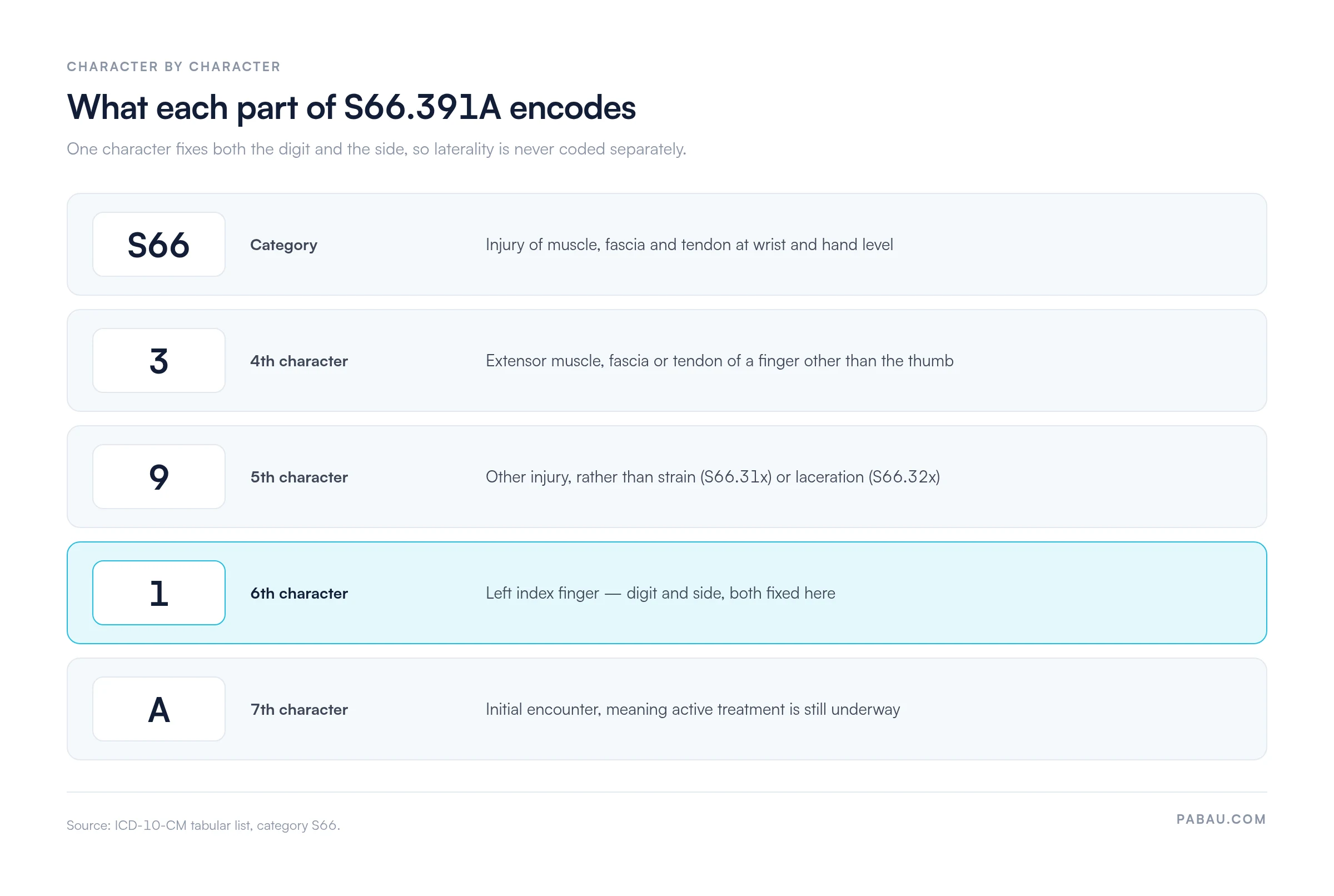
Thumb injuries belong to separate subcategories. S66.0x covers the long flexor and S66.2x covers the extensor. Flexor injuries of the same left index finger are coded from S66.1x rather than S66.3x. Similar tendon injuries at forearm level sit elsewhere in Chapter 19. The full 6th character map for the S66.39x family is worth keeping beside the encounter note.
Laterality is therefore not something a coder records separately alongside S66.391A. Selecting the code is itself the statement that the left index finger was injured, so the record has to support that reading. If the note names a finger but no side, query the provider rather than defaulting to the unspecified code S66.399.
The 7th character “A” in S66.391A signals active treatment, not necessarily the patient’s first calendar visit. According to the CMS ICD-10-CM Official Coding Guidelines, Section I.C.19.a, a patient may have multiple encounters coded with “A” during the course of active treatment. That window covers surgical repair, wound care under the operating physician, and follow-up while that physician is still managing the acute injury.
Switch to “D” once the injury has been treated and the patient is receiving routine aftercare. Cast checks and therapy under a different provider are the typical examples. The same 7th-character switch applies to every digit in the S66.39 subcategory. On the right little finger, S66.396D is the subsequent-encounter code for the same injury type. “S” applies exclusively to sequelae, meaning a condition that arises as a late effect of the original injury after the injury itself has healed.
This distinction causes more denials than any other element of the code. A practice that defaults to “D” on the second visit introduces a compliance error. That holds even when the surgeon is still debriding or repairing the tendon, and most commercial payers will reject the claim.
Category S66 carries Excludes2 notes only. There is no Excludes1 note anywhere on the category, so no other code is flatly prohibited from appearing on the same claim as S66.391A.
An Excludes2 note means the excluded condition is not part of what S66.391A describes. It does not make the two mutually exclusive. Assign both when the record independently documents both.
S61 is not an Excludes2 entry on S66. It carries an official “Code also” instruction, which tells the coder to report the associated open wound as well. When a tendon injury occurs through a laceration, S61 and S66.391A are both assigned. Sequence the open wound code first when it is the principal diagnosis.
The expensive mistake here runs in the opposite direction to the usual one. Coders who read the S63 sprain note as an Excludes1 drop one of the two codes the payer expected. The claim then comes back short-paid rather than denied outright.
Category S66 is dense with subcategories distinguished by tendon type (flexor vs extensor), injury type (strain, laceration, other), digit, and side. Picking the wrong neighbor is a common specificity error, and the table below sets each near miss beside the code it is mistaken for.
When documentation clearly identifies a laceration of the tendon itself, S66.321A is more specific than S66.391A and should be preferred. Both codes name the same digit and the same side, so the only decision left is which injury type the note actually supports. S66.391A is the catch-all for injuries that are documented but do not meet the threshold for the strain or laceration subcategories.
An intrinsic hand muscle injury belongs to S66.59 rather than S66.39, so confirm the structure the note names before you fix the digit. S66.598A is that subcategory’s other-injury code, with 6th character 8 for other finger at the initial encounter.
Medical records must clearly establish five elements before S66.391A can be assigned without compliance risk. ICD-10-CM Official Guidelines Section I.C.19 is the standard an auditor will hold the note against.
When a finger tendon injury occurs through an open wound, two codes are needed. The S61 open wound code covers wrist, hand, and finger lacerations. Assign it alongside S66.391A whenever the mechanism involves a break in the skin. Sequencing follows the principal diagnosis rule. The condition chiefly responsible for the encounter leads, and that choice affects DRG assignment and reimbursement under facility billing.
CPT-ICD pairing must reflect documented treatment. The codes below cover common clinical scenarios, and payer local coverage determinations govern whether a specific pairing will be reimbursed. Submitting through a clearinghouse such as Claim.MD, Pabau’s clearinghouse partner for US practices, validates each pairing against payer edits. That check catches the NCCI and MUE conflicts that would otherwise produce a denial.
Secondary repair of a ruptured central slip at the PIP joint sits outside this list. That procedure is reported with 26428, so check which extensor structure the operative note describes before the claim is built.
S66.391A denials cluster around five predictable errors. Reviewing these patterns against your own ERA data shows where the coding workflow breaks down. Sort rejections by root cause rather than by payer, then match each CO or PR reason against the denial codes that recur on injury claims.
Run a 90-day audit of all S66.391A claims returned with CO-4 (inconsistent modifier) or CO-11 (diagnosis inconsistent with procedure). Sort by CPT code. If 26410 or 26418 pairings dominate, coders are probably reaching for S66.391A too often. Check whether S66.321A, the laceration code for the same finger, is what the operative report supports.
In most hand surgery and occupational medicine practices, the 7th character and the open wound pairing are checked by hand. A coder opens the operative note, reads the laterality, then reconciles it against the procedure codes already sitting on the claim. That review happens after the claim has been built, which is how a right-sided wound code survives next to S66.391A.
Practice management software like Pabau moves the check earlier. Built-in ICD-10 search returns S66.391A with its full descriptor attached. The coder reads “left index finger” at the moment of selection, not three screens later. Pabau’s claims management software then validates the 7th character and the code pairing before the batch is released.
The outcome is fewer rework cycles on a small set of predictable errors. A mismatch gets corrected while the encounter is still open and the operative note is still to hand. The billing team then spends its time on appeals worth filing.

Pabau’s built-in ICD-10 code search and Claim.MD clearinghouse integration help practices submit musculoskeletal injury claims accurately the first time. Fewer denials, faster reimbursement.

ICD-10 Code S66.391A is fully specific. It names the extensor tendon, the left index finger, and an encounter during active treatment. Three simple errors account for most of the money lost on it. Coders switch from “A” to “D” too early, or they omit the S61 wound code when a laceration is present. The third error is assigning the code from a note that never establishes the left index finger.
Practices carrying hand surgery or occupational medicine volume should build a coding checklist around the five documentation requirements and the five denial patterns above. A check that runs before submission costs far less than an appeal filed six weeks later.
Pabau’s integrated ICD-10 code search and clearinghouse connection through Claim.MD let billing teams validate S66.391A claims before they reach the payer. Book a demo to see how Pabau handles musculoskeletal injury coding workflows end to end.

Need a broader framework for preventing coding denials? Denial management in healthcare covers root-cause analysis and resubmission workflows beyond a single code.
Considering the unspecified-finger code when the note is incomplete? ICD-10 Code S66.399S explains when the unspecified sixth character is defensible and when it invites a denial.
Want a closer look at the clearinghouse step before submission? Claim.MD clearinghouse explains how electronic claim submission and real-time ERA processing work for US practices.
ICD-10 Code S66.391A covers an injury of the extensor muscle, fascia, or tendon of the left index finger at wrist and hand level. It is billable, and the 7th character “A” confirms active treatment is still underway. “Other injury” means the documented injury does not meet the threshold for the more specific strain or laceration subtypes.
No. The digit and the side are already built into S66.391A itself. The 6th character “1” fixes both the left hand and the index finger. Selecting the code itself states that the left index finger was injured. A note that names a finger but not a side cannot support S66.391A, so query the provider rather than defaulting to the unspecified code S66.399.
The two codes describe the same injury on opposite hands. S66.391A covers the left index finger, and S66.390A covers the right index finger. Only the 6th character changes between them, so confirm which hand the operative note documents before choosing either code.
Switch to S66.391D once active treatment has ended and the patient is receiving routine aftercare. A cast check or physical therapy follow-up under a different provider are typical examples. Keep “A” for every encounter where the treating surgeon is still actively managing the injury, even past the first visit. Using “D” too early is one of the most common causes of denial for this code.
S66.391A is the “other injury” catch-all for the left index finger extensor tendon. S66.321A applies when the record documents a laceration of that same tendon. Both codes name the same digit and the same side, so the choice depends only on whether the note supports a laceration. Prefer S66.321A whenever the documentation is specific enough to support it.
No. Category S66 carries no Excludes1 note, so no code is flatly barred from appearing alongside S66.391A. Sprain codes (S63.x) sit under an Excludes2 note, meaning both may be reported when the record documents both conditions. Open wound codes (S61.x) carry a “Code also” instruction, requiring both codes when a laceration caused the tendon injury.
Five denial patterns dominate S66.391A claims. Using “D” while active treatment is still underway is the most common. Others include omitting the S61 code for a laceration and coding from a note that never names the finger. Pairing S66.391A with a wound or procedure code for the opposite hand is another common cause. Missing documentation of extensor muscle, fascia, or tendon involvement is the fifth pattern. Reviewing denials against these causes before resubmission prevents repeat rejections.