CCSD code XR940: Foreign body retrieval billing guide
CCSD code XR940 is the UK private healthcare code for retrieval of a foreign bod...

Last Updated: Nov 26, 2026
45171 is the CPT code for excision of rectal tumor, transanal approach, not including muscularis propria (ie, partial thickness).
The code sits in the Surgery section of the AMA CPT codebook under Excision Procedures on the Rectum. It applies when the excision stops short of the muscularis propria. A full-thickness excision that includes that layer is reported with 45172. Denials on 45171 usually trace to an operative report that leaves out the depth of excision, the margin status, or the transanal approach.
Let Pabau's smart automation suggest the right codes, reduce claim denials, and keep your practice compliant—effortlessly.
Automate repetitive tasks and focus on what matters most—your patients.
Reduce coding errors and ensure compliance with the latest regulations.
Clean claims, fewer denials, and faster reimbursements.
Powerful insights and reporting to help your practice thrive.
HIPAA compliant SOC 2 certified GDPR-compliant Trusted by 4,000+ clinics worldwide

CPT code 45171 covers transanal excision of a rectal tumor at partial thickness, leaving the muscularis propria in place.
The split with 45172 is depth, not lesion count. Code 45172 is a full-thickness excision that includes the muscularis propria.
The operative report must state the depth of excision, the transanal approach, tumor location and distance from the anal verge, size, and margins.
Medicare pays 45171 at different facility and non-facility rates, so always verify current figures in the CMS Physician Fee Schedule.
Pabau’s claims management workflow helps colorectal practices submit cleaner 45171 claims and spot denial patterns early.
CPT code 45171 is a partial-thickness transanal excision of a rectal tumor. AAPC’s plain-language summary of the code confirms that the excision does not include the muscularis propria, the thin muscle layer lining the rectum. The CPT code set defines it as: Excision of rectal tumor, transanal approach; not including muscularis propria (ie, partial thickness).
The code sits in the Surgery section, Digestive System subsection, under Excision Procedures on the Rectum (CPT range 45100-45172). Three elements make 45171 the right code: A rectal tumor (not colonic), a transanal approach (no abdominal incision), and a partial-thickness excision. If the surgeon removes the muscularis propria, the excision is full thickness and the code is 45172.
For CPT code 45171 to clear payer review, the operative report must document five specific elements. Payers audit these records when the code is submitted, and a vague op note is the fastest path to a medical-necessity denial.
Typical care settings include ambulatory surgery centers (ASCs) and hospital outpatient departments. Facility billing differs from professional billing: The surgeon bills the professional component with CPT code 45171. The facility bills separately under the Outpatient Prospective Payment System (OPPS) or ASC fee schedule.
Accurate superbill documentation at the time of service shortens the lag between procedure and claim submission. It also captures the detail payers expect before they process payment.
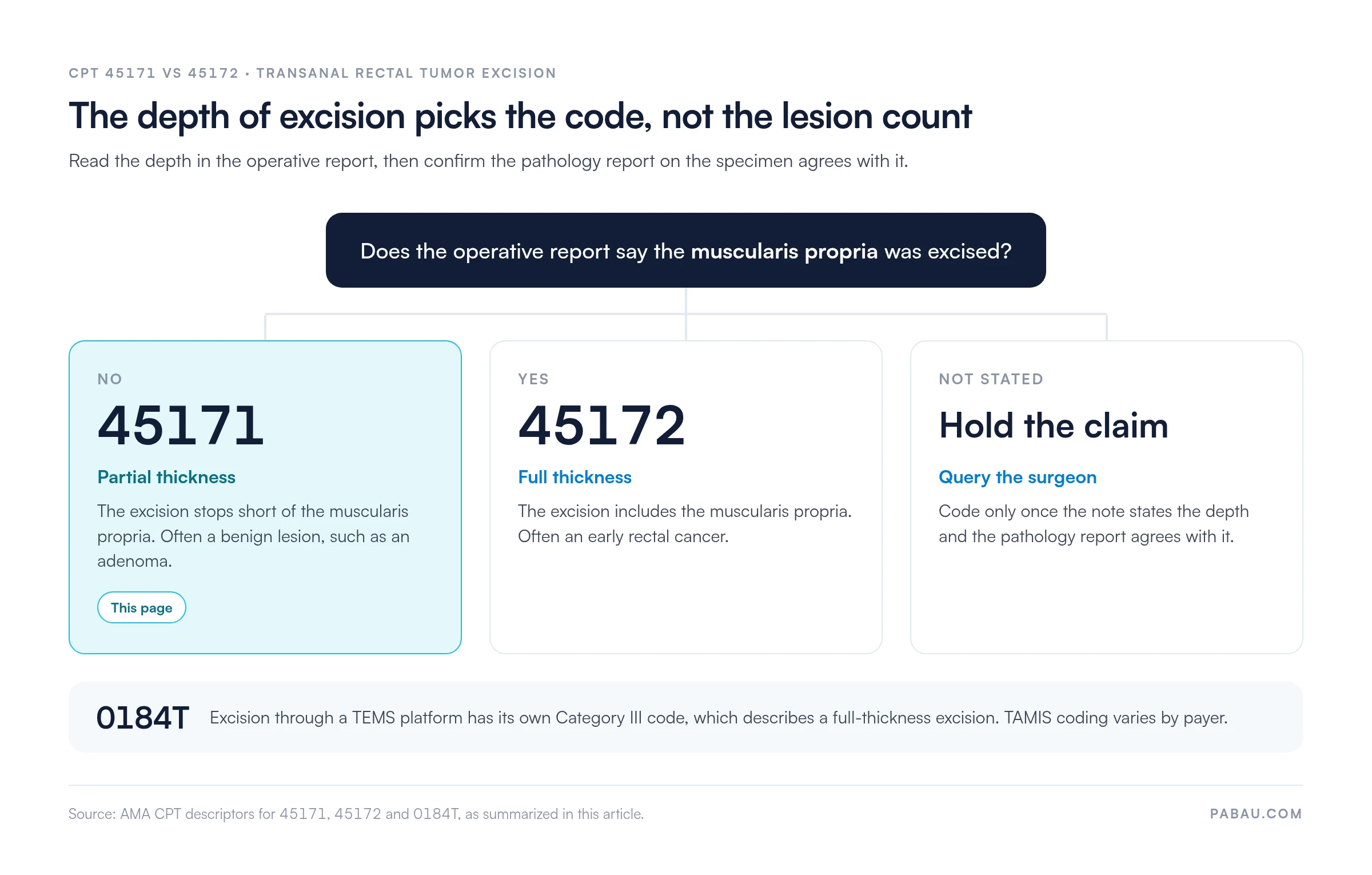
45171 and 45172 split by depth of excision, not by the number of lesions. Code 45171 is a partial-thickness excision that leaves the muscularis propria in place. Code 45172 is a full-thickness excision that includes it. Both codes arrived in 2010, when CPT deleted 45170 so partial- and full-thickness excisions could be reported separately (AMA CPT Assistant, June 2010).
Coders often default to 45171 when the op note is vague about depth. Read the operative report for the depth, then check that the pathology report on the specimen agrees with it. The diagram below maps each depth statement to its code.
The descriptors do not address lesion count. When a session includes more than one excision, document each lesion’s site, size, and depth separately. Then check the current CMS National Correct Coding Initiative (NCCI) procedure-to-procedure table and the payer’s policy before reporting more than one line. The pair’s modifier indicator tells you whether modifier 59 or an X modifier can bypass the edit. CMS updates the edits quarterly, so check the table for the date of service.
Every CPT code 45171 claim must carry an ICD-10-CM diagnosis code that establishes medical necessity. Payers cross-reference the diagnosis against their local coverage determination (LCD) for anorectal surgery.
The diagnosis should also fit the depth billed. Transanal excision of an early rectal cancer is usually full thickness. A C20 diagnosis on a 45171 claim therefore deserves a second look at the op note. The following codes commonly support transanal rectal tumor excision.
Verify covered diagnosis codes against the applicable MAC’s LCD before submission. Palmetto GBA, Novitas, and CGS each maintain anorectal surgery LCDs that may specify a narrower list of accepted diagnoses than the codes above.
Always link the ICD-10-CM code to the pathology report finding, not only to the pre-operative impression. When pathology upgrades a polyp to an adenoma or confirms malignancy, update the claim with the corrected diagnosis before submission. That avoids a medical-necessity denial on audit.
Medicare reimbursement for CPT code 45171 is calculated from the Relative Value Unit (RVU) assigned under the Medicare Physician Fee Schedule (MPFS). Rates change with each annual MPFS rule. Verify current figures using the CMS Physician Fee Schedule Lookup Tool or the FastRVU 2026 lookup for your geographic payment locality.
CPT code 45171 carries a 90-day global surgery period under Medicare. Postoperative visits within 90 days of the procedure date are bundled into the surgical payment. Bill separately only for unrelated E/M services during the global period, appended with modifier 24. Verify the global period designation for 45171 in the MPFS database before counseling patients on expected follow-up billing.
Prior authorization requirements for CPT code 45171 vary significantly by payer and plan type. No universal rule applies, so front-office staff must verify authorization status for each patient before scheduling.
When authorization is required, submit the operative plan, relevant imaging or endoscopy reports, and the treating physician’s order. State the planned depth of excision, because an authorization for 45171 may not cover a full-thickness 45172 excision. If the surgeon changes depth during the case, ask the payer how to update the authorization. Including the authorization number in field 23 of the CMS-1500 form is part of submitting a clean claim.
Modifiers on CPT code 45171 communicate procedural context to payers that would otherwise trigger automatic edits or bundling. Using the wrong modifier, or omitting a required one, is a primary cause of rejected claims.
The Office of Inspector General (OIG) flags modifier 59 misuse as a major compliance concern in surgical billing. When appending 59 to a claim that includes CPT code 45171, the operative note must explicitly describe a distinct service or separate anatomical site. A sound medical billing compliance program audits modifier use internally at least quarterly. Outlier patterns then get corrected before a payer audit surfaces them.
Denials on CPT code 45171 follow predictable patterns. Each cause below starts before the claim leaves the practice, so each one has a fix your team can build into the workflow.
Run a quarterly denial report filtered to CPT 45171 and 45172. If more than 15% of claims are denied, audit the operative report template your practice uses. A high denial rate usually traces back to one missing field on the shared template. The same error then repeats for every surgeon who uses it.
Payers explain each denial with standard denial codes on the remittance advice. Route those codes through denial management processes that send each denial to the right reviewer, and your team fixes the root cause once.
Coders working with CPT code 45171 regularly encounter related codes in the same operative session or the same billing queue. Knowing when each applies prevents upcoding, undercoding, and NCCI bundling errors.
Search the full range on AAPC Codify’s CPT lookup when verifying descriptors for anorectal codes adjacent to 45171. Map each code to a distinct surgical scenario in your billing workflow. That habit stops 45171 from becoming a catch-all for any transanal procedure.
In many colorectal practices, the depth of excision lives in a free-text operative note. Someone in billing reads it days later and picks 45171 or 45172. Eligibility and authorization checks happen in a separate payer portal.
Pabau, a practice management platform with built-in billing, keeps the clinical note and the claim in one patient record. Its claims management software sends claims through the Claim.MD clearinghouse, Pabau’s US partner. Claim.MD connects practices to thousands of US payers for eligibility checks and electronic remittance.
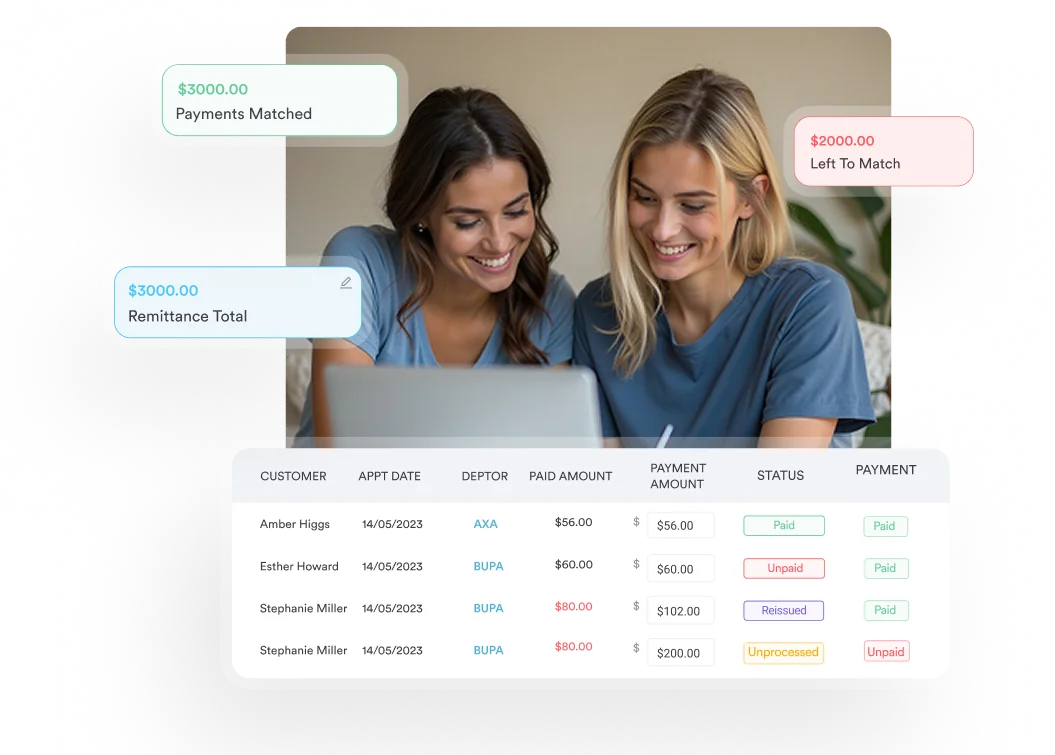
The coder works from the same record the surgeon signed, and the eligibility check is done before surgery day. Each denial comes back with its reason code against the claim, so a run of 45171 denials points your team to a single fix.

Pabau’s billing workflow connects colorectal practices to thousands of US payers and automates eligibility checks before surgery day. It also tracks denial patterns, so your team fixes the root cause rather than resubmitting individual claims.

Treat the depth statement as the deciding field on every 45171 claim. If the operative report does not say whether the muscularis propria was excised, the claim waits for the surgeon. A claim coded from a guess either leaves revenue unclaimed or invites recoupment.
The second habit is checking the current NCCI pair before reporting two excisions from one session. Both checks happen before submission, which is the cheapest point to fix a wrong code. To see how Pabau ties the op note, the claim and the remittance together for anorectal surgery billing, book a demo.

Need to understand how clearinghouse submission works for surgical codes? Claim.MD clearinghouse guide explains how electronic claim routing reduces payment delays on procedure codes like 45171.
Looking for a framework to reduce surgical code denials systematically? Denial codes in medical billing covers the most common CARC and RARC codes your team will see on 45171 remittances.
Want to verify eligibility before anorectal surgery day? Insurance eligibility verification outlines the workflow for confirming authorization and coverage before the procedure date.
CPT code 45171 covers transanal excision of a rectal tumor at partial thickness, without removing the muscularis propria. The surgeon works through the anus, with no abdominal incision. The operative report must document the approach, the depth of excision, the tumor’s location and distance from the anal verge, its size, and the margins.
The two codes differ by depth of excision, not lesion count. Code 45171 is a partial-thickness excision that leaves the muscularis propria in place. Code 45172 is a full-thickness excision that includes it. Both use a transanal approach, and both replaced code 45170 in 2010.
Never for the same lesion, because one excision has one depth. When a session includes separate partial- and full-thickness excisions, check the current CMS NCCI procedure-to-procedure table for this pair first. Its modifier indicator shows whether modifier 59 or an X modifier can apply. Document each lesion’s site, size, and depth separately.
Medicare reimbursement for CPT code 45171 varies by geographic payment locality and setting. The facility rate (for ASC or hospital outpatient) is lower than the non-facility rate. Use the CMS Physician Fee Schedule Lookup Tool or FastRVU to find the current year’s RVU-based payment for your ZIP code. MPFS rates update each January.
Prior authorization requirements for CPT 45171 depend on the payer. Traditional Medicare FFS does not currently mandate prior auth for this code. Medicare Advantage plans and most commercial insurers frequently require it for surgical procedures. Medicaid requirements vary by state. Verify authorization status with each payer before scheduling the procedure.
CPT 45171 carries a 90-day global surgery period under Medicare. Routine postoperative follow-up visits within 90 days of the procedure date are bundled into the surgical payment. Unrelated E/M services during the global period can be billed separately but require modifier 24. Confirm the global period designation in the CMS MPFS database for your specific payer contract.
The primary CPT code for flexible sigmoidoscopy is 45330 (flexible sigmoidoscopy, diagnostic). Related sigmoidoscopy codes include 45331 (with biopsy) and 45335 (with directed submucosal injection). These are distinct from CPT code 45171, which covers transanal excision rather than endoscopic visualization of the sigmoid and rectum.