

CCSD code XR940: Foreign body retrieval billing guide
CCSD code XR940 is the UK private healthcare code for retrieval of a foreign bod...

Last Updated: Nov 26, 2026
59120 is the CPT code for surgical treatment of ectopic pregnancy; tubal or ovarian, requiring salpingectomy and/or oophorectomy, abdominal or vaginal approach.
The American Medical Association (AMA) maintains the code. It covers removal of the fallopian tube, the ovary, or both through an open abdominal or vaginal incision. The laparoscopic equivalent is CPT 59151, and reporting the wrong approach is a common cause of denial. The operative report must document the approach, the ectopic site, and the structures removed.
Let Pabau's smart automation suggest the right codes, reduce claim denials, and keep your practice compliant—effortlessly.
Automate repetitive tasks and focus on what matters most—your patients.
Reduce coding errors and ensure compliance with the latest regulations.
Clean claims, fewer denials, and faster reimbursements.
Powerful insights and reporting to help your practice thrive.
HIPAA compliant SOC 2 certified GDPR-compliant Trusted by 4,000+ clinics worldwide

CPT code 59120 covers removal of the tube and/or ovary for a tubal or ovarian ectopic pregnancy through an abdominal or vaginal incision. Laparoscopic removal is 59151.
Pair it with the most specific code in the ICD-10-CM O00 category, such as O00.101, O00.102 or O00.109 for a tubal pregnancy.
A 90-day global surgical package applies, so post-op care is bundled unless modifier -24, -78 or -79 justifies separate billing.
A laparoscopic case converted to open is reported with the open code, so the operative report must document the conversion.
Pabau, a practice management platform, keeps patient records, claim submission and denial tracking in one workflow.
CPT code 59120 is defined by the AMA as surgical treatment of ectopic pregnancy; tubal or ovarian, requiring salpingectomy and/or oophorectomy, abdominal or vaginal approach. AAPC’s Codify summary of 59120 describes the same work: The provider removes the fallopian tube, the ovary, or both, abdominally or vaginally. The code sits in the Excision subsection (59100-59160) of Maternity Care and Delivery (59000-59899). It applies only to an open abdominal or vaginal incision, never to laparoscopic ports.
OB/GYN practices billing for ectopic surgery should check this descriptor against the operative report before assigning any code from the 591xx family. Mapping each code to its surgical approach at charge entry stops a wrong-approach claim before it is built.
CPT code 59120 covers the complete open surgical episode for a tubal or ovarian ectopic pregnancy. The billable work starts with abdominal exploration and identification of the ectopic site. It continues through removal of the affected fallopian tube (salpingectomy) and/or ovary (oophorectomy), hemostasis, irrigation, and wound closure.
The approach is the defining factor. “Abdominal or vaginal approach” in the descriptor means a surgical incision, not laparoscopic access. The operative note must reflect this.
59120 is appropriate when a ruptured or unruptured tubal or ovarian ectopic pregnancy is treated by open surgery. Clinical scenarios that lead to an open procedure include:
The code does not apply to watchful waiting, to medical management alone, or to procedures where the tube is preserved (salpingostomy). Surgical indication must be supported by physician documentation in the medical record.
Audit the operative report before code assignment, because approach is the first axis of code selection in the 591xx family. A case that started laparoscopically and was converted to laparotomy takes the open code. The report must state the conversion and the reason for it.
CPT 59151 is the laparoscopic equivalent of CPT 59120. Laparoscopy is the preferred approach for most hemodynamically stable patients, so 59151 is the code billed more often. Submitting 59120 when the approach was laparoscopic is a common cause of denial for ectopic surgery claims.
When a laparoscopic case converts to open because of hemorrhage or adhesions, CPT reports the open procedure, and the laparoscopy is not billed separately. If conversion to laparotomy occurred and salpingectomy was completed open, 59120 is correct. Document the conversion reason explicitly in the operative report.
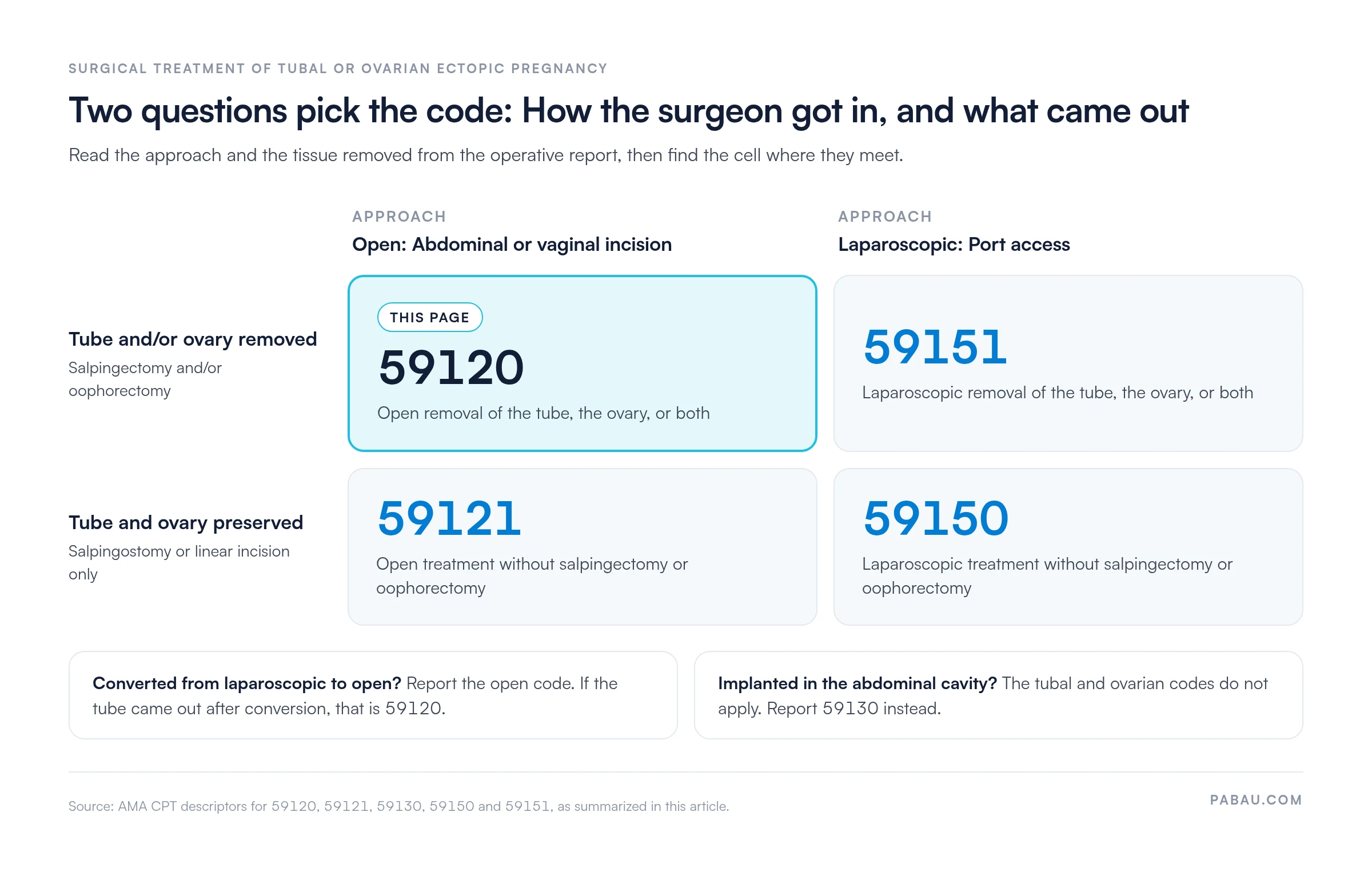
Three adjacent codes are often confused with CPT 59120. Each one changes a single variable: whether the tube is kept, where the pregnancy implanted, or how the surgeon got in.
The choice between 59120 and 59121 hinges entirely on whether the tube was removed. If the surgeon performed a linear salpingostomy and expressed the ectopic without excising the tube, 59121 applies. If the tube was removed in whole or in part, the code is 59120 for an open approach or 59151 for a laparoscopic one. The grid below reads both questions off the operative report at once.
Every CPT 59120 claim requires an ICD-10-CM diagnosis code from the O00 category. The billable codes sit at the fifth or sixth character, so O00.1 or O00.2 on its own is not valid on a claim. An unspecified code such as O00.109 or O00.90, used when the report documents the side or site, is a common audit finding. Use the most specific code the operative and pathology documentation supports.
Most ectopic pregnancies implant in the fallopian tube. A tubal code with its side, O00.101 or O00.102, is therefore the correct pairing for most CPT 59120 claims. The AAPC Codify CPT lookup crosswalk tool can verify ICD-10 pairing compatibility for specific payer edits.
The operative report is the single most important document for a 59120 claim. Payers audit it to confirm the approach, the anatomical findings, and the procedure performed. Missing any of the following elements is grounds for denial or clawback.
Supporting a clean claim submission for CPT 59120 starts with confirming these six elements are present before the claim leaves the practice. A checklist in the OB/GYN charge capture workflow catches a missing element while the surgeon can still add it.
Emergency ectopic pregnancy surgery generally needs no prior authorization from Medicare or commercial payers, because it treats a life-threatening condition. Planned or semi-elective cases involving a suspected but unruptured ectopic may require expedited authorization from some commercial plans and state Medicaid programs.
Even when authorization is waived for emergencies, retain the clinical documentation that supports the emergency designation. Payers may request it during retrospective review.
CPT 59120 carries a 90-day global surgical package under Medicare. All routine post-operative care, including wound checks, suture removal and surgical-site follow-up, is bundled into the 59120 payment for 90 days after the procedure. Billing a separate E/M visit during the global period for routine post-op care will trigger a denial.
Three modifiers allow separate billing within the global period when the documentation supports them. Each one tells the payer why a service falls outside the package, a routine check in revenue cycle management for surgical codes.
Medicare pays for CPT code 59120 based on the Relative Value Unit (RVU) system under the Medicare Physician Fee Schedule (MPFS). The payment amount varies by year, geographic location (locality adjustments), and facility vs. non-facility setting. Use the CMS Physician Fee Schedule lookup tool to retrieve the current-year national payment rates and your locality-adjusted figures.
For a faster view, the FastRVU 2026 RVU lookup reflects the current Medicare Physician Fee Schedule. It also applies your geographic adjustment automatically.
The RVU breakdown for 59120 follows the standard major surgical structure:
Commercial payer rates are negotiated separately and typically exceed Medicare rates. Run an eligibility check through your clearinghouse before submission, so coverage problems surface before the claim reaches the payer’s adjudication system.
Billing the wrong approach is a common cause of denial for CPT 59120. The table below covers five common denial patterns and how to fix each one. Good denial management workflows track each pattern as its own category and fix it at the source.
Tracking 59120 denials by category in your claims management software reveals patterns across the team. A single miscoded approach field on a coder’s default template can generate dozens of identical denials before anyone notices. Reviewing denial codes against the full list of denial codes in medical billing helps map each CARC reason to a specific workflow fix.
Beyond the global period modifiers covered above, three more modifiers are relevant to CPT 59120 claims. Incorrect modifier use is a compliance risk, so each modifier should be applied only when the clinical and documentation criteria are met.
Modifier -22 for CPT 59120 needs a written narrative, in box 19 of the CMS-1500 or an attached cover letter. It must explain the specific factors that made the case substantially more complex. Without this narrative, the modifier is routinely ignored.
In most practices the approach gets decided twice. The surgeon records it in the operative note, and a coder later reads that note and chooses between 59120 and 59151. When the note is vague about a conversion or the tissue removed, the coder is left guessing days after the case.
Pabau, a practice management platform with built-in billing, keeps the patient record, the procedure code and the claim in one place. Coders work from the note the surgeon signed, not a retyped summary. Pabau’s medical billing workflow then follows each claim from submission to payment and logs any denial against it.
The result is an ectopic surgery claim that agrees with its operative report. Your team spends less time rebuilding surgical detail for a payer months after the case.

Pabau connects claim submission, denial tracking, and patient records in one place. Your coding team spends less time chasing paperwork and gets paid accurately.

For an open ectopic case, picking the code is rarely the hard part. A 59120 claim holds when the operative report names the approach, any conversion, the side and the structures removed in plain words.
Build those four facts into OB/GYN charge capture, and both the 59120-or-59151 decision and the O00 diagnosis follow from the note. The cost is a few extra lines of documentation per case, which takes less time than working an appeal.
Book a demo to see how Pabau keeps ectopic surgery claims tied to the record they came from.

Was the case done laparoscopically? CPT code 59151 covers laparoscopic removal of the tube and/or ovary for an ectopic pregnancy.
Removing a tube for a reason other than ectopic pregnancy? CPT code 58700 covers salpingectomy, complete or partial, as a separate procedure.
Need a clearinghouse that handles OB/GYN claim submission? Claim.MD clearinghouse guide explains how a clearinghouse scrubs and submits claims before they reach the payer.
Seeing the same denials on surgical claims? Denial management in healthcare sets out how to track denial patterns and fix them at the source.
CPT code 59120 covers removal of the fallopian tube and/or ovary to treat a tubal or ovarian ectopic pregnancy, through an abdominal or vaginal incision. It does not apply to laparoscopic removal, which is 59151. The AMA places it in the Excision subsection (59100-59160) of Maternity Care and Delivery.
CPT 59120 covers the open approach to ectopic pregnancy surgery with removal of the tube and/or ovary, and CPT 59151 covers the laparoscopic approach. The approach documented in the operative report determines the code. Submitting 59120 for a case performed laparoscopically is a common coding error and denial trigger. A laparoscopic case converted to open is reported with the open code.
The diagnosis comes from the ICD-10-CM O00 category, coded to the most specific level. Most 59120 claims use a tubal code: O00.101 (right), O00.102 (left) or O00.109 (side unspecified), or O00.111 to O00.119 when an intrauterine pregnancy coexists. Ovarian cases use O00.201, O00.202 or O00.209. Use O00.90 or O00.91 only when the site cannot be documented.
CPT 59120 carries a 90-day global surgical package under Medicare. All routine post-operative care within 90 days is bundled into the procedure payment. Separate billing during the global period requires modifier -24 (unrelated E/M visit), -78 (return to the OR for a related complication) or -79 (unrelated procedure).
Emergency ectopic pregnancy surgery generally bypasses prior authorization requirements under most commercial plans and Medicare. Non-emergent or planned cases may require expedited authorization from some commercial insurers and state Medicaid programs. Always verify the specific payer’s policy before elective scheduling.
Five denial reasons come up often. The first is the wrong approach code, such as 59120 for a laparoscopic case that should be 59151. Another is an unspecified diagnosis, such as O00.109 when the report documents the side. NCCI bundling edits catch a secondary code billed without a modifier. Claims also deny when the operative report is missing, or when a post-op E/M visit in the 90-day global period has no modifier.



