CCSD Code B2710: Radical mastectomy including block dissection
CCSD Code B2710: Definition and clinical scope CCSD Code B2710 is the UK private...

Last Updated: Nov 13, 2026
26356 is the CPT code for primary repair or advancement of a flexor tendon in zone 2 of the digital flexor tendon sheath. It applies when no free graft is used and is reported once per tendon.
Zone 2, known as no man's land, sits inside the fibro-osseous flexor sheath, where the flexor digitorum profundus and superficialis share one tight corridor. Payers check the operative note for zone 2, the tendons repaired and the injury date, and a missing element commonly triggers a denial.
Let Pabau's smart automation suggest the right codes, reduce claim denials, and keep your practice compliant—effortlessly.
Automate repetitive tasks and focus on what matters most—your patients.
Reduce coding errors and ensure compliance with the latest regulations.
Clean claims, fewer denials, and faster reimbursements.
Powerful insights and reporting to help your practice thrive.
HIPAA compliant SOC 2 certified GDPR-compliant Trusted by 4,000+ clinics worldwide

CPT Code 26356 covers primary repair of a flexor tendon in zone 2 only. Repairs outside zone 2 use the 26350-26352 “not in zone 2” codes.
The code applies to the finger flexors (FDP and FDS) and to the thumb’s flexor pollicis longus (FPL) when the injury sits in zone 2.
A 90-day global period applies, meaning most post-op visits are bundled into the surgical fee; billed separately only under specific modifier rules.
Pabau, the practice management platform we build, tracks claim status, denial codes, and resubmissions, so hand surgery practices can close out 26356 denials faster.
CPT Code 26356 reports primary repair or advancement of a flexor tendon in the zone 2 digital sheath, without a free graft, once per tendon. The official descriptor comes from the AMA’s CPT code set, which reads as follows.
Repair or advancement, flexor tendon, in zone 2 digital flexor tendon sheath (eg, no man’s land); primary, without free graft, each tendon.
Three elements in that descriptor drive code selection. First, the repair must sit in zone 2, not an adjacent zone. Second, it must be a primary repair. Coders generally treat a repair within roughly two to three weeks of injury as primary, before retraction and scarring set in. Third, it must not need a free graft, so the tendon ends are joined directly.
The code is reported per tendon. When both the FDP and FDS are repaired in the same zone 2 surgical field, each tendon supports its own unit of 26356.
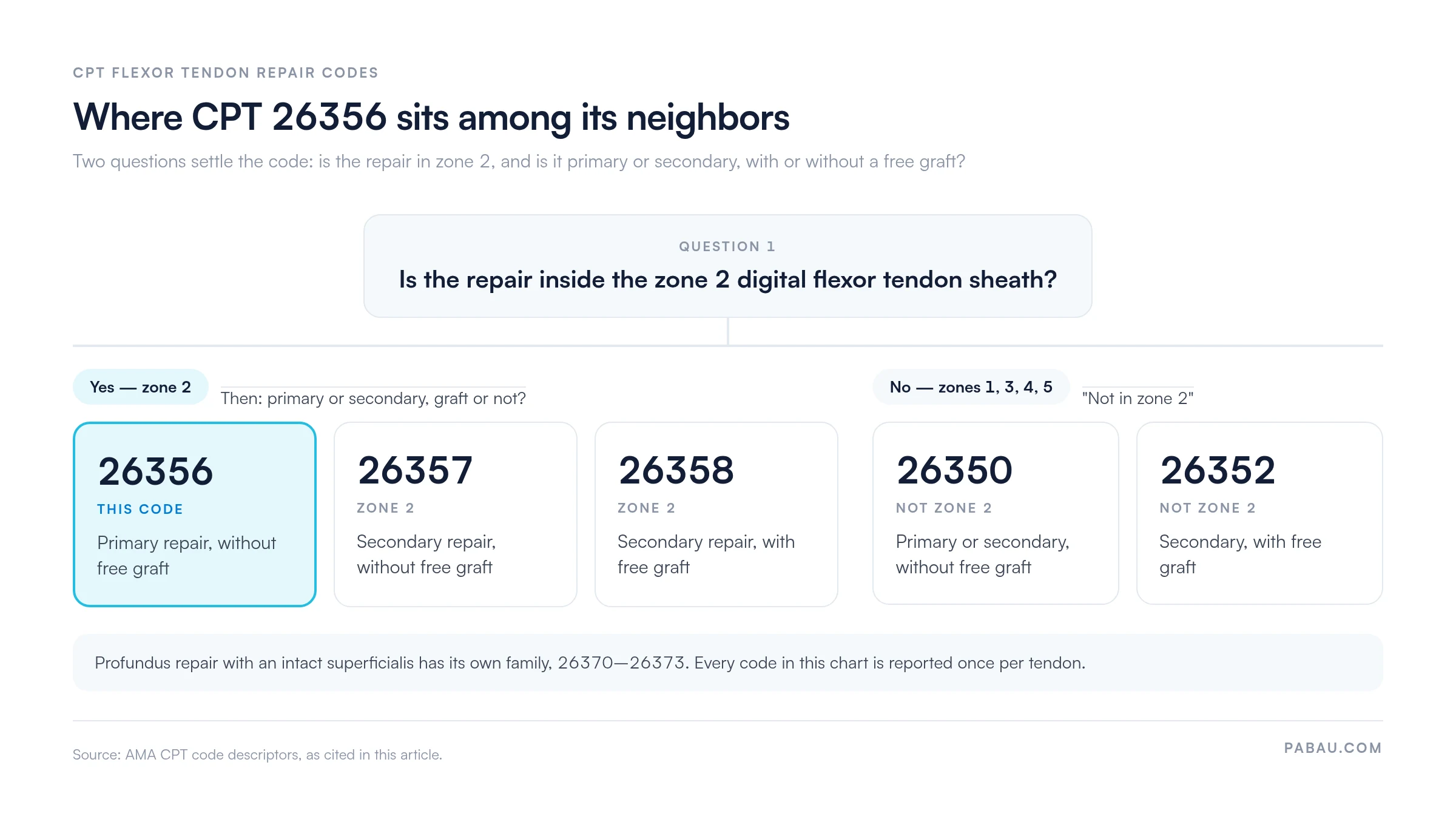
Verdan’s five-zone classification divides the flexor tendon system by anatomical region. Zone 2 has its own CPT family, 26356-26358. Repairs in zones 1, 3, 4 and 5 use the “not in zone 2” codes, 26350-26352, while profundus repair with an intact superficialis takes 26370-26373.
For the thumb, the flexor pollicis longus (FPL) has its own zone classification. Zone T2 corresponds anatomically to zone 2 in the digits. It is covered by the same 26356-26358 code family when the operative findings confirm the injury is within the fibro-osseous sheath.
The operative report must name the zone explicitly. Payers will not infer it from the injury narrative or the ICD-10 code alone. A note that describes “flexor tendon laceration repaired through a Bruner incision” without specifying zone 2 is a common documentation deficiency on 26356 claims.
The bundling rules decide what you can add to a 26356 claim and what is already paid inside it.
Included (do not bill separately):
Separately reportable (when documented as distinct):
An extensor repair on the same finger takes its own code, such as CPT 26418 for a finger extensor tendon repair. Document it as a separate procedure in the operative note so the payer sees two distinct repairs.
Coders judge primary repair by the time elapsed since injury, and coding references commonly cite a window of two to three weeks. The operative note should state the days since injury, so the coder can confirm the repair fits the primary descriptor rather than a secondary code.
All three codes cover zone 2 flexor tendon repair. The selection criterion is timing and technique, not anatomy.
A common miscoding error is reporting 26357 on an acute laceration. When the injury falls within the primary repair window, 26356 is correct regardless of operative complexity. Using 26357 on a fresh laceration conflicts with the ICD-10 seventh character A (initial encounter), which triggers payer review.
Zone comes before timing, as the decision path below shows: only a repair inside zone 2 can reach 26356 at all.
The table below compares 26356 with the flexor tendon codes it is most often confused with. It also lists codes that interact with it on a claim.
Search the AAPC Codify CPT lookup to verify current descriptor text and any edit relationships before billing. Refer also to the CMS Physician Fee Schedule lookup tool for the full list of applicable NCCI edits on 26356.
Modifier selection on flexor tendon repair claims is a frequent source of denials, particularly around laterality and multiple-procedure rules.
Modifier 50 caution: Do not use modifier 50 (bilateral procedure) for finger repairs. Each finger is an anatomically distinct digit, not a bilateral paired organ. Payers expect RT or LT to indicate the hand, and the finger is specified through the operative note and ICD-10 laterality. Applying modifier 50 to 26356 is a recognized denial trigger.
Run the operative note against the NCCI edit table before billing 26356 alongside any nerve repair or additional tendon code. NCCI edits change annually, and an edit that did not exist in a prior year may bundle two codes that were previously separately payable. Modifier 59 can override a column-2 edit only when the procedures are distinct. It does not override column-1 edits.
The following values are drawn from the 2026 Medicare Physician Fee Schedule. Actual payment varies by geographic payment locality and annual conversion factor adjustments. Verify current figures using the FastRVU 2026 RVU lookup tool or the CMS MPFS lookup before submitting claims.
FastRVU lists the same 22.56 total RVUs for facility and non-facility settings. The 2026 national rate for 26356 therefore does not change with site of service. Your final payment still moves with your locality’s geographic adjustment, which the CMS lookup applies by Medicare payment locality.
CPT Code 26356 carries a 90-day global surgical period under the Medicare global surgery package. Front-desk and billing staff who schedule post-operative visits need to know which of those visits are already paid.
What is included in the 90-day global:
What may still be billed separately:
Workers’ compensation payers generally follow state fee schedules rather than the Medicare global package rules. Confirm the applicable post-op billing policy with each workers’ comp carrier before billing follow-up visits.
The operative report is the billing record. Payers validate 26356 against it, and an op note missing any of the following elements is a likely denial.
Use a clean claim submission checklist that maps each operative note element to its corresponding billing requirement. For practices managing medical billing compliance across multiple hand surgery providers, standardizing operative note templates against these requirements cuts rework.
The denial triggers below recur on 26356 claims, and each fix starts in the operative note or the coding workflow.
Structured denial management workflows ensure each 26356 denial is categorized, routed to the right staff member, and tracked to resolution. For the reason codes payers return, see this reference on medical billing denial codes.
Without a systematic approach, the same documentation deficiency can recur across multiple surgeons for months before anyone identifies it.
The principal diagnosis on a 26356 claim must establish medical necessity for the repair. For acute lacerations, S66.0xx covers the thumb’s long flexor and S66.1xx covers the flexors of the other fingers, both by finger and laterality. The seventh character must be A (initial encounter) on the operative claim.
Use the CrossCoder CPT-to-ICD-10 crosswalk to verify that the diagnosis code selected is on the payer’s covered diagnosis list for 26356. Some local coverage determinations (LCDs) specify an approved ICD-10 list. A code outside that list generates an automatic denial even when the clinical documentation is complete.
Medicare covers flexor tendon repair when medical necessity is established through the operative report and paired ICD-10 diagnosis. Most commercial payers follow American Academy of Orthopaedic Surgeons (AAOS) and American Society for Surgery of the Hand (ASSH) guidelines. Those guidelines support primary repair as the standard of care for acute zone 2 lacerations.
Prior authorization requirements vary significantly. Emergency or same-day acute repairs are generally exempt from pre-auth requirements across most payers. Repairs performed days after the injury, once the patient was stabilized elsewhere, often do require pre-authorization from commercial payers and managed care organizations.
Workers’ compensation cases operate on state-specific fee schedules and documentation standards. The operative note must often include a mechanism of injury description that links the work activity to the laceration. Some states require employer notification before elective surgical procedures. Confirm the applicable state schedule and authorization pathway with the claims adjuster before submitting.
Keep authorization records next to the clinical note, so a claim is less likely to go out before authorization is confirmed. That habit belongs with the other medical billing fundamentals for practices billing multiple payers.
Without one system, a 26356 claim lives in three places. The operative note sits in the EHR, the claim in a clearinghouse portal, and the denial in a spreadsheet. Each handoff is a chance to lose the zone, the injury date, or the laterality modifier.
Pabau’s claims management software keeps the operative note, the claim, and the payer response on one patient record. Claims go to Medicare and commercial payers electronically through our Claim.MD clearinghouse integration. ERA responses post back, and denial reason codes surface without manual follow-up.
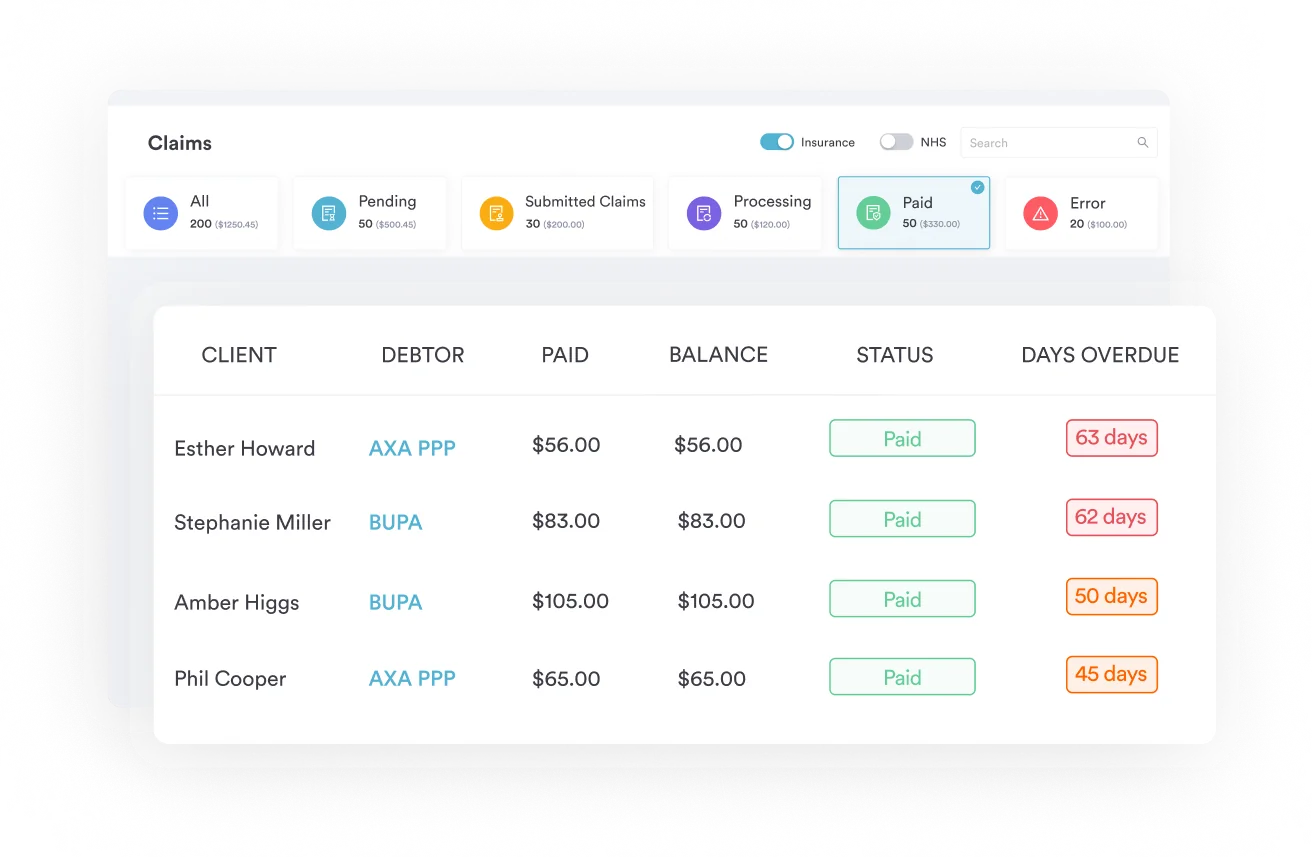
The result is fewer rework cycles on a high-value surgical code. If a payer rejects a claim for a missing zone or a wrong seventh character, your team fixes the note and resubmits from one record.

Pabau links your operative notes to your claims workflow. Your billing team reviews codes, modifiers, and ICD-10 pairings against the note before each claim goes out.

Treat the operative note as the claim for 26356. A note that names zone 2, each tendon repaired, and the injury date holds up against a 26357 challenge or an ICD-10 mismatch.
Timing is the trade-off to remember. A repair that slips past the primary window moves to 26357 or 26358, so record the days since injury on every note, including same-day repairs.
Book a demo to see how Pabau ties hand surgery operative notes to clean, trackable 26356 claims.

Billing an extensor repair on the same finger? CPT code 26418 covers finger extensor tendon repair, with its own documentation and modifier rules.
Confused about which denial reason codes are driving rejections? Denial codes in medical billing breaks down CARC and RARC codes so your team can action them without looking up each one manually.
Looking for a checklist to verify claims before submission? Clean claim submission walks through the data elements that must be present on a claim before it reaches a payer.
CPT Code 26356 reports primary repair or advancement of a flexor tendon in zone 2 of the digital flexor tendon sheath, without a free graft. It is reported per tendon repaired. It applies to both finger flexors (FDP and FDS) and the thumb’s flexor pollicis longus when the injury is confirmed in zone 2.
CPT 26356 is for primary repair, which coders generally apply within about two to three weeks of injury. CPT 26357 is for secondary repair without a free graft, and 26358 is for secondary repair with a free graft. Using 26357 on an acute laceration is a common miscoding error, because it conflicts with the ICD-10 seventh character A (initial encounter).
The most commonly required modifiers are RT or LT for hand laterality and modifier 51 for multiple procedures in the same session. Modifier 59 applies when 26356 is billed alongside a code that has an NCCI edit relationship. Modifier 22 may be appended for documented increased complexity but requires a written justification in the operative note. Do not use modifier 50 for finger procedures.
CPT 26356 has a 90-day global period under the Medicare global surgery package. Routine post-op visits, suture removal, and standard wound checks during that window are bundled into the surgical fee. Separately billable services during the global period include unrelated E&M visits (modifier 24), staged procedures (modifier 58), and return-to-OR complications (modifier 78).
CPT 69990 (microsurgical technique, add-on) may be separately billable with 26356 when the operative report documents use of the operating microscope. The payer’s NCCI edit table must also permit the combination. NCCI edits change annually and payer policies vary, so verify the current edit status before including 69990 on the claim.
The operative report must state zone 2 explicitly and name each tendon repaired. It also needs the days elapsed since the injury, the suture technique and material, and the pulley status. The principal ICD-10 diagnosis must be a finger- and laterality-specific S66.0xx (thumb) or S66.1xx (other fingers) code. Its seventh character is A on the initial encounter claim.