Pabau Engage inbox

Pabau Engage is here: every patient conversation in one inbox.

Learn more
Book a demo Book a demo
☰
CPT Code

CPT code 28208 – Secondary tendon repair, foot


Code Definition

28208 is the CPT code for repair, tendon, extensor, foot; primary or secondary, each tendon. It covers direct repair of a cut or ruptured extensor tendon in the foot, at the time of injury or later, billed once per tendon.

The tendon type and the graft decide the code. A flexor repair moves to 28200 or 28202, and a secondary extensor repair with a free graft moves to 28210.

Section
10004-69990 Surgery
Subsection
20100-29999 Musculoskeletal system
Code range
28001-28899 Foot and toes
Billable
No
Code also known as
extensor tendon repair foot, foot extensor tendon repair
Save time. Improve accuracy. Get paid faster.
Automate coding with Pabau

Let Pabau's smart automation suggest the right codes, reduce claim denials, and keep your practice compliant—effortlessly.

  • AI-powered code suggestions
  • Real-time compliance checks
  • Faster claims, fewer denials
Why practices choose Pabau
Save hours every week

Automate repetitive tasks and focus on what matters most—your patients.

Improve accuracy

Reduce coding errors and ensure compliance with the latest regulations.

Get paid faster

Clean claims, fewer denials, and faster reimbursements.

Grow with confidence

Powerful insights and reporting to help your practice thrive.

HIPAA compliant SOC 2 certified GDPR-compliant Trusted by 4,000+ clinics worldwide

Key takeaways

Key takeaways

CPT code 28208 covers repair of an extensor tendon in the foot, primary or secondary, reported once for each tendon repaired.

Two facts pick the code. A flexor tendon goes to 28200 or 28202, and a secondary extensor repair with a free graft goes to 28210.

A delayed or revision extensor repair stays on 28208 unless the surgeon uses a free graft, so timing alone never moves the code.

For CY2026, 28208 carries 4.40 work RVUs, 14.92 non-facility and 9.27 facility total RVUs, and a 90-day global period.

Pabau’s claims management software sends claims through Claim.MD, tracks prior authorizations, and posts ERA remittances back to each claim.

CPT code 28208 covers extensor tendon repair in the foot

CPT code 28208 reports a surgeon repairing a cut or ruptured extensor tendon in the foot, once per tendon. The descriptor in the American Medical Association CPT code set reads: Repair, tendon, extensor, foot; primary or secondary, each tendon. The repair can happen at the time of injury or weeks later.

Three words in the descriptor carry most of the coding weight. “Extensor” separates it from the flexor codes 28200 and 28202. “Primary or secondary” means timing does not change the code. “Each tendon” means two repaired tendons are reported twice, as units or separate lines depending on payer policy.

The extensor tendons on the top of the foot all fall here when the repair is at the foot level. That includes extensor hallucis longus, extensor digitorum longus and extensor digitorum brevis. AAPC’s Podiatry Coding Alert also reports an anterior tibial tendon repaired in the foot with 28208. The same repair above the ankle moves to the leg codes.

The great toe is not excluded. An extensor hallucis longus repair in the foot reports with 28208, just like a repair to the lesser toes.

FieldValue
CPT code28208
Official descriptorRepair, tendon, extensor, foot; primary or secondary, each tendon
CPT sectionMusculoskeletal system, Foot and Toes (28001-28899)
Tendon typeExtensor tendons of the foot and toes
Unit of serviceEach tendon repaired
Global period90 days
SettingFacility (hospital, ASC) or non-facility (office, where clinically appropriate)

What 28208 includes, and when another code applies

The scope of 28208 rests on three facts in the operative note. The note has to show which tendon was repaired, where it was repaired, and whether a free graft was used.

What is included

  • Direct suture repair of an extensor tendon in the foot, at the time of injury (primary) or later (secondary)
  • Retrieval of the tendon ends from the wound and layered closure after the repair
  • Each extensor tendon repaired in the session, reported once per tendon
  • Routine post-operative care inside the 90-day global period

What is excluded (and the correct code)

  • Flexor tendon repair, foot: use CPT 28200 without a free graft, or 28202 for a secondary repair with a free graft
  • Secondary extensor repair with a free graft: use CPT 28210, which includes obtaining the graft
  • Extensor tendon repair above the ankle: use CPT 27664 for a primary repair without graft, or 27665 for a secondary repair
  • Achilles tendon repair: use CPT 27650 or 27652 for a primary repair, or 27654 for a secondary repair
  • Open extensor tenotomy: cutting the tendon to release it is CPT 28234, not a repair
  • Splint or dressing after surgery: part of the global package, so it is not billed separately

The NCCI edit table controls which codes can be billed alongside 28208 in the same session. Run each pair through the CMS NCCI edits before you bill a second procedure, such as a hammertoe correction under 28285.

28208 vs 28200, 28202 and 28210: tendon type and graft decide the code

Four codes cover tendon repair in the foot, and two questions separate them. Was the tendon a flexor or an extensor? Did the surgeon use a free tendon graft? The flexor pair is covered on the CPT code 28200 page.

CodeDescriptor summaryTendon typePrimary or secondaryFree graft
28200Repair, tendon, flexor, foot; primary or secondary, without free graft, each tendonFlexorEitherNo
28202Repair, tendon, flexor, foot; secondary with free graft, each tendon (includes obtaining graft)FlexorSecondaryYes
28208Repair, tendon, extensor, foot; primary or secondary, each tendonExtensorEitherNo
28210Repair, tendon, extensor, foot; secondary with free graft, each tendon (includes obtaining graft)ExtensorSecondaryYes
27664Repair, extensor tendon, leg; primary, without graft, each tendonExtensor (leg level)PrimaryNo
27665Repair, extensor tendon, leg; secondary, with or without graft, each tendonExtensor (leg level)SecondaryEither

Use the two questions in order:

  • Flexor tendon: 28200 for a direct repair, or 28202 for a secondary repair with a free graft.
  • Extensor tendon, no free graft: 28208, whether the repair is primary, delayed or a revision of a failed repair.
  • Extensor tendon, secondary repair with a free graft: 28210. The graft harvest is included, so no separate graft code goes with it.

A revision of a failed extensor repair is still 28208 when no graft is used. The prior surgery supports medical necessity, but it does not change the code.

Laid out together, the level of repair, the tendon type and the graft settle every code in the family.
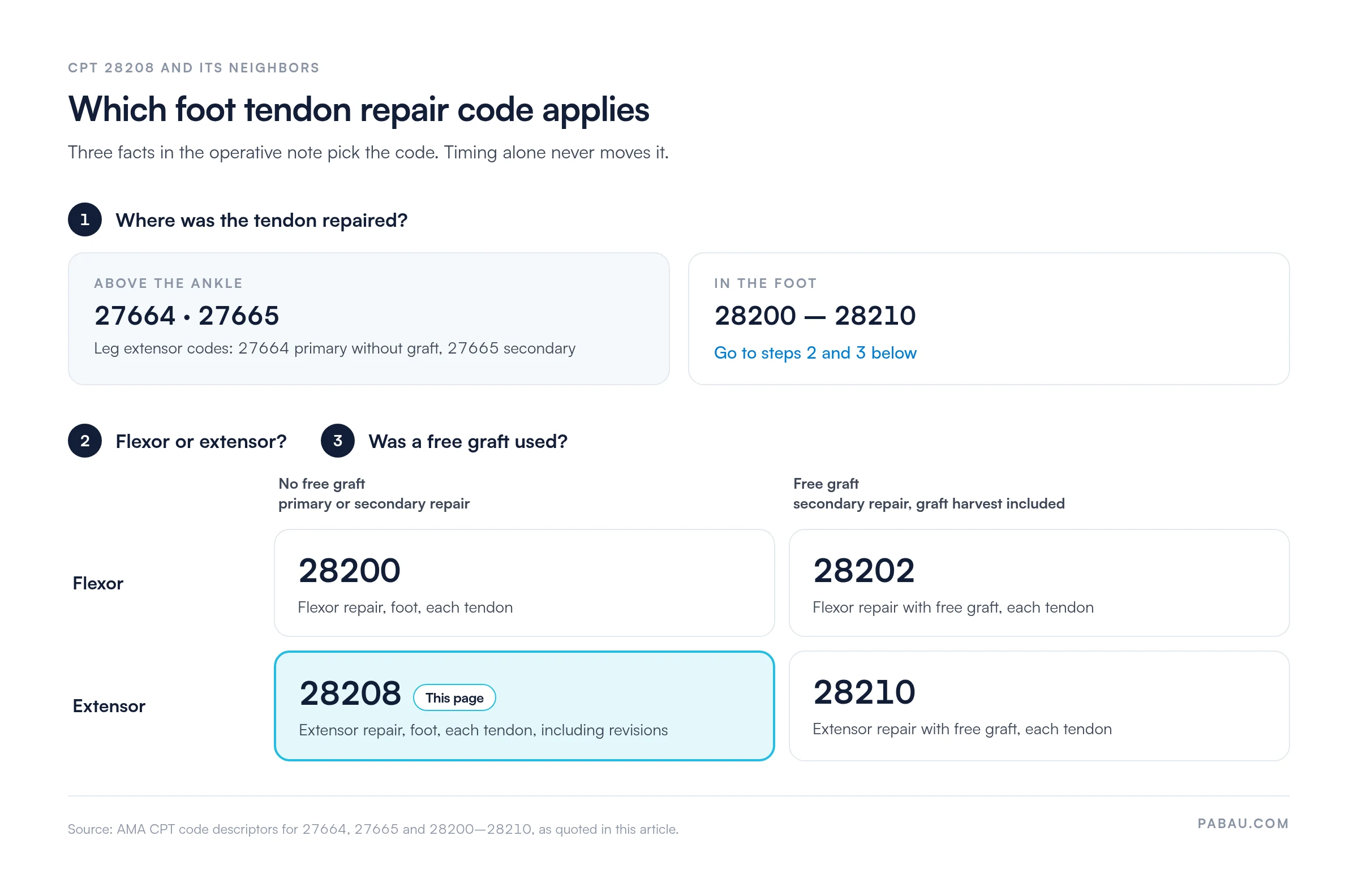
Decision diagram for foot tendon repair codes
Only an extensor repair in the foot without a free graft lands on 28208, whatever the timing. Descriptors from the AMA CPT code set.

Pro Tip

Make the surgeon name the tendon in the final diagnosis line, not just in the narrative. Extensor or flexor decides 28208 versus 28200, and auditors read that line first.

What the operative note must show for 28208

Payers review tendon repair claims against the operative note. The note should cover each item below to support the code and the units billed.

  • Laterality: left foot or right foot, stated explicitly
  • Tendon named: the specific extensor tendon, such as extensor hallucis longus or extensor digitorum longus to the third toe
  • Level of repair: confirm the repair was in the foot, because a repair above the ankle reports with 27664 or 27665
  • Timing: primary or secondary, with the prior repair described for a revision. Timing supports medical necessity without changing the code
  • Graft status: state that no free graft was used. A secondary repair with a free graft moves to 28210
  • Technique and closure: the suture method and the layered closure
  • Tendon count: the number of tendons repaired, which drives the units or lines billed

ICD-10 codes that support a 28208 claim

The diagnosis must describe an extensor tendon injury, matching the tendon in the note. Traumatic injuries code to category S96, and non-traumatic ruptures code to M66.27-. A flexor diagnosis on an extensor repair is a mismatch payers catch.

ICD-10-CM codeDescriptorNotes
M66.271Spontaneous rupture of extensor tendons, right ankle and footNon-traumatic rupture of an extensor tendon, right side
M66.272Spontaneous rupture of extensor tendons, left ankle and footLeft-side variant of M66.271
S96.111AStrain of muscle and tendon of long extensor muscle of toe at ankle and foot level, right foot, initial encounterTraumatic strain or rupture; S96.112A is the left-foot variant
S96.121ALaceration of muscle and tendon of long extensor muscle of toe at ankle and foot level, right foot, initial encounterTendon cut by a laceration; S96.122A is the left-foot variant
S91.311ALaceration without foreign body, right foot, initial encounterCode also the open wound with an S96 laceration; S91.312A is the left-foot variant

Verify each code against the current fiscal-year ICD-10-CM tabular list. The 7th character “A” fits while the patient is receiving active treatment, and a delayed repair is still active treatment. “D” and “S” describe later encounters and do not support the repair itself.

Pro Tip

Put laterality and the tendon name in the same sentence of the final diagnosis. A right-foot S96 code on a claim billed with -LT is an easy denial to avoid.

How Medicare prices CPT code 28208

Medicare pays the work, practice expense and malpractice RVUs, each adjusted by the locality GPCI, multiplied by the conversion factor. The figures below come from the CY2026 CMS PFS relative value file (October release).

ComponentCY2026 valueNotes
Work RVU4.40Surgeon time, skill and intensity
Practice expense RVU9.96 non-facility, 4.31 facilityThe facility figure applies in a hospital or ASC
Malpractice RVU0.56Same in both settings
Total RVUs14.92 non-facility, 9.27 facilityBefore locality (GPCI) adjustment
Global period09090 days of bundled post-operative care
Multiple procedure indicator2Standard reduction applies to the second and later procedures
Conversion factor$33.4009 standard, $33.5675 for qualifying APM participantsCY2026 dual conversion factors

Multiplying total RVUs by the conversion factor gives the national amount before locality adjustment.

SettingStandard ($33.4009)Qualifying APM ($33.5675)
Non-facility (14.92 RVUs)$498.34$500.83
Facility (9.27 RVUs)$309.63$311.17

Your MAC pays a locality-adjusted amount, so pull exact figures from the CMS Physician Fee Schedule search tool. Commercial rates are set by contract. Medicaid rates vary by state.

Modifiers that keep 28208 claims moving

Modifier choice depends on the operated foot, the toe involved and any other procedure in the same session. A missing laterality modifier is a common denial cause for this code.

ModifierNameWhen to use
-LT / -RTLeft side / right sideEvery 28208 line, matching the laterality of the diagnosis code
-TA to -T9Toe modifiersWhere the payer asks for the specific toe, such as -TA for the left great toe
-51Multiple proceduresA second procedure in the session, where the payer requires it. Medicare applies the reduction itself.
-59 / -XSDistinct procedural service / separate structureOnly when an NCCI edit pairs the codes and the note documents a separate site or tendon
-22Increased procedural servicesSubstantially more work than typical, such as dense scarring from a prior repair. Attach a written explanation.
-80 / -82Assistant at surgeryCMS assistant-at-surgery indicator 1, so Medicare pays an assistant only with documentation of medical necessity

Report each tendon once. If the payer takes units, two extensor repairs bill as 28208 with 2 units. If it wants separate lines, the second line carries the modifiers the payer specifies.

The 90-day global period after a 28208 repair

CPT code 28208 carries a 90-day global period under CMS policy. Routine care from the day before surgery through day 90 is bundled into the surgical payment.

What is bundled in the global period

  • Routine post-op visits for the repair, including wound checks and suture removal
  • Splint, boot or dressing changes related to the procedure
  • Complications that do not require a return to the operating room

What can be billed separately during the global period

  • Unrelated E/M visit: append modifier -24
  • Return to the OR for a complication: report the procedure with modifier -78
  • New, unrelated procedure: append modifier -79
  • Physical therapy by a separate provider: billed by that provider, outside the surgical global

Prior authorization rules vary by payer

Settle authorization before the surgery date is booked. Build the check into your medical billing workflow so it happens at scheduling.

  • Traditional Medicare: generally no prior authorization for tendon repair; check your MAC for any local coverage policy
  • Medicare Advantage: each plan sets its own rules, so verify before scheduling
  • Commercial payers: many require authorization for elective foot surgery, with notes and imaging
  • Medicaid: rules vary by state

An acute laceration repaired the same day rarely waits for authorization. A planned secondary repair usually can, so collect the operative plan and the history of the failed repair first.

A 28208 claim from op note to payment

Here is a typical claim. A patient drops a kitchen knife on the top of the left foot. The surgeon repairs extensor hallucis longus and extensor digitorum longus to the second toe the same day, without a graft.

  1. Code: 28208 for each of the two extensor tendons.
  2. Diagnosis: S96.122A, laceration of the long extensor tendon of toe, left foot, plus S91.312A for the open wound.
  3. Modifiers: -LT on both repairs, as two units or two lines per payer policy.
  4. Authorization: attach the number if the plan required one.
  5. Payment: check the ERA. The second repair should pay at the reduced multiple-procedure rate, not zero.

Before you submit a 28208 claim

  • The note names extensor tendons, not flexor tendons
  • The repair was in the foot, not above the ankle
  • No free graft is described for a secondary repair
  • Units or lines match the tendon count
  • Laterality matches between modifier and diagnosis
  • Any second procedure code is checked against the NCCI table

Common 28208 denials and how to fix them

Most 28208 denials trace back to a mismatch between the claim and the note. The table pairs each cause with its claim adjustment reason code (CARC). For appeals, see our guide to denial management workflows.

Denial type / CARCRoot causeCorrective action
CO-4 (modifier missing or inconsistent)Laterality modifier missingResubmit with -LT or -RT that matches the note and the diagnosis
CO-11 (diagnosis inconsistent with procedure)Flexor diagnosis, such as M66.37-, billed with an extensor repairRecode to the extensor diagnosis the note supports and resubmit
CO-97 (included in another service)NCCI edit with another procedure, or a post-op visit billed inside the global periodCheck the NCCI pair or the global window; use -59/XS or -24/-79 only when the note supports it
CO-197 (authorization absent)Required authorization not obtainedAppeal with the authorization number, or request a retroactive one with clinical notes
Wrong code in the familyGraft used on a secondary repair, or a flexor tendon repairedCorrect to 28210, 28200 or 28202 to match the note

Other reason and remark codes can appear on the same ERA. Our reference to denial codes in medical billing explains each one and the usual fix.

How claims software keeps 28208 claims clean

A 28208 claim often fails on work that happens outside the coding. The authorization was never logged, the patient’s plan was never checked, or the second-tendon line came back unpaid and nobody noticed.

Pabau’s claims management software sends US claims as CMS-1500/837P files through Claim.MD. Your team can run an eligibility check before the surgery date, and ERA remittances post back to the claim.

Prior authorization sits on the patient’s case, with the auth code, dates and sessions recorded. Pabau warns the team when an authorization is missing, so a missing authorization surfaces before the claim goes out, not as a CO-197 denial.
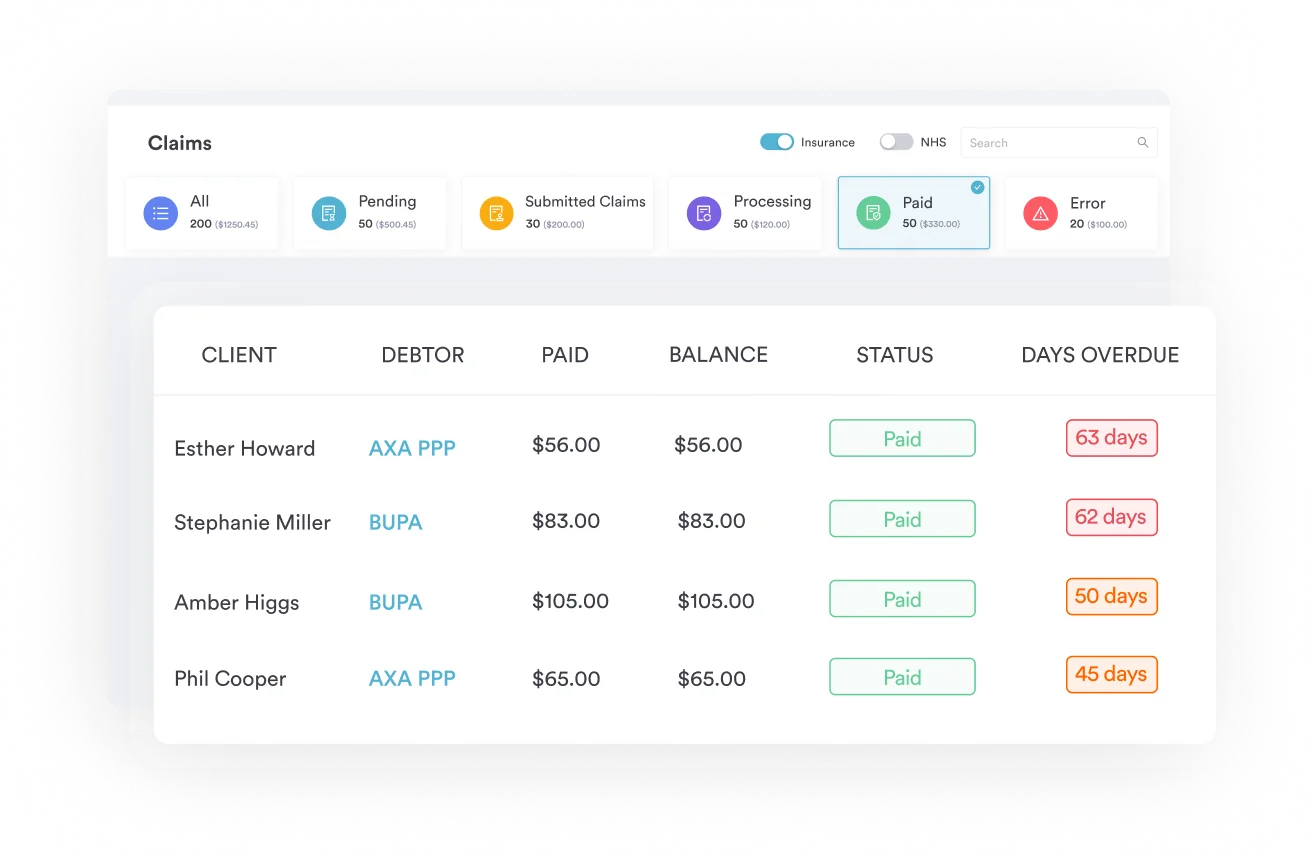
Pabau claims management screen tracking claim status from submission to payment
Pabau’s claims tracking shows where each 28208 claim sits, so a denied second-tendon line gets worked before it ages.

A clean claim on the first pass means less follow-up for the billing team and faster payment for the practice.

Send cleaner foot surgery claims with Pabau

Pabau sends claims through Claim.MD, tracks prior authorizations on the patient’s case, and posts ERA remittances back to each claim.

Pabau claims management dashboard

Conclusion

For 28208, the tendon decides the code before the billing starts. An extensor tendon repaired in the foot without a free graft is 28208, whether it is a fresh laceration or a failed repair. A flexor tendon or a grafted secondary repair belongs elsewhere in the family.

Get the note to name the tendon, the foot and the count, and the claim follows. Pabau keeps the authorization, the claim and the remittance on one patient record. Book a demo to see it run foot surgery claims in your workflow.

Continue your research

Continue your research

Repairing a flexor tendon instead? CPT code 28200 covers flexor tendon repair in the foot, with the documentation that separates it from 28208.

Need to track claim submissions and ERA responses in one place? Electronic remittance advice (ERA) explained covers how 835 ERA files work and how to reconcile payments automatically.

Looking to understand the broader clearinghouse landscape? Medical claims clearinghouse guide explains how clearinghouses validate and route claims before they reach payers.

Want to benchmark your superbill against best practices? Superbill guide walks through the required fields, CPT code capture, and how to export a compliant superbill for foot surgery procedures.

Frequently asked questions

What does CPT code 28208 cover?

CPT code 28208 covers repair of an extensor tendon in the foot, primary or secondary, reported once for each tendon. It includes extensor hallucis longus, extensor digitorum longus and extensor digitorum brevis repairs at the foot level.

What is the difference between CPT 28200 and CPT 28208?

The tendon type. CPT 28200 covers a flexor tendon repair in the foot without a free graft. CPT 28208 covers an extensor tendon repair in the foot. Both apply to primary or secondary repairs, once per tendon.

What is the Medicare reimbursement rate for CPT 28208?

For CY2026, 28208 carries 14.92 non-facility and 9.27 facility total RVUs. At the standard $33.4009 conversion factor, that is about $498.34 non-facility and $309.63 facility nationally. Your MAC adjusts these amounts for locality.

When should you report 28210 instead of 28208?

Report 28210 when a secondary extensor tendon repair in the foot uses a free tendon graft. The code includes obtaining the graft. A revision without a graft stays on 28208.

What ICD-10 codes are appropriate for CPT 28208?

Use M66.271 or M66.272 for a spontaneous extensor tendon rupture of the right or left foot. For trauma, use S96.11- for a strain or S96.12- for a laceration of a long extensor tendon. Add the open wound code from S91 when there is one.
Avatar photo
Despina Petrushevska
Content Writer

Despina Petrushevska is a content writer covering aesthetics, dermatology, and clinic operations, known for making detailed clinical concepts clear and engaging. Outside of work, she enjoys photography, weekend getaways, and finding inspiration in everyday experiences.
×