



CCSD code G5100: Bypass of duodenum billing guide
CCSD code G5100 bills a bypass that leaves the duodenum in place CCSD code G5100...

Last Updated: Oct 16, 2026

CPT code 26428 covers secondary repair of the extensor tendon central slip with a free graft, billed per finger for boutonniere deformity correction.
The graft harvest is bundled into 26428 and cannot be billed separately, since doing so is an NCCI violation.
Digit modifiers FA and F1-F9 identify the finger treated, and omitting them is the most common denial trigger.
Pabau’s claims management software supports accurate CPT 26428 claim submission through its Claim.MD clearinghouse integration.
CPT code 26428 is the billable code for secondary repair of the extensor tendon central slip using a free graft, reported once per finger. The full AMA descriptor reads: Repair of extensor tendon, central slip, secondary (e.g., boutonniere deformity) with free graft (includes obtaining graft), each finger.
Three elements separate this code from its neighbors in the 26400s series.
Boutonniere deformity arises from central slip disruption. The common causes are rheumatoid arthritis, traumatic laceration, closed crush injury, and iatrogenic damage following PIP joint surgery.
When conservative management such as splinting and physical therapy fails to restore extension, reconstruction with a free graft becomes the treatment of choice. That is the clinical scenario CPT code 26428 captures.
Coders unfamiliar with hand surgery frequently confuse codes in this range. Three differentiators separate them: primary versus secondary timing, graft versus no graft, and which extensor component is repaired. The table below maps the key distinctions.
Key decision point: Suppose the surgeon repaired the central slip with local tissue advancement rather than a harvested free graft. Code 26426 is then correct. CPT code 26428 requires both secondary timing and a free graft, and using it without a graft is upcoding.
Reference the AAPC Codify CPT lookup to verify code descriptors before submission. Reviewing adjacent code families in the CPT procedure code reference prevents selection errors across surgical categories.
Medical necessity for CPT code 26428 must be supported by a diagnosis code that reflects the clinical indication. Payers cross-check the procedure code against the ICD-10-CM diagnosis code to confirm the service is appropriate. The table below lists the codes most commonly paired with boutonniere deformity and related extensor tendon pathology.
Specify laterality whenever possible. Note that the S66.3 series is finger-specific rather than hand-level, so its sixth character names the individual digit. Unspecified codes such as M20.029 are acceptable only when the operative report genuinely lacks laterality documentation, which should be uncommon in hand surgery.
For accurate ICD-10-CM diagnostic code selection across specialties, the principle is the same. The most specific code supported by documentation is always preferred. Claims submitted with M20.029 when the operative note clearly documents laterality risk medical necessity challenges on audit. Additional guidance on paired diagnosis coding practices applies here as well.
Reimbursement for CPT code 26428 under Medicare is calculated from Relative Value Units multiplied by the annual conversion factor. Medicare Administrative Contractors then apply geographic adjustments.
The CMS Physician Fee Schedule lookup tool gives current-year payment amounts by locality. Verify the rates for your MAC region before finalizing estimates, because national averages vary by Geographic Practice Cost Index. For current RVU values, the FastRVU 2026 RVU lookup draws directly from CMS published data.
Submit claims electronically through electronic claims via Claim.MD, the clearinghouse integration in practice management software like Pabau, which supports over 4,000 US payers. That routing reduces submission errors and speeds ERA remittances for surgical claims like CPT 26428.
CPT 26428 is a major surgical procedure with a work-intensive RVU profile, reflecting the complexity of free graft harvest and central slip reconstruction. The components below are representative, based on CMS MPFS published data. Verify the current fiscal year final rule for exact values.
CPT 26428 can be performed in an office-based surgical suite (non-facility), a hospital outpatient department, or an ambulatory surgery center (ASC, facility). The reimbursement rate differs because the practice expense RVU component is higher in non-facility settings. There the physician absorbs overhead costs the facility would otherwise cover.
Run a quarterly audit on your CPT 26428 claims to confirm place of service codes match the operative setting documented in the case notes. A single POS mismatch across a high-volume hand surgeon’s claims can trigger a MAC-level probe audit covering the preceding 12 months.
Modifier selection for CPT code 26428 is not optional. Missing digit modifiers is the single most preventable denial trigger for hand surgery claims. Ten digit modifiers cover the ten digits, and the map below shows which one goes where.
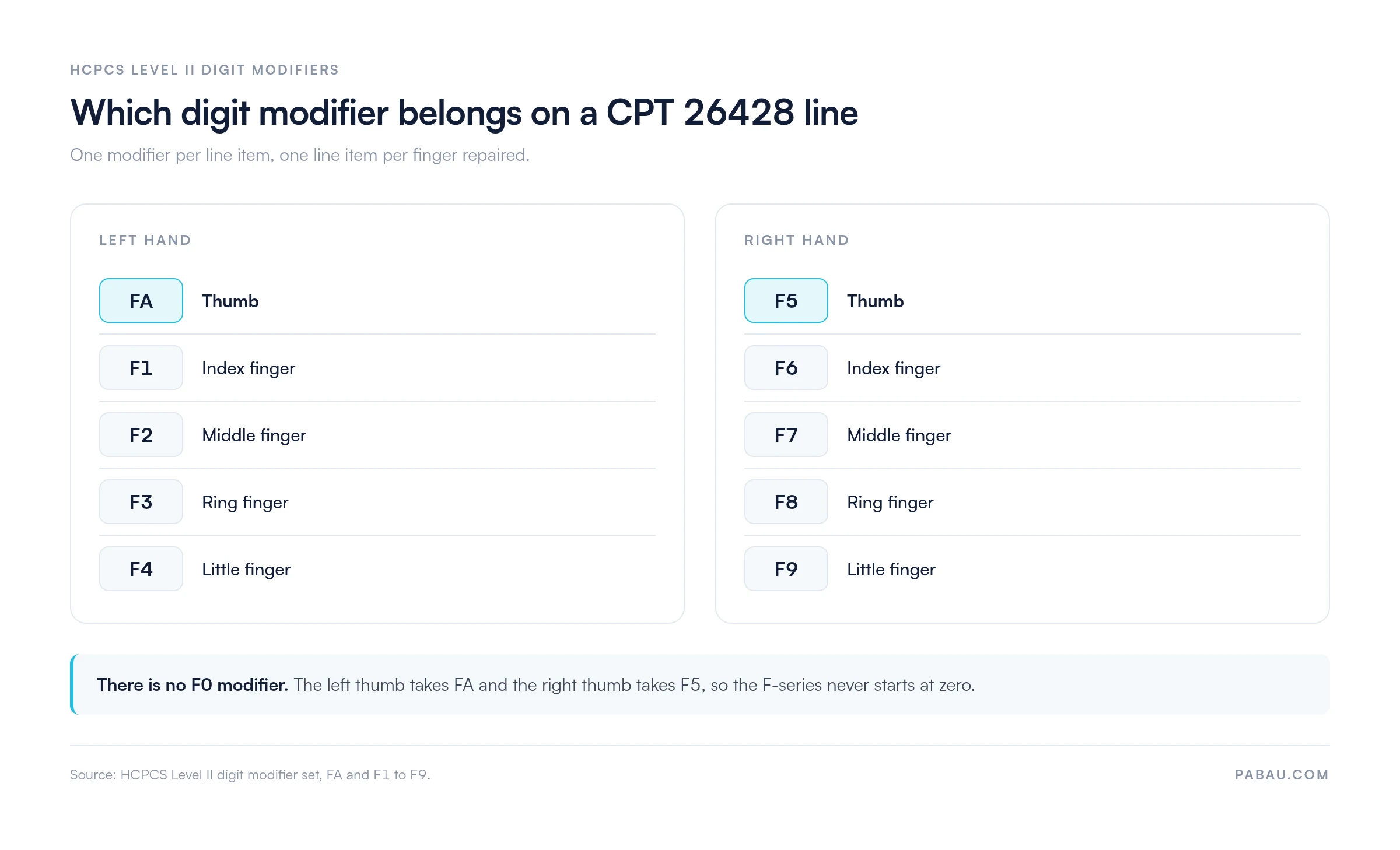
The table below adds the remaining modifiers that apply to CPT 26428, with usage guidance.
CPT 26428 carries a 90-day global surgical package, consistent with major surgical procedures. Most post-operative care provided within 90 days of surgery is bundled into the procedure’s reimbursement and cannot be billed separately.
Accurate claims management software should flag global period encounters automatically, so coders do not submit a duplicate claim by mistake.
Pre-operative visits one day before surgery are also bundled. Visits earlier than that are separately billable. Where the pre-op visit was the session that decided on surgery, document it with an E/M code and modifier 57.
Preparing a complete superbill documentation for each encounter during the global period reduces the risk of inadvertent duplicate billing.
The operative note must support every element of CPT code 26428. Missing or vague documentation causes most medical necessity denials and audit recoveries in hand surgery. Writing the operative note as a billing document as well as a clinical record prevents most of them. Reference standards for clinical documentation and CPT coding apply broadly across surgical specialties.
Denial rates on hand surgery codes track incomplete documentation and modifier errors. The patterns below account for most avoidable denials on CPT 26428 claims.
A structured denial management workflow should be in place before these claims reach the clearinghouse. Strong medical billing fundamentals stay the most reliable prevention. That means clean claims, correct code selection, and complete documentation.
Practices using Pabau’s integrated medical claims clearinghouse can configure scrubbing rules that flag common errors before submission. Missing modifiers and mismatched diagnosis-procedure pairs are the two worth building first. That cuts denial rates without adding manual review.
The same pre-submission scrubbing logic appears in our outpatient procedure code guides for other specialties.
Most hand surgery practices find a missing digit modifier only after the payer rejects the line. A coder re-reads the operative note, corrects the modifier, and the claim goes back out weeks later.
Pabau moves that check before submission. Claims are built from the clinical record. The finger named in the operative note and the modifier on the claim line come from one entry. Scrubbing rules hold back a 26428 line that carries no FA or F1-F9 modifier.
Claims then go out to payers as 837P files through the Claim.MD integration, and remittances post back automatically. The result is fewer reworked lines each month and a shorter wait between surgery and payment.

Pabau’s claims management software connects to the Claim.MD clearinghouse and covers CPT 26428 with adjacent hand surgery codes. Built-in scrubbing, ERA processing, and modifier validation run across 4,000+ US payers.

Two questions settle whether 26428 is the right code. Was the repair delayed rather than primary, and did the surgeon harvest a free graft? Answer no to either one and the claim belongs on 26426 or 26418.
The denials on this code are mechanical rather than clinical. A missing digit modifier and a separately billed graft harvest cause most of them, and a scrubbing rule catches both before submission.
Pabau’s claims management software integrates with Claim.MD to support accurate 837P submission, ERA remittance matching, and denial routing for surgical codes including CPT 26428. To see how the platform handles hand surgery billing workflows end to end, book a demo.

Need a structured approach to clean claim submission? Clean claim best practices walks through the documentation and code elements that prevent denials across surgical billing workflows.
Want to understand how clearinghouses process surgical claims? Medical claims clearinghouse guide explains how 837P files are validated, scrubbed, and routed to payers.
Looking for revenue cycle guidance beyond individual codes? Revenue cycle management overview covers the full lifecycle from charge capture through remittance posting.
CPT code 26428 covers secondary repair of the extensor tendon central slip with a free graft, billed per finger. The graft harvest is included in the code. It applies most often to boutonniere deformity correction when primary repair is no longer viable.
Yes. The code descriptor specifies “each finger,” so each finger treated requires a separate line item with the corresponding digit modifier (FA, F1-F9). A surgeon repairing the central slip of two fingers on the same hand bills CPT 26428 twice with different digit modifiers on each line.
CPT 26426 covers secondary central slip repair without a free graft, using direct repair or local tissue. CPT 26428 requires a harvested free graft. The graft is the defining distinction. Using 26428 when no free graft was performed is upcoding. Using 26426 when a graft was harvested is undercoding. Both errors carry audit risk.
CPT 26428 carries a 90-day global surgical package. Routine follow-up visits, wound checks, and dressing changes by the operating surgeon are bundled for 90 days. They cannot be billed separately. Return to the OR for a complication during this window requires modifier 78 or 79. The choice depends on whether the complication relates to the original procedure.
No. The CPT descriptor explicitly states “includes obtaining graft,” which means the harvest is bundled into 26428. Billing a separate graft harvest or tissue graft code alongside 26428 is an NCCI bundling violation and will be denied or recovered on audit. Submit CPT 26428 only, and document the harvest in the operative note to support the higher-value code over 26426.
Yes. CPT 26428 can be performed in an office-based surgical suite (non-facility) or in a hospital outpatient or ASC setting (facility). The physician reimbursement rate differs between settings. Non-facility rates are higher because practice expense is included. The place of service code must match where the surgery happened. Use POS 11 for office, 22 for outpatient hospital, and 24 for an ASC.



