



CCSD code G5100: Bypass of duodenum billing guide
CCSD code G5100 bills a bypass that leaves the duodenum in place CCSD code G5100...

Last Updated: Oct 16, 2026

CPT code 25105 describes arthrotomy of the wrist joint with synovectomy, inside the Excision Procedures on the Forearm and Wrist range (25100-25145)
The 90-day global surgery period applies, meaning routine post-op visits within that window cannot be billed separately
Modifier 50 (bilateral) and modifier 51 (multiple procedures) come up most often, and laterality belongs explicitly in the operative note
Payers deny 25105 without documented failure of conservative treatment, so record the therapies tried and how long they ran
Practice management software like Pabau automates claim submission and tracks denials for surgical codes including CPT 25105
According to the American Medical Association (AMA), CPT code 25105 carries the official descriptor: Arthrotomy, wrist joint; with synovectomy. It sits within the Excision Procedures on the Forearm and Wrist subsection of the Musculoskeletal System chapter (codes 25100-25145). The procedure involves a surgical incision into the wrist joint (radiocarpal joint) to access and remove diseased synovial tissue from the joint space.
The code sits in the excision family rather than the arthroscopy family, so the operative note has to describe an open procedure. Coders reach for it when the surgeon opens the wrist joint and excises synovial membrane in the same session. Pabau’s claims management software helps practices track and resolve these coding issues before they become revenue losses.
This guide covers the official descriptor, Medicare reimbursement, and the modifiers that apply. It then works through ICD-10 pairings, documentation requirements, global period rules, related codes, and the most common billing errors.
CPT code 25105 covers two surgical actions performed together. The arthrotomy is the incision into the wrist joint capsule, and the synovectomy is the excision of the synovial membrane lining it. Opening the joint to take a biopsy, without excising synovial membrane, is CPT 25100 instead. Documented removal of synovial tissue is what justifies 25105 over that code.
Resection arthroplasty falls outside the arthrotomy family. When the surgeon removes a joint surface and interposes tissue at an intercarpal or carpometacarpal joint, the code is 25447.
The procedure is typically performed under general or regional anesthesia. The surgeon makes a dorsal or volar incision over the wrist and opens the joint capsule. Inflamed or hypertrophic synovial tissue is then excised from the joint compartments. The goal is to reduce pain, preserve range of motion, and slow joint destruction in patients who have not responded to conservative management.
Common clinical indications include:
Documentation must confirm that conservative treatment was attempted and failed before a payer will approve the procedure as medically necessary. This conservative-treatment-first requirement is where many prior authorization requests stall.
Medicare reimbursement for CPT code 25105 differs based on where the procedure is performed. The CMS Physician Fee Schedule (MPFS) publishes a facility rate and a non-facility rate. The facility rate covers hospital outpatient departments and ambulatory surgery centers, and the non-facility rate covers in-office procedures. Submit claims through electronic claims via Claim.MD to reach thousands of US payers, including Medicare. Eligibility responses come back in real time, before the day of surgery.
Rates above are approximate national averages based on published CMS MPFS data. Actual payment varies by Geographic Practice Cost Index (GPCI) adjustment for each Medicare Administrative Contractor (MAC) region. Use the FastRVU 2026 RVU lookup tool to verify current wRVU and calculated payment amounts for your specific locality before building your fee schedule.
Commercial payer rates for CPT 25105 typically exceed Medicare rates. Negotiate benchmarks at or above the Medicare rate, ideally as a percentage of MPFS. Expressing it that way, at 130% of Medicare for example, captures annual fee schedule updates automatically.
Choosing the wrong modifier, or omitting one entirely, is among the fastest ways to trigger a denial on CPT 25105. The table below covers the modifiers coders encounter most often with this procedure.
Always verify modifier 59 use against current National Correct Coding Initiative (NCCI) edits before submitting. Applying modifier 59 without a valid NCCI basis is a compliance risk, not a billing shortcut.
Every claim for CPT code 25105 must be paired with a diagnosis code that establishes medical necessity. Payers, including Medicare, use Local Coverage Determinations (LCDs) to define which ICD-10-CM codes are acceptable. The codes below are the most commonly paired diagnoses. Always verify them against your MAC’s current LCD for wrist procedures.
Selecting an unspecified wrist code (such as M06.039 for unspecified wrist) when a laterality-specific code is available will draw payer scrutiny. Laterality specificity is a straightforward way to demonstrate coding accuracy and reduce medical necessity denials.
Run an insurance eligibility check before scheduling the procedure. Synovectomy procedures often require prior authorization, and confirming coverage early prevents last-minute cancellations and unbillable surgical time.
Thorough documentation is not optional for CPT 25105 claims. Payers, auditors, and Medicare Administrative Contractors all expect the operative note to tell the full clinical story. Understanding medical billing fundamentals starts with one rule. Every element of the service must exist in the medical record before the claim is submitted, not after a denial arrives.
The operative note for CPT 25105 must include all of the following:
Submitting a clean claim for a surgical procedure like CPT 25105 means the operative note, the diagnosis code, and the procedure code are internally consistent. Inconsistencies between the note and the claim are the single most common trigger for a medical review request from Medicare.
CPT code 25105 carries a 90-day global surgery period. This means the surgeon’s fee covers all routine post-operative care for 90 days following the procedure. Billing a separate evaluation and management (E/M) visit during the global window results in a denial. A routine wound check or suture removal is bundled into the surgical fee. The split between bundled and separately billable care is worth mapping before the first post-op visit.
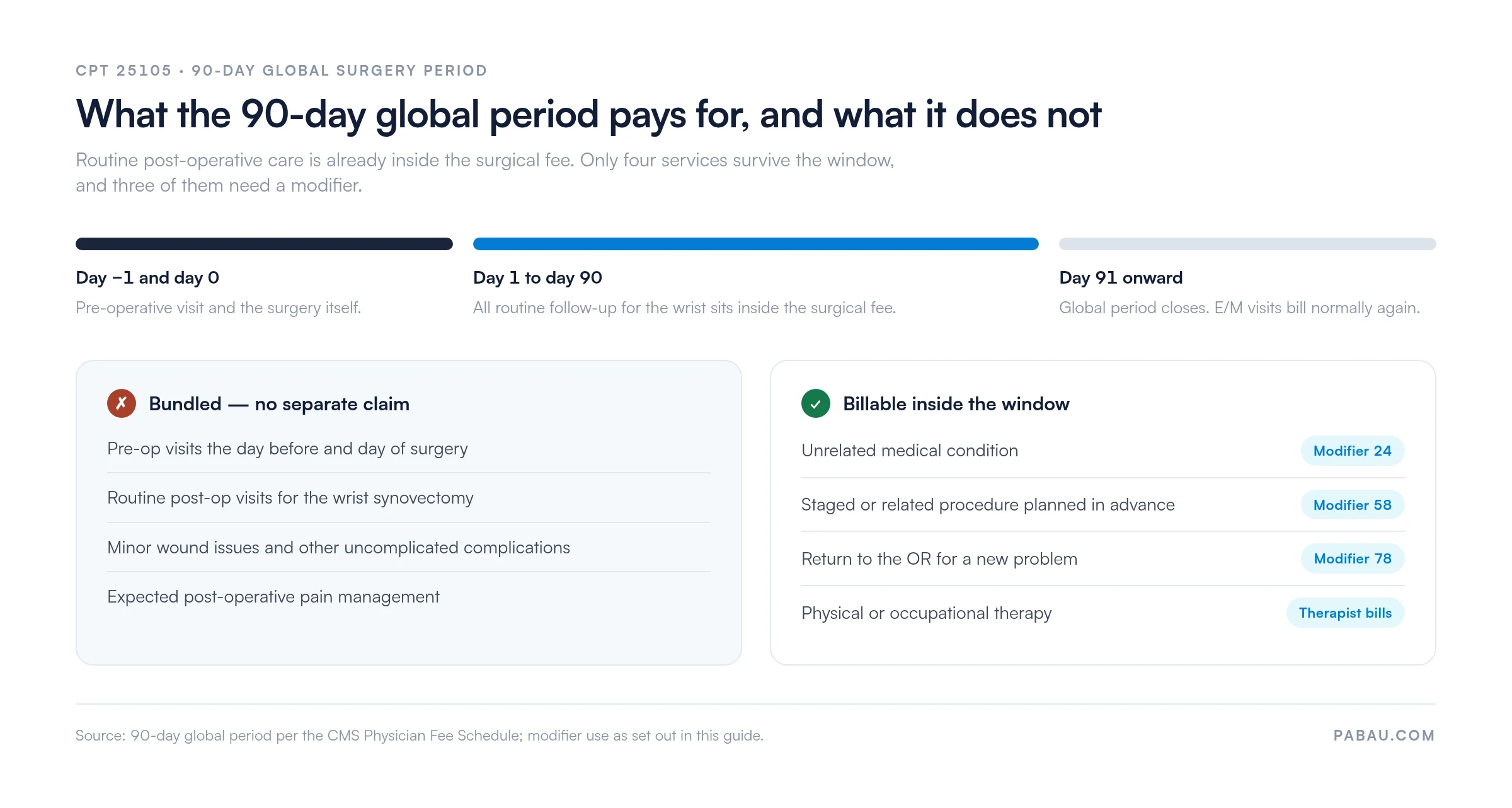
What is included in the global period:
What can be billed separately during the global period:
The superbill documentation for global period services must state the modifier. It also needs a brief note linking the visit to the original surgery, or explicitly separating it. Payers review global period claims carefully. Data from electronic remittance advice shows global period bundling among the most frequent adjustment reason codes for surgical claims.
Selecting the right code from the wrist arthrotomy family depends entirely on what was documented in the operative note. The table below helps coders working across orthopedic and physical therapy practices choose the most accurate code.
The most frequent upcoding risk involves billing 25105 when the operative note only documents a simple arthrotomy for biopsy or drainage. If the surgeon did not explicitly perform synovectomy, CPT 25100 is correct. Consult the AAPC Codify CPT lookup to cross-reference descriptions and verify code selection before submission.
CPT code 25105 has a higher-than-average denial rate for a surgical code, largely because of thin documentation and modifier misuse. Naming the pattern lets billing staff fix the root cause instead of resubmitting the same claim. Effective denial management workflows start by categorizing why claims for a specific code fail, then correcting the upstream documentation process.
The most common errors:
Review common denial codes in medical billing to see which adjustment reason codes your ERA returns for these errors. Each code points to a specific fix. CO-4 flags an incorrect modifier, CO-50 a medical necessity denial, and CO-97 a bundling adjustment.
Commercial payers, Medicaid managed care plans, and workers’ compensation carriers each set their own coverage rules for CPT 25105. Prior authorization requirements differ too. A claim that sails through Medicare may be denied by a commercial plan using a stricter definition of conservative treatment failure. Strong medical billing compliance means checking the payer’s policy before the surgery is scheduled, not after the denial.
Key payer-specific considerations:
Use insurance eligibility verification workflows to confirm active coverage, plan type, and authorization requirements before the surgical schedule is finalized. Tighten revenue cycle management at the front end. A denied surgical claim costs far more to resolve than a 10-minute eligibility check before booking.
Flag CPT 25105 in your practice management system as requiring prior authorization by default. Set an automated workflow to prompt staff to confirm PA status. It should fire 7 days before any scheduled wrist arthrotomy.
In most practices the surgical claim and the 90-day follow-up live in separate systems. The operative note sits in the chart. The claim sits with the biller, and the post-op appointments sit on the calendar. Nobody is checking whether a day-40 wound check is about to go out as a billable E/M.
Pabau keeps all three against one patient record. Claims go out electronically through the Claim.MD integration, which reaches thousands of US payers and returns eligibility responses in real time. Remittance advice returns to that same record, so a CO-50 on a 25105 claim lands beside the operative note behind it.
The payoff is fewer surgical claims reworked by hand. Billing staff catch a missing laterality modifier before submission rather than 30 days later. Practices adding orthopedic codes to their fee schedule can also review credentialing requirements before the first claim goes out.

Pabau’s claims management tools help orthopedic and hand surgery practices submit cleaner claims and track denial patterns. Post-operative billing across the 90-day global period stops needing manual follow-up.

Almost every 25105 denial traces back to the operative note rather than the claim form. If the note names the synovectomy, the compartments entered, the laterality, and the conservative therapy that failed, the coding decisions after that are mechanical.
The trade-off worth remembering is timing. Verifying coverage and prior authorization costs ten minutes before the surgery is booked, and unwinding a denied surgical claim costs weeks. Build the check into scheduling rather than into your denial queue. Book a demo to see how Pabau validates surgical claims and tracks denials across the 90-day global period.

Need to understand how clearinghouse claims submission works? Medical claims clearinghouse guide explains the role of clearinghouses in validating and routing surgical claims to payers.
Want to reduce claim rework across all surgical CPT codes? How to submit a clean claim covers the documentation and coding requirements that prevent denials before submission.
Managing billing for orthopedic or musculoskeletal procedures? CPT code billing guides provide structured reference material for coding staff working across multiple surgical specialties.
CPT code 25105 is the surgical procedure code for arthrotomy of the wrist joint with synovectomy. The surgeon makes an incision into the wrist joint and removes diseased synovial membrane tissue. It is classified by the AMA under Excision Procedures on the Forearm and Wrist, within the Musculoskeletal System chapter.
Modifier 50 (bilateral) applies when both wrists are operated on in the same session. Modifier 51 (multiple procedures) applies when 25105 runs alongside another separate surgical procedure. Modifier LT or RT identifies the side operated on. Modifier 59 may bypass NCCI bundling edits where the services are genuinely distinct. Always verify modifier 59 use against current NCCI edits before submitting.
Approximate national facility rates range from $350 to $550, and non-facility rates from $550 to $750, based on published CMS MPFS data. Actual payment is adjusted by GPCI for each MAC region. Use the CMS Physician Fee Schedule lookup or the FastRVU tool to obtain the current rate for your specific locality.
CPT 25105 carries a 90-day global surgery period. During this window, routine post-operative follow-up visits are bundled into the surgical fee and cannot be billed separately. Separate billing during the global period is only permitted for unrelated conditions (modifier 24), staged procedures (modifier 58), or return-to-OR complications (modifier 78).
CPT 25100 covers arthrotomy of the wrist joint with biopsy, used when the joint is opened but the synovial membrane is not excised. CPT 25105 requires that the surgeon explicitly performs and documents the removal of synovial tissue. Billing 25105 when the operative note only supports 25100 is upcoding and an audit risk.
The work RVU for CPT 25105 is approximately 8.40, reflecting the surgical complexity and time involved. Total RVUs (including practice expense and malpractice components) vary by place of service. Use the FastRVU lookup tool or the CMS Physician Fee Schedule to obtain current RVU values and calculated Medicare payment amounts for your locality.
The most common pairings are M06.031 and M06.032, rheumatoid arthritis without rheumatoid factor of the right or left wrist. M65.831 and M65.832 cover other synovitis and tenosynovitis of the right or left forearm, since ICD-10-CM has no wrist-specific code in that family. Always select the laterality-specific code and verify acceptance against your MAC’s current LCD before submitting.



