CPT code 93503: Swan-Ganz catheter billing and modifiers
CPT code 93503: Official descriptor and procedure overview In the AMA CPT code s...

Last Updated: Oct 23, 2026
D0330 is the CCSD code for pinnaplasty, the surgery that reshapes and sets back a prominent ear. One code covers one or both ears, so a bilateral operation goes on the claim once.
It sits in chapter 5 (Ear, nose and throat), in the External Ear section of the schedule. Payment turns on the insurer's age limit and plan wording, so check cover before you book the surgery date.
Let Pabau's smart automation suggest the right codes, reduce claim denials, and keep your practice compliant—effortlessly.
Automate repetitive tasks and focus on what matters most—your patients.
Reduce coding errors and ensure compliance with the latest regulations.
Clean claims, fewer denials, and faster reimbursements.
Powerful insights and reporting to help your practice thrive.
HIPAA compliant SOC 2 certified GDPR-compliant Trusted by 4,000+ clinics worldwide

CCSD code D0330 covers pinnaplasty on one or both ears, so a bilateral operation goes on the claim once.
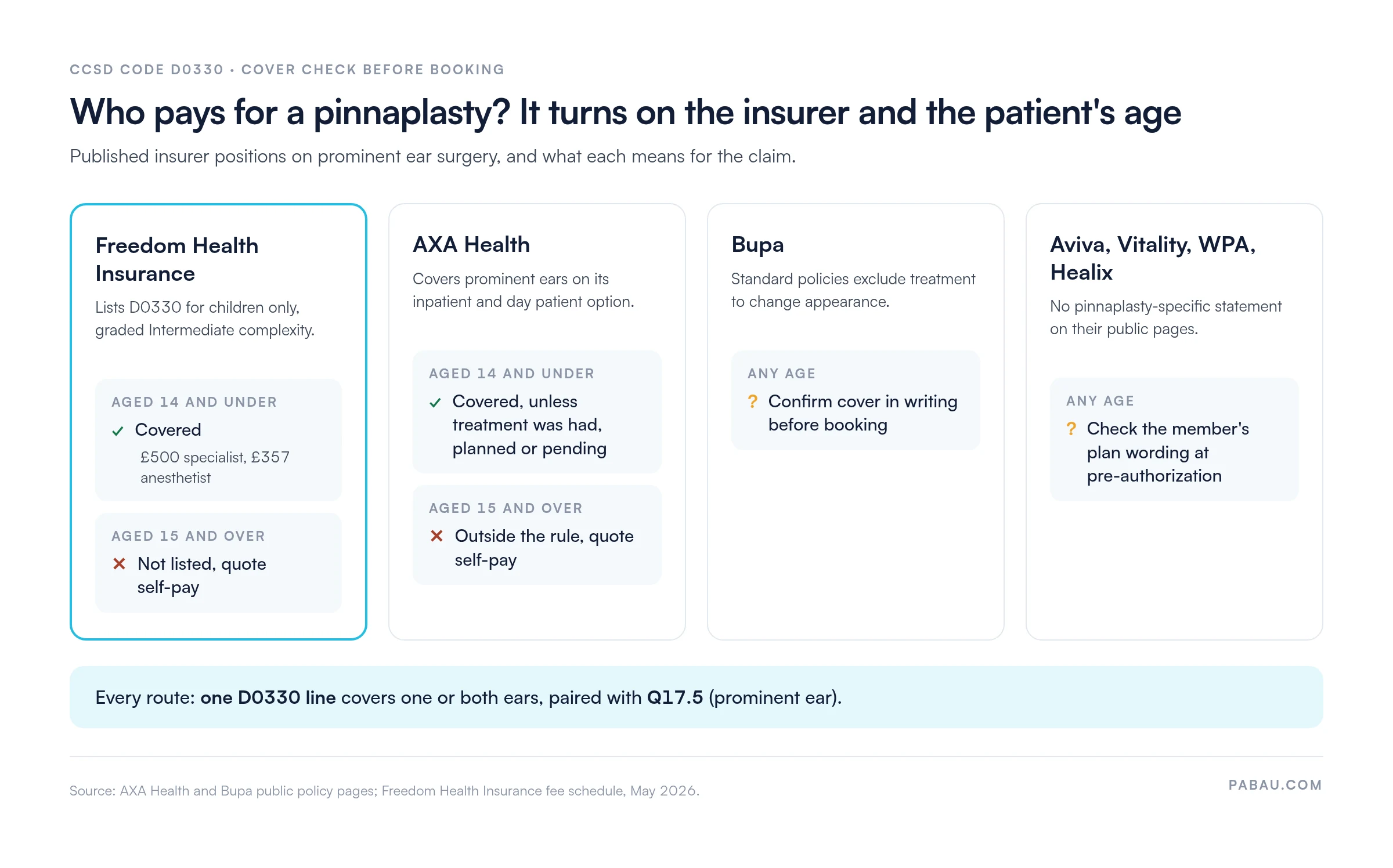
Cover depends on age and plan wording. AXA Health and Freedom Health Insurance both limit prominent ear surgery to children aged 14 and under.
Bupa’s standard policies exclude treatment that changes appearance, so confirm adult cover in writing before you book the date.
A consultation letter that records distress, function and a measured prominence makes the medical case far easier to approve.
Check the patient’s age on the planned surgery date, because a child referred at 14 can turn 15 before the operation.
CCSD code D0330 is the UK private insurance code for pinnaplasty. The operation reshapes the ear cartilage and sets a prominent ear closer to the head. The official descriptor reads “Pinnaplasty (including bilateral)”, and that wording matters. One claim line covers one ear or both, so a bilateral case never goes in as two units.
D0330 sits in chapter 5 (Ear, nose and throat) of the schedule, in the External Ear section. The Clinical Coding and Schedule Development (CCSD) group maintains it. Insurers such as Bupa, AXA Health, Aviva, Vitality, WPA and Healix use it for surgeon and anesthetist claims. Our guide to CCSD codes shows how the chapters fit together.
The code alone does not decide payment. Each insurer sets its own fee and its own view on whether ear correction is cosmetic. That second question settles most D0330 claims, so it gets its own section below.
Surgeons use several pinnaplasty techniques, and the code stays the same for all of them. Insurers still read the op note to confirm the operation matched the authorization. A typical pinnaplasty includes these steps:
The op note should record which ears were treated, the technique used and the type of anesthetic. Children usually have a general anesthetic, while some adults have the operation under local. Either way, the code is D0330.
Insurers look for a reason beyond appearance. The strongest claims show one or more of these:
NHS commissioning policies make a useful benchmark. Cheshire and Merseyside ICB funds pinnaplasty only for patients aged 7 to 18 who meet criteria like these. Private insurers set their own rules. Still, a letter written to this standard answers most of their questions before they ask.
Insurer policies split three ways. Some cover children up to an age limit, some exclude appearance-changing treatment outright, and many leave it to the plan wording.
The pattern is consistent. A child’s pinnaplasty has a fair chance of cover, while an adult case often ends up self-pay. The chart below maps each outcome by insurer and age. Use it to warn older patients at the consultation, not after the invoice comes back.
UK insurers expect a WHO ICD-10 diagnosis code next to the procedure code. For pinnaplasty, the choice is short.
Avoid a vague ear code when Q17.5 fits. A loose pairing invites a query from the insurer, and every query holds up payment.
Several External Ear codes sit close to D0330. Picking the wrong one changes the fee and can trigger a rejection. A skin tag removed in front of the ear is D0132, for example, and a drained pinna hematoma is D0410.
An ear that is absent or underdeveloped from birth is reconstructed under CCSD code D0310, not D0330.
The descriptors below come from Freedom Health Insurance’s May 2026 schedule.
Bilateral cases cause a separate error. Coders sometimes add a second D0330 line for the second ear. The descriptor already includes both ears, so the insurer reads that second line as a duplicate.
Pinnaplasty sits close to the cosmetic line, so insurers read the file more closely than usual. Send these with the claim, or keep them ready for a query:
Capture the history at the first appointment. A digital form can prompt for the measurement, school concerns and hearing aid problems while the patient is still in the room.

Run through this list before each pinnaplasty claim leaves the practice:
Five minutes on this list costs far less than a resubmission and a second wait for payment.
Each insurer sets its own D0330 fee, and most publish rates only to registered specialists. Freedom Health Insurance is an exception. Its May 2026 schedule grades D0330 as Intermediate complexity.
Because the descriptor includes bilateral surgery, one fee covers both ears. Give self-pay patients a written quote before the date, and confirm insurer rates when you request authorization.
Check which date an insurer’s age limit applies to. A child referred at 14 may turn 15 before the operation, which can take the case outside a 14-and-under rule. Confirm it at pre-authorization, not at invoice.
Here’s how the pieces fit on a typical case. Picture a 12-year-old with Freedom Health Insurance cover and two prominent ears. Classmates tease her, and she has stopped wearing her hair up.
Swap in a 15-year-old and the same file falls outside Freedom’s rule. The practice would then offer a self-pay quote at the consultation, before the surgery date is booked.
These are the errors that send pinnaplasty claims back, and the fix for each one.
A pinnaplasty claim draws on several records. The age check and authorization sit with the booking, the letter and photos with the consultation, and the op note with the surgery.
Pabau holds them all on the patient record. Your team logs the authorization number on the booking, and forms capture the history before surgery. Pabau’s claims management software then sends the invoice to the insurer through Healthcode from the same screen.
Your team stops chasing paperwork after the operation. Claims leave the practice complete, and fewer of them come back.

Pabau logs authorization numbers, keeps letters and op notes with the patient record, and sends CCSD-coded invoices through Healthcode. Your D0330 claims reach insurers complete.

D0330 is easy to code and harder to get paid. One line covers both ears, and the diagnosis is usually Q17.5. The work that decides payment happens before surgery.
Check the age limit and the plan wording at the consultation. Write the letter so a reviewer sees function, distress and a measurement, not appearance alone. If cover looks unlikely, offer a self-pay quote that day. Patients take that news better in the consultation room than on a returned invoice.
Book a demo to see how Pabau keeps authorizations, letters and op notes together for every CCSD claim.

Coding other external ear surgery? CCSD code D0140 covers excision of a preauricular sinus and the infection history insurers expect.
Is it a skin tag rather than a prominent ear? CCSD code D0132 covers excision of a preauricular appendage.
Need the full schedule for Bupa claims? Bupa CCSD codes reference walks through the schedule chapter by chapter.
Comparing insurer fees? Bupa procedure code fee schedule explains how allowed amounts work for common CCSD chapters.
Yes. Otoplasty and ear pinning are other names for pinnaplasty, and UK insurers take all three under CCSD code D0330. The term on the op note does not change the code.
OPCS-4 code D03.3 covers pinnaplasty, including correction of a prominent ear. NHS hospitals record that code, while UK private insurers pay against CCSD code D0330. The CCSD number follows the OPCS one, which is why the two look alike.
Usually, yes. NHS trusts such as Evelina London run pinnaplasty as a day case, and most patients go home the same day. That fits the day patient cover AXA Health offers for children aged 14 and under.
NHS policies usually set a lower limit of 5 years, because results in very young children are less predictable. Royal College of Surgeons guidance uses age 5, while Cheshire and Merseyside ICB sets its NHS minimum at 7.