ICD-10 Code Y76.0: Diagnostic obstetric and gynecological devices
ICD-10 Code Y76.0: Definition and billable status ICD-10 Code Y76.0 is a valid, ...

Last Updated: Oct 23, 2026
Billable Code Specific Code
S63.004D is the billable ICD-10-CM code for unspecified dislocation of right wrist and hand, subsequent encounter.
That last letter is where follow-up claims break down, because it tracks the phase of care instead of the visit number. Bill D on a visit that reads like active treatment, and the payer has grounds to reject it.
Let Pabau's smart automation suggest the right codes, reduce claim denials, and keep your practice compliant—effortlessly.
Automate repetitive tasks and focus on what matters most—your patients.
Reduce coding errors and ensure compliance with the latest regulations.
Clean claims, fewer denials, and faster reimbursements.
Powerful insights and reporting to help your practice thrive.
HIPAA compliant SOC 2 certified GDPR-compliant Trusted by 4,000+ clinics worldwide

S63.004D is the billable ICD-10-CM code for unspecified dislocation of right wrist and hand, subsequent encounter.
It is a dislocation code rather than a sprain code, and sprains of this region sit in S63.5, S63.6, S63.8, and S63.9.
Laterality is fixed as right, and the word unspecified refers to the joint that was displaced.
The 7th character D marks routine healing care after active treatment for the dislocation has finished.
Pabau’s claims management software records ICD-10 detail at the point of care, so follow-up claims keep the encounter intact.
S63.004D is a valid, billable ICD-10-CM code for unspecified dislocation of right wrist and hand, subsequent encounter. The right side comes from the code itself. Unspecified means the record never names which wrist or hand joint was displaced.
The patient is also past active treatment. Instead of the treatment phase, the 7th character D places the visit in the healing and recovery phase.
According to the Centers for Medicare and Medicaid Services (CMS), ICD-10-CM codes are updated every October 1. So check S63.004D against the current fiscal year tabular list before you submit. Code validity and instructional notes can both change between updates.
Read the code left to right and each segment hands you one piece of clinical information. That habit is the fastest way to catch a wrong code before it reaches the claim.
The parent code S63.004 is not billable on its own. ICD-10-CM wants the 7th character before a claim goes out, so a payer will reject S63.004 without A, D, or S attached.
S63.004D describes a dislocation of the right wrist and hand. It never covers a sprain, and it never covers a single named joint. Two swaps produce most of the errors on this code.
The first is the sprain swap. Category S63 does cover both injuries, which is why the two get confused, but they sit in separate subcategories. Subluxations and dislocations occupy S63.0 through S63.2. Traumatic ligament ruptures occupy S63.3 and S63.4. Sprains occupy S63.5, S63.6, S63.8, and S63.9.
The second is the carpometacarpal swap. That specificity exists only on the dislocation side of the category. S63.041 to S63.046 cover the carpometacarpal joint of the thumb, and S63.051 to S63.056 cover the other carpometacarpal joints. Meanwhile, ICD-10-CM has no carpometacarpal sprain code at all.
One more boundary sits at the edge of the category. The Excludes2 note on S63 sends strain of muscle, fascia and tendon of the wrist and hand to S66. Because the note is Excludes2, both codes can be reported when the record documents both injuries.
D reports routine healing care that follows active treatment. The number of visits so far has no bearing on it.
Per the ICD-10-CM Official Guidelines, Section I.C.19.a, each of the three options describes a phase of care rather than a point on the calendar.
Where this goes wrong: the calendar has no say in the character. A patient who comes back for a repeat reduction is receiving active treatment again, so that visit takes the A character. Three weeks later, a cast check with no new treatment delivered takes the D character.
Applying D to a visit where active treatment is still being delivered is a common source of denials. Managing claim denials after the fact costs more time than recording the phase of care at the visit.
The CDC/NCHS ICD-10-CM web tool carries the official tabular list, including the 7th character note printed at the head of category S63.
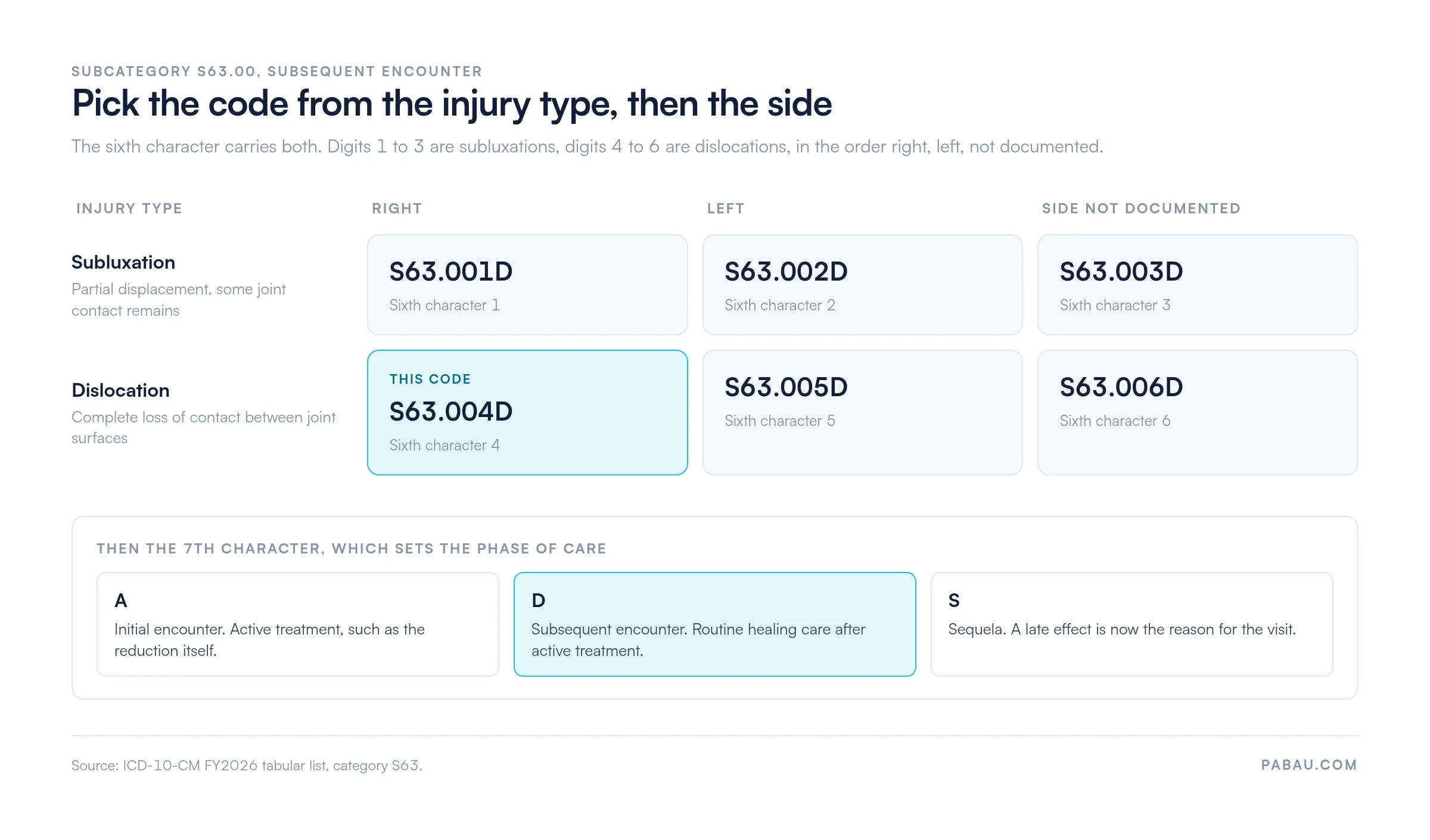
Five codes sit within one digit of S63.004D, and each one names a different injury or a different side. The grid below shows how the sixth character splits the S63.00 subcategory, and where this code lands inside it.
Practices with high musculoskeletal volume work in this block constantly, including sports medicine practices and orthopedic groups. Outside S63.00, the rest of S63.0 names the joint that was displaced.
Each of those subcategories repeats the sixth-character pattern from S63.00. Digits 1 to 3 identify a subluxation of the right, left, or undocumented side. Digits 4 to 6 identify a dislocation in the same order. So once you know the joint and the injury type, the sixth character follows without a lookup.
The same Chapter 19 rules govern the sequela version of this code. ICD-10 code S63.004S covers the identical dislocation once a late effect becomes the reason for the visit.
A dislocation is a complete loss of contact between the surfaces of a joint. A subluxation is a partial displacement, where some contact remains. Because that difference drives the code choice, it belongs in the note in plain words.
Within S63.0 the joints in question are the distal radioulnar, radiocarpal, and midcarpal joints. The subcategory also covers the carpometacarpal joints, the proximal end of a metacarpal, and the distal end of the ulna. Carpal patterns such as perilunate and lunate dislocation usually follow high-energy trauma.
Physical therapy practices see these injuries during the recovery phase, which is exactly the point where the code takes the D character. Typical mechanisms include a fall on an outstretched hand, axial loading through the wrist, a crush injury, and contact sport trauma.
Carpal stability often gets rechecked as motion returns, and the Watson test is the usual maneuver for scapholunate instability. Findings like that one also decide whether the visit still counts as healing care or has moved on to a late effect.
ICD-10-CM asks for the most specific code the documentation supports. If the note names the joint, use the joint-specific code. A dislocated right radiocarpal joint is S63.024D, and a dislocated right thumb carpometacarpal joint is S63.044D.
Keep S63.004D for records that confirm the side and the injury type but stop short of the joint. The AAPC ICD-10-CM code lookup is useful for cross-checking the sixth character inside S63.0.
Accurate selection depends on the codes immediately around S63.004D. The table below covers the ones that come up most often, and how each one relates to it.
The WHO’s ICD-10 browser gives hierarchical navigation of the S63 block, which helps when you are checking where a code sits. If the documentation turns out to describe a sprain rather than a dislocation, ICD-10 code S63.501D is the right-wrist equivalent.
The procedure side has its own pairings. CPT code 26675 covers closed treatment of a carpometacarpal dislocation other than the thumb. CPT code 25676 covers open treatment of a distal radioulnar dislocation.
The ICD-10-CM Official Guidelines for Coding and Reporting set the rules for injury codes. AHIMA, CMS, and the National Center for Health Statistics maintain them jointly.
For S63.004D the relevant parts are Section I.C.19 on injuries, plus the general conventions on laterality and specificity.
A structured note keeps those elements in the same place at every visit. A progress note template is the simplest way to hold that shape across a series of follow-ups.
Consistent documentation is the foundation of medical billing compliance. Payers review encounter-character patterns, and a provider who bills D on visits that read like active treatment will draw attention. The note has to support the character used.
Write the phase of care into every dislocation follow-up note. A single line does the job. Record that the right wrist dislocation was reduced, that active treatment is complete, and that today’s visit is a routine healing review. That wording gives the coder the basis for D and gives an auditor the trail.
The claim travels the same route as any other medical billing submission. One extra decision sits at the start of it, and the rest of the path depends on that decision holding up.
Most rejections on this code trace back to step one. Three problems account for the bulk of them.
A short check before the claim leaves catches all three. Run it while the note is still open.
Practices billing dislocation follow-ups usually lose the encounter detail somewhere between the treatment room and the claim. The note records a routine healing review.
Then the code gets chosen days later by someone reading back through the chart. By then the phase of care is a judgment call rather than a record.
Practice management software like Pabau keeps the diagnosis attached to the encounter that produced it. Pabau’s claims management software supports structured ICD-10 entry at the point of care. The code on an S63.004D follow-up is then the one the treating clinician selected.
US practices submit through the Claim.MD integration, Pabau’s US clearinghouse partner, which reaches thousands of US payers and verifies eligibility before submission. The integration handles 837P claim files and returns 835 ERA remittances into the practice workflow.
Raising the claim in the same system that holds the visit also removes the re-keying step. That matters across a series of follow-ups, where each encounter carries its own date, its own 7th character, and its own supporting note.
Revenue cycle management for injury codes rests on that continuity. A clean claim for a dislocation follow-up needs three things to agree. The 7th character, the CPT code for the service delivered, and the note behind both have to line up.

Pabau’s claims management records ICD-10 detail at the point of care. The Claim.MD integration then submits clean claims to thousands of US payers.

S63.004D is precise about three things and open about one. It fixes the injury type as a dislocation, the side as right, and the phase of care as routine healing. The joint is the only part left open, which is why the code works better as a fallback than as a habit.
So if your notes name the joint, the joint-specific code is the one ICD-10-CM asks for. If they do not, S63.004D is correct, and the fix belongs in the documentation rather than in the coding.
Practices that record the phase of care at the visit, instead of at billing, stop losing dislocation follow-ups to preventable denials. Book a demo to see how Pabau keeps ICD-10 detail attached to the encounter that produced it.

Coding the same injury as a late effect? ICD-10 code S63.004S covers unspecified dislocation of the right wrist and hand once a sequela becomes the reason for the visit.
Documentation says sprain rather than dislocation? ICD-10 code S63.501D is the right-wrist sprain code for a subsequent encounter, and it sits in a different S63 subcategory.
Coding a partial displacement on the left side? ICD-10 code S63.002D is the left wrist subluxation guide, and it walks through the same sixth-character pattern.
Rechecking carpal stability during recovery? The Watson test covers the scaphoid shift maneuver, how to interpret it, and what the accuracy evidence supports.
Record names no injury type at all? ICD-10 code S69.91XS reports an unspecified right wrist injury as a sequela, when the note stays that vague.
Yes. ICD-10-CM does not use aftercare Z codes for injury healing. The injury code carries a 7th character instead, which is exactly what S63.004D does.
There is no fixed time limit. D applies for as long as the patient receives routine care for healing. It ends when the injury resolves, or when a late effect takes over and S applies.
Not with S63.004D. A joint that dislocates repeatedly without fresh trauma belongs in the M24.4- category for recurrent dislocation. Injury codes report the traumatic event.
No. Diagnosis codes take no modifiers, and the sixth character already reports the right side. RT belongs on the procedure line, where the payer’s policy asks for it.
Yes, when the record documents both injuries. Sequence the condition that brought the patient in first. Each code needs the 7th character that matches its own phase of care.
Yes, it sits on the present on admission exempt list. That only affects inpatient claims, so an outpatient follow-up visit is unaffected either way.