CPT code 93503: Swan-Ganz catheter billing and modifiers
CPT code 93503: Official descriptor and procedure overview In the AMA CPT code s...

Last Updated: Oct 23, 2026
CCSD code C7122 is the code UK private insurers use for ultrasound phacoemulsification of cataract with a lens implant in one eye. Topical or local anesthetic is included, and the code covers cataract removal and lens placement at the same sitting.
The operative note decides whether C7122 holds up, and a mismatch is the quickest route to a queried claim. A note with no implant points to C7123. Both eyes in one episode means C7125, and a conversion to extracapsular extraction means C7180. This guide covers what C7122 bundles, how it differs from those neighbors, and what to check before you submit.
Let Pabau's smart automation suggest the right codes, reduce claim denials, and keep your practice compliant—effortlessly.
Automate repetitive tasks and focus on what matters most—your patients.
Reduce coding errors and ensure compliance with the latest regulations.
Clean claims, fewer denials, and faster reimbursements.
Powerful insights and reporting to help your practice thrive.
HIPAA compliant SOC 2 certified GDPR-compliant Trusted by 4,000+ clinics worldwide

CCSD code C7122 covers ultrasound phacoemulsification of cataract with a lens implant in one eye, including topical or local anesthetic.
Code choice across the phaco codes depends on whether a lens was implanted and whether one or both eyes were treated, not on surgical complexity.
C7123 is the unilateral code when no lens is implanted, for example when an eye is left aphakic ahead of a planned secondary lens.
C7125 is the CCSD code for bilateral phaco with implant in one episode, so confirm each insurer’s bilateral rules before billing both eyes.
If a planned phaco converts to extracapsular extraction with an implant in one eye, the claim moves from C7122 to C7180.
Pabau, the practice management platform we build, submits CCSD-coded claims through Healthcode and checks required fields, such as the authorization number, before sending.
CCSD code C7122 is the UK private insurance code for ultrasound phacoemulsification of cataract with a lens implant in one eye. Its official descriptor reads “Ultrasound phacoemulsification of cataract, with lens implant – unilateral (including topical or local anaesthetic).”
The code is maintained by the Clinical Coding and Schedule Development (CCSD) Group. Its schedule is used by insurers such as Bupa, AXA Health, Aviva and Vitality.
Phacoemulsification is the standard technique for cataract removal in UK practice. The surgeon makes a small corneal incision and uses an ultrasonic probe to emulsify the lens nucleus.
The cortex is then aspirated, and a foldable intraocular lens (IOL) is placed in the capsular bag. C7122 covers that whole sequence for one eye, as long as the operation is completed as phaco with an implant.
C7122 sits in Chapter 4 (Eye and orbital contents) of the CCSD schedule, in section 4.9, Lens. Our index of CCSD codes for consultants lists its neighbors. Descriptors and fees are reviewed periodically, so check the current entry in the Bupa code search or your insurer’s own schedule before you submit.
Three questions about the operative note settle C7122 against every neighboring cataract code, as the decision path below shows.
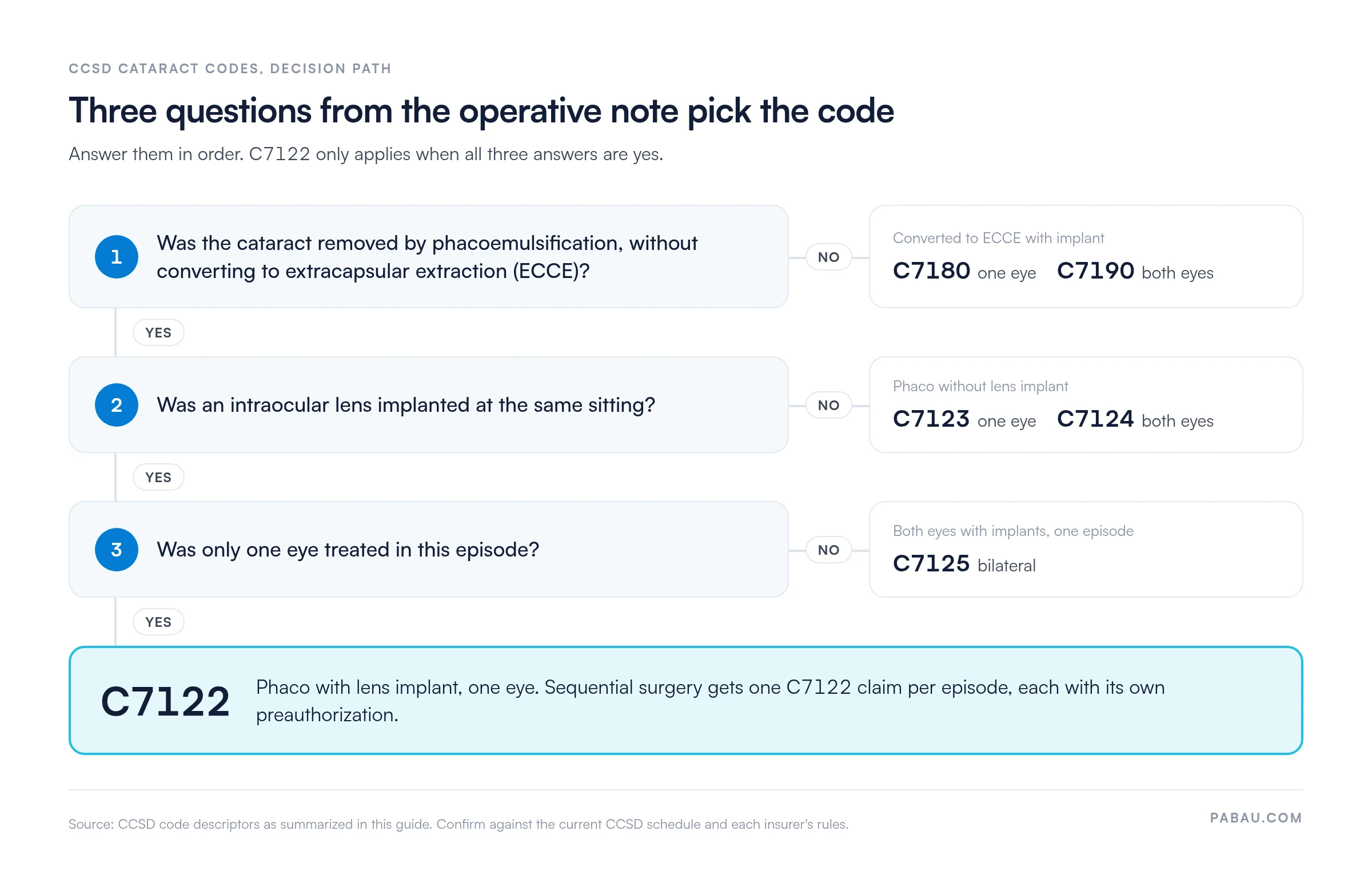
Knowing what is bundled into C7122 prevents both underbilling and unbundling errors. The table separates the components the code covers from those that take a separate code.
Billing the capsulorhexis or wound construction as extra line items alongside C7122 is unbundling. Insurers are likely to reject those lines on review.
C7123 is the CCSD code for phacoemulsification of cataract without a lens implant in one eye. Both codes cover the same phaco technique on a single eye, and both include topical or local anesthetic. The only difference is whether an IOL goes in at that sitting.
Surgical complexity plays no part in the choice. A dense nucleus or weak zonules still codes as C7122 when a lens is implanted. A straightforward case codes as C7123 when the eye is left without one.
Secondary lens implantation is the usual follow-on for a C7123 eye. When that eye later receives its IOL, the second operation is a separate procedure and is not billed as C7122. Check the insurer’s code search for the right secondary implant code.
Let the operative note drive the code. A note that records an implant supports C7122. A note that records none supports C7123. The same implant test runs through the Globe and orbit codes. Enucleation with an orbital implant at that sitting is C0122, and without one it is C0120.
C7125 is the CCSD code for bilateral phaco with implant in one episode. Confirm each insurer’s bilateral rules before you bill both eyes. Its no-implant counterpart is C7124, phacoemulsification without lens implant in both eyes.
Two C7122 lines for both eyes treated in one session describe the same case as C7125, so insurers may query or reject the claim. Sequential surgery is handled differently. When each eye is operated on in a separate episode, each episode is a unilateral C7122 with its own preauthorization and operative note.
Here is how that plays out. A patient has the right eye done in March and the left eye six weeks later. That is two episodes, so you send two C7122 claims, each carrying its own authorization number.
Bilateral policies vary between Bupa, AXA Health, Aviva, Vitality and other UK insurers. Before your first bilateral claim with an insurer, call its provider helpline. Keep written confirmation of the agreed coding in the patient record.
Extracapsular cataract extraction (ECCE) with implant has its own codes, C7180 for one eye and C7190 for both eyes. In ECCE the nucleus is expressed through a larger incision rather than emulsified ultrasonically. The techniques are clinically distinct, so the codes are never interchangeable.
The distinction matters most when a planned phaco converts to ECCE during surgery. A very dense nucleus that cannot be emulsified safely is the usual reason. The claim must reflect the procedure performed, which for one eye with an implant is C7180.
Some surgeons still choose ECCE for specific cases. The operative note must name the technique, because a C7122 claim for an ECCE is a coding error with audit consequences.
Most C7122 claims pass through the same six stages. Each stage leaves a record the insurer may ask to see later.
Missing documentation is the most preventable reason a C7122 claim fails. Insurers can request records on audit, and a note that does not describe the procedure billed puts the payment at risk.
Before the claim goes to Healthcode, the patient record for the C7122 episode should hold the items below.
Healthcode is the main electronic billing clearinghouse for UK private medical claims. Claims sent through Healthcode should carry the correct CCSD code, the preauthorization number and the consultant’s GMC number. Incomplete submissions are returned for correction, which delays payment.
A complication changes the code only when it changes what was done to the eye. Treat the scenarios below as general guidance. Verify the code and any evidence requirements against the current CCSD schedule and the insurer’s policy before you submit.
Document every intraoperative complication during or immediately after surgery. A note written days later may be queried on audit. If you add a complication code alongside C7122, record which CCSD schedule edition you used and when the insurer’s provider team confirmed the coding.
UK private medical insurers generally require preauthorization before cataract surgery under CCSD code C7122. The visual acuity threshold, the clinical evidence and the submission process vary by insurer and change over time. Check each insurer’s current provider guidance. Our Bupa CCSD code guide covers the Bupa-specific context.
The table summarizes the general approach of the major UK insurers, based on their published provider guidance. Verify current requirements with each insurer before you request authorization.
Visual acuity thresholds vary by insurer and change periodically. Check the threshold that applies at the point of submission, and share it with your billing team and the patient.
Rejections for CCSD code C7122 fall into a few recurring categories. A pre-submission checklist prevents most of them.
Two minutes with the claim open catches most of the problems above.
The C7122 descriptor includes topical or local anesthetic, so neither is billed separately. That covers anesthetic drops and local blocks given as part of the operation.
Separate billing applies only when an anesthetist provides general anesthesia or care beyond local anesthesia, such as sedation with monitoring. The anesthetist then bills on their own claim under the insurer’s anesthetic codes, and the values vary by insurer.
Facility costs such as theater time, equipment and the lens itself usually sit on the hospital’s account under its own insurer contract. Confirm the split with the hospital before surgery, so the consultant’s C7122 claim carries only the professional fee.
Most C7122 rejections trace back to three records that drift apart: the operative note, the preauthorization and the claim. In many practices they live in separate systems, and the billing team rekeys the code and authorization number by hand.
Pabau’s claims software for consultants keeps all three on one patient episode. The CCSD code, the insurer’s authorization number and the operative note sit together, and claims go out through Pabau’s Healthcode integration. Required fields, such as membership and authorization numbers, are checked before the claim can be sent.
The result is fewer returned claims and an audit trail that is already assembled. When an insurer queries a C7122 claim, the note showing the implant and the eye treated is attached to the same episode.

Pabau links CCSD codes, preauthorization numbers and operative notes on one patient record. Claims go through Healthcode with required fields checked, so fewer come back for correction.

C7122 is one of the more forgiving cataract codes, because case difficulty never moves it. What moves it is the operative note, so that is where your effort pays back.
Settle each insurer’s bilateral rules and preauthorization evidence once, then build them into your booking routine. Hold every note to the checklist above. An auditor’s query then becomes a quick reply with the record attached, rather than a week of chasing the surgeon.
If that routine still lives in spreadsheets and email, it is worth seeing it run in one place. Book a demo to watch a C7122 claim leave with its authorization and operative note already attached.

Leaving the eye without a lens this time? CCSD code C7123 covers unilateral phaco without an implant and how to document the reason.
Treating both eyes in one session? CCSD code C7125 explains bilateral phaco with implants and the insurer checks it needs.
Did the case convert in both eyes? CCSD code C7190 covers bilateral extracapsular extraction with implant.
Need guidance on how Bupa uses CCSD codes for surgical procedures? Bupa CCSD codes covers the Bupa-specific coding and preauthorization context for UK private procedures.
Looking for the full Bupa fee schedule for private surgical procedures? Bupa procedure codes fee schedule provides a structured reference for Bupa reimbursement rates and code requirements.
C7122 is phacoemulsification with a lens implant in one eye, and C7123 is the same procedure without one. Case complexity plays no part. C7123 usually applies when the eye is left aphakic ahead of a secondary lens.
Hospital coders usually record phaco with a lens implant as OPCS-4 C71.2, phakoemulsification of lens, plus C75.1 for inserting the prosthetic lens. A laterality code for the eye treated is added too. Check local coding rules with the hospital team.
The hospital usually bills theater time, equipment and the lens itself under its own insurer contract. The consultant’s C7122 claim then carries only the professional fee. Confirm the split with the hospital before surgery.
No. A YAG capsulotomy for posterior capsule clouding happens at a later episode and is billed under the relevant CCSD capsulotomy code.
The surgeon still bills C7122, because the code only bundles topical or local anesthetic. The anesthetist bills general anesthesia or sedation with monitoring on a separate claim, under the insurer’s anesthetic codes.