HCPCS code E0246: Transfer tub rail attachment billing guide
HCPCS code E0246 covers a rail that clamps to the tub HCPCS code E0246 is the Le...

Last Updated: Oct 13, 2026
E0198 is the HCPCS Level II code for a water pressure pad for mattress, standard mattress length and width. It's a non-powered, water-filled pad that sits on a regular mattress and spreads pressure away from bony areas.
Medicare treats it as a Group 1 support surface under LCD L33830. It pays only when the notes show complete immobility, or limited mobility or a trunk or pelvic ulcer plus a risk factor. Below, we cover those criteria, the KX modifier, and how E0198 differs from E0197, E0185 and E0199.
Let Pabau's smart automation suggest the right codes, reduce claim denials, and keep your practice compliant—effortlessly.
Automate repetitive tasks and focus on what matters most—your patients.
Reduce coding errors and ensure compliance with the latest regulations.
Clean claims, fewer denials, and faster reimbursements.
Powerful insights and reporting to help your practice thrive.
HIPAA compliant SOC 2 certified GDPR-compliant Trusted by 4,000+ clinics worldwide

HCPCS code E0198 covers a non-powered water pressure pad that fits a standard mattress, billed by DMEPOS suppliers.
Medicare pays for it only when the medical record shows the patient meets the Group 1 criteria in LCD L33830.
Missing documentation of those criteria, or an invalid order, causes most E0198 denials.
Add KX only when every coverage criterion is met and documented, and use RR or NU to show rental or purchase.
Code the pad by its fill medium: E0197 is air, E0198 is water, E0185 is gel and E0199 is a dry pad.
HCPCS code E0198 is the code for a water pressure pad for mattress, standard mattress length and width. The pad is filled with water and sits on top of a regular home mattress. It spreads body weight away from bony areas such as the sacrum, hips and heels.
The code belongs to CMS’s HCPCS Level II set, which CMS maintains and updates every year. Medicare treats E0198 as a Group 1 support surface. Coverage follows LCD L33830, which the DME Medicare Administrative Contractors (MACs) publish and can revise, so check it before each billing cycle.
E0198 covers a water-filled pad or overlay that lowers pressure where the body meets the mattress. The pad has to fit a standard mattress. Hospital-size, bariatric or other non-standard pads are not billed under E0198.
Covered under E0198:
Billed under a different code:
The descriptor says “standard mattress length and width” for a reason. A product that doesn’t meet that size can’t be billed as E0198 without risking a descriptor mismatch denial.
Medicare Part B covers E0198 when the patient meets one of three criteria in LCD L33830. Risk of a pressure ulcer on its own is not enough. The notes have to show which route applies.
The four risk factors are:
The record should also hold a care plan set by the treating clinician or home care nurse. Prior authorization rules for DMEPOS change over time, so check the current CMS list when the order arrives.
Most E0198 denials trace back to the supplier file rather than the product. A reviewer reads the order and the notes together, looking for one clear story. Strong medical billing compliance habits make that story easy to follow.
Before you submit, run this check:
A supplier bills E0198 to the DME MAC on the CMS-1500 or its electronic version. The MAC’s automated edits check modifiers, units and place of service first. A claim that fails those edits is rejected before anyone reads the notes.
Units: E0198 is billed as one unit per pad. Never bill more than one unit for a single item. If two separate items go out on the same date, each gets its own line.
Place of service: home (POS 12) is the most common setting. A nursing facility (POS 32) can count as the patient’s home for DME. A skilled nursing facility (POS 31) can’t, so Part B won’t pay for the pad there.
E0197, E0198, E0199 and E0185 share the same descriptor except for one word, the fill medium. The chart below shows how that one word decides the code. Picking the wrong one counts as upcoding or downcoding, whatever the intent.
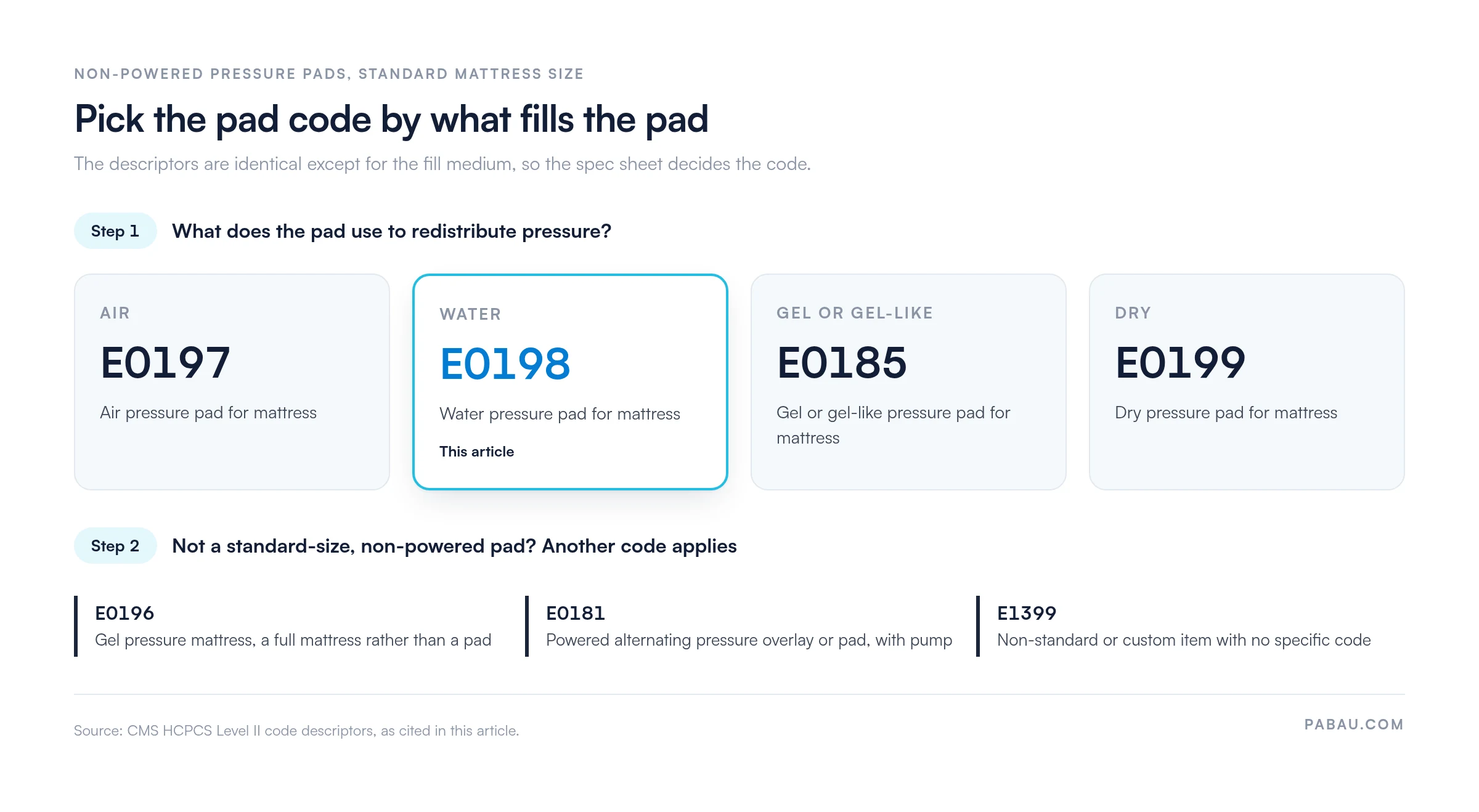
The usual mistake is coding from the product name instead of the spec sheet. A dry pad goes to E0199, even if its cover looks or feels like gel. When a product mixes materials, code it by the medium that does the pressure work.
Not sure how a product is classified? The Pricing, Data Analysis and Coding (PDAC) contractor publishes product coding decisions. Keep the spec sheet in the supplier file either way.
E1399 is the miscellaneous DME code. Use it only when no specific HCPCS Level II code describes the item. A water pad that matches the E0198 descriptor must be billed as E0198, because CMS requires the most specific code.
E1399 fits a narrow case, such as an oversized water pad for a bariatric bed. The claim then needs a detailed written description of the item. Expect more prepayment review, and add a letter explaining why a standard pad won’t work.
Never use E1399 to dodge a modifier or a documentation step. Payers compare E1399 claims with the item description, and a standard water pad will be recoded and denied.
Check the supplier file before every E0198 submission. The product spec sheet should confirm both the water fill and the standard mattress size. One line in the brochure saying the pad is water-filled is a quick audit defense.
Most E0198 denials fall into a short list of preventable causes. Good denial management catches them before the claim reaches the payer.
Medicare appeals run through five levels, and most E0198 disputes end at the first two. Start by reading the denial code reference on the remittance advice. It tells you whether the problem is technical, like a missing modifier, or about medical necessity.
For a medical necessity denial, ask the treating clinician for a short letter. It should explain which Group 1 criterion the patient meets, even if the notes didn’t use the LCD’s wording.
Group 1 surfaces have no fixed list of covered diagnoses. The diagnosis on the claim has to support the criterion that your notes document. The codes below show how that works in practice.
Choose a specific code over an unspecified one where the record allows it. L89.311, a stage 1 ulcer of the right buttock, says far more than L89.90. Multiple sclerosis now needs a type-specific code, such as G35.D when the type isn’t documented.
Medicare pays E0198 under the DMEPOS fee schedule, which CMS updates each January. Look up the current amounts in the CMS DMEPOS fee schedule. The figures change too often to quote here.
Key fee schedule facts for E0198:
For quick code checks, the AAPC HCPCS lookup and PGM Billing’s HCPCS tool both draw on CMS data.
Many practices still keep the order in one folder, the notes in another and the claim in a third system. That split is how a claim leaves without the document a reviewer asks for later.
Pabau, the practice management platform we build, keeps orders, notes and claims on the same patient record. Its claims software for billers helps you submit and track claims from that record. Required claim fields are checked before the claim can be sent.
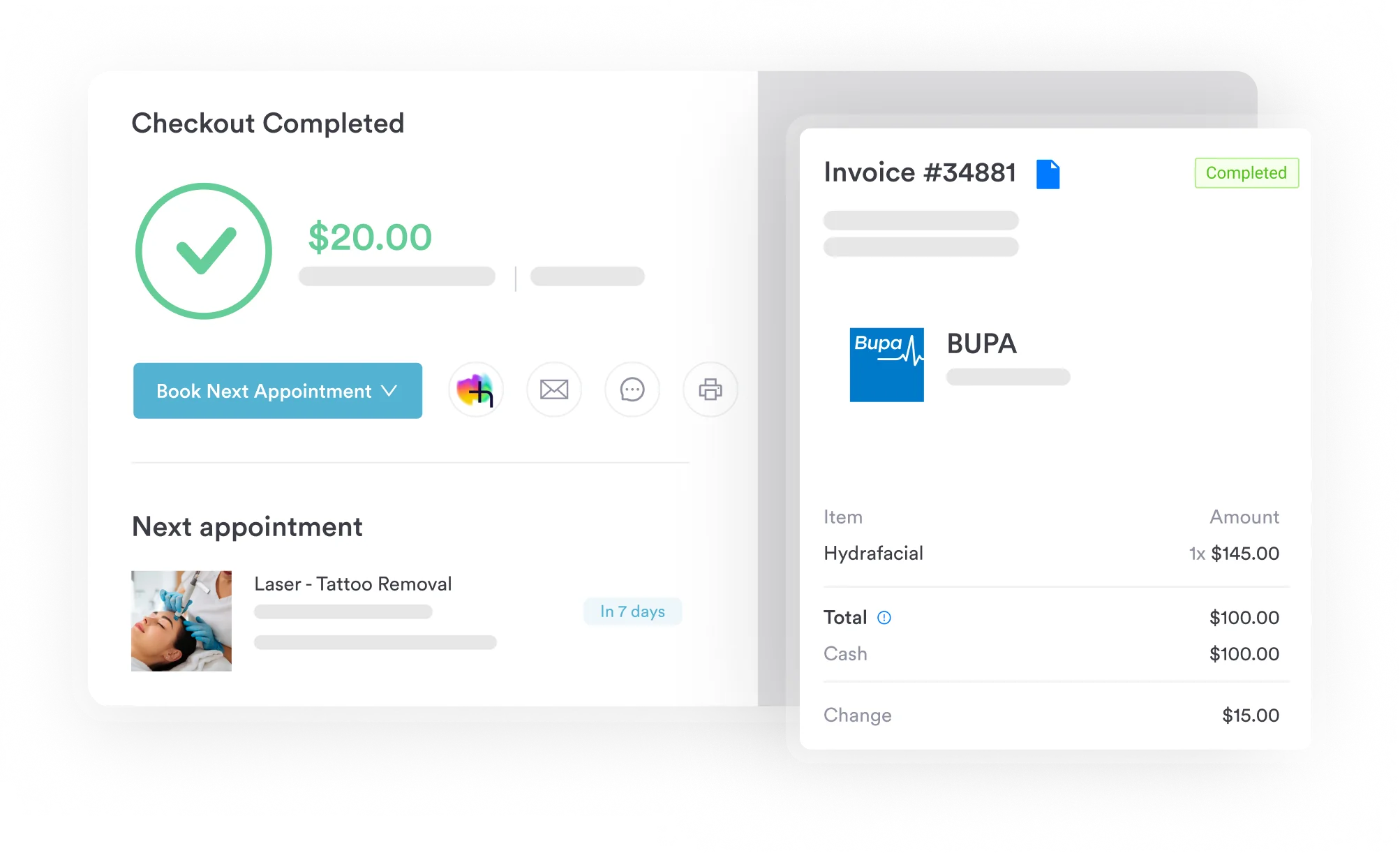
In the US, claims go out through Claim.MD, with eligibility checks and claim status tracking built in. Your team spends less time chasing paperwork and more time on the work in front of them.

Pabau’s claims management software helps teams submit and track claims, with orders and notes kept on the patient record. See how it fits your billing workflow.

E0198 claims rarely fail because of the pad. They fail because the file doesn’t show which Group 1 criterion the patient meets. Fix that at intake, before the pad ships.
Ask for notes that name the criterion, a complete written order and a spec sheet that confirms water fill. Then add KX with confidence, or an ABN when you can’t. Book a demo to see how Pabau keeps orders, notes and claims together for your billing team.

Billing a pad with no air, water or gel fill? HCPCS code E0199 covers dry pressure pads for standard mattresses.
Is the pad filled with gel instead? HCPCS code E0185 explains the gel or gel-like pressure pad code.
Working with an air-filled pad? HCPCS code E0197 walks through air pressure pad billing.
Does the overlay use a pump? HCPCS code E0181 covers powered alternating pressure overlays.
Replacing a pad the patient already owns? HCPCS code A4640 covers replacement alternating pressure pads.
E0198 covers a non-powered water pressure pad or overlay that fits a standard mattress. Air pads use E0197, gel pads use E0185 and dry pads use E0199.
No. CMS has retired DMEPOS CMNs, and Group 1 support surfaces have no CMN requirement. Medicare looks for a standard written order and notes that show the Group 1 criteria.
Not on its own. LCD L33830 uses mobility, ulcer and risk factor criteria, not a Braden cutoff. A Braden assessment can still help document risk factors like poor nutrition or incontinence.
It depends on the facility. A nursing facility can count as the patient’s home for Part B DME. A skilled nursing facility can’t, so Part B won’t pay there.
Medicare generally expects DME to last at least five years. An earlier replacement needs documented loss, theft or damage beyond repair.
Group 1 covers non-powered pads and overlays like E0198. Group 2 covers powered surfaces, with stricter criteria such as large or multiple stage 3 or 4 ulcers on the trunk or pelvis.