HCPCS code E0246: Transfer tub rail attachment billing guide
HCPCS code E0246 covers a rail that clamps to the tub HCPCS code E0246 is the Le...

Last Updated: Oct 13, 2026
E0193 is the HCPCS Level II code for a powered air flotation bed (low air loss therapy). It covers a complete hospital bed with a fully integrated powered pressure reducing mattress, billed to Medicare Part B as a Group 2 support surface.
Timing decides most E0193 claims. Medicare has required prior authorization nationwide since October 21, 2019, so the affirmed decision has to arrive before the bed does. Without it, each monthly rental claim is denied. The sections below cover the coverage criteria, the qualifying L89 codes, the rental modifiers and what to check before you submit.
Let Pabau's smart automation suggest the right codes, reduce claim denials, and keep your practice compliant—effortlessly.
Automate repetitive tasks and focus on what matters most—your patients.
Reduce coding errors and ensure compliance with the latest regulations.
Clean claims, fewer denials, and faster reimbursements.
Powerful insights and reporting to help your practice thrive.
HIPAA compliant SOC 2 certified GDPR-compliant Trusted by 4,000+ clinics worldwide

HCPCS code E0193 covers a complete hospital bed with an integrated powered air mattress, a Group 2 support surface billed to Medicare Part B.
Prior authorization has been required nationwide since October 21, 2019, and an affirmed decision for a support surface is valid for one month.
LCD L33642 covers the bed for stage 2 to 4 pressure ulcers on the trunk or pelvis, or after a recent flap or graft.
Only 52 L89 codes qualify, and stage 1, deep tissue and unspecified stage codes never support the claim.
E0193 is a capped rental, so each monthly line carries RR, a KH, KI or KJ modifier, and KX, GA or GZ.
HCPCS code E0193 pays for a powered air flotation bed that delivers low air loss therapy. The official descriptor from the Centers for Medicare and Medicaid Services (CMS) reads “powered air flotation bed (low air loss therapy).” It sits in the E-code range of Level II HCPCS codes, which Medicare uses for durable medical equipment.
Policy article A52490 defines the product more closely. E0193 is a semi-electric or total electric hospital bed with a fully integrated powered pressure reducing mattress. That mattress must have every characteristic of a powered mattress coded E0277.
So E0193 always includes the bed frame. When a patient needs a powered mattress for a hospital bed they already have, the item is coded E0277 instead.
CMS places E0193 in Group 2 of the pressure reducing support surfaces, alongside E0277, E0371, E0372 and E0373. Heavy duty and bariatric versions are included in the same code, according to A52490.
Support surface codes sit close together, and billing the wrong neighbor sinks the claim. Three questions decide the code: is it powered, is it a bed, mattress or overlay, and which group does it sit in?
In practice, if the patient receives a complete hospital bed with the powered surface built in, the code is E0193. If the powered surface goes on a bed the patient already has, look at E0277 or E0372.
When a Group 1 item, such as the overlay coded E0181, meets the clinical need, the claim belongs under LCD L33830. An air fluidized bed is a separate Group 3 item, billed as E0194 under LCD L33692.
A product that meets neither the Group 1 nor the Group 2 specifications is billed as E1399. That claim needs the manufacturer name and the model name or number. Once the code is settled, the next hurdle comes before the bed ships.
Yes, E0193 needs prior authorization under Original Medicare, and the decision has to come before delivery. CMS added E0193 and the four other Group 2 codes to the Required Prior Authorization List in 2019.
The program started on July 22, 2019 in California, Indiana, New Jersey and North Carolina. It went nationwide for dates of delivery on or after October 21, 2019.
Here is how one E0193 rental moves from order to payment:
An affirmed decision for a support surface is valid for one month, according to CGS, a DME MAC. If the bed isn’t delivered in that window, the supplier submits a new request.
A claim for E0193 without an affirmed decision and a matching UTN is denied. A non-affirmed request can be corrected and resubmitted, and the decision letter names what was missing.
Medicare Advantage and commercial plans run their own authorization rules. Check the plan’s DME policy before delivery, even when the Original Medicare criteria are met. Good medical billing compliance means applying each payer’s policy on its own terms.
LCD L33642 covers a Group 2 surface such as E0193 when the patient meets at least one of three criteria. Only one has to apply, but the record has to show it clearly.
For criterion 3, that discharge from a hospital or nursing facility must fall within the past 30 days.
Criterion 1 is the only route that depends on a failed Group 1 trial. Its treatment program has six named parts, and each one needs to appear in the notes for that month:
Coverage then continues until the ulcer heals. If healing stalls, the notes must show the care plan being changed, or the surface still being needed for wound management.
After a flap or graft, coverage generally runs for 60 days from the date of surgery. A Braden Scale score can support the record, but it doesn’t replace one of the three criteria.
Policy article A52490 lists 52 ICD-10-CM codes that support medical necessity for Group 2 surfaces. Each one is an L89 pressure ulcer code for the back, sacral region, hip or buttock, coded as unstageable or stage 2, 3 or 4.
The codes left off the list matter just as much. None of these supports an E0193 claim on its own:
A quick example shows why the stage matters. A note reading “sacral pressure ulcer, stage 3” supports L89.153. A note that only says “sacral pressure ulcer” codes to L89.159, unspecified stage, which is not on the list.
E0193 is billed as a monthly capped rental, never as a purchase. Medicare pays up to 13 months of continuous rental, and title to the bed then passes to the patient. Across those months, one modifier changes while the rest of the line stays fixed.
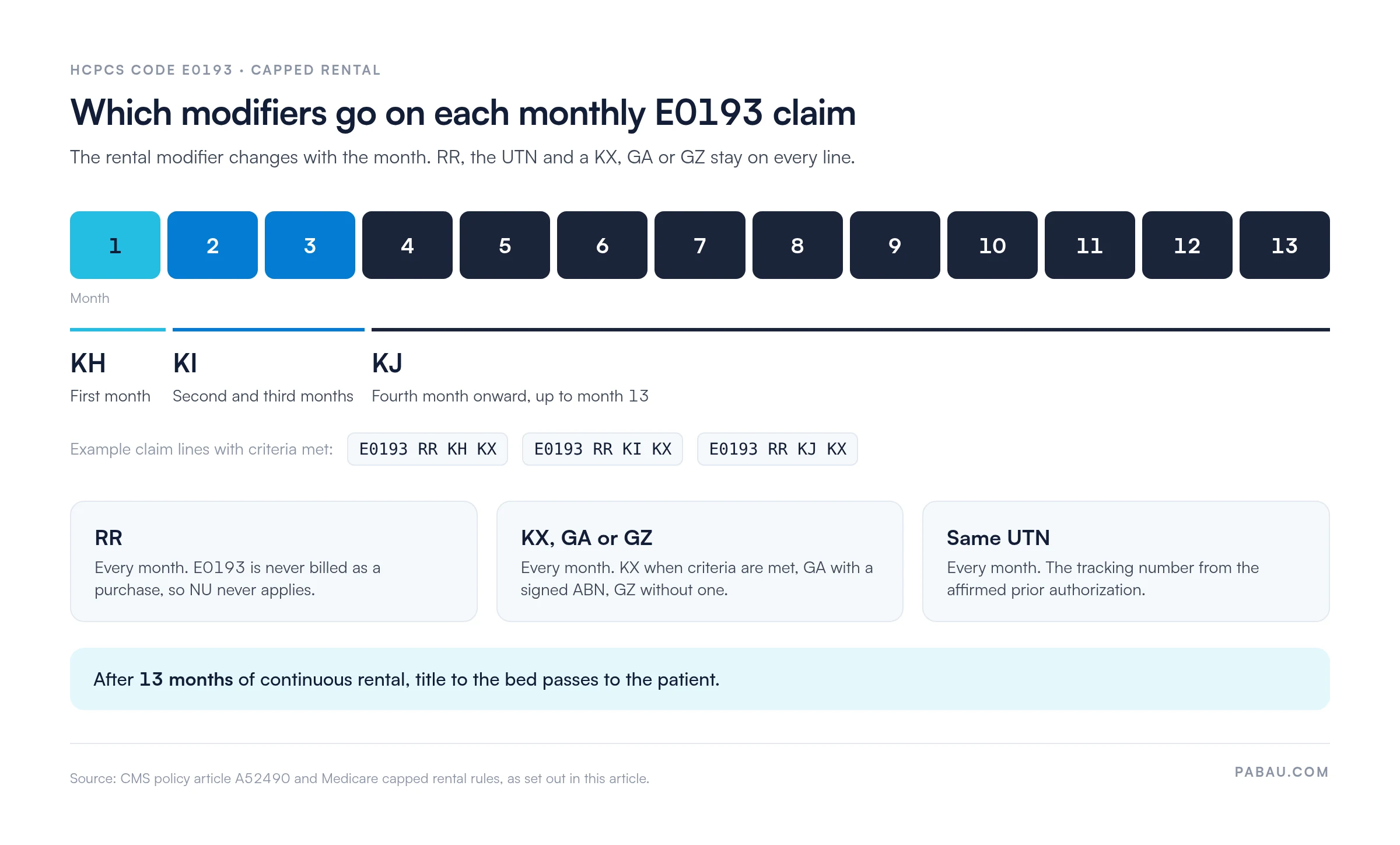
KX, GA and GZ are not optional. A52490 states that a line billed without one of the three is rejected as missing information. NU marks new purchased equipment, so it does not belong on an E0193 line.
Support surfaces need no Certificate of Medical Necessity (CMN). CMS stopped using CMNs for claims with dates of service on or after January 1, 2023.
Bill POS 12 when the patient is at home. During a covered Part A skilled nursing facility stay, the facility is paid for the equipment, so the DME MAC is not billed.
Rates are set by state on the DMEPOS fee schedule, which CMS updates during the year. Pull the current file before quoting a patient or opening a rental.
Under prior authorization, the record has to be complete on the day the request goes out. Keep these items on file before the request, and check them again before each monthly claim:
Store the UTN against the rental series, not against one claim. Every monthly E0193 claim in that series carries the same tracking number, so pull it from the patient record each month instead of retyping it.
The same handful of errors turns up again and again on E0193 claims. Each row below pairs one with its cause and the check that prevents it.
Submitting a clean claim each month is easier once these checks run on a schedule, rather than after a rejection. When one does slip through, a steady denial management routine spots the pattern before next month’s claim repeats it.
A Group 2 rental creates a new claim every month. Each one carries the same UTN and a changing modifier, and a rejected month can sit unnoticed when billing runs across separate tools.
Pabau, the practice management platform we build, keeps patient records and claims in one system. Its claims management software submits claims electronically, through Claim.MD in the US, and tracks each claim’s status until it is paid.
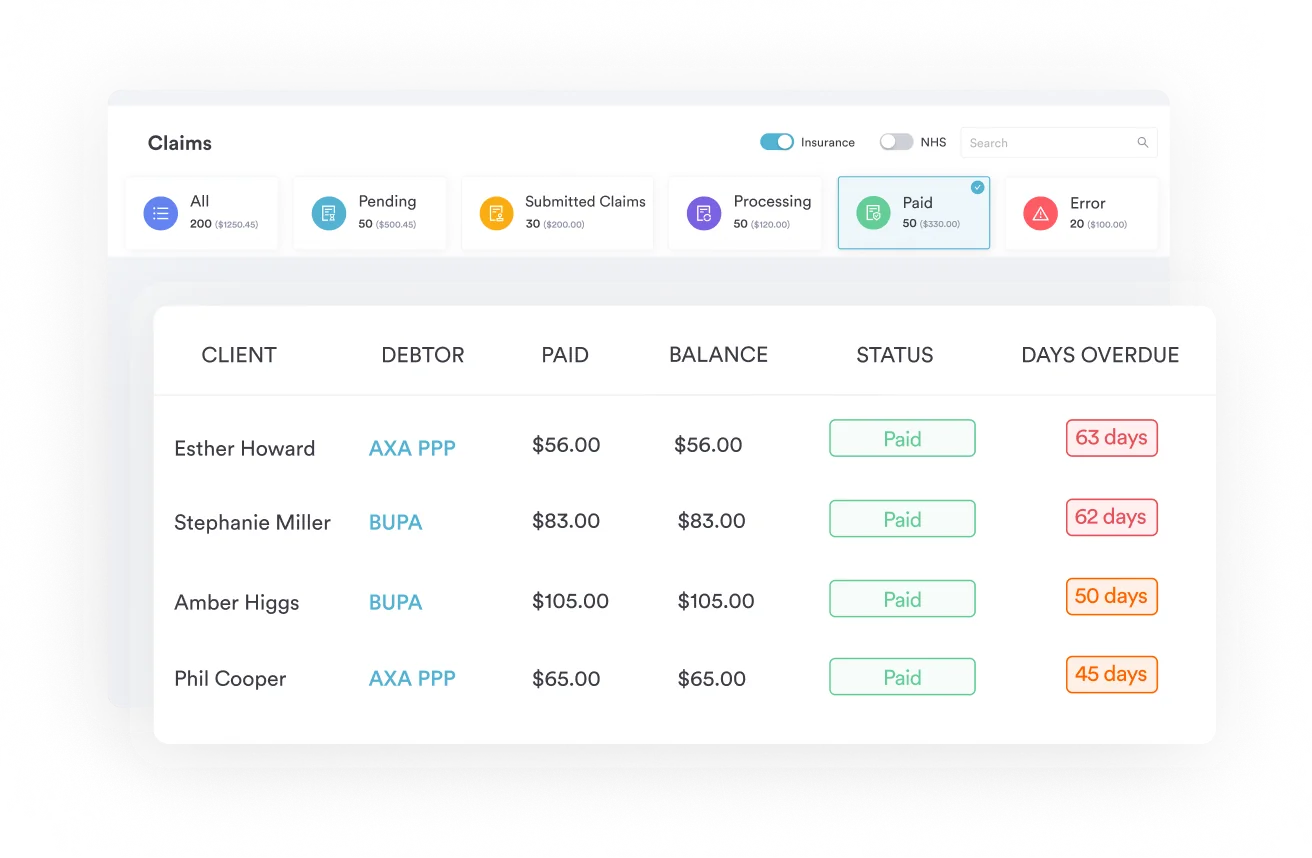
The outcome is fewer rental months lost to silence. Your billing team sees a rejection when it lands, fixes the line, and keeps the series paid through to month 13.

Pabau submits claims and tracks their status next to the patient record, so your team spots a rejected rental month the day it comes back.

E0193 claims are won or lost before the bed arrives. Prior authorization moves the whole review to the front. The record has to prove a Group 2 criterion on the day the request goes out.
The coding choice deserves the same care. A mattress billed as E0277 only fits a patient who already has a hospital bed. When the bed is part of the delivery, E0193 is right, and the notes have to show the ulcer’s site and stage.
Once the UTN arrives, the rental becomes routine work, as long as each modifier follows its month. Book a demo to see how Pabau tracks each E0193 rental claim from month 1 to month 13.

Billing a powered mattress instead of a full bed? HCPCS code E0277 covers the Group 2 mattress that goes on a hospital bed the patient already owns.
Is a Group 1 overlay enough for your patient? HCPCS code E0181 explains the powered alternating pressure overlay and the Group 1 policy behind it.
Need a guide to managing claim rejections? Denial management in healthcare covers how to track, appeal and prevent recurring claim denials.
Want the bigger picture on how claims get paid? What is medical billing explains how a claim moves from order to payment across payer types.
Building a compliance routine for your billing team? Medical billing compliance outlines the documentation and coding habits that keep claims audit-ready.
Yes, when the patient meets one of the three Group 2 criteria in LCD L33642 and prior authorization is affirmed before delivery. A complete bed bills as E0193, while a low air loss mattress for an existing bed bills as E0277.
After the Part B deductible, Medicare pays 80% of the fee schedule amount for each rental month, and the patient owes 20% coinsurance. The amounts vary by state on the DMEPOS fee schedule.
No. A low air loss bed is a Group 2 surface billed as E0193. An air fluidized bed moves warm air through silicone-coated beads, bills as E0194 and falls under the Group 3 policy, LCD L33692.
Coverage continues only while the ulcer is healing or the care plan is being adjusted. Once it heals, the bed no longer meets the criteria, so KX no longer applies to later months.
No. CMS stopped using CMNs for dates of service from January 1, 2023. The supplier still needs a Standard Written Order, notes that meet a Group 2 criterion and an affirmed prior authorization.