CPT code 93503: Swan-Ganz catheter billing and modifiers
CPT code 93503: Official descriptor and procedure overview In the AMA CPT code s...

Last Updated: Oct 23, 2026

CPT code 11622 covers excision of a malignant skin lesion including margins from the scalp, neck, hands, feet, or genitalia.
The excised diameter must fall between 1.1 and 2.0 cm, measured as the lesion plus the narrowest margin taken.
Medicare pays roughly $250 in an office setting and about $144 in a facility, based on 2026 national RVUs.
Missing pathology documentation is the most common reason a claim under this code is denied or reversed on audit.
Practice management software like Pabau handles claims management and fee schedules alongside clinical notes, reducing coding errors on CPT 11622 and related skin codes.
CPT code 11622 covers the excision of a malignant skin lesion, including margins, from the scalp, neck, hands, feet, or genitalia. In addition, it applies only when the excised diameter measures 1.1 to 2.0 cm. In other words, both conditions have to hold at once. Therefore, site alone does not select the code, and neither does size.
This reference covers the billing picture coders need: code structure, 2026 Medicare rates, RVUs, covered ICD-10 diagnoses, modifiers, documentation requirements, and the adjacent codes. In particular.
The American Medical Association publishes the official descriptor as: Excision, malignant lesion including margins, scalp, neck, hands, feet, genitalia; excised diameter 1.1 to 2.0 cm. Specifically, it sits in the Integumentary System section of the CPT code set, within the Excision-Malignant Lesions category (11600-11646).
Three elements must all be true at the same time for the code to apply:
“Including margins” is the critical phrase. In other words, the excised diameter you report is the tissue actually removed, which is the lesion plus the rim of normal-appearing skin around it. Consequently, coding the lesion size alone, without the margins, triggers downcoding audits.
The AAPC’s CPT code reference organizes malignant skin excision codes along two axes: anatomical site and excised diameter. Accordingly, this code sits in the middle diameter band for the scalp, neck, hands, feet, and genitalia group. As a result, reading the full series prevents upcoding and downcoding errors.
These diameter and site thresholds are hard boundaries, not guidelines. For example, a specimen measured at exactly 1.0 cm maps to 11621. Likewise, a specimen between 3.1 and 4.0 cm at the same sites maps to 11624. Per AMA convention, diameter is always measured across the widest dimension of the excised specimen.
The CMS fee schedule tool is the authoritative source for current payment rates. In addition, rates update every January 1 and are adjusted by the Geographic Practice Cost Index (GPCI) for each Medicare locality. Therefore, the figures below are 2026 national averages, so actual payment varies by region and payer.
Both figures come from the 2026 total RVUs multiplied by the conversion factor. Specifically, CMS set two conversion factors for 2026: $33.4009 for most practitioners and $33.5675 for qualifying alternative payment model participants. As a result, that works out to roughly $250 in the office and $144 in a facility.
Non-facility rates run higher because the physician absorbs supplies, staff, and overhead when the excision happens in an office. By contrast, in a facility, the hospital or ambulatory surgical center bills those costs separately. On top of that, GPCI adjustments can move rates 15-30% either side of the national average. For instance, high-cost localities such as Manhattan or San Francisco sit at the top of that range. Co-claiming restrictions in the Australian schedule decide which items can appear on the same day.
Verify your exact 2026 Medicare payment rate using the CMS Physician Fee Schedule Look-Up Tool before billing. Select your MAC locality, enter CPT 11622, and compare facility versus non-facility rates. Rates changed January 1, 2026 and may differ materially from prior-year estimates.
Surgeons billing these codes often run the whole workflow inside dedicated plastic surgery software.
RVU data comes from the CMS relative value files, updated annually. RVUs differ between facility and non-facility settings because the practice expense (PE) component changes. However, the work RVU stays the same in both.
Revenue cycle teams use work RVU data to benchmark physician productivity. For example. It also shows whether the productivity thresholds in a payer contract are being met.
Medicare requires a covered ICD-10-CM diagnosis code to establish medical necessity. For instance, the codes below are commonly accepted under CMS Local Coverage Determinations for malignant skin lesion excision. That said, MAC jurisdiction affects which codes are covered, so check your own MAC’s LCD before billing.
Most MACs accept the D04 carcinoma in situ codes where clinical and pathological evidence supports excision with margins. In turn, picking the code that matches the histological type and the exact body site cuts medical necessity denials. Consequently.
Modifier selection depends on three things. Specifically, those are whether multiple procedures happened on the same date, the laterality of the surgical site, and the provider’s role. Because of that, a wrong or missing modifier is one of the most auditable errors in dermatology excision claims. Therefore, check every rule against current CMS National Correct Coding Initiative (NCCI) edits.
Modifier -51 exemptions apply to certain add-on codes. For example, if the excision needs a separately coded repair. In fact, some repairs are bundled into the excision and cannot be reported separately. The same rule shows up in the intraoral codes, where CPT 40812 carries simple repair inside its own descriptor.
CMS LCD guidance for malignant skin lesion excision (Article ID 57660) sets out what the operative note must contain to survive an audit. As a result, missing any of these elements is the main reason claims for this code fail pre-payment or post-payment review. That’s why good paperless documentation workflows capture these details consistently at the point of care.
Practices using digital intake forms can build these prompts into the clinical workflow, which cuts the incomplete notes that drive denials. In addition.

The codes most often confused with this one are its neighbors on the diameter scale, 11621 and 11623. Meanwhile, the other is 11602, the trunk, arms, and legs counterpart at the same diameter. In every case, each carries a different reimbursement rate. As a result, billing the wrong neighbor is a recoverable audit finding that triggers an overpayment demand.
The boundary at exactly 1.0 cm is a common source of coding disputes. For example, a specimen measuring exactly 1.0 cm is 11621. Conversely, a specimen documented at 1.1 cm is 11622. Therefore, always work from the measured excised specimen, never the clinical estimate made before the procedure.
The 114xx benign excision series and the 116xx malignant series are not interchangeable. For instance, CPT 11422 covers a benign lesion from the same five sites at the same 1.1 to 2.0 cm diameter. Therefore, choosing between the two series means knowing the histological behavior of the lesion before you bill.
Billing 11622 when the pathology comes back benign is a fraud and abuse exposure. That said, where the excision was performed for a clinically suspected malignancy, some MACs still allow 11622 if the suspicion was documented at the time. Even so, check your MAC’s LCD for that scenario and put a written policy in your compliance program. Overall.
Six errors account for most claim denials and post-payment audit findings in this code family. Fortunately, catching them at billing entry stops nearly all of them before submission.
High-volume excision practices benefit from workflows that link the operative note to the claim automatically. In turn, those workflows flag missing pathology and prompt coders to confirm the excised diameter before anyone picks a code.
Review your CPT 11622 claim acceptance rate quarterly. If denials for this code pass 5%, pull a sample and check three root causes. Those are the wrong site category, missing pathology documentation, and improper closure bundling.
Reference sites tell you what CPT code 11622 means. However, getting it onto a clean claim is a separate job, and that is where dermatology practices lose revenue. That’s where practice management software like Pabau joins the two.
Pabau’s billing tools sit in the same platform as clinical notes, pathology tracking, and patient records. As a result, the specimen size recorded in the operative note is there at billing entry. Similarly, the ICD-10 code stays tied to the clinical encounter, and the fee schedule for 11622 is held against payer-specific rates instead of a manual lookup.
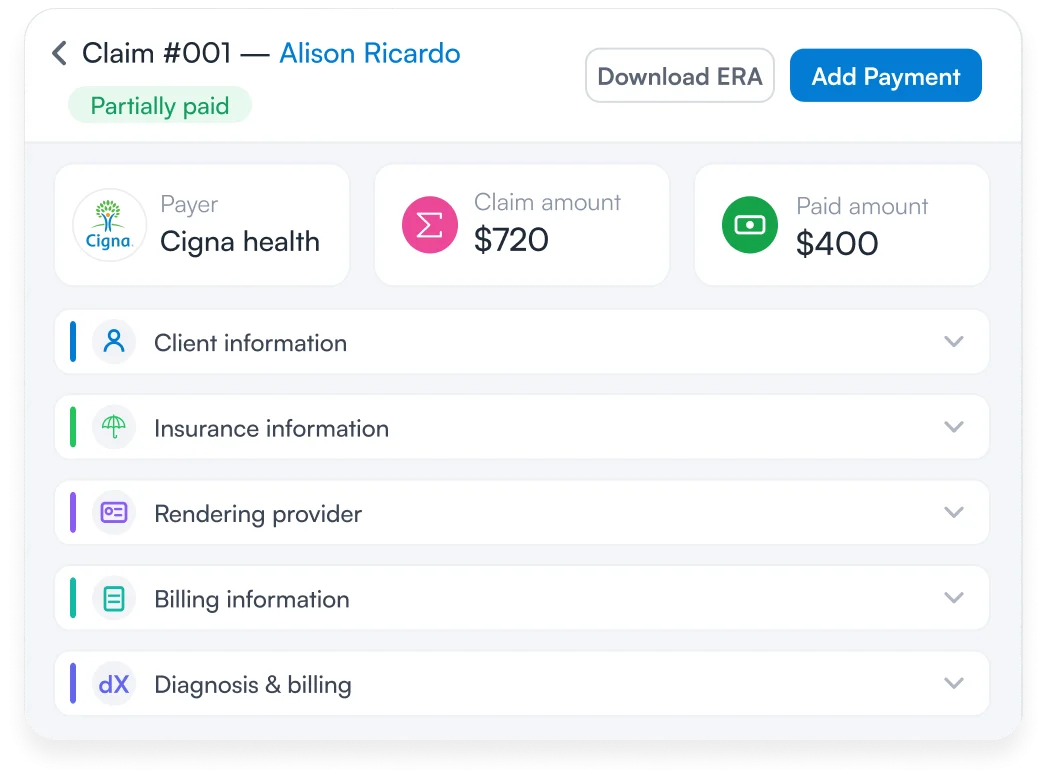
A practice billing 20 to 50 excisions a week cannot cross-check site categories and diameter thresholds by hand on every claim. Instead, integrated billing ties the clinical record to the claim. For teams already on the practice management platform, that removes the rework cycle that follows a coding error caught after submission.

Pabau helps skin clinics and dermatology practices manage CPT code lookup, fee schedules, and claims submission in one platform. Reduce coding errors and claim denials with integrated billing tools built for clinical workflows.

Two measurements decide whether an 11622 claim survives review: the site group and the excised diameter taken from the specimen. Therefore, record both in the operative note and the code picks itself.
Most denials on this code are documentation failures rather than coding failures. Consequently, a practice that captures specimen dimensions, site, closure type, and the pathology result at the point of care rarely ends up arguing with a payer.
Book a demo to see how Pabau links the operative note to the claim for skin lesion excision billing.

Preparing a recipient site after a wide excision? 15005 explains when surgical preparation of the wound bed is separately reportable.
Coding a urethral malignancy? ICD-10 Code C68.0 identifies malignant neoplasm of the urethra once pathology confirms the primary tumor site.
Coding a thyroid malignancy? ICD-10 code C73 covers every histological subtype of thyroid carcinoma, from papillary to anaplastic.
CPT code 11622 reports the excision of a malignant skin lesion, including margins, from the scalp, neck, hands, feet, or genitalia. It applies when the excised diameter is 1.1 to 2.0 cm. The code sits in the CPT Integumentary System section and needs a covered ICD-10 malignant diagnosis on the claim.
The common ones are -59 for a distinct procedural service when bundling edits apply, and -51 for multiple procedures on the same date. Add -RT or -LT for right or left side, and -FA through -F9 to identify a specific finger. Check current NCCI edits before appending -59.
Yes. In a physician office the total RVU payment is higher because the practice expense component is included. In a hospital or ASC the practice expense RVU is lower, because the facility submits a separate claim for overhead. The work RVU of 2.35 is identical in both settings.
The operative note needs the excised specimen dimensions in centimeters with margins included, the specific anatomical site, and the type of closure performed. It also needs a reference to pathological confirmation of malignancy. Keep the correlating histopathology report in the patient record for Medicare coverage.