CPT code 93503: Swan-Ganz catheter billing and modifiers
CPT code 93503: Official descriptor and procedure overview In the AMA CPT code s...

Last Updated: Oct 23, 2026

CPT code 11621 covers excision of a malignant skin lesion on the scalp, neck, hands, feet, or genitalia. The excised diameter has to measure 0.6 to 1.0 cm, margins included.
Measure the specimen at the time of removal. A lesion width taken before the excision will down-code the claim to 11620.
Simple closure is already paid for inside 11621, so a separate repair code triggers an unbundling denial.
Medicare wants a pathology report confirming malignancy, and the code carries a 10-day global period afterwards.
Match the diagnosis code to the site you excised, with laterality wherever the ICD-10-CM code offers it.
CPT code 11621 covers the excision of a malignant skin lesion from the scalp, neck, hands, feet, or genitalia. It applies when the excised diameter measures 0.6 to 1.0 cm, margins included.
That second sentence is where the money goes missing. Payers compare the diameter in your note against the size tier you billed. A lesion measured without its margins usually reads as 0.5 cm or less. The claim then comes back down-coded to 11620, or denied outright when the pathology report is missing.
Two things have to be true before the code fits. The site must be the scalp, neck, hands, feet, or genitalia. The excised diameter, measured with surgical margins at the time of removal, must fall between 0.6 and 1.0 cm. Miss either condition and a different code in the 11600 family applies instead.
Simple repair is already paid for inside 11621, which the American Medical Association states in the CPT guidelines for this family.
Reporting a closure code next to it counts as unbundling, and payer edits catch it automatically. Teams working in dermatology EMR software are better off building that rule into code selection than into a month-end billing review.
The malignant excision family holds 18 codes across three site groupings. Trunk, arms, and legs run from 11600 to 11606. Scalp, neck, hands, feet, and genitalia run from 11620 to 11626. Face, ears, eyelids, nose, lips, and mucous membranes run from 11640 to 11646. Inside each grouping, the excised diameter is the only variable left. Most avoidable denials on this code trace back to eligibility verification that was never run. Risk of complications carries more weight than volume of notes when the visit level is questioned.
The table below covers the codes you meet most often alongside 11621. For the full series with descriptor detail, the AAPC Codify lookup lists every member of the family.
Work in one direction only. Identify the site, then confirm the excised diameter, and never let the pre-excision lesion width pick the code. Confusing the scalp and hands group with the face group is a frequent audit flag. The face-group twin of 11621 is CPT 11641, and it carries a higher payment.
Destruction is a different family altogether. When a lesion is destroyed rather than cut out, the claim moves to the 17000 series. Inside it.
Clinical intent and the pathology report choose the series, not the size of the lesion. The 11400 codes cover benign excision and the 11600 codes cover malignant, so 11621 belongs to the malignant group. At the benign end of the same site-then-size logic sit CPT 11400 and CPT 11443. The benign codes for those same five sites include CPT 11422, which covers an excised diameter of 1.1 to 2.0 cm.
Sequencing matters while pathology is pending. Many practices hold the charge, then bill the malignant code once the report confirms malignancy.
If it comes back benign, the charge moves to the matching 11400-series code and a new diagnosis. At these five sites that series starts with CPT 11420 at 0.5 cm or less. Payer rules on that sequence vary, so confirm the approach with your MAC before making it standard.
Medical necessity for 11621 rests on the diagnosis code you pair with it. Coverage depends on a record that links the excision to a confirmed or suspected malignancy at that specific location. CMS publishes the current code files in its ICD-10 code set, and the pairings below are the ones that come up most.
Specificity is what gets these paid. Pick the code that names the histologic type and the exact location, then add laterality for hands and feet whenever the code offers it. A vague skin-cancer code on a hand excision invites a request for records. The site on the claim has to be the site in the note.
Payment runs through the Resource-Based Relative Value Scale, so the figures below are national averages before geographic adjustment. Your locality shifts them through the Geographic Practice Cost Index. Confirm the number for your area in the CMS Physician Fee Schedule look-up tool before you quote it to anyone.
The gap between those two rows is the biggest variable on this code. Excising in the office earns the practice expense side of the payment.
The same work in a hospital sends that portion to the facility instead. Watch it closely when your surgeons split the week between sites, and re-check both rates each January when the conversion factor changes.
Run an RVU report on your malignant excision codes once a quarter. If collections on 11621 sit below 85% of the Medicare non-facility rate, audit the notes for missing margin measurements and pathology confirmation. Those two items drive most of the underpayment on this code.
Five modifiers do most of the work on this code, and one popular choice is simply wrong. Modifier 50 does not belong on 11621, because the 11600 series is not a bilateral family. Two lesions on two hands are two claim lines, not one bilateral line.
Modifier 22 carries the highest denial risk of the group. The operative note has to say what made the case harder. Scar tissue from a prior excision counts, as does a site over a tendon or an unusually vascular field.
A line reading “complex excision” will not support the modifier. Practices on plastic surgery EMR workflows can prompt for that narrative while the clinician is still in the note.
CMS spells the list out in its billing and coding article A57660 on excision of malignant skin lesions. Each element has to be in the record before the claim goes out, and a missing one is grounds for denial or recoupment on audit.
Medicare sets that bar and most commercial payers follow it closely. Review your largest payers’ coverage policies once a year, since documentation standards shift with the fee schedule. A medical chart audit is the quickest way to find which element your notes keep dropping.
This code has a pathology-shaped wait in the middle of it, which is what separates it from a same-day office procedure. A clean claim follows six steps.
Patient balances get worked in that final step too. Skin cancer excisions often follow a deductible reset, so the patient share on this code can be larger than people expect.
Even with that checklist in hand, six errors keep turning up on this code. Every one of them is preventable in the exam room rather than at the billing desk.
Fix the margin measurement first. Add a required field for excised diameter to the procedure note template, and the number stops depending on who happens to be writing that day. One more boundary is worth knowing. A Mohs case is billed from its own family.
In most practices this checklist lives in somebody’s head. The clinician writes a free-text note, a coder reads it a day later, and the missing diameter only surfaces when the remittance comes back light.
Practice management software like Pabau lets you turn those elements into fields instead. A procedure template can require the excised diameter, the site, and the pathology referral before the note can be signed. Photos and reports attach to the same patient record, so nobody is hunting for a fax on the day the claim goes out.
Pabau’s claims management software then checks the fields an insurer needs, holds the claim until the record is complete, and shows where every submission stands. You get fewer light payments, fewer record requests, and notes that still hold up when an auditor reads them two years later.
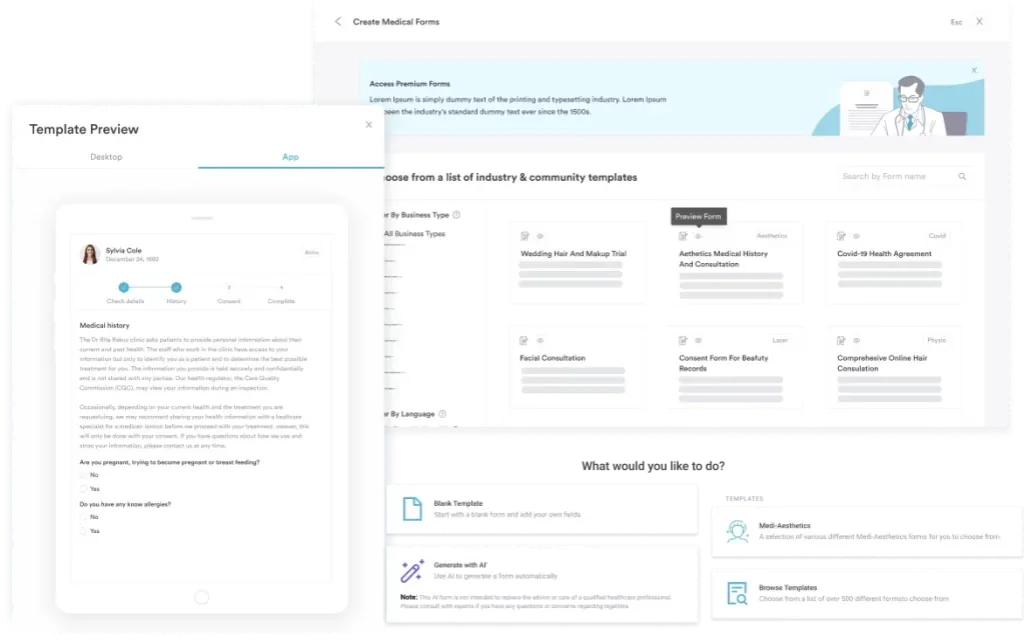

Pabau’s procedure templates prompt for excised diameter, site, and pathology referral inside the clinical note. Your 11621 claims then leave the practice carrying the documentation Medicare asks for.

Nothing about this code is hard to look up. What decides the payment is the measurement, the pathology report, and the diagnosis pairing, and all three get settled in the exam room.
So the real fix is a template change rather than a training day for your coders. Make excised diameter a required field, gate the claim on pathology, and the two largest denial reasons on 11621 drop out of your work queue. The rest of the code is just site and size.
If you would rather not police that by hand, book a demo. You will see how Pabau prompts for margins, site, and pathology before a note can be signed.

Same size band, but the lesion is on the trunk or an arm? CPT 11601 covers the 0.6 to 1.0 cm range for the trunk, arms, and legs.
Coding a benign excision on the trunk instead? CPT 11402 walks through the size tiers and the documentation the benign series needs.
Destroying a premalignant lesion rather than excising it? CPT 17000 explains how the first-lesion and additional-lesion rules work.
Closing a defect that needs more than simple repair? CPT 15276 covers skin substitute application, which is reported separately from the excision.
Documenting a malignant kidney tumor? ICD-10 code C64.1 covers malignant neoplasm of the right kidney, except the renal pelvis, and requires documented laterality.
The office rate includes the practice expense side of the payment, which covers your room, staff, and supplies. That is why the non-facility rate sits around $220 to $230 while the facility rate lands near $100 to $130. In a hospital, that overhead portion goes to the hospital instead.
Ten days. Routine wound checks and suture removal inside that window are already paid for, so a separate office visit will be denied. Use modifier 24 only when you treat something unrelated during those ten days.
Not for the same lesion. When a biopsy and the definitive excision happen in one session on one lesion, only the excision is reported. A biopsy of a different lesion is billable, with modifier 59 to show it was a separate site.
Report the code that matches the diameter of the new specimen, and add modifier 58 for a staged procedure in the global period. Do not add the two excisions together to reach a larger size tier.
Not for the same lesion on the same day. Mohs carries its own staged margin control, so the two approaches are mutually exclusive there. A second lesion at a different site can be reported with modifier 59, subject to your payer’s policy.