HCPCS code E0198: Water pressure pad billing guide
HCPCS code E0198 is a water pad for a standard mattress HCPCS code E0198 is the ...

Last Updated: Oct 13, 2026

CPT Code 17110 covers destruction of 1 to 14 benign skin lesions by any method, including cryotherapy, laser, electrocautery, or chemical destruction.
The lesion count decides the code, so treating 15 or more moves the claim to CPT 17111.
CPT 17110 carries a 10-day global period, so routine follow-up inside those 10 days is not billed separately.
Skin tags and cutaneous vascular proliferative lesions fall outside 17110, so skin tag removal bills as CPT 11200 or 11201.
Practice management software like Pabau cuts 17110 denials by prompting for the lesion count before the note is signed.
CPT Code 17110 covers the destruction of 1 to 14 benign skin lesions in a single encounter, by any method. The count is what separates it from CPT 17111, and it is the element most often missing from the note. A chart that reads “multiple warts treated” leaves the coder guessing.
The official descriptor comes from the American Medical Association’s CPT code set.
Destruction (eg, laser surgery, electrosurgery, cryosurgery, chemosurgery, surgical curettement), of benign lesions other than skin tags or cutaneous vascular proliferative lesions; up to 14 lesions.
AMA CPT descriptor for 17110
The code sits within the 17000-17111 destruction family and applies to dermatology practice management workflows across office and outpatient settings.
Most 17110 denials come down to two rules, the 14-lesion ceiling and the 10-day global period that bundles routine follow-up. Both are documentation problems before they are billing problems.
The code is method-agnostic. Any technique that physically destroys the lesion qualifies, provided the lesion type is benign and the count stays at 14 or fewer. Destruction means the tissue is eliminated, not merely reduced or treated topically.
Explicitly excluded: skin tags (use CPT 11200 or 11201) and cutaneous vascular proliferative lesions. If skin tags are treated in the same session as warts, each procedure family requires its own code. Mixing them under 17110 is a coding error.
Medical necessity for CPT Code 17110 has to be supported by a covered ICD-10-CM diagnosis. The codes below are the ones that carry these claims most often. Payers maintain their own Local Coverage Determinations (LCDs), so verify against your MAC’s current LCD before billing.
Actinic keratosis sits at a coding crossroads. The lesion is premalignant, so 17000 and 17003 usually fit better than 17110. Document the clinical finding clearly, so the diagnosis supports whichever family you bill from.
Unspecified codes invite scrutiny as well. B07.9 is legitimate when the note does not name the wart type, but it gives a reviewer less to work with on medical necessity.
The 14-lesion threshold is the most important rule in this code family. It also causes the most denials, because lesion counts slip when the session runs long.
CPT 17110 and CPT 17111 cannot be billed on the same date of service. NCCI edits bundle them. If a session involves 18 lesions destroyed, bill only 17111. Billing both codes at once creates a duplicate claim and triggers an edit.
Knowing where 17110 sits in the wider family prevents wrong-code submissions. The table below covers the codes most likely to appear in the same billing context. Malignant lesion destruction leaves this family altogether and bills from 17260 through 17286, such as 17271.
Two variables settle the choice, in order. The chart below runs the type first, then the count, which is the sequence that keeps 17110 and 17000 from being swapped.
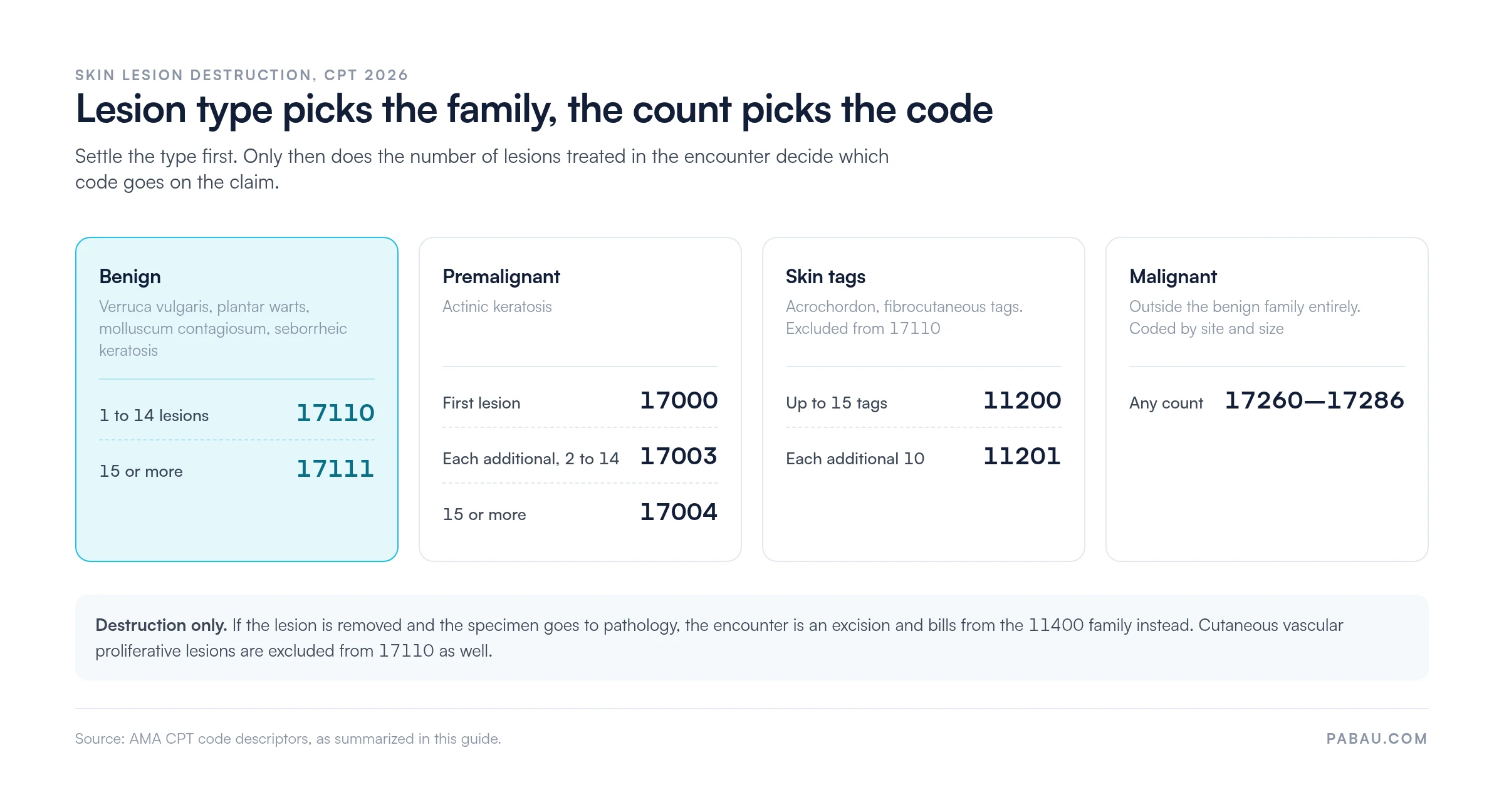
Check whether the lesion is benign vs premalignant before selecting a code family. Seborrheic keratosis and molluscum belong to the 17110/17111 group. Actinic keratosis belongs to 17000/17003/17004. Billing 17110 for actinic keratoses, or 17000 for molluscum, is a mismatched diagnosis-procedure pairing that triggers payer review.
Medicare reimbursement for CPT Code 17110 varies by setting and geographic locality. The 2026 non-facility national average is approximately $105 to $115. That lands near $111, from a total RVU of 3.33 and the 2026 conversion factor of $33.4009.
Facility rates (hospital outpatient, ambulatory surgical center) are lower, because the facility is paid its overhead separately. Check the CMS Medicare Physician Fee Schedule Look-Up Tool for your MAC locality before quoting rates to patients or building revenue projections.
CPT 17110 carries a 10-day global period. Routine post-procedure follow-up inside those 10 days is bundled into the payment for the destruction, so it is not billed separately. An unrelated problem addressed in that window can still be billed when the note supports it. RVU components change annually, so pull current figures for your locality before you build projections.
Modifiers tell payers when a standard code is being billed under non-standard circumstances. For CPT Code 17110, three modifiers appear regularly in dermatology and primary care billing.
Modifier -25 is the most frequently misused modifier in this context. Appending it without a separately documented E/M service creates an audit flag. The visit note must show that the clinician evaluated a condition beyond the lesions being treated that same day.
Most 17110 claims that fail an audit fail on documentation rather than code selection. Payers reviewing these claims look for a specific set of elements. Building those fields into your digital intake forms and note templates prevents omissions at the point of care. Every note supporting a 17110 claim should document the following:
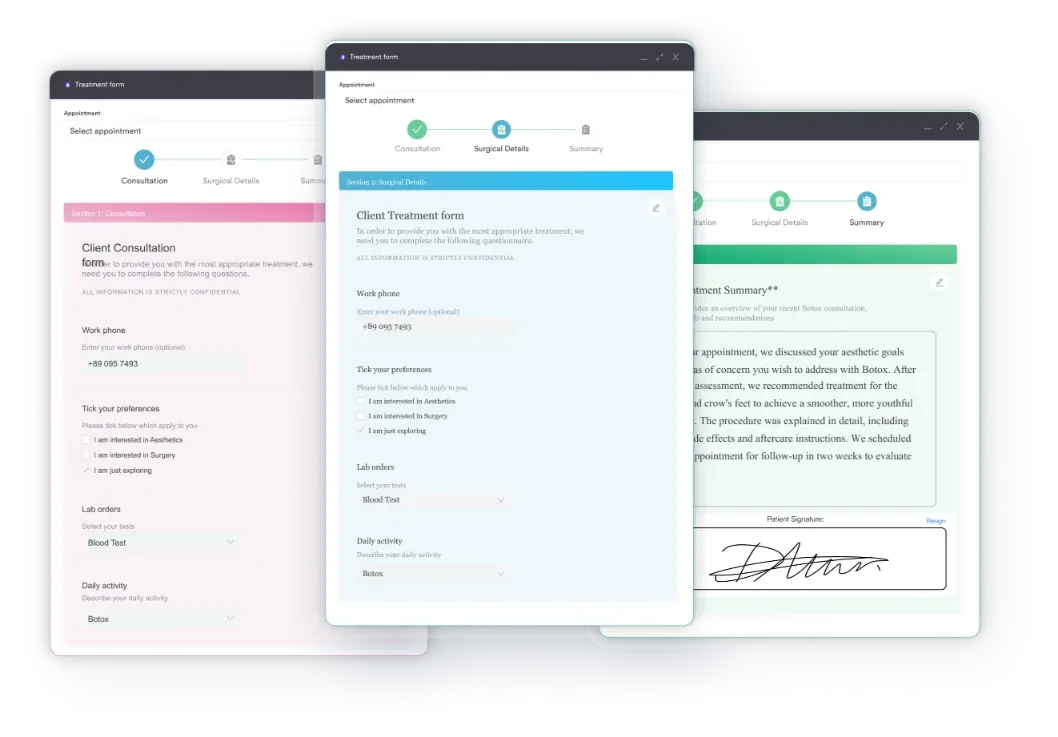
A note that reads only “warts treated” will not survive a payer audit. The coder then has to guess the count, the method, and the necessity, which is how a clean claim turns into a rework queue.
Most 17110 denials are preventable. They cluster around five error types that recur across dermatology and primary care practices. Sound denial management workflows flag them before submission rather than after the payer returns the claim. The denial codes on the remittance name which one you hit.
Run a pre-submission audit on 17110 claims before batch submission. Filter claims where the documentation note does not include a numeric lesion count. That one filter catches the majority of 17110 downcoding and unbundling errors before they generate a denial that requires rework.
Coverage for CPT Code 17110 is not automatic. Payers separate medically necessary destruction from cosmetic removal, and the chart has to support the first. Document that distinction at the time of service, not retrospectively.
Conditions typically covered by Medicare and commercial payers:
Conditions typically denied as cosmetic:
Prior authorization requirements vary by payer and by MAC region. Some Medicare Administrative Contractors carry specific LCD provisions for benign lesion destruction. Review the applicable LCD before treating, particularly for Medicare Advantage patients, whose criteria can run tighter than traditional Medicare. The AAPC CPT code lookup carries payer-specific notes that supplement an LCD review.
The documentation errors that drive 17110 denials are systemic. Providers writing into free-text fields with no structured prompts leave the lesion count out. Coders working from an incomplete note then assign a code without the clinical detail to support it.
Practice management software like Pabau fixes that by building the required fields into the clinical workflow. Pabau’s claims management software connects note completion to claim submission. The count, diagnosis, method, and necessity are on the record before the claim is queued.
From there, the claim leaves the practice electronically through a medical claims clearinghouse. The Claim.MD integration is the submission and status-tracking pathway for US payers. You can see which 17110 claims paid, which are pending, and which came back.
Practices running high volumes of benign destruction carry the same documentation burden wherever they sit. Molluscum in pediatric primary care, plantar warts in podiatry, and seborrheic keratoses in a skin practice all bill the same code. Getting the note right at the point of care keeps revenue cycle management moving without manual corrections at each step.

Pabau prompts for the lesion count, diagnosis, and method inside the note, then submits the claim electronically and tracks its status. See how it fits your billing workflow.

CPT Code 17110 is high-volume work in dermatology and primary care, and its denials are boringly consistent. Three patterns account for most of them: no lesion count in the note, the wrong code past 14 lesions, and skin tags folded in. Fix those habits at the point of care and the billing queue stops absorbing the cost.
The 10-day global period is the one to watch after the fact. Follow-up visits inside that window are already paid for, so billing them separately invites a takeback later.
Pabau structures the note so 17110 claims leave the practice with the count, diagnosis, method, and necessity already recorded. Book a demo to see how that fits your billing workflow.

Destroying a malignant lesion instead? 17276 covers malignant lesion destruction, where the site and size of the lesion drive the code instead of the count.
Sending the specimen to pathology? 11404 shows how an excision is sized and coded, which is the fork 17110 sits on.
Working below the fascia rather than on the skin? 21014 covers soft tissue tumor excision of the face and scalp.
Treating with liquid nitrogen? The cryotherapy aftercare template gives patients written instructions for the method most 17110 claims are billed for.
CPT Code 17110 is used to bill for the destruction of 1 to 14 benign skin lesions in a single encounter, using any method. That includes cryotherapy, electrocautery, laser ablation, chemical destruction, and surgical curettement. Common applications are wart removal, molluscum contagiosum treatment, and seborrheic keratosis destruction. The code excludes skin tags and cutaneous vascular proliferative lesions.
Common ICD-10-CM codes paired with CPT 17110 include B07.0 for plantar wart and B07.8 for other viral warts. B07.9 covers a viral wart of unspecified type, and B08.1 covers molluscum contagiosum. L82.0 and L82.1 cover inflamed and other seborrheic keratosis. The diagnosis must support medical necessity for the destruction. Verify against your MAC current LCD, since covered diagnoses vary by payer.
CPT 17110 is the standard wart removal code for destruction of 1 to 14 viral warts using any method. That covers verruca vulgaris, plantar warts, and flat warts. Use CPT 17111 when 15 or more warts are treated in the same session. The relevant ICD-10 codes are B07.0 for plantar warts, B07.8 for other viral warts, and B07.9 when the wart type is unspecified.
Yes. CPT 17110 carries a 10-day global period, shown as 010 on the fee schedule. Routine post-procedure follow-up inside those 10 days is bundled into the payment for the destruction, so it is not billed separately. An unrelated problem addressed during that window can still be billed when the documentation supports it.