



HCPCS code E0198: Water pressure pad billing guide
HCPCS code E0198 is a water pad for a standard mattress HCPCS code E0198 is the ...

Last Updated: Oct 13, 2026

CPT Code 17276 covers destruction of a malignant skin lesion greater than 4.0 cm on the scalp, neck, hands, feet, or genitalia.
All five approved techniques fall under the same code. Laser, electrosurgery, cryosurgery, chemosurgery, and curettement do not change it.
The record needs histologic confirmation of malignancy, a measured diameter above 4.0 cm, and the exact site in the operative note.
Medicare pays 3.17 work RVUs for 17276 in 2026, with a 10-day global period and a facility rate well below the office rate.
Practice management software like Pabau submits 17276 claims through the Claim.MD clearinghouse, covering eligibility checks, 837P submission, and ERA remittance.
CPT Code 17276 is the billable code for destruction of a malignant skin lesion greater than 4.0 cm. The qualifying sites are the scalp, neck, hands, feet, and genitalia. It is modality-agnostic. Laser surgery, electrosurgery, cryosurgery, chemosurgery, and surgical curettement all map to the same code. Only the body site and the measured diameter decide which code you bill.
This reference walks through the 17260-17286 series, the ICD-10 crosswalk, the 2026 Medicare rates, the modifiers that apply, and the paperwork a reviewer asks for. Dermatology billers and surgical coders get what they need to bill 17276 correctly on the first submission. Pabau’s claims management software submits those claims electronically and tracks the remittance that comes back.
CPT Code 17276 describes the destruction of a malignant skin lesion greater than 4.0 cm located on the scalp, neck, hands, feet, or genitalia. The American Medical Association maintains the CPT code set and writes the descriptor. It covers any technique used to destroy a confirmed malignant lesion at those sites, once the diameter passes 4.0 cm.
A confirmed malignant lesion of the qualifying size at a qualifying site is 17276. The technique makes no difference, whether that is a laser, liquid nitrogen, electrocautery, a chemosurgical approach, or sharp curettement. Benign lesion destruction is a separate family, coded from 17110 onward, so the pathology report settles the code before size or site does.
CPT Code 17276 belongs to the malignant lesion destruction series, which runs from 17260 to 17286. The series splits into three body-site groups, each with six size tiers. A site or size mismatch is the most common error on these claims.
The most frequent site-group confusion involves neck lesions. The neck sits in the scalp/neck/hands/feet/genitalia group, not the face/ears group. A 4.5 cm malignant lesion on the posterior neck is 17276, not 17286. The tiers below 4.0 cm carry their own codes too, so a 0.8 cm scalp lesion is 17271.
The grid below puts the whole series on one axis pair, with the three codes most often billed in 17276’s place marked.
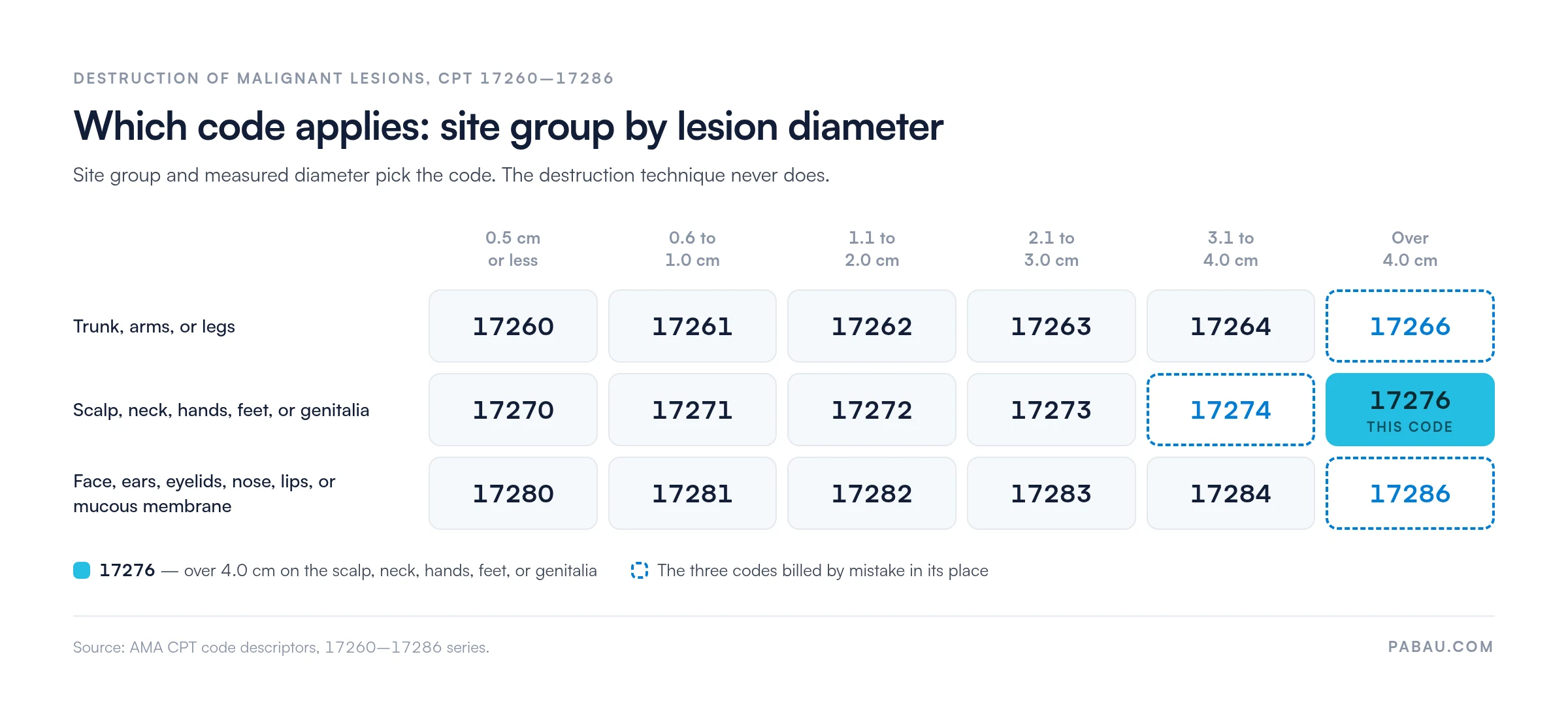
The code descriptor names five modalities as examples rather than as a closed list. No modifier indicates which technique was used. The operative note records it for clinical reasons, but it does not change the code billed.
If a clinician performs a shave removal of a lesion later confirmed malignant on pathology, the correct code is not 17276. Shave removal is coded from 11300 onward. CPT Code 17276 applies when the clinical intent at the time of service is destruction of a known malignant lesion.
Every CPT Code 17276 claim needs an ICD-10-CM diagnosis code that supports medical necessity. The diagnosis has to be written down and confirmed, not suspected. The C44 series carries the skin cancer codes, and the site matters as much as the histology.
ICD-10-CM has no skin cancer code just for the hand or foot. A hand lesion codes to the upper limb group and a foot lesion to the lower limb group, hip and shoulder included.
The laterality digit in this block runs 1 for unspecified, 2 for right, and 9 for left. Most ICD-10-CM laterality blocks put right first, so the habit of typing 1 for right produces an unspecified-side code here.
Code to the histologic type and the site the pathology report gives you. A general malignant neoplasm of skin code without site specificity draws more scrutiny on Medicare and commercial claims. The rules in medical billing compliance cover what a reviewer expects to find behind each pairing.
Medicare pays 17276 under the Physician Fee Schedule, and the work RVU is 3.17 in both settings. Practice expense is what separates them. The figures below come from the CMS July 2026 relative value file, before any geographic adjustment. Check your own locality with the CMS fee schedule lookup or the published relative value files.
The facility rate fell hard this year. Facility practice expense dropped from 2.48 RVUs in 2025 to 1.51 in 2026, taking the facility payment from about $196.99 down to $167.67.
The office rate moved the other way, from $276.24 to $279.23, because the conversion factor rose to $33.4009. Clinicians in a qualifying alternative payment model use $33.5675 instead, which lifts each rate by half a percent.
The 10-day global period folds pre-operative and post-operative visits into the payment. You cannot bill them separately unless they treat an unrelated condition or a complication.
Document every post-operative visit, and use modifier 24 on a separate E/M for an unrelated problem inside that window. Running insurance eligibility verification before the procedure date confirms coverage and the patient’s share.
Run a pre-authorization check and eligibility verification on every malignant lesion destruction case before scheduling. Commercial payers vary widely on coverage criteria for lesions over 4.0 cm. Some want clinical notes or the pathology report before they approve the procedure. Catching a missing authorization before the claim goes out avoids an appeal you are unlikely to win.
Modifier choice here follows National Correct Coding Initiative (NCCI) editing rules. The most common modifiers are listed below, but coders must check current NCCI policy before applying any modifier, since edits update quarterly.
The common mistake is reaching for modifier 59 when XS is the Medicare-only choice. CMS has stated a preference for the X-modifiers over 59. The paperwork needed is the same either way. The operative note has to describe a distinct site or service that justifies separate billing.
Thin paperwork is what drives post-payment audits on malignant lesion destruction codes. A clean 17276 claim needs all of the following in the record before submission. Capture each element at the point of care rather than reconstructing it days later.
Pabau’s dermatology EMR software lets you build clinical note templates that prompt for lesion size, site, and technique. The fields a payer will ask about get captured while the patient is still in the room.
Prior authorization requirements for 17276 vary by payer and plan. Traditional Medicare does not require it for malignant lesion destruction, though Medicare Advantage plans set their own rules. Commercial payers often want pre-authorization on lesions over 4.0 cm. Building the prior authorization process into scheduling is the only reliable way to catch them.
A denial for missing authorization is rarely recoverable without an appeal, and the appeal costs more than the check would have. Confirm authorization before the case reaches the procedure date, not after.
The 17260-17286 series produces a predictable set of errors on Medicare and commercial audits. Structured denial management catches the pattern rather than the individual claim. Our denial codes reference lists the CARC and RARC codes that come back on dermatology claims.
Selecting from 18 codes by hand, across three site groups and six size tiers, is where site and size errors enter the claim. The measurement lives in the operative note, and the code gets picked later from a drop-down. Shortening the distance between those two moments is what reduces the error rate.
Pabau integrates with Claim.MD, our US clearinghouse partner, for real-time eligibility verification, 837P claim submission, and ERA remittance processing. A dermatology practice can check coverage before the appointment, send the claim once the note is signed, and see the remittance post automatically.
Completeness checks flag a claim that is missing a field such as a membership or authorization number. Code choice itself stays with the coder, where the pathology report and the measurement live.
Claims management is part of every Pabau subscription, so the Claim.MD integration needs no add-on purchase. The same submission path serves a single-site dermatology practice and a multi-location skin clinic group. For a descriptor cross-check while you prepare the claim, the AAPC CPT lookup lists the full series.


Pabau submits 837P claims through the Claim.MD clearinghouse, runs real-time eligibility checks, and posts ERA remittance back against the patient record. Completeness checks catch missing fields before a claim leaves the practice.

Three things decide whether a 17276 claim survives. They are a caliper reading in the note, the right site group, and a pathology report dated on or before the procedure. Get those on the chart at the point of care and the coding is arithmetic.
The 2026 figures change one decision. The facility rate is now $167.67 against $279.23 in the office. A practice equipped to do these cases in-office has a clear reason to keep them there.
Pabau submits the claim through Claim.MD and posts the remittance back against the patient record. Book a demo to see how that runs from encounter to payment for a dermatology practice.

Need the punch biopsy code that pairs with a destruction? 11104 covers a single punch biopsy and takes the same separate-site modifier rules.
Shaved a lesion on the hand or scalp instead? 11310 is the shave removal code for that site group, and it is not a destruction code.
Removing a margin rather than ablating the lesion? 11603 sits in the malignant excision series, where a margin specimen is expected.
Referring the case for Mohs surgery? 17313 covers the first stage on the trunk, arms, or legs, billed separately from a destruction.
Want the whole revenue cycle in one place? What is medical billing walks from charge capture through to payment posting.
CPT Code 17276 is the destruction of a malignant skin lesion greater than 4.0 cm in diameter. The qualifying sites are the scalp, neck, hands, feet, and genitalia. Any approved technique counts, such as laser surgery, electrosurgery, cryosurgery, chemosurgery, and surgical curettement.
The lesion diameter must exceed 4.0 cm. A lesion of exactly 4.0 cm or less falls under CPT 17274 for the same body-site group. The measurement must be written in the operative note using a caliper or similar tool.
Both codes describe destruction of a malignant lesion greater than 4.0 cm, but they cover different body-site groups. CPT Code 17276 applies to the scalp, neck, hands, feet, and genitalia. CPT 17286 applies to the face, ears, eyelids, nose, lips, and adjacent mucous membranes. Billing the wrong site group is a common audit trigger.
The C44 series carries the skin cancer codes. C44.41 covers basal cell carcinoma of the scalp and neck, and C44.42 covers squamous cell carcinoma at the same site. ICD-10-CM has no code just for the hand or foot. A hand lesion codes to the upper limb group, so right is C44.612 and left is C44.619. A foot lesion codes to the lower limb group, C44.712 for right and C44.719 for left.



