CPT code 51797: Intra-abdominal voiding pressure add-on
What CPT code 51797 covers CPT code 51797 is the add-on code for intra-abdominal...

Last Updated: Oct 19, 2026

CPT code 15150 reports a tissue cultured skin autograft applied to the trunk, arms, or legs, covering the first 25 sq cm or less.
Add-on code 15151 covers the additional 1 sq cm to 75 sq cm as a single unit, so report it once per session, and never without 15150.
Add-on code 15152 covers each additional 100 sq cm, or part thereof. In practice, it starts once the area passes the 100 sq cm that 15150 and 15151 cover together.
Medicare payment varies by place of service, so confirm the facility or non-facility rate in the current fee schedule before you submit.
Practice management software like Pabau keeps wound size, graft source, and medical necessity in one record. Coders are then not rebuilding the operative detail later.
CPT code 15150 covers the first 25 sq cm or less of a tissue cultured skin autograft applied to the trunk, arms, or legs. In practice, it is the base code in a three-code family, and the two add-on codes that follow it are where skin graft claims usually go wrong.
The two add-ons are not counted the same way. For instance, 15151 covers a range and is reported once. By contrast, 15152 covers an increment and repeats. As a result, coders who treat 15151 as a repeating 25 sq cm block either overstate units on a large graft or leave most of it unbilled.
This reference sets out the descriptor, the RVU components, the modifiers that apply, and the documentation payers expect. Rates are drawn from the CMS Physician Fee Schedule, so confirm the applicable year before you submit a claim.
CPT code 15150 sits within the Integumentary System section of the AMA CPT code set, in the Autografts/Tissue Cultured Autograft category. The American Medical Association maintains the code set and issues annual updates. Even so, the wording of 15150 has been stable across recent cycles.
The official descriptor reads: Tissue cultured skin autograft, trunk, arms, legs; first 25 sq cm or less. Breaking that down into its billing-critical components:
Tissue cultured skin autografts are grown in a laboratory from the patient’s own keratinocytes. As a result, that makes them distinct from allografts, which use donor tissue, and from skin substitute products derived from cadaveric or animal sources. In practice, the distinction matters at the claim level. Specifically, using CPT code 15150 to bill a non-autologous graft misrepresents the procedure and risks recoupment.
Report 15150 once for the first 25 sq cm. Next, add a single unit of 15151 for anything above that, up to a 100 sq cm total. Then add 15152 at one unit for each further 100 sq cm. The two add-ons behave differently because their descriptors are written differently. Specifically, 15151 states a range, so one unit absorbs the whole range. Meanwhile, 15152 states an increment, so it repeats.
Part thereof means a partial increment still bills as a whole unit. For example, a remaining 150 sq cm is two units of 15152, not one and a half. For infants and children, 15152 also accepts each additional 1% of body area in place of the 100 sq cm increment. Either way, use whichever measure the operative note records.
Vericel’s AMA-sourced coding guide for cultured epidermal autograft works the same math. For example, take a 250 sq cm graft across both thighs. It reports 15150 for the first 25 sq cm and one unit of 15151 for the next 75 sq cm. Two units of 15152 then cover the remaining 150 sq cm. In total, that is four units across three lines, not ten units of a single add-on.
Neither add-on stands alone. Instead, both 15151 and 15152 are reported on the same claim as 15150, and both are exempt from modifier 51. Therefore, total the grafted area before you decide the unit count. For instance, a graft split across two limbs is still measured as one area for this family.
Relative value units (RVUs) determine how Medicare calculates payment for CPT code 15150. Three components combine to produce the total RVU: Work RVU, Practice Expense (PE) RVU, and Malpractice (MP) RVU. Notably, PE RVU differs depending on whether the service is performed in a facility or non-facility setting. Accordingly, use the FastRVU lookup tool to retrieve the current year’s values directly from CMS data.
The CMS conversion factor changes each January with the Medicare Physician Fee Schedule update. Therefore, specific dollar amounts must be confirmed against the current MPFS; historical rates are not valid for active claims.
Medicare reimburses CPT code 15150 at different rates depending on place of service (POS). Facility settings such as an inpatient hospital or ambulatory surgery center yield a lower physician payment, because the facility bills separately for overhead. By contrast, the physician office (POS 11) is the non-facility setting and pays more to offset practice costs. Meanwhile, a hospital-based wound care center is an outpatient department, so it bills under POS 19 or POS 22 and pays at the facility rate. Auditors read the note before the code, so the documentation level has to support what was submitted. A paper claim is scanned before it is read, so alignment and legibility affect whether it processes.
Commercial payers may reimburse at rates above or below Medicare. Therefore, running insurance eligibility verification before the procedure confirms the contracted rate and any plan-specific coverage policy. In addition, tissue cultured autograft sits behind prior authorization at many commercial plans, especially for chronic wound indications.
First, before submitting any CPT code 15150 claim, pull the patient’s benefit verification. Then, confirm whether the payer requires prior authorization for tissue cultured skin autograft. Medicare generally does not require prior auth, but many commercial plans do. Either way, catching this before the procedure prevents claim holds after service delivery.
Modifier use with CPT code 15150 depends on the clinical scenario and the payer. Modifier rules for Medicare follow the National Correct Coding Initiative (NCCI) edits; commercial payer rules may differ. Therefore, apply modifiers only when clinically appropriate and document the rationale in the chart.
Add-on codes 15151 and 15152 are exempt from modifier 51, so it should never be appended to either one. Instead, each add-on inherits the surgical package status of 15150 and does not need a multiple-procedure modifier. In short, modifier 51 belongs on a separate primary procedure billed the same day, not on 15150 itself.
Insufficient documentation is the primary reason CPT code 15150 claims are denied or subjected to post-payment audit. Specifically, the operative report must capture specific clinical elements that establish medical necessity and verify the procedure matches the code billed. To that end, digital intake and clinical forms in practice management software like Pabau can structure these fields. Documentation is then captured at the point of care, not reconstructed after the fact.
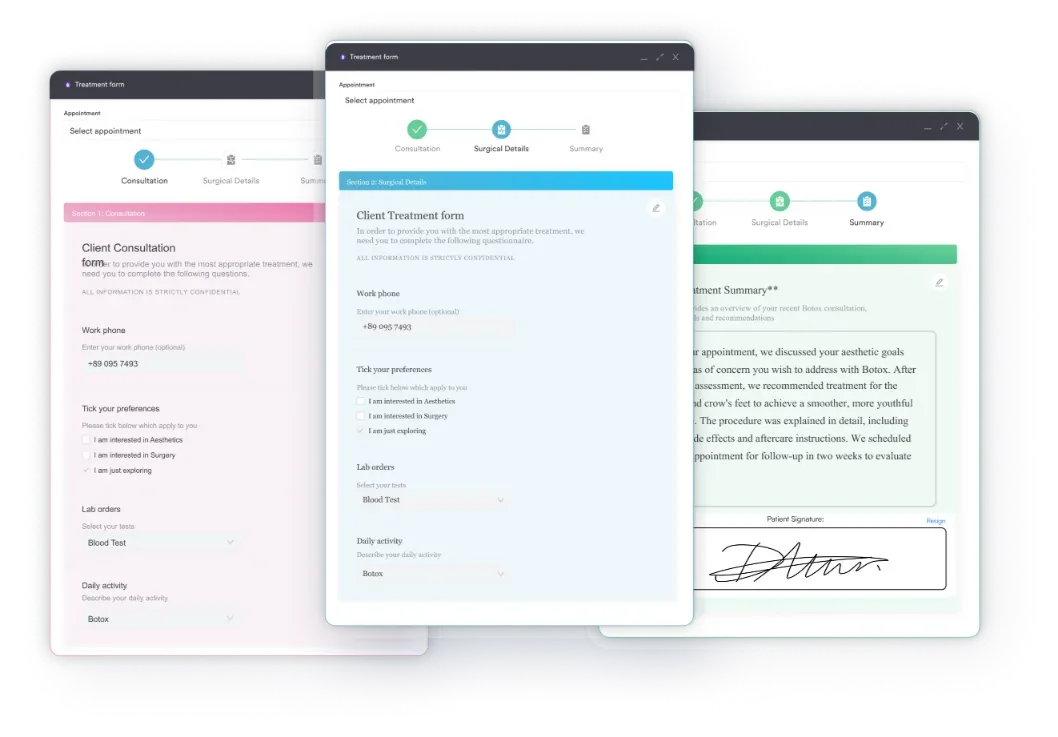
Required elements for a clean 15150 claim:
Practices using structured patient records with procedure-specific documentation templates can reduce the time spent reconstructing these elements before claim submission.
Every CPT code 15150 claim requires a supporting ICD-10-CM diagnosis code that establishes medical necessity. Specifically, the diagnosis code must be clinically appropriate and documented in the patient’s chart. Indeed, mismatched or unsupported diagnosis codes are a leading cause of denial. For reference, the CDC/NCHS ICD-10-CM lookup tool provides official code definitions and hierarchy.
ICD-10 code selection must reflect the documented clinical picture rather than billing convenience. In burn cases, the T31 series reports the extent of body surface involved. For example, a code such as code such as T31.54 pairs the total burned area with the third-degree portion. Report it in addition to a site-specific burn code from T20-T25.
Payer local coverage determinations for advanced wound care often name the diagnosis codes that count as covered indications for tissue cultured autograft. Therefore, check the determination that applies to your contractor before the procedure.
CPT code 15150 is the base code in a family of tissue cultured autograft codes. Specifically, knowing how 15151 and 15152 attach to it, and how the family differs from other autograft types, prevents both underbilling and unbundling. For grafts at the face, scalp, neck, hands, feet, or genitalia, the parallel primary code is CPT code 15155.
A defect closed by moving adjacent tissue rather than grafting belongs to a different family. For the scalp, arms, or legs that family starts at 14020, and for the eyelids, nose, ears, or lips at 14060. Either way, check which technique the operative note describes before you reach for a graft code.
The key clinical distinction between 15150 and 15110 is the graft composition. Specifically, CPT code 15150 captures laboratory-grown tissue cultured autografts. By contrast, CPT 15110 covers traditional epidermal autografts harvested directly from the patient. Therefore, the operative report must clearly identify which type was applied. Using 15110 terminology when a tissue cultured product was used, or vice versa, creates an audit vulnerability.
Skin graft billing draws a disproportionate share of Medicare audit activity. Indeed, CPT code 15150 claims carry several error patterns that recur across wound care practices and dermatology groups. Notably, most of them start in the operative note rather than in the code selection itself.
Dermatology and plastic surgery practices performing skin grafts alongside other integumentary procedures should review NCCI edits before submitting. In practice, those using structured billing workflows through skin clinic management software can embed these checks into the pre-submission process.
Accurate billing for CPT code 15150 depends on documentation quality at the point of care. When wound size, graft type, and the procedure narrative sit in structured fields, coders already have what a clean claim needs. By contrast, free-text notes force the billing team to query the clinician, which delays the claim and slows cash flow.
Pabau’s digital forms let wound care practices build procedure-specific templates that prompt for every required element. That means wound location, measured area, graft source confirmation, and the medical necessity narrative. The completed form attaches to the patient record, so the billing team can read it without opening a query cycle.
For groups running more than one site, multi-location management tools standardize those templates, so coding consistency does not depend on individual clinician habits. In addition, the plastic surgery workflows in Pabau add configurable treatment plans plus pre-care and post-care documentation.
Ultimately, submission is where that detail pays off. Pabau’s Claim.MD integration sends electronic claims to payers and returns their status, so a coded 15150 line does not sit unnoticed in a queue.
For practices weighing up practice management software, structured capture at the point of care is the lever that moves clean claim rates most.
Run a quarterly audit of your CPT code 15150 claims. First, pull every submission from the past 90 days. Then, check that each one carries a documented wound size in sq cm, an identified graft source, and a matching ICD-10 diagnosis. Claims missing any of those three are your highest denial risk, and the easiest to fix before they age into write-offs.

Pabau’s claims management tools help wound care teams document wound size, graft type, and procedure codes. CPT code 15150 claims then submit clean the first time.

CPT code 15150 rewards precision on four points. Specifically, those are the measured area, the graft type named in the note, the add-on unit count, and a supporting ICD-10 diagnosis. Of these, the add-on math is the one most practices get wrong, and it costs money in both directions. One unit of 15151, then 15152 for each further 100 sq cm, is the rule worth committing to memory.
Fix the operative note first and the coding follows. In turn, a measured area and a named graft product turn the unit count into arithmetic rather than a judgment call. That is what keeps these claims out of audit.
Pabau’s structured clinical documentation and claims management tools give wound care practices one record for the whole procedure. As a result, the detail coders need is captured at the point of care, not reconstructed afterward. Book a demo to see how that works on a skin graft claim.

Grafting at the face, neck, hands, or feet? CPT code 15155 is the parallel primary code for those sites, with its own pair of add-ons and the same measurement rules.
Applying a manufactured skin substitute instead? CPT code 15274 sits in the 15271-15278 family that covers non-autologous products.
Debriding the wound bed before the graft goes on? CPT code 11043 covers muscle and fascia debridement, which is reported separately from the graft itself.
Coding a diagnosis of familial dysautonomia? ICD-10 code for familial dysautonomia It confirms G90.1 is billable and specific, valid for reimbursement through FY2026.
Coding a diagnosis of POTS? ICD-10 code for POTS It covers when to assign G90.A, the documentation payers require, and the CPT codes it pairs with.
CPT code 15150 reports a tissue cultured skin autograft on the trunk, arms, or legs. Specifically, it covers the first 25 square centimeters or less of wound area. In addition, it covers laboratory-grown skin derived from the patient’s own cells, not donor or synthetic skin substitutes.
Medicare reimbursement for CPT code 15150 varies by place of service and changes annually with the Medicare Physician Fee Schedule update. Therefore, verify the current year’s facility and non-facility rates through the CMS MPFS lookup before submitting. In other words, rates from prior years are not valid for active claims.
Modifier 51 (multiple procedures) is commonly used when 15150 is performed alongside other separately reportable procedures. Meanwhile, modifier 59 applies when services would otherwise bundle under NCCI edits but are clinically distinct. In addition, modifiers 78 and 79 apply for return-to-OR scenarios within a global period. Either way, never append modifier 51 to add-on codes 15151 or 15152, which are modifier-51 exempt.
CPT 15150 is the primary code and covers the first 25 sq cm or less of tissue cultured autograft to the trunk, arms, or legs. By contrast, CPT 15151 is the add-on code for the next 1 sq cm to 75 sq cm, and one unit covers that whole range. Therefore, it is reported once per session, not once per 25 sq cm block, and it is never billed without 15150.
Commonly paired ICD-10-CM codes include the T31 series for burns by extent of body surface and L97.x for chronic lower extremity ulcers. In addition, others are E11.621 for type 2 diabetes with foot ulcer, L89.x for pressure ulcers, and I87.2 for venous insufficiency. Regardless, the diagnosis code must reflect the documented clinical condition and satisfy any payer LCD requirements for advanced wound care.
Report 15150 first, then add one unit of 15151 if the grafted area exceeds 25 sq cm. Once the total passes 100 sq cm, add 15152 at one unit for each further 100 sq cm, or part thereof. A 250 sq cm graft therefore reports 15150, one unit of 15151, and two units of 15152. Finally, do not append modifier 51 to either add-on, and document the measured area in the operative report.
Report one unit of 15151 per session. Specifically, its descriptor covers the additional 1 sq cm to 75 sq cm in a single unit, so it does not repeat. Once the total grafted area passes 100 sq cm, move to 15152. From there, report one unit of 15152 for each additional 100 sq cm, or part thereof.
CPT code 15150 carries Work RVU, Facility PE RVU, Non-Facility PE RVU, and Malpractice RVU components that are updated annually by CMS. To calculate the Medicare payment, multiply the total RVU by the current year’s conversion factor. Therefore, use the CMS Physician Fee Schedule lookup or the FastRVU tool to retrieve current values, as hardcoded figures become outdated each January.