CCSD Code E1310: Antral puncture and washout billing guide
CCSD Code E1310: Definition and official descriptor CCSD Code E1310 is the Clini...

Last Updated: Nov 4, 2026
M0220 is the CCSD code for nephro-ureterectomy, unilateral: the removal of one native kidney together with its ureter. It sits in Chapter 12 of the CCSD schedule, Urinary system and male reproductive, under Kidney / Renal Pelvic. Urologists bill it to UK private medical insurers, most often after surgery for cancer of the renal pelvis or ureter.
The side and the approach decide whether M0220 is the right choice. The same operation on both sides is M0221, and laparoscopic and robotic-assisted versions carry their own codes. Matching the code to the operative note keeps the claim out of the query pile.
Let Pabau's smart automation suggest the right codes, reduce claim denials, and keep your practice compliant—effortlessly.
Automate repetitive tasks and focus on what matters most—your patients.
Reduce coding errors and ensure compliance with the latest regulations.
Clean claims, fewer denials, and faster reimbursements.
Powerful insights and reporting to help your practice thrive.
HIPAA compliant SOC 2 certified GDPR-compliant Trusted by 4,000+ clinics worldwide

CCSD code M0220 is a unilateral nephro-ureterectomy, the removal of one native kidney together with its ureter, filed in CCSD Chapter 12.
Both sides use M0221 and a living donor operation uses M0222, so side and purpose decide the code first.
CCSD gives laparoscopic (M0282) and robotic-assisted (M0284) unilateral nephroureterectomy their own codes, so the approach in the operative note must match the invoice.
A clean claim carries the operative note, the histology or diagnosis record, signed consent and the insurer’s pre-authorization reference.
CCSD does not set fees, so check the M0220 benefit in each insurer’s schedule before you quote the patient.
CCSD code M0220 is the private billing code for a unilateral nephro-ureterectomy. The surgeon removes one native kidney and the ureter that drains it, in a single operation.
CCSD files the code in Chapter 12, Urinary system and male reproductive, under Kidney / Renal Pelvic. Our CCSD guides for specialists cover the neighboring kidney codes too.
The most common reason for the operation is urothelial cancer of the renal pelvis or ureter, also called upper tract urothelial carcinoma. This cancer can recur anywhere along the lining of the urinary tract. That is why the surgeon takes the whole ureter, and usually a small cuff of bladder, rather than the kidney alone.
The operating urologist bills the professional fee to the patient’s private medical insurer (PMI). The hospital and the anesthetist invoice the insurer separately, so this guide follows the surgeon’s claim.
A common M0220 coding error starts with a neighbor that sounds close enough. CCSD splits kidney removal by side, by purpose and by surgical approach.
Each split has its own code, listed in the CCSD schedule. Removing the kidney alone, with the ureter left in place, falls under a nephrectomy code such as M0210.
Look closely at the M0220 descriptor. It names no surgical approach, while laparoscopic and robotic operations have entries of their own. Check the schedule before you bill M0220 for a keyhole case. The approach in the operative note has to match the code on the invoice.
The decision path below asks the four questions in the order a coder should.
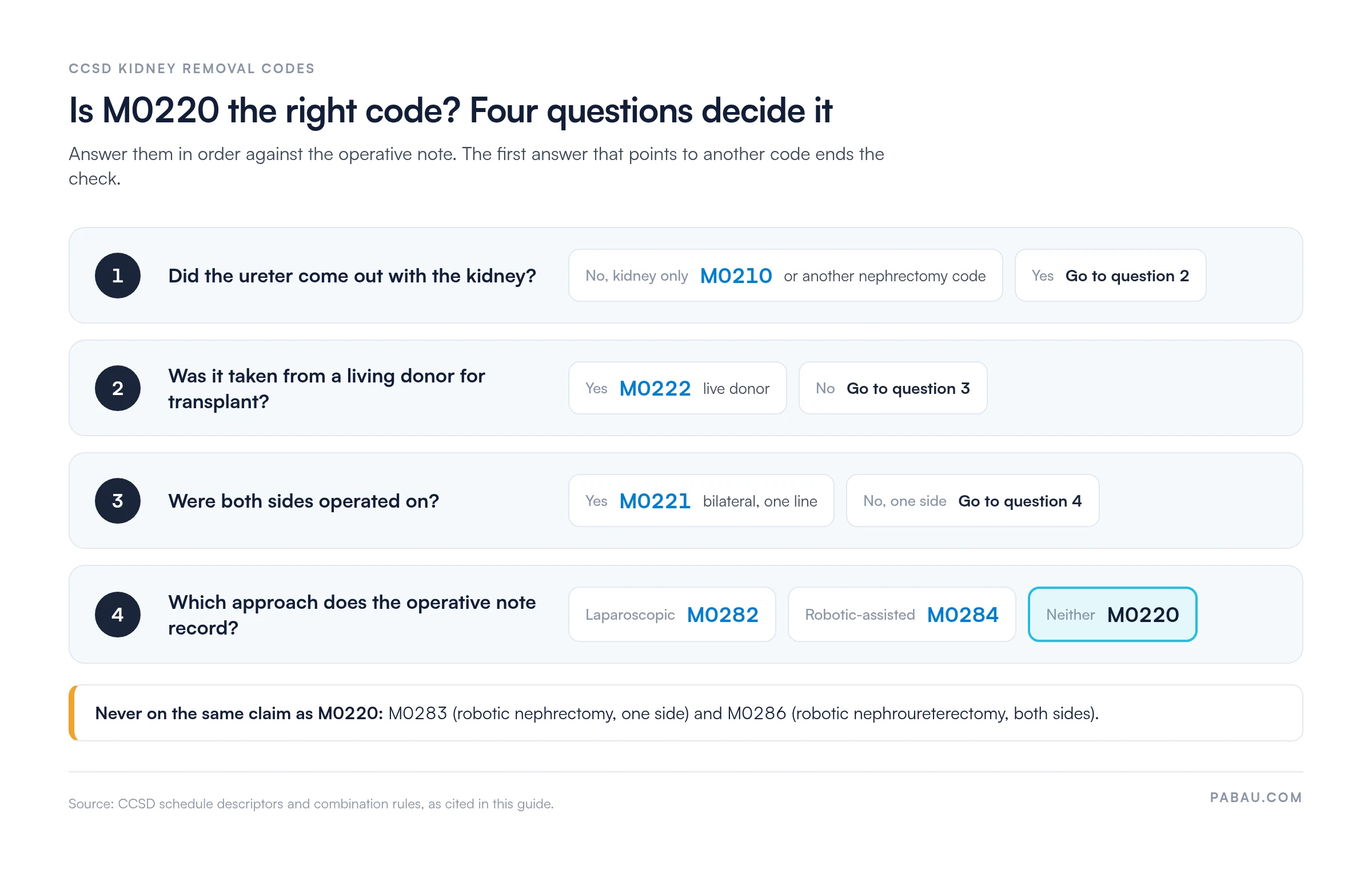
CCSD lists M0220 as an unacceptable combination with M0283, robotic assisted nephrectomy on one side. It also blocks M0220 alongside M0286, robotic assisted nephroureterectomy on both sides. A separate nephrectomy line would bill the kidney twice, since the nephro-ureterectomy already includes it.
CCSD describes its coding principles as guidance, and each insurer decides whether to apply a given rule. If a case seems to need two codes, check that payer’s own policy before you submit.
An insurer reviewing M0220 wants the side, the approach, the reason and the authorization in writing. Four documents cover those points between them.
Conversion deserves a second look. When a laparoscopic case converts to open surgery, the authorized code and the operation performed may no longer match. Call the insurer before you submit, rather than waiting for a query.
With the paperwork in place, the claim follows the same six steps every time. The order matters, because each step feeds the next.
A urologist removes a patient’s left kidney and ureter with robotic assistance, for a tumor of the ureter. The billing team reaches for M0220 because the descriptor sounds right.
The operative note says robotic, though, and CCSD lists M0284 for a robotic unilateral nephroureterectomy. Billing M0220 here invites a query, and the authorization may not cover it either. The note, the authorization and the invoice should all name the same code.
CCSD agrees codes and descriptors for its member insurers, but it does not set fees. Each insurer publishes its own benefit for M0220, and the amounts differ between payers and change over time.
When your fee is higher than the insurer’s benefit, the patient may face a shortfall. Tell them before surgery, in writing, so the difference never arrives as a surprise. Our guide to Bupa CCSD codes explains how Bupa’s schedule is laid out.
Run through this list with the operative note open. It takes a couple of minutes and catches the errors behind the queries in the next section.
A queried claim usually points to one of a handful of causes. Match the insurer’s question to the likely cause, then send the evidence that settles it.
In many private urology practices, the authorization sits in an email, the consent on paper and the invoice in another system. When a query lands, someone rebuilds the episode by hand.
In Pabau, the practice management software our team builds, those pieces live on one patient record. The authorization reference, the signed consent and the clinical documents sit against the episode. Its claims management software then sends the claim to Healthcode from that record.
Before a claim goes, Pabau checks that required fields, such as the membership number and authorization code, are filled in. Status updates flow back from Healthcode, so your team can see which claims are paid, queried or outstanding.
You still choose the code, and Pabau keeps the claim behind it complete and traceable.

Pabau stores the authorization, consent and clinical documents on the patient record, checks required claim fields and submits private claims through Healthcode. Your team spends less time rebuilding a claim after a query.

M0220 is a narrow code. It covers one kidney and its ureter, removed on one side, and its neighbors handle every change in side, purpose and approach. Treat the operative note as the source of truth and let the code follow it.
The payoff is fewer queries on a major surgical claim. Lock the authorization to the right code before surgery, match the side across every document and check the schedule before you quote.
Book a demo to see how Pabau keeps urology claims complete from authorization to Healthcode submission.

Coding a kidney removal without the ureter? CCSD code M0210 covers nephrectomy and excision of perirenal tissue.
Removing only part of the kidney? CCSD code M0300 explains how partial excision of kidney is billed.
Billing a transplant kidney removal? CCSD code M0260 walks through transplant nephrectomy claims.
Submitting to Bupa? Bupa CCSD codes shows how the Bupa schedule is organized and how to claim against it.
No. CCSD codes are for billing private medical insurers in the UK. NHS hospitals record procedures in OPCS-4, the NHS classification of interventions and procedures.
A nephrectomy removes the kidney and leaves the ureter in place. A nephro-ureterectomy removes the kidney and the whole ureter, usually because disease can recur along the urinary lining. CCSD codes them separately.
No. Removing a kidney and ureter from a living donor for transplantation has its own code, M0222. M0220 covers a nephro-ureterectomy carried out to treat the patient’s own condition.
The operating surgeon bills the professional fee, usually a consultant urologist. Insurers pay only specialists they recognize, so confirm the surgeon’s recognition with the patient’s insurer before booking surgery.
The insurer may decline the claim, which can leave the patient paying the bill. In an urgent case, contact the insurer as soon as possible and record when the request was made.