ICD-10 Code S02.602D: Fracture of mandible, subsequent encounter
ICD-10 Code S02.602D: Definition and billable status ICD-10 Code S02.602D is the...

Last Updated: Oct 8, 2026
Billable Code Specific Code
T87.43 is the billable ICD-10-CM code for infection of amputation stump, right lower extremity.
Most denials on T87.43 claims trace back to two problems: a chart that documents wound redness without specifying infection, and a coder who defaulted to T87.40 because laterality wasn't confirmed. Accurate assignment requires the operative or wound care record to document both the anatomical site and the laterality explicitly — without that, the claim reverts to T87.40 (unspecified) and payer scrutiny increases.
Let Pabau's smart automation suggest the right codes, reduce claim denials, and keep your practice compliant—effortlessly.
Automate repetitive tasks and focus on what matters most—your patients.
Reduce coding errors and ensure compliance with the latest regulations.
Clean claims, fewer denials, and faster reimbursements.
Powerful insights and reporting to help your practice thrive.
HIPAA compliant SOC 2 certified GDPR-compliant Trusted by 4,000+ clinics worldwide
ICD-10 Code T87.43: Infection of amputation stump, right lower extremity is a billable ICD-10-CM code, valid for FY2026 HIPAA-covered transactions. It took effect on October 1, 2025 under the CDC/NCHS ICD-10-CM FY2026 release.
Assign it when the record documents an infected amputation stump on the right leg. It is one of five billable codes under T87.4, and laterality is what separates them. Amputation level does not change it. A below-knee stump and an above-knee stump on the right side both code to T87.43.

T87.43 is the billable ICD-10-CM code for an infected amputation stump on the right lower extremity, effective October 1, 2025.
Parent code T87.4 has five billable children, T87.40 through T87.44, and laterality is what separates them.
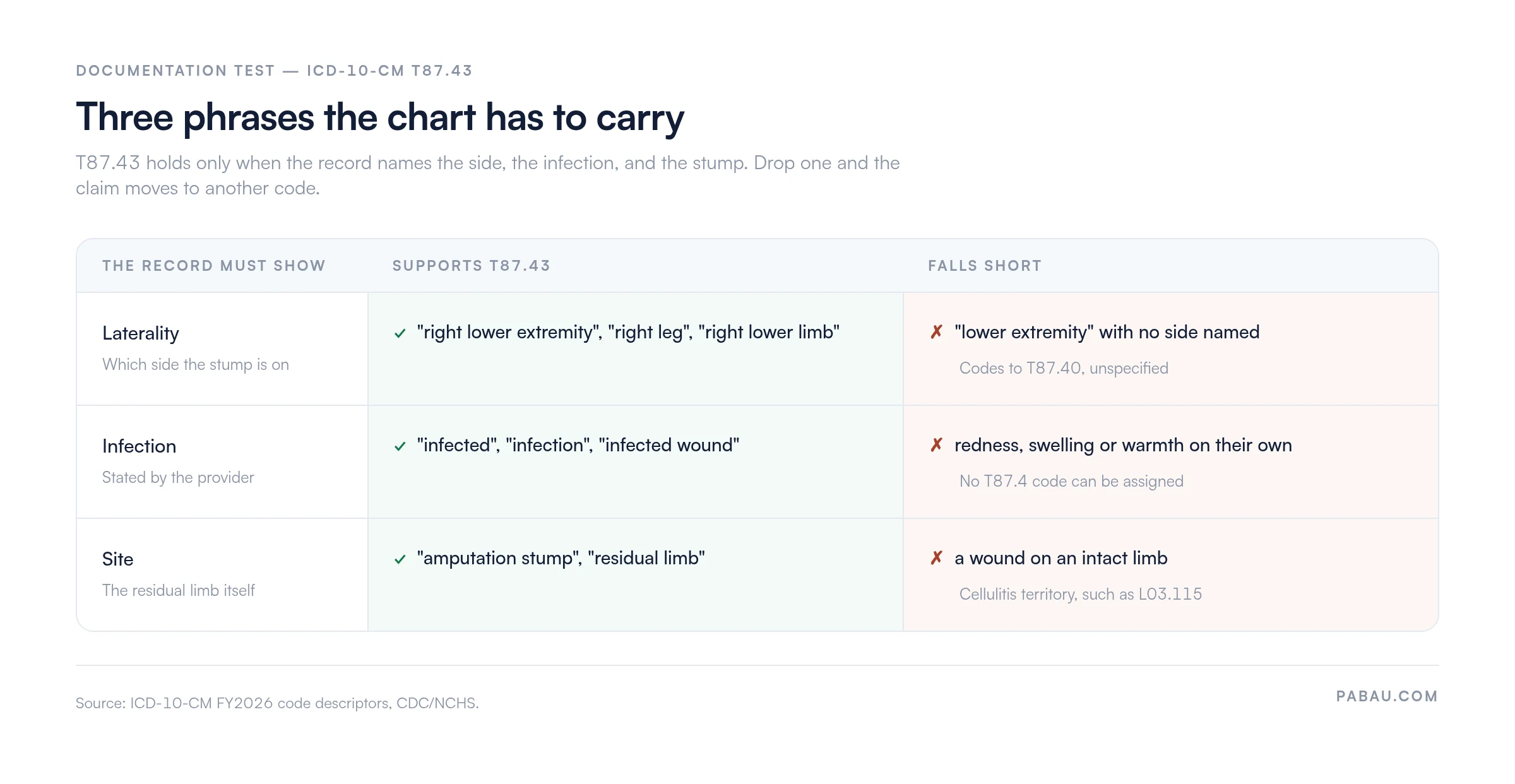
The chart must name the side and state infection, because redness or swelling alone will not support T87.43.
Amputation level does not change the code, so below-knee and above-knee right stumps both code to T87.43.
Practice management software like Pabau validates ICD-10 codes before submission, so a laterality error surfaces before the payer sees it.
Parent code T87.4 covers amputation stump infection at any site. Five billable child codes sit under it, and each one names a site and a side. The common error in this family is the left-for-right swap between T87.43 and T87.44.
T87.4 itself is a header code and is never billable. A claim carrying T87.4 alone comes back rejected as insufficiently specific. Assign one of the five child codes above instead, based on the site and side in the record. Where the record names no side, T87.40 is the correct fallback.
Laterality decides the code, and the chart decides the laterality. When the record says only “stump infection”, the coder has to fall back to T87.40. That assignment is correct, though many payers follow it with a request for records.
Use this framework before assigning any T87.4x code:
“Right lower extremity” covers below-knee and above-knee stumps alike. The code does not differentiate by amputation level. A transtibial stump infection on the right side codes to T87.43, and so does a transfemoral one.
The ICD-10-CM Official Guidelines for Coding and Reporting govern how T87.43 is assigned. The includes notes, the excludes notes, and the checklist below cover the three denial patterns this code attracts.
T87.43 includes post-procedural wound infection of the amputation stump. A stump wound that becomes infected after the original amputation belongs here. The infection is a sequela of the procedure rather than a separate primary condition.
T87.43 carries no formal Excludes 1 or Excludes 2 note at the code level. Cellulitis of the lower limb is still a separate condition from stump infection. Where the provider describes cellulitis of the residual limb, L03.115 fits the right side better. Query the provider when the chart reads ambiguously between the two.
Those three requirements fail in predictable ways, so it helps to see the wording side by side.
Documentation has to support the code before the claim goes out, not after a denial lands. Querying the provider during the encounter, or right after it, costs far less time than appealing later.
Flag T87.43 claims for secondary coding review. When the chart names a specific organism such as MRSA or Pseudomonas, add a code from B95-B98 to identify the causative agent. That second code supports medical necessity when a payer reviews the antibiotics billed alongside the visit.
An amputation stump infection is bacterial invasion of residual limb tissue after surgical amputation. It is a post-procedural complication, separate from cellulitis of an intact limb. Peripheral arterial disease and diabetic foot complications drive most lower-limb amputations in the US, so wound care and vascular teams meet these stumps often.
Indicators that support T87.43 include erythema spreading beyond the wound edge, purulent discharge, local warmth, fever, a raised white cell count, and positive wound cultures. The provider has to document these findings. A coder cannot infer infection from a list of signs without a provider statement.
Structured note templates help wound care teams capture these findings at the point of care. The wording lands in the chart during the visit, so the coder rarely has to query it afterwards.
Coders in wound care, vascular surgery, and orthopedics meet the codes next to T87.43 often. The table below maps the ones most often confused with it. Our ICD-10-CM code index covers the neighboring codes in this chapter.
T87.43 and T87.5x are not mutually exclusive. Where the chart documents both infection and necrosis of the same right stump, assign both codes. Sequence them by the condition chiefly responsible for the encounter.
Wound care and vascular practices billing T87.43 need the laterality question settled before a claim leaves the building.
Practice management software like Pabau gives coders a workflow for billing teams that validates ICD-10 codes through the Claim.MD clearinghouse before submission. A claim missing laterality, or one coded to T87.40 by default, gets flagged at validation rather than returned as a denial weeks later.
Pabau also carries structured clinical note templates for the provider. They prompt for site, side, and infection wording while the patient is still in the room. That capture feeds the billing workflow, so coders chase fewer queries after the encounter. For electronic claims, Pabau supports the 837P format and electronic remittance advice through Claim.MD.
The built-in ICD-10 catalog makes it quicker to find T87.43 next to its siblings, without switching reference tools mid-session. For a practice where stump-infection coding comes up every week, that saves the coder a lookup on every claim.

Pabau validates ICD-10 codes through the Claim.MD clearinghouse before submission. Laterality errors on stump-infection claims get flagged while your team can still fix them.

T87.43 has a narrow assignment window. The chart has to document infection, and it has to name the right side, before the code holds.
The denial worth preventing is the one caused by a provider writing “stump infection” with no side named. Fixing that in the note takes seconds. Fixing it in an appeal takes weeks.
Pabau’s claims workflow and Claim.MD validation help wound care and vascular practices catch these errors before submission. Book a demo to see how a T87.43 claim gets checked before it reaches the payer.

Need a clean-claim checklist for post-procedural codes? Clean claim guide covers the documentation and coding requirements that prevent rejections before submission.
Unsure how payer eligibility affects stump-infection claims? Insurance eligibility verification explains how real-time eligibility checks reduce avoidable claim rejections.
Want to understand how denials get resolved after submission? Denial codes in medical billing maps common CARC denial codes to actionable appeals steps.
ICD-10 Code T87.43 is the billable, specific ICD-10-CM diagnosis code for infection of amputation stump, right lower extremity. It is valid for FY2026 (effective October 1, 2025) and may be used for all HIPAA-covered transactions. It sits under parent code T87.4, which has five billable child codes split by site and laterality.
Yes, T87.43 is a fully billable, specific ICD-10-CM code. It can be used as a standalone diagnosis code for reimbursement on HIPAA-covered claims. The parent code T87.4 is not billable – only the child codes, T87.40 through T87.44, may be submitted on claims.
T87.43 covers infection of an amputation stump on the right lower extremity, while T87.44 covers the left lower extremity. The distinction is laterality only, and both codes are billable and specific. Assign T87.43 when the chart documents right-side involvement. Assign T87.44 for the left side. If the chart names no side, use T87.40 and query the provider where possible.
The record must document three elements. First, the word “infection” or “infected wound”, since redness or swelling alone is not enough. Second, the site as the amputation stump residual limb rather than a separate wound. Third, laterality as right lower extremity, right leg, or right lower limb. Miss any one of the three and the code cannot be assigned as T87.43.
The sibling codes under parent T87.4 are T87.40 (unspecified), T87.41 (right upper extremity), T87.42 (left upper extremity), and T87.44 (left lower extremity). With T87.43 that makes five billable codes in the family. Selection depends on the documented site and laterality, and laterality must be confirmed before a site-specific code is chosen over T87.40.
Yes. T87.43 (infection) and T87.5x (necrosis of amputation stump) are not mutually exclusive. When the record documents both infection and necrosis of the right lower extremity stump in one encounter, both codes may be assigned. Sequence the condition chiefly responsible for the encounter as the principal or first-listed diagnosis.