ICD-10 Code S53.013D: Anterior subluxation of unspecified radial head
ICD-10 Code S53.013D: Quick reference summary Use the table below as your first ...

Last Updated: Nov 6, 2026
Billable Code Specific Code
T87.1X1 is the billable ICD-10-CM code for complications of reattached (part of) right lower extremity. It covers infection, necrosis, wound breakdown, vascular failure, and other problems that follow replantation of the right leg, ankle, foot, or toe.
The code sits in category T87, beside T87.1X2 for the left side and T87.1X9 for an unspecified side. The record must show both the earlier reattachment and a complication in the right lower extremity.
Let Pabau's smart automation suggest the right codes, reduce claim denials, and keep your practice compliant—effortlessly.
Automate repetitive tasks and focus on what matters most—your patients.
Reduce coding errors and ensure compliance with the latest regulations.
Clean claims, fewer denials, and faster reimbursements.
Powerful insights and reporting to help your practice thrive.
HIPAA compliant SOC 2 certified GDPR-compliant Trusted by 4,000+ clinics worldwide

T87.1X1 is a billable ICD-10-CM code, valid in FY 2027, for complications after reattachment of the right lower extremity.
It is complete at six characters. No 7th character applies, so codes such as T87.1X1A do not exist.
Right leg, ankle, foot, and toe replants take T87.1X1. A right arm or hand replant takes T87.0X1 instead.
Amputation stump problems with no replantation history belong in T87.3 to T87.9, never in T87.1X1.
Pabau, the practice management platform we build, connects to the Claim.MD clearinghouse, so T87.1X1 claims are checked before submission.
ICD-10 code T87.1X1 is a specific, billable ICD-10-CM code for complications of reattached (part of) right lower extremity. It has been valid since October 1, 2015, and remains current in FY 2027. The table below lists the fields coders need for claim submission.
Check the code each year in the CDC/NCHS web tool. It reflects the official tabular list that the National Center for Health Statistics releases for each fiscal year.
T87.1X1 captures complications that arise after replantation of the right lower extremity or any part of it. That includes a thigh or leg segment, the ankle, the foot, or a toe. The code names no single complication type, so it groups every problem the provider ties to the reattachment.
Complications that fall within the code include:
The key clinical test is a causal link. If the operative or progress note ties the complication to the prior replantation, T87.1X1 is the correct code. If the right leg or foot problem is unrelated to a reattachment, look elsewhere in Chapter 19.
T87.1X1 is restricted to reattachment complications in the right lower extremity. It does not apply to amputation stump complications, to the upper extremity, or to the left side.
Per the ICD-10-CM Official Guidelines for Coding and Reporting (FY2027), an Excludes1 note means the two codes are never reported together. Check the tabular list for any notes before you pair a T87 code with another diagnosis.
The boundary that matters most is reattachment versus amputation. A stump problem with no history of replantation is never T87.1X1. Right lower extremity stump codes include T87.43 for stump infection and T87.53 for stump necrosis.
T87.1X1 sits within category T87, which covers complications peculiar to reattachment and amputation. Coders need the full map to pick the most specific code and avoid unspecified defaults.
Category T87 sits near the end of Chapter 19 (S00-T88). Coders new to the chapter sometimes search by body system instead of by injury consequence. That is how T87.1X1 loses out to musculoskeletal or vascular codes that miss the replantation history.
Four neighboring reattachment codes are often picked in error when T87.1X1 is correct. None of them splits complications by tissue type. The choice turns only on the body region and the side.
The coder decision rule has three steps, and the path below shows where each answer leads. Confirm the reattachment history, confirm the lower extremity, then confirm the right side. A right toe replant with arterial thrombosis is still T87.1X1, because no vessel-specific reattachment code exists.
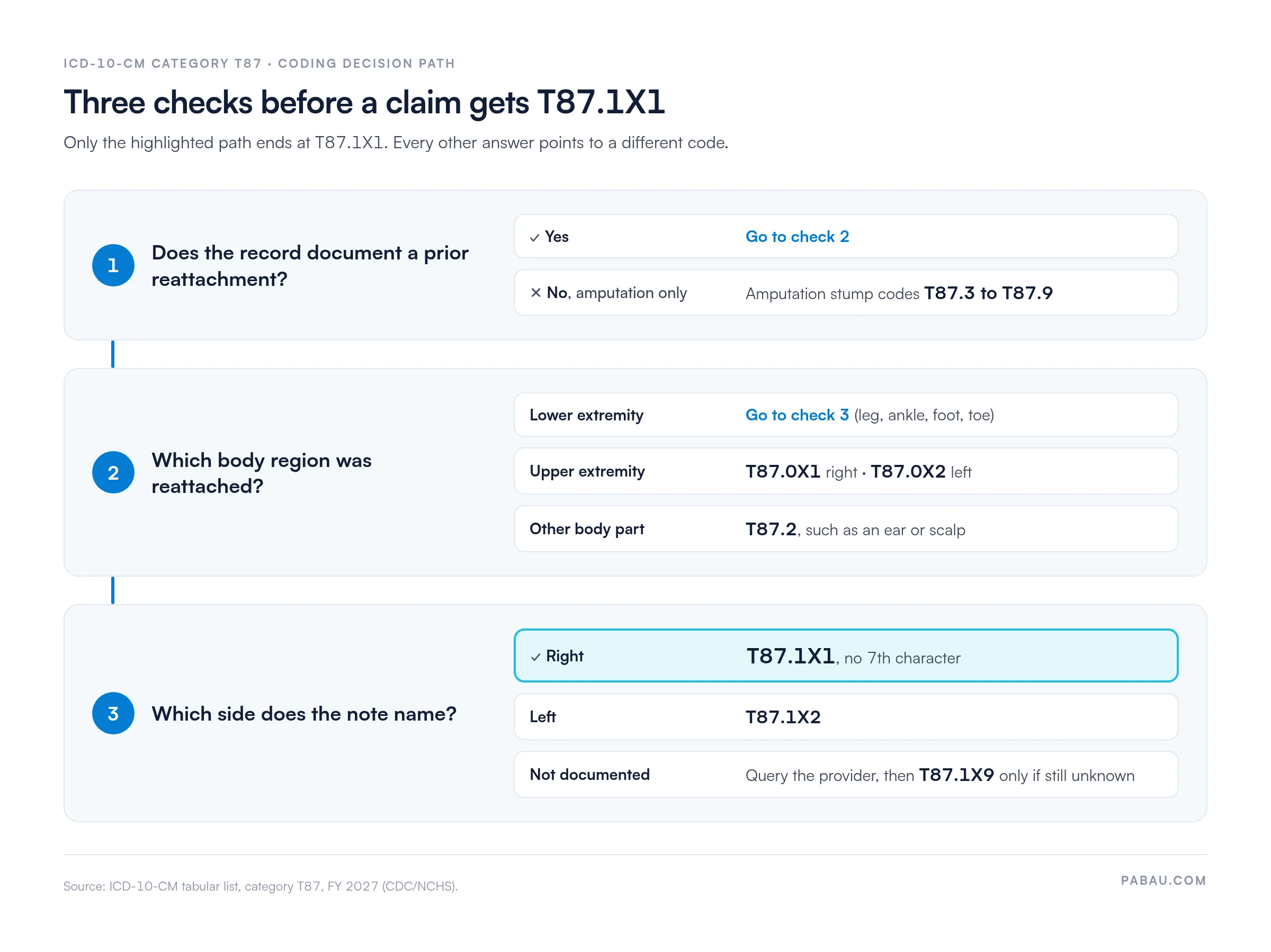
Upper extremity replants follow the same pattern one subcategory above. A right arm or hand complication codes to T87.0X1, and the left lower extremity takes T87.1X2. A reattached part outside the limbs takes T87.2.
If the side is missing from the operative or progress note, query the provider before you assign T87.1X9. Most replantation reports name the limb, so an unspecified claim usually means the record was not retrieved.
Replantation reattaches a completely or partially amputated part, using microsurgery to reconnect bone, tendons, nerves, and blood vessels. Lower extremity replantation is far rarer than upper extremity replantation. Surgeons reserve it for carefully selected cases, because recovery is long and function is harder to predict.
After a right leg, foot, or toe replant, vascular surgeons, wound care teams, and physical therapists may all see the patient. Each of them may bill T87.1X1 for their own encounters, so every note needs the same side and procedure history.
The complication types most often reported after lower extremity replantation are:
Each of these maps to T87.1X1 when it occurs in the right lower extremity after reattachment. The code does not separate complication types. A second code for the specific complication, such as an infection code, may be added when documentation and sequencing guidelines support it.
Per the CMS ICD-10-CM coding guidelines, coders assign diagnosis codes from provider documentation. For T87.1X1, that documentation must address four elements.
A medical billing workflow that builds these checks into charge capture confirms all four elements before the claim leaves the practice. Missing any one of them is the most common path to an edit error or denial.
Follow-up care after a right lower extremity replant usually involves wound management, vascular studies, imaging, and sometimes surgery. The CPT codes below are often billed with T87.1X1. Confirm payer coverage and medical necessity rules before you submit, because pairing requirements vary by plan.
Pabau’s claims management software links each diagnosis to its procedure codes at claim creation. That lowers the risk of a CPT-to-diagnosis pairing that a payer’s edit engine will flag.
Run a procedure-to-diagnosis crosswalk check before you submit any replantation follow-up claim. A debridement code such as 97597 needs a note that records the wound surface area and the complication. T87.1X1 alone does not justify it.
Medicare and commercial payers generally do not require prior authorization for office-based wound care visits billed with T87.1X1. Surgery is different. Revision replantation, flap coverage, revision amputation, or hardware removal typically needs prior authorization.
For those requests, the payer’s clinical review team will usually want the original replantation operative report and recent progress notes. It will also ask for the treating surgeon’s plan of care. Requirements vary by payer and plan year, so check them before you schedule the procedure.
Pabau connects to the Claim.MD clearinghouse to check patient eligibility and validate diagnosis-to-procedure pairings before T87.1X1 claims reach the payer. Clearinghouse edits catch structural errors, such as a missing placeholder X, that would otherwise trigger an immediate rejection.
T87.1X1 denials follow predictable patterns. Most of them are preventable at the coding and documentation review stage.
For appeals after a denial, denial management in healthcare applies directly. Identify the denial category, confirm the root cause, and send a corrected claim or a written appeal within the filing window. Our guide to medical billing denial codes explains the reason codes on the remittance advice.
Build a four-question charge capture checklist for replantation follow-up visits. Is the reattachment in the problem list? Is it the lower extremity? Is the right side named? Does the note link the complication to the reattachment? Those four answers prevent most T87.1X1 denials.
ICD-10 code T87.1X1 is valid in FY 2027, which runs from October 1, 2026, through September 30, 2027. The code has been part of the classification since ICD-10-CM took effect on October 1, 2015.
No 7th character extension applies to T87.1X1. Many Chapter 19 injury codes need an encounter character, such as A for initial, D for subsequent, or S for sequela. Category T87 does not, so T87.1X1 is submitted exactly as written.
Confirm the code’s status before each fiscal year in the AAPC ICD-10-CM code lookup or the CDC/NCHS tabular list. A clean claim also depends on catching annual changes elsewhere in category T87.
Many practices still check T87.1X1 claims by hand. A coder reads the operative report, confirms the limb and side, and hopes the payer already holds the replantation history.
Pabau moves those checks ahead of submission. Its claims tools connect to the Claim.MD clearinghouse and run eligibility checks before the visit is billed. Coverage problems and pairing errors surface while they are still cheap to fix.
Remittance data comes back into the same workflow. Your billing team can spot repeat T87.1X1 denials and work the appeals without switching systems.

Pabau’s claims management tools validate ICD-10 diagnosis codes and run real-time eligibility checks before submission, so T87.1X1 and similar complication codes reach payers clean.

ICD-10 code T87.1X1 captures one precise situation: A complication after replantation of the right leg, ankle, foot, or toe. Its denials almost always trace back to the chart. The note names the wrong limb, leaves out the side, or never mentions the replantation.
A missing side or procedure history costs less to fix in the note than on appeal. A post-replantation template that asks for limb, side, and the original operative report settles most claims before a coder touches them.
To see how Pabau checks T87.1X1 claims against payer edits before you submit them, book a demo.

Looking up common denial code categories? Common denial codes in medical billing provides a reference guide to CARC and RARC denial reason codes.
Want to understand the full claims submission process? Clean claim submission explains the structural and documentation requirements that prevent edit errors at clearinghouse validation.
ICD-10 code T87.1X1 is the diagnosis code for complications of reattached (part of) right lower extremity. It applies when a patient develops necrosis, infection, wound dehiscence, or vascular failure after replantation of the right leg, ankle, foot, or toe. The left-side equivalent is T87.1X2.
Yes. T87.1X1 is a billable and specific ICD-10-CM code, valid for claims in FY 2027. It needs no 7th character and is complete at six characters, so T87.1X1A, T87.1X1D, and T87.1X1S are not valid codes.
T87.1X1 covers complications of a reattached right lower extremity, such as the leg or foot. T87.0X1 covers the right upper extremity, such as the arm or hand. Both are general codes that include every complication type, so the body region decides which applies.
T87.1X1 covers the right lower extremity, and T87.1X2 covers the left. They are identical in clinical scope. The side documented in the chart decides which code applies, and T87.1X9 is reserved for records where the side cannot be found.
The most common trigger is a right arm or hand replant coded as T87.1X1 instead of T87.0X1. Others are T87.1X9 used when the side is documented, and notes that never link the complication to the reattachment. Codes submitted with an invented 7th character are also rejected.
Yes. T87.1X1 can be the principal diagnosis when the reattachment complication is the reason for the admission or visit. When the complication is incidental to a different chief reason, list that reason first. Per the ICD-10-CM Official Guidelines, the condition chiefly responsible for the encounter drives sequencing.