

HCPCS Code Q4185: Cellesta flowable amnion billing guide
HCPCS Code Q4185: definition and official descriptor HCPCS Code Q4185 is the Lev...

Last Updated: Nov 20, 2026
Billable Code
27590 is the CPT code for amputation, thigh, through femur, any level. It reports an above-knee amputation closed in the same session, at the femoral level the surgeon chooses.
Peripheral vascular disease, diabetic gangrene and osteomyelitis are common indications. A claim holds up when it carries the LT or RT modifier and an operative note that documents the closure and the medical necessity.
Let Pabau's smart automation suggest the right codes, reduce claim denials, and keep your practice compliant—effortlessly.
Automate repetitive tasks and focus on what matters most—your patients.
Reduce coding errors and ensure compliance with the latest regulations.
Clean claims, fewer denials, and faster reimbursements.
Powerful insights and reporting to help your practice thrive.
HIPAA compliant SOC 2 certified GDPR-compliant Trusted by 4,000+ clinics worldwide

CPT code 27590 reports a thigh amputation through the femur at any level, closed in the same session. Open circular cases go to 27592, and immediate fitting cases go to 27591.
Medical necessity rests on documented non-viable limb tissue from peripheral vascular disease, diabetic gangrene, osteomyelitis, trauma, malignancy or severe infection.
Append LT or RT to every 27590 line, because automated payer edits reject a claim line that carries no laterality modifier.
Acquired absence codes Z89.611 and Z89.612 belong on follow-up visits, never as the primary diagnosis on the amputation claim.
Pabau, the practice management platform we build, submits CMS-1500 claims through Claim.MD, with eligibility checks before surgery and ERA remittances matched to each claim.
CPT code 27590 is the Current Procedural Terminology code for “Amputation, thigh, through femur, any level.” The code set is published and maintained by the American Medical Association (AMA).
The code describes surgical removal of the lower limb above the knee, with the femoral shaft cut at the level the surgeon chooses. Tissue perfusion and wound closure decide that level, and the stump is closed in the same session.
The phrase “any level” is intentional. It captures amputations at the proximal, mid-shaft, or distal femur without requiring a separate code for each anatomic zone. What it does not cover is an open technique, immediate prosthetic fitting, or reamputation of a previously amputated stump. Those distinctions drive the sibling code selection covered in the next section.
Who performs and bills this code: Vascular and orthopedic surgeons typically perform this procedure, and general surgeons may operate in trauma settings. It happens almost exclusively in a hospital inpatient or outpatient setting. The facility rate therefore applies on the physician’s professional claim, and the hospital bills separately on a UB-04.
The surgical package for CPT 27590 includes the operative procedure itself and routine intraoperative services. It also covers the operating surgeon’s post-operative care within the 90-day global period. It does not bundle prosthetic fitting, stump revision after healing, or a subsequent reamputation at a different level.
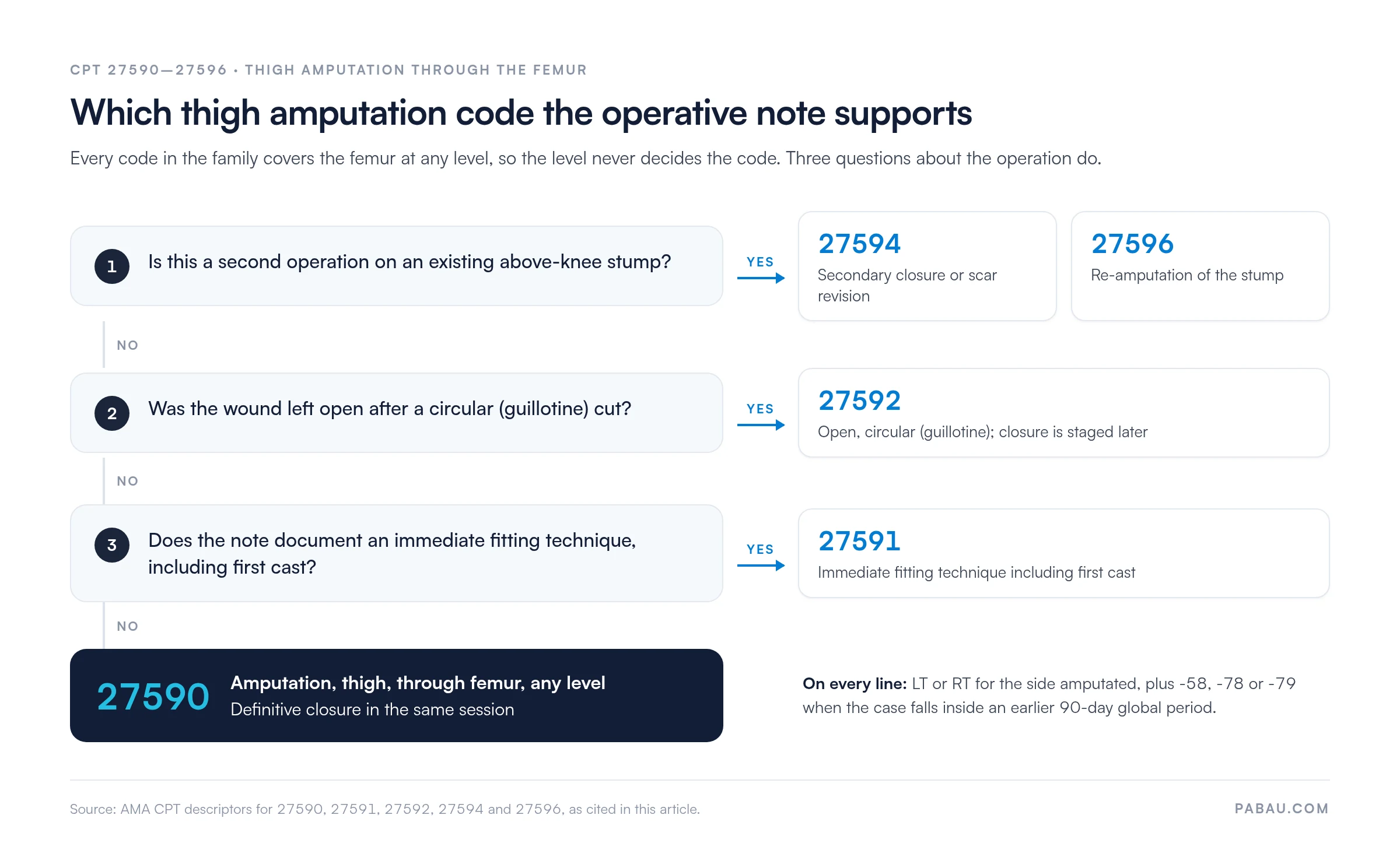
The thigh amputation family runs from 27590 to 27596, and every code in it covers the femur at any level. What separates them is the operation itself, so the table below shows when each code applies.
A typical upcoding error is billing 27591 when the note documents no immediate fitting technique. Another mismatch is billing 27592 when the operative report describes definitive myodesis closure, which is 27590.
Reamputation usually follows a complication in the existing stump. When infection drives a 27596 case, the stump infection is coded T87.43 on the right leg or T87.44 on the left.
Because the femoral level never changes the code, three questions about the operation settle it, in this order.
CMS and commercial payers require documented medical necessity before paying a CPT 27590 claim. Medicare Administrative Contractors (MACs) publish Local Coverage Determinations (LCDs) that define covered indications for lower-extremity amputation in their jurisdiction. Meeting billing compliance requirements starts with matching the operative indication to a covered LCD criterion.
Commonly accepted indications include:
The operative note must state the specific indication and explain why limb salvage was not attempted or failed. A note that says only “non-healing wound”, with no underlying pathology, perfusion data or treatment history, invites a medical necessity denial.
Before submitting a CPT 27590 claim, check the chart for four items. Look for a vascular surgery or podiatry consultation note and ABI or arterial duplex results. Then confirm at least one documented conservative intervention and the surgeon’s statement that limb salvage is not feasible. Together they answer the criteria MAC coverage policies most often list for amputation.
Every CPT 27590 claim requires a primary ICD-10-CM diagnosis code that establishes the clinical indication. Laterality matters, so choose the code variant that specifies the right or left side. Per the CMS ICD-10 coding guidelines, the principal diagnosis is the condition chiefly responsible for the admission, not a secondary comorbidity.
Z89.6xx codes are status indicators used in follow-up encounters after the amputation, not as the primary diagnosis on the operative claim. Using Z89 as the primary diagnosis on the initial surgical claim is an audit flag and a common reason for automatic payer rejection.
Laterality is not optional on a unilateral procedure on a paired structure. A missing or wrong modifier combination triggers automatic payer edits on a CPT 27590 claim.
CPT 27590 carries a 90-day global surgical period designation under the CMS Medicare Physician Fee Schedule. This means the operating surgeon’s post-operative follow-up visits related to the amputation are bundled into the procedure payment for 90 days after the operative date. Billing a routine follow-up E/M visit within that window triggers an automatic denial.
What is separately billable during the global period: New, unrelated conditions take modifier -79. A return to the OR takes -78 when it treats a related complication and -79 when it is unrelated. Services by a provider other than the operating surgeon are billed separately too.
Physical therapy, prosthetics, and wound care by non-operating providers are always billed separately regardless of the global period.
Prior authorization: Medicare fee-for-service does not typically require prior authorization for CPT 27590 in emergency or urgent surgical situations. Medicare Advantage plans and most commercial payers commonly require prior auth for non-emergency above-knee amputations.
Emergency amputations may bypass prior auth but require retrospective medical necessity review within 24-72 hours depending on the payer. Always verify the specific plan’s requirements before the procedure when the clinical situation permits.
CMS sets payment rates for CPT 27590 through the annual Medicare Physician Fee Schedule (MPFS). RVU values and payment amounts are updated each January 1. Use the CMS Physician Fee Schedule lookup or the FastRVU 2026 RVU calculator for current locality-adjusted payment rates.
The figures below reflect published national facility RVU components. Apply your MAC’s geographic practice cost index (GPCI) to calculate the payment in your area.
Because CPT 27590 is performed almost exclusively in a facility setting, the physician bills the professional component at the lower facility rate. The hospital separately claims the technical component via a DRG assignment on the UB-04.
Above-knee amputation claims face a distinctive denial profile. Because the procedure is high-dollar and life-altering, payers apply heightened scrutiny, particularly for planned (non-emergency) cases. Effective denial management workflows for CPT 27590 start with knowing which CARC denial codes are most common for surgical amputation claims.
Pull your 27590 denials for the past 12 months and group them by CARC code. If CO-4 (missing modifier) makes up more than 20% of them, add a claim scrubber rule before you schedule retraining. If CO-50 (medical necessity) dominates, fix the operative note template first.
Every CPT 27590 claim should be backed by a complete documentation package before submission. The medical billing fundamentals for high-dollar surgical codes require more supporting material than a standard E/M claim. Use this checklist at the time of claim preparation.
In many surgical practices, a biller rebuilds each 27590 claim by hand. They read the operative note, key in the side and the code, then check eligibility and remittances in separate portals.
Pabau keeps that work on the patient record instead. Its claims software for surgeons submits CMS-1500 claims through Claim.MD, so you can run an eligibility check before the surgery date. ERA remittances come back against the same claim, so your team sees what paid without matching paper statements.
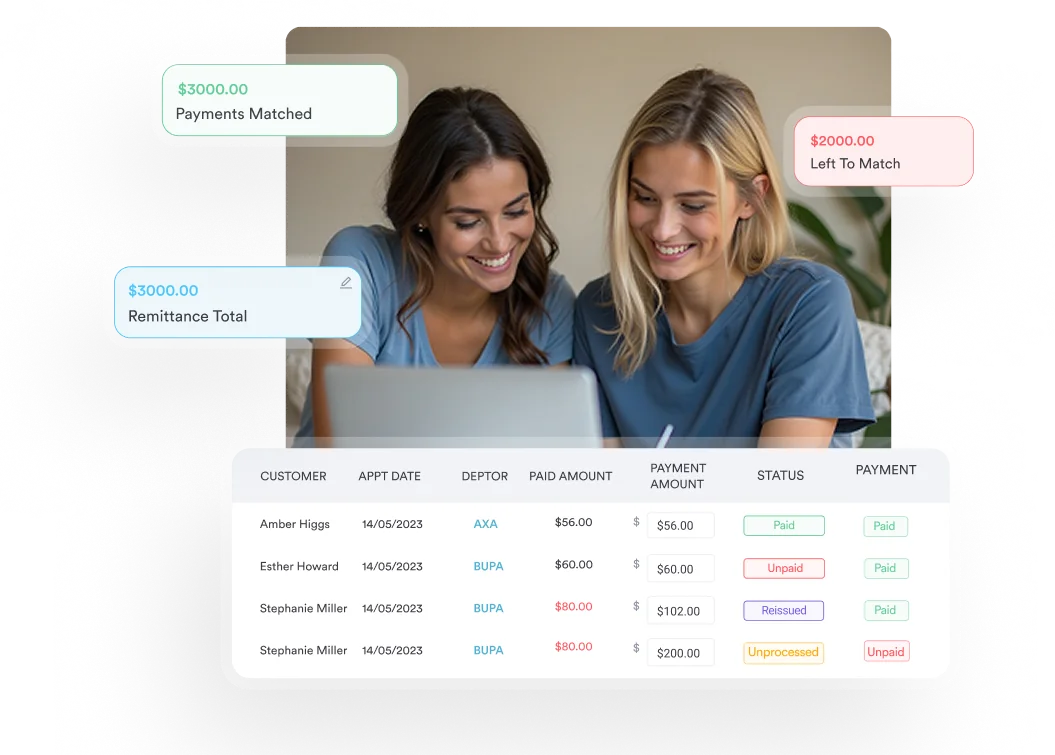
Prior authorization sits on the case too, with the auth code, dates and sessions recorded. Pabau warns you when one is missing, which matters for planned amputations under Medicare Advantage and commercial plans.

Pabau submits CMS-1500 claims through Claim.MD, with eligibility checks before surgery and ERA remittances matched to each claim. Your billing team spends less time chasing high-value codes like CPT 27590.

A CPT 27590 claim pays when it tells the same story as the operative note. Before you submit, confirm the side matches LT or RT and that the closure was definitive rather than staged. Then check that the indication carries perfusion data or imaging.
That check takes a few minutes per case. An appeal on a high-value surgical denial takes far longer, and some never recover the full fee.
Pabau’s medical billing software keeps the claim, the eligibility check and the remittance on one record. Book a demo to see how your surgical billing team can send amputation claims without rebuilding them by hand.

Need a full framework for managing claim rejections? Denial management in healthcare covers the end-to-end process for tracking, appealing, and preventing claim denials across surgical and E/M code categories.
Submitting claims through a clearinghouse? Understanding the Claim.MD clearinghouse explains how 837P electronic claim submission, payer enrollment, and real-time eligibility work together to reduce rework.
Looking for billing compliance guidance? Medical billing compliance outlines the documentation standards and audit-readiness practices that protect high-dollar surgical claims from retrospective denial.
Coding gangrene with no diabetic or vascular cause? ICD-10 code I96 covers gangrene not elsewhere classified, with the exclusions that send diabetic and atherosclerotic cases to other codes.
CPT code 27590 is the AMA procedure code for “Amputation, thigh, through femur, any level.” It reports removal of the lower limb above the knee, with the femur cut at the level the surgeon chooses. It covers definitive closure in the same session. Open circular (guillotine) amputations go to 27592, and the immediate fitting technique goes to 27591.
CPT 27590 carries a 90-day global surgical period under the CMS Medicare Physician Fee Schedule. Routine post-operative follow-up visits related to the amputation are bundled within that 90-day window and may not be billed separately by the operating surgeon.
Missing laterality tops the list, with LT or RT absent from the claim line. Other frequent causes are thin medical necessity documentation in the operative note and the wrong pick between 27590, 27591 and 27592. Payers also deny E/M visits billed in the 90-day global period without a modifier. Medicare Advantage and commercial plans add missing prior authorization.
The most commonly paired primary diagnosis is E11.52, type 2 diabetes with peripheral angiopathy with gangrene. I70.261 and I70.262 cover atherosclerosis with gangrene of the right or left leg. M86.151 and M86.152 cover acute osteomyelitis of the femur. The Z89.6xx acquired-absence codes are status codes for post-amputation follow-up visits, not for the operative claim itself.
Medicare fee-for-service typically does not require prior authorization for emergency or urgent CPT 27590 cases. Medicare Advantage plans and commercial payers commonly require prior auth for planned amputations. Emergency cases may bypass prior auth but face retrospective review. Verify the specific plan’s policy before the procedure when time permits.
CPT 27590 is the standard above-knee amputation with definitive stump closure. CPT 27591 adds the immediate fitting technique, including the first cast, at the time of amputation. CPT 27592 describes an open circular (guillotine) technique where the wound is left open for staged closure, typically in septic cases. The code follows the operative documentation, not the surgeon’s verbal description.





