Pabau Engage inbox

Pabau Engage is here: every patient conversation in one inbox.

Learn more
ICD-10-CM Code

ICD code S98.921S – Partial traumatic amputation of right foot, sequela

Billable Code Specific Code


Code Definition

S98.921S is the billable ICD-10-CM code for partial traumatic amputation of right foot, level unspecified, sequela. Coders use it when a healed partial amputation has caused a problem treated today, such as phantom limb pain or a stump neuroma.

The most important rule is order. The treated condition goes first, and S98.921S follows to explain where it came from. Reverse that, or leave out the word "partial" or the side, and the claim can come back denied. Below, you'll see how the code is built, which codes travel with it, how the claim moves and what to check before you submit.

Chapter
S00-T88 Injury, poisoning and certain other consequences of external causes
Category
S98 Traumatic amputation of ankle and foot
Group
S98.921 Partial traumatic amputation of right foot, level unspecified
Billable
Yes
Code also known as
right foot partial amputation late effect, traumatic right foot amputation sequela, right foot amputation downstream condition
Save time. Improve accuracy. Get paid faster.
Automate coding with Pabau

Let Pabau's smart automation suggest the right codes, reduce claim denials, and keep your practice compliant—effortlessly.

  • AI-powered code suggestions
  • Real-time compliance checks
  • Faster claims, fewer denials
Why practices choose Pabau
Save hours every week

Automate repetitive tasks and focus on what matters most—your patients.

Improve accuracy

Reduce coding errors and ensure compliance with the latest regulations.

Get paid faster

Clean claims, fewer denials, and faster reimbursements.

Grow with confidence

Powerful insights and reporting to help your practice thrive.

HIPAA compliant SOC 2 certified GDPR-compliant Trusted by 4,000+ clinics worldwide

Key takeaways

Key takeaways

S98.921S codes the late effect of a partial traumatic amputation of the right foot, level unspecified.

The condition treated today goes first, and S98.921S follows to explain where it came from.

A note that doesn’t say “partial” points to the complete code, S98.911S, instead.

Most denials come from using S when D fits, coding the left foot or leaving out the sequela condition.

Before you submit, check the side, the word “partial”, the code order and any prior authorization.

ICD-10 code S98.921S explains the old injury behind today’s care

ICD-10 code S98.921S is the billable ICD-10-CM code for a partial traumatic amputation of the right foot, level unspecified, sequela.

Use it when a healed partial amputation has caused a condition treated at this visit. It sits in Chapter 19, under category S98, Traumatic amputation of ankle and foot. The CDC/NCHS ICD-10-CM web tool confirms its billable status in the current code set.

FieldValue
CodeS98.921S
Official descriptorPartial traumatic amputation of right foot, level unspecified, sequela
Code systemICD-10-CM (US clinical modification)
Chapter19, Injury, poisoning and certain other consequences of external causes (S00-T88)
CategoryS98, Traumatic amputation of ankle and foot
BillableYes, valid for HIPAA-covered transactions
7th characterS, sequela
Present on admissionExempt from POA reporting
Category note (S98)An amputation not identified as partial or complete is coded to complete.
Excludes2 (S90-S99)Burns and corrosions (T20-T32), fracture of ankle and malleolus (S82.-), frostbite (T33-T34), venomous insect bite or sting (T63.4)

S98.921S has no Excludes1 note of its own. The Excludes2 conditions above are separate problems, so a patient can carry both codes when each is documented. The Chapter 19 note also asks for Chapter 20 codes that show how the injury happened.

Each character in S98.921S points to a different fact

S98.921S has seven characters, and each one carries its own meaning. Get one wrong, and the claim describes a different injury from the one in the record. The WHO ICD-10 browser shows the international S98 category that the US codes build on.

PositionCharacter(s)Meaning
1SChapter 19 injury code
2-398Category: traumatic amputation of ankle and foot
4.9Level unspecified (the record does not place the amputation at the ankle, toes or midfoot)
52Partial amputation (1 = complete)
61Right foot (2 = left, 9 = unspecified)
7SEncounter type: sequela of the original injury

Partial or complete? A partial amputation means some tissue still connected the foot after the injury. A complete amputation means the part was fully detached, and it’s coded under S98.91-. The S98 category note sets the default. An amputation not called partial or complete is coded to complete. So a note that says only “traumatic amputation of right foot” supports S98.911S, not S98.921S.

Level matters too. S98.92- is the fallback when the record names no level. If the note places the injury at the ankle or midfoot, the right-foot sequela codes are S98.021S and S98.321S. Partial toe amputations sit in S98.1- and S98.2-.

The S character means the injury has already healed

The 7th character tells the payer which phase of care the visit belongs to. Under ICD-10-CM Official Guidelines Section I.C.19.a, S98.921 takes A (initial encounter), D (subsequent encounter) or S (sequela).

All three are billable. Choosing between them is the biggest decision on this claim.

7th characterLabelClinical scenarioCoded as
AInitial encounterThe patient receives active treatment for the acute injury in the ED, the OR or with the first treating provider.S98.921A
DSubsequent encounterThe patient is healing. The visit is routine care such as a wound check, dressing change or suture removal.S98.921D
SSequelaThe injury has healed. Today’s visit treats a condition it caused, such as phantom limb pain, a stump neuroma or a fitting complication.S98.921S

The sequencing rule. With the S character, the condition the injury caused goes first. Section I.C.19.a sets this order, for example G54.6 (phantom limb syndrome with pain) followed by S98.921S. S98.921S describes the original amputation. It’s an injury code, so it never stands in for an external cause code. Reversing the order is a common reason these claims are denied.

One character separates S98.921S from its closest neighbors

Category S98 holds codes that differ only in completeness, side or phase of care. Payer edits compare the code with the notes, so a one-character slip can trigger a denial.

The AAPC ICD-10-CM code lookup is a quick way to confirm a neighboring code before you submit.

CodeDescriptorKey distinction
S98.921SPartial traumatic amputation of right foot, level unspecified, sequelaThis code: partial, right foot, sequela phase
S98.922SPartial traumatic amputation of left foot, level unspecified, sequelaSame completeness and phase, but the left foot
S98.929SPartial traumatic amputation of unspecified foot, level unspecified, sequelaOnly when the record gives no side, never as a shortcut
S98.911SComplete traumatic amputation of right foot, level unspecified, sequelaSame side and phase, but the foot was fully detached or completeness is not stated
S98.921APartial traumatic amputation of right foot, level unspecified, initial encounterSame base code, for active treatment of the acute injury
S98.921DPartial traumatic amputation of right foot, level unspecified, subsequent encounterSame base code, for routine care while the site heals

S98.921S always travels with the condition it caused

S98.921S is never the first-listed code. Section I.C.19.a puts the sequela condition first, and S98.921S follows to name the injury behind it. Most of these claims carry at least one more code, and often two.

  • The sequela condition, listed first: code the problem treated today. Common examples are G54.6 for phantom limb syndrome with pain and T87.33 for a neuroma of the right leg’s amputation stump. T87.43 covers a stump infection on the right leg, and T87.89 covers other stump complications.
  • S98.921S, listed second: it records that the condition came from a partial traumatic amputation of the right foot.
  • Z89.431, when relevant: add the acquired absence of the right foot when the record documents it and it matters to the visit. Check the payer’s guidance on where it goes.
  • External cause codes: the Chapter 19 note asks for Chapter 20 codes that show the cause. No national rule makes them mandatory, but some payers and states require them. They sit alongside S98.921S, never in its place.

When the record is unclear: a note may describe both a sequela condition and a site that’s still healing. Before you choose between the S and D characters, ask the provider which problem today’s care focuses on. A query costs less than a character that misstates the visit.

Follow-up, sequela or status code? Ask what’s treated today

Injury follow-up has its own rules. ICD-10-CM doesn’t allow aftercare Z codes for injuries, so routine healing care takes the D character.

The S character applies once the healed injury has caused a new problem that’s now the focus. Time since the injury doesn’t decide it. The treated condition does, and the flow below runs the questions in order.
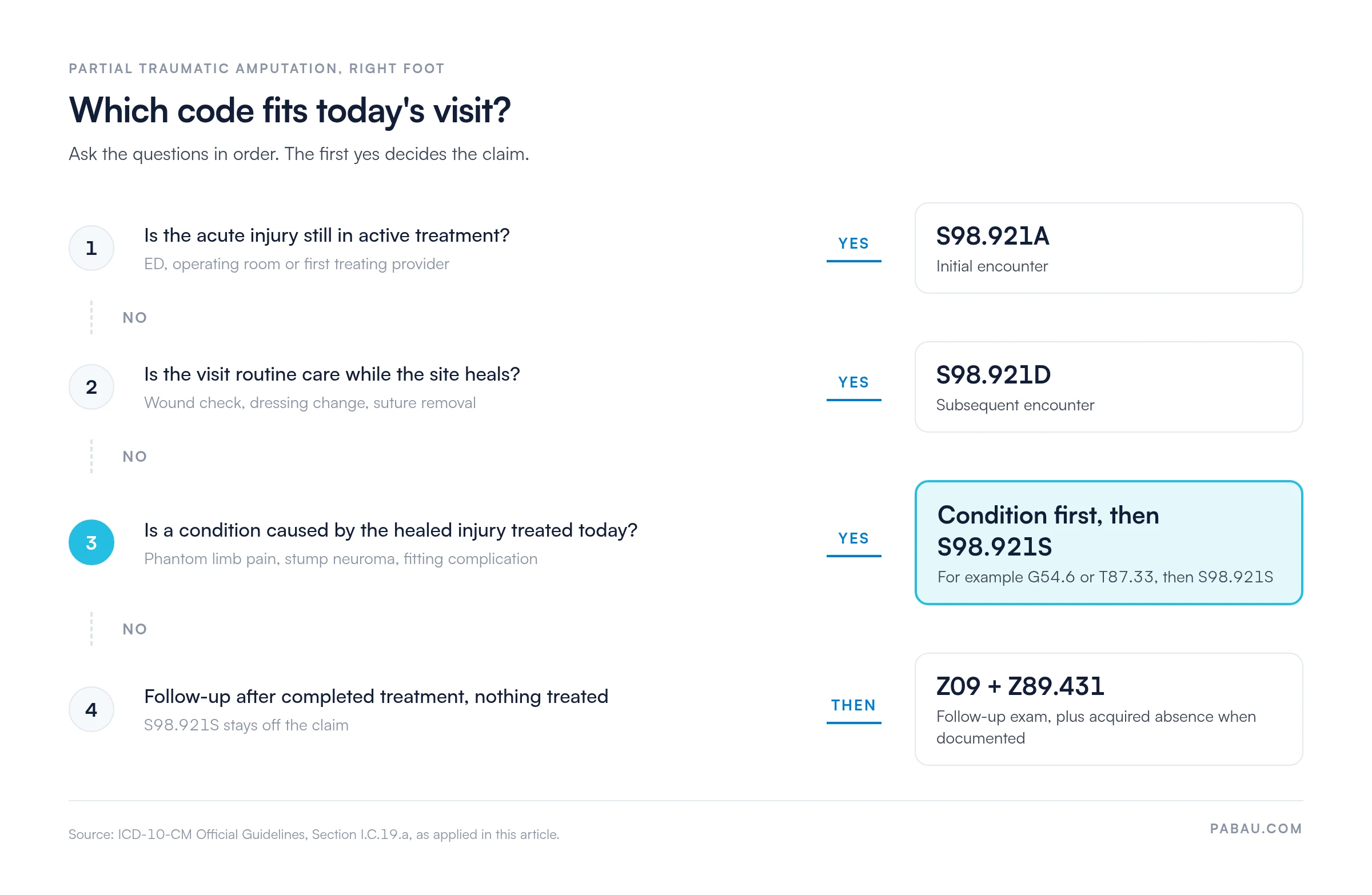
Decision flow for a partial traumatic amputation of the right foot
Ask the four questions in order, and the first yes picks the code. The logic follows ICD-10-CM Official Guidelines Section I.C.19.a.
ScenarioCorrect approachCode(s) used
Stump healed; follow-up exam after completed treatment, with no condition being treatedFollow-up and status codesZ09 (follow-up examination after completed treatment) + Z89.431 when documented
Stump healed; the patient has phantom limb pain caused by the old traumatic amputationSequela codingG54.6 (first) + S98.921S + Z89.431
Amputation site still healing; wound check with sutures in placeSubsequent encounterS98.921D
Stump healed; the patient develops a stump neuroma linked to the traumatic amputationSequela codingT87.33 (first) + S98.921S + Z89.431
Prosthetic fitting with a healed stumpDepends on the clinical documentationQuery the provider: routine fitting (a Z44.1- fitting and adjustment code) or treatment of a fitting complication (sequela S)?

A worked example. A patient lost part of her right foot in a workplace crush injury 18 months ago. The stump has healed, but burning pain now wakes her at night. The physician documents phantom limb pain from the prior partial traumatic amputation. The claim lists G54.6 first, then S98.921S, then Z89.431 because the absence is documented.

The note has to say partial, right and caused by

A claim for ICD-10 code S98.921S needs a record that ties today’s problem to a specific traumatic event. “History of right foot amputation” doesn’t support it unless the note also says traumatic and partial.

That’s where medical billing compliance starts, and it’s why a clean claim submission depends on the provider’s wording.

  • The traumatic event: the record names the mechanism, such as a crush injury, industrial accident or car crash.
  • The word “partial”: without it, the S98 category note sends the coder to S98.911S.
  • The right side: the note, operative report or imaging names the right foot. A record with no side supports only S98.929S.
  • The sequela condition: the assessment names a problem caused by the old injury. “Phantom limb pain following prior partial traumatic amputation, right foot” gives the coder that link.
  • Linkage language: some payers want the provider to state that the condition resulted from the prior injury.
  • A traumatic cause: S98 covers traumatic amputation only. An amputation for diabetes or arterial disease takes Z89.431 for the absence, not S98.921S.

Here’s how an S98.921S claim moves from note to payment

Most of the risk on a sequela claim sits before it leaves the practice. Here’s the path a typical one takes.

  1. The visit is documented. The provider records the treated condition and links it to the old partial amputation of the right foot.
  2. The coder sequences the codes. The condition goes first and S98.921S second. Z89.431 and any external cause codes the payer wants follow.
  3. Eligibility and authorization are checked. This step matters most for prosthetic fittings and therapy, which often need prior approval.
  4. The claim goes out. A medical claims clearinghouse checks the format and routes it to the payer.
  5. The payer runs its edits. It checks the diagnosis codes against each other and against the billed services.
  6. The remittance comes back. A paid claim closes. A denial carries a reason code that tells you which step to revisit.

Prosthetic and rehab claims need approval as well as the right code

Medicare covers many of the prosthetic and rehab services that follow a partial foot amputation. Local and National Coverage Determinations (LCDs and NCDs) set the rules.

The CMS ICD-10 codes page links to the current annual code files. Run an eligibility check before the appointment rather than after a denial.

Service typeTypical procedure codesPayer notes
Partial foot prostheticsHCPCS L5000-L5020Medicare requires LCD compliance and documented functional level. Prior authorization rules vary by payer.
Physical therapy and rehabilitationCPT 97161-97163 (evaluation), 97110, 97530Medical necessity must be documented. Medicare applies the KX modifier threshold, and commercial payers may require prior authorization.
Stump wound careCPT 97597, 97598The sequela condition, such as stump dehiscence or infection, must be documented as the treatment focus.
Pain management (phantom limb)E/M codes, plus any documented nerve block or injection codeG54.6 is coded first, with documentation tying the pain to the old injury.

Prior authorization check: Medicare Advantage plans and many commercial payers require prior authorization for prosthetic devices. Confirm it before the fitting is scheduled. A claim filed without a required authorization is often denied with little room for appeal.

Seven mistakes that send S98.921S claims back

Denials on ICD-10 code S98.921S follow predictable patterns. Denial management workflows and a working list of denial codes help you catch them before submission.

  • Using S when D fits: the visit still focuses on healing the site, such as wound care or suture removal. Fix: use S98.921D, and save S for a distinct later condition.
  • Missing the sequela condition: S98.921S goes out alone or listed first. Fix: find the treated condition in the record and sequence it first.
  • Completeness not documented: the note never says “partial”, so it supports the complete code. Fix: query the provider and record the completeness of the original injury.
  • Wrong side: the note documents the right foot, but the claim carries S98.922S. Fix: cross-check the side on the procedure and diagnosis codes.
  • A disease-related amputation coded as traumatic: the record shows a diabetic or vascular amputation. Fix: use Z89.431 for the acquired absence of the right foot.
  • Missing prior authorization: a prosthetic fitting or rehab service is billed without approval. Fix: run the check before scheduling, not on the day of service.
  • External cause codes left off: some commercial payers and state programs ask for them. Fix: check the payer’s billing manual before you submit.

Pro Tip

Run a monthly audit of claims using S98.921S alongside S98.921D. If S claims far outnumber D claims, review a sample for clinical accuracy. Most follow-up visits during healing are subsequent encounters, not sequela encounters, and an internal review costs less than a payer audit.

Before you submit, run this six-point check

Each check below maps to one of the denial reasons above. Run them on every S98.921S claim before it goes out.

  • The treated condition is coded and listed first.
  • S98.921S comes second, with the S character rather than D.
  • The note says “partial” and “right”, matching the code.
  • The record shows a traumatic cause, not a diabetic or vascular one.
  • Z89.431 and external cause codes are added where the payer wants them.
  • Prior authorization is on file for any prosthetic or rehab service.

How Pabau keeps S98.921S claims complete before they’re sent

Sequela claims often fail on details outside the coding manual. A missing authorization number, a flipped side or a diagnosis retyped from an old note can each send one back.

Pabau, the practice management platform we build, starts each claim from the patient record instead. Its claims management software pre-fills the CMS-1500 from the visit and pulls ICD-10 codes from the patient’s problem list. Coders confirm S98.921S and its sequela condition in the built-in ICD-10-CM lookup. A claim can’t go out until required fields, such as authorization numbers, are complete.

In the US, claims go out through Claim.MD, with eligibility checks before the visit and status tracking after it. Remittances post back as ERAs, so a denied claim surfaces while the visit is still fresh.
Pabau checkout screen showing a completed invoice billed to the patient's insurer
Pabau’s checkout raises the invoice against the patient’s insurer, so a sequela visit is billed from the same record that holds its diagnosis codes.

Send cleaner sequela claims the first time

Pabau pre-fills claims from the patient record, checks required fields before submission, and sends them through Claim.MD with real-time eligibility checks. See it in a live demo.

Pabau claims management dashboard

Conclusion

S98.921S is a narrow code, and that’s what makes it useful. It fits only a healed partial traumatic amputation of the right foot, when the visit treats a problem that injury caused. If the note misses one of those facts, a different code fits.

So fix the record before the claim. Ask the provider to state completeness, side and the link to the old injury. Then put the treated condition first. One extra query costs far less than reworking a denial.

Book a demo to see how Pabau builds sequela claims from the patient record and stops incomplete ones before they reach the payer.

Continue your research

Continue your research

Need to understand how denials get resolved once they occur? Denial management in healthcare walks through the workflows RCM teams use to track, appeal, and prevent repeat denials.

Want to understand the clearinghouse layer behind claim submission? Medical claims clearinghouse guide explains how clearinghouses validate and route claims between providers and payers.

Looking for a breakdown of common denial codes on remittances? Electronic remittance advice (ERA) guide covers how to read 835 files and act on CARC denial reason codes.

Coding a complete amputation with no side documented? S98.919S covers the sequela of a complete traumatic amputation of an unspecified foot.

Frequently asked questions

What is the ICD-10 code for phantom limb pain after a foot amputation?

G54.6 covers phantom limb syndrome with pain. After a partial traumatic amputation of the right foot, list G54.6 first and S98.921S second. Phantom limb syndrome without pain takes G54.7.

How long after the injury can you use the sequela code?

There’s no time limit. The S character applies once a condition caused by the healed injury is treated, whether that’s months or years later. Routine care while the site still heals takes D instead.

What’s the code for a partial right great toe amputation sequela?

S98.121S. Toe amputations have their own codes in S98.1- and S98.2-, split by toe, side and completeness. Use S98.921S only when the note names no level.

How do you code partial amputations of both feet?

Report S98.921S for the right foot and S98.922S for the left. Category S98.92 has no bilateral code, so each side is coded separately after the sequela condition.

Can S98.921S go on a claim for a new prosthesis?

Only if the visit treats a complication caused by the old injury. A routine fitting or adjustment takes a Z44.1- code instead. Query the provider when the note doesn’t make the purpose clear.
Avatar photo
Monika Lazarevska
Content Writer

Monika Lazarevska writes content for owners and healthcare professionals who want clear, no-fluff content that actually helps them run their practice better. With a background in storytelling and SEO, she knows how to make even the driest topics worth reading. Off the clock, you'll find her in a café somewhere in Europe, probably with a good book and an even better coffee.
×