ICD-10 Code R63.4: Abnormal weight loss
ICD-10 code R63.4: Definition, billability and code structure ICD-10 code R63.4 ...

Last Updated: Nov 13, 2026
Billable Code Specific Code
M79.605 is the billable ICD-10-CM code for pain in left leg, also listed as pain in left lower limb NOS. It is a one-sided code under M79.60 (Pain in limb, unspecified) in Chapter 13 of ICD-10-CM.
No code in this family is bilateral, so pain in both legs is reported as M79.604 plus M79.605. When the note places the pain in the left thigh or left lower leg, the more specific M79.652 or M79.662 applies instead.
Let Pabau's smart automation suggest the right codes, reduce claim denials, and keep your practice compliant—effortlessly.
Automate repetitive tasks and focus on what matters most—your patients.
Reduce coding errors and ensure compliance with the latest regulations.
Clean claims, fewer denials, and faster reimbursements.
Powerful insights and reporting to help your practice thrive.
HIPAA compliant SOC 2 certified GDPR-compliant Trusted by 4,000+ clinics worldwide

M79.605 codes pain in the left leg (left lower limb NOS). It is a one-sided code, not a bilateral one.
No code in the M79.60- family is bilateral. For pain in both legs, report M79.604 (right leg) and M79.605 (left leg) together.
When the note pins the pain to the left thigh or left lower leg, the more specific M79.652 or M79.662 replaces M79.605.
Pabau’s claims and billing software connects to the Claim.MD clearinghouse for eligibility checks and electronic ICD-10-CM claim submission.
ICD-10 Code M79.605 is a valid, billable ICD-10-CM code for pain in the left leg. AAPC’s Codify entry for M79.605 lists the official descriptor, Pain in left leg, with the inclusion term pain in left lower limb NOS. It covers one side only, so pain in both legs is coded M79.604 plus M79.605.
The table below summarizes the reference data coders need before submission.
The CDC/NCHS ICD-10-CM web tool lets coders verify M79.605 against the official tabular list for the applicable fiscal year. CMS releases updated code files each October, so confirm annual validity before submission.
M79.605 applies when a patient presents with pain in the left leg and no underlying cause has been documented. The code is deliberately non-specific. It captures the symptom while the cause, and often the exact segment, remains unresolved.
Included clinical presentations: Aching, cramping, heaviness or diffuse pain in the left lower limb, with no documented cause such as fracture, vascular disease or neuropathy.
When to use a more specific code instead: If a definitive cause is documented, M79.605 is not the correct code. Examples include deep vein thrombosis (I82.4-), peripheral arterial disease (I70.2-), peripheral neuropathy (G60-G64), stress fracture (M84.3-) and nontraumatic compartment syndrome (M79.A2-).
Excludes2 note: The M79.6 subcategory carries an Excludes2 note for pain in joint (M25.5-). Left knee pain therefore takes M25.562, and left hip pain takes M25.552. Excludes2 means both codes may be reported when the patient has joint pain and separate limb pain.
Site specificity rule: M79.605 describes the left leg as a whole. When the note places the pain in the left thigh, use M79.652. When it places the pain between the knee and ankle, use M79.662. Pain in the left foot or toes has its own codes (M79.672 and M79.675).
M79.605 sits in the M79.60- family, which codes pain by limb and side. The table below compares it with its two leg siblings.
No code in this family is bilateral. The arm codes are M79.601 (right), M79.602 (left) and M79.603 (unspecified). The leg codes are M79.604 (right), M79.605 (left) and M79.606 (unspecified), and M79.609 covers an unspecified limb.
Pain in both legs: The ICD-10-CM Official Guidelines (Section I.B.13) say that when no bilateral code exists, you assign separate codes for left and right. Pain in both legs is therefore coded M79.604 plus M79.605.
When a segment is documented: The thigh codes are M79.651 (right), M79.652 (left) and M79.659 (unspecified). The lower-leg codes are M79.661, M79.662 and M79.669, in the same order. Use them whenever the note names the segment, because they are more specific than M79.605. Read side and site together, and the grid below gives one code for each combination.
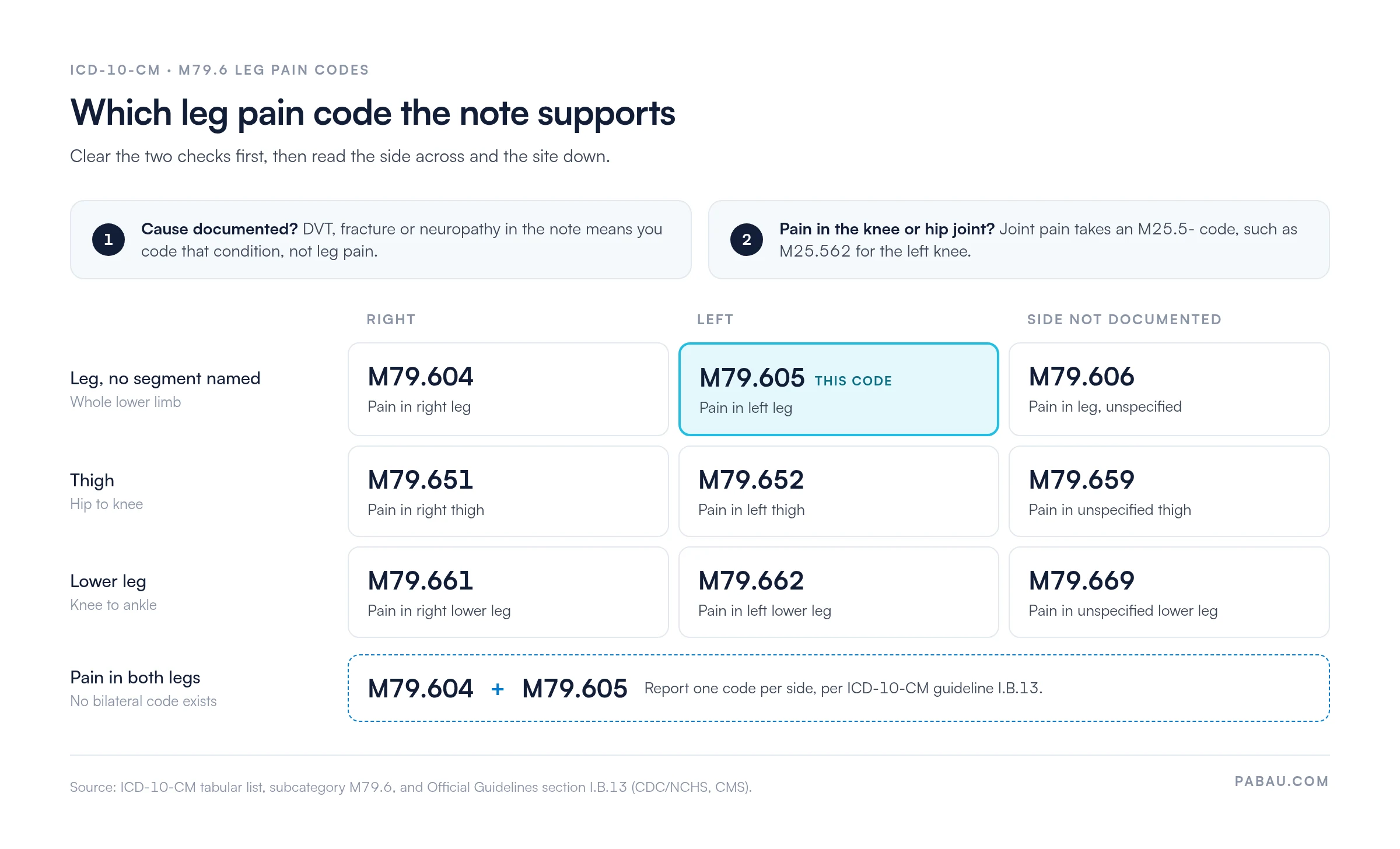
A claim supported by M79.605 needs the clinical note to establish four things before the code is defensible.
If the patient reports pain in both legs, the note should say so in plain terms. The coder then reports M79.604 and M79.605 together. The MEAT framework (Monitor, Evaluate, Assess, Treat) strengthens the note for payer review.
M79.605 is a diagnosis code, so it always pairs with a CPT code that describes what was done at the encounter. The table below lists frequently co-billed codes across common practice settings.
The note must show that the paired procedure is medically necessary for left leg pain of unspecified origin. Procedures performed on one side often carry the -LT modifier, which should match the left-sided diagnosis.
For physical therapy, payers increasingly ask for a referral or a functional limitation assessment before approving therapy under an unspecified pain code. A clearinghouse such as Claim.MD runs claim edits that flag mismatched diagnosis-procedure pairs before they reach the payer.
Coverage for services billed with M79.605 depends on the associated procedure, not the diagnosis alone. Payers rarely adjudicate a diagnosis code in isolation.
Running insurance eligibility verification before the encounter lowers the risk of billing an unspecified pain code against a plan that wants a confirmed diagnosis. Solid medical billing compliance processes, including LCD lookups before submission, keep denial rates manageable.
Run an LCD lookup for every CPT code you pair with M79.605 before submission. The CMS Coverage Database lists active LCDs by jurisdiction and procedure. If M79.605 is missing from the covered diagnoses, attach a short narrative explaining why the cause is still unspecified and what workup is planned.
M79.605 claims are denied for a small set of predictable reasons. Each one has a straightforward fix.
Denial management workflows that track denial reasons by code show whether M79.605 denials cluster around a CPT pairing, a payer or a provider. The first step toward submitting a clean claim is confirming side and site in the note before the code is selected.
Use this decision workflow each time the clinical note describes leg pain of unspecified origin.
The hierarchy below helps coders move around the M79.6 family and pick the most specific code available.
The CMS ICD-10 codes page provides downloadable tabular list files for each fiscal year. Coders can use them to browse the full M79.6- family for the billing period. Many neighboring codes also have their own page in our code library for billers, with documentation and denial notes for each.
Leg pain codes look simple, but side, segment and cause all have to line up before a claim is clean. Most M79.605 denials trace back to a note that left one of those out, or a claim that did not match the note.
Pabau keeps the clinical record and the claim in one system, so the billing team codes from the note itself. Its claims management software works with Claim.MD to run ICD-10-CM and CPT checks at submission, catching code-pairing errors before they reach the payer.
Eligibility responses, claim status and electronic remittance advice come back against the same patient record. A rejection shows up the day it happens, so the billing team can correct and resubmit it before month-end reconciliation.

Pabau’s integrated claims management and Claim.MD connection help US practices submit accurate ICD-10-CM claims and run real-time eligibility checks. Track denial patterns before they become write-offs.

M79.605 means pain in the left leg, and its scope stops there. The code carries one side, no named segment and no confirmed cause. Most coding errors on it come from stretching it past one of those limits.
Pain in both legs takes two codes, a named thigh or lower leg takes its own code, and a confirmed diagnosis replaces the symptom. When the note states side and site plainly, the code choice follows. Book a demo to see how Pabau keeps documentation and claim submission in one workflow.

Sending ICD-10-CM claims through a clearinghouse? The Claim.MD clearinghouse guide explains how claims, eligibility checks and remittances move between a practice and its payers.
Looking to understand the full billing workflow behind a diagnosis claim? Revenue cycle management fundamentals explains how ICD-10-CM codes move from documentation through to payment posting.
Want to reduce denials across your practice’s ICD-10-CM submissions? Denial codes in medical billing covers CARC reason codes and appeals workflows for common claim rejections.
ICD-10 Code M79.605 is the billable ICD-10-CM diagnosis code for pain in left leg, also listed as pain in left lower limb NOS. It sits under M79.60 (Pain in limb, unspecified) in Chapter 13 of ICD-10-CM. It is a one-sided code, not a bilateral one.
Yes, M79.605 is a valid, billable ICD-10-CM code and can be submitted on a claim for the current fiscal year. Confirm annual validity against the CMS tabular list each October, when new codes take effect.
M79.605 is pain in the left leg. M79.606 is pain in leg, unspecified, used when the note documents leg pain but does not say which leg. Use M79.605 only when the note confirms the left side.
The M79.60- family has no bilateral code. Under ICD-10-CM guideline I.B.13, a bilateral condition with no bilateral code takes separate codes for each side. Report M79.604 (right leg) and M79.605 (left leg) together.
Use M79.662 when the note places the pain in the left lower leg, between knee and ankle. Use M79.652 when it places the pain in the left thigh. M79.605 is for left leg pain with no segment specified.
The note must state that the pain is in the left leg and that no more specific cause has been diagnosed. It should also record onset, duration, severity and the evaluation performed. A missing side is the most common documentation gap.
The leading reason is a side mismatch, such as M79.605 billed for right-sided or undocumented-side pain. Others include coding only one side when both legs hurt, and skipping a more specific site or diagnosis. Thin medical necessity documentation for the paired CPT code also triggers denials.
Yes, M79.605 is valid for Medicare billing. Coverage depends on the paired CPT code and on whether the applicable Local Coverage Determination lists M79.605 as a covered indication. The code alone does not guarantee payment for any service.