ICD-10 Code R63.4: Abnormal weight loss
ICD-10 code R63.4: Definition, billability, and code structure ICD-10 code R63.4...

Last Updated: Nov 13, 2026
Billable Code Specific Code
R73.9 is the billable ICD-10-CM code for hyperglycemia, unspecified. It covers elevated blood glucose that a clinician documents without diagnosing diabetes or naming a more specific R73 glucose disorder.
The code sits in category R73, Elevated blood glucose level. A typical case is a high random glucose on routine labs, recorded as hyperglycemia with no cause named. Once the note says diabetes, prediabetes or impaired fasting glucose, a more specific code replaces R73.9.
Let Pabau's smart automation suggest the right codes, reduce claim denials, and keep your practice compliant—effortlessly.
Automate repetitive tasks and focus on what matters most—your patients.
Reduce coding errors and ensure compliance with the latest regulations.
Clean claims, fewer denials, and faster reimbursements.
Powerful insights and reporting to help your practice thrive.
HIPAA compliant SOC 2 certified GDPR-compliant Trusted by 4,000+ clinics worldwide

R73.9 is the billable ICD-10-CM code for elevated blood glucose without a confirmed diabetes diagnosis.
The Excludes1 note at R73 keeps R73.9 off any claim that carries an E08-E13 diabetes code.
Prediabetes takes R73.03, impaired fasting glucose R73.01 and impaired glucose tolerance R73.02, so R73.9 applies only when the note names no such disorder.
Moving from R73.9 to an E11 code requires a clinician’s documented diabetes diagnosis. A lab value above the ADA threshold isn’t enough on its own.
Pabau’s claims management software flags excluded code combinations before submission, which helps practices avoid the CO-11 and CO-50 denials tied to R73.9 claims.
ICD-10 Code R73.9 is the billable code for hyperglycemia, unspecified. It covers elevated blood glucose that a clinician documents without diagnosing diabetes or naming a specific glucose disorder.
The CDC’s FY2027 ICD-10-CM tabular list places it in category R73, whose Excludes1 note bars the diabetes codes E08-E13. “Unspecified” means the type or cause of the elevation hasn’t been determined.
Three documentation scenarios most commonly support R73.9 at the encounter level:
Documentation decides the code. A glucose of 130 mg/dL supports R73.9 when the encounter note reads “hyperglycemia, further evaluation needed.” The same reading supports E11.9 only when a physician states that the patient has type 2 diabetes mellitus. A note that says “elevated fasting glucose” points to R73.01 instead, because the tabular list files that phrase under impaired fasting glucose.
The Excludes1 note at the R73 category level is the most consequential rule governing ICD-10 Code R73.9. An Excludes1 note means the two conditions are never coded together. R73.9 and an excluded code can’t share the same encounter claim.
The Excludes1 list at R73 covers the whole diabetes mellitus code block plus three related conditions:
Once a diabetes diagnosis is established and coded, the diabetes code itself captures the hyperglycemia. R73.9 and any E08-E13 code can’t appear together on the same encounter claim. Submitting both triggers a CO-11 edit (“The diagnosis is inconsistent with the procedure”) at most clearinghouses.
R73.9 and R73.09 sit one character apart but cover different clinical situations. Mixing them up is a frequent R73 error, particularly when the note carries a prediabetes label or an abnormal glucose tolerance result.
Prediabetes has its own subcode, R73.03, which took effect on October 1, 2016, the start of FY2017. When a clinician documents “prediabetes” explicitly, R73.03 is correct.
Impaired fasting glucose takes R73.01, and impaired oral glucose tolerance takes R73.02. R73.09 covers the remaining abnormal glucose findings, such as abnormal glucose NOS. R73.9 is correct only when the note names no specific glucose disorder.
R73.9 versus E11.9 is a decision coders often misjudge. Using R73.9 when the documentation supports E11.9 (type 2 diabetes mellitus without complications) can underrepresent the patient’s condition. Using E11.9 without documentation support leads to medical necessity denials.
The ICD-10-CM Official Guidelines set the rule: code what the physician documented, and leave the reading of lab values to the physician. A fasting glucose of 128 mg/dL does not automatically produce a diabetes code. The physician’s encounter note must include a diabetes diagnosis statement.
Use this decision sequence before assigning either code:
Per the CMS ICD-10-CM coding guidelines, coders should not interpret lab results independently of physician documentation. The ADA’s clinical threshold (HbA1c 6.5% or FPG 126 mg/dL) is a clinical anchor, not an automatic coding trigger.
The chart below maps that sequence onto the code each branch lands on.
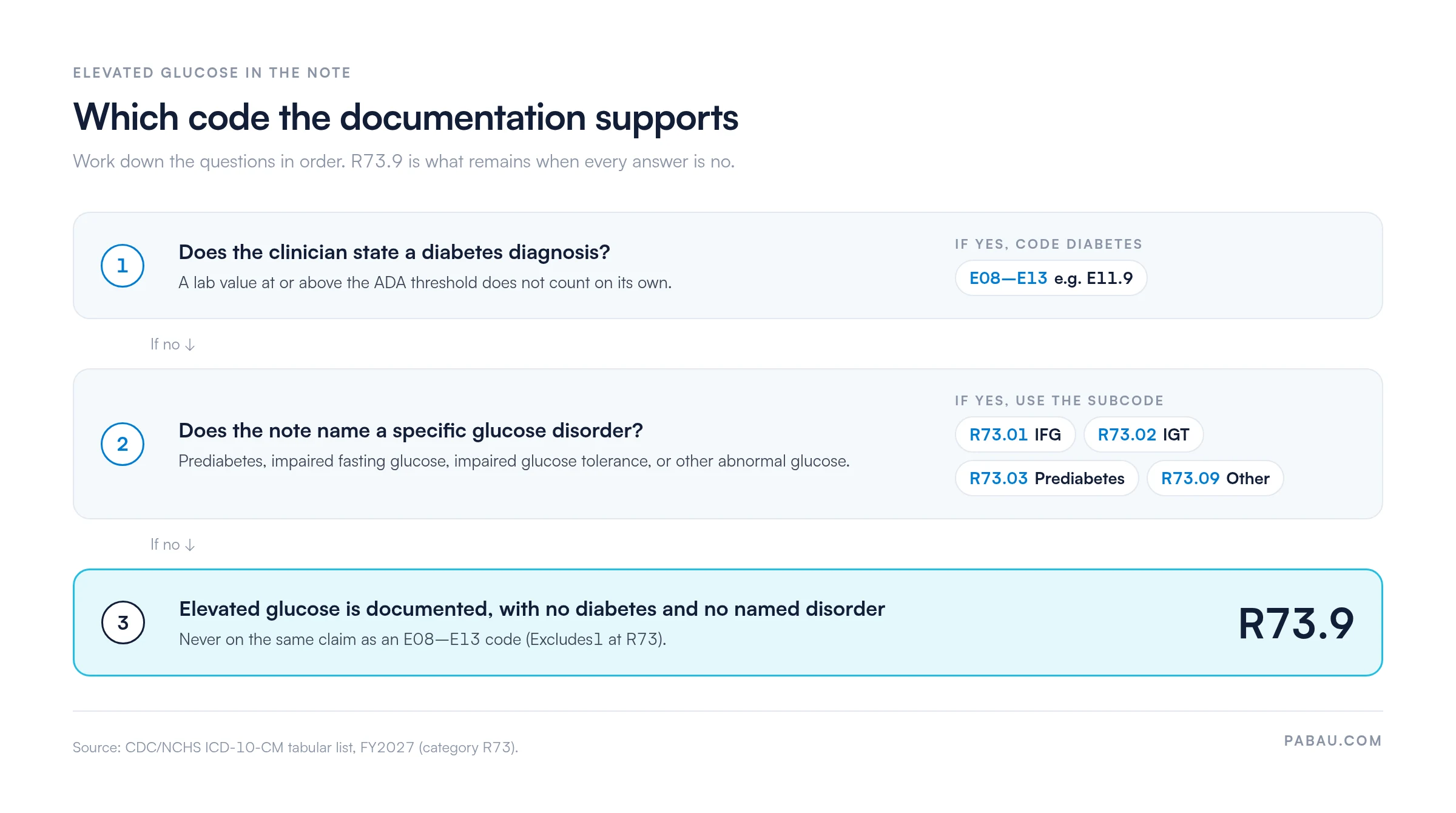
Before signing off on R73.9, run a quick note search for the words diabetes, prediabetes, impaired, and tolerance. Any of those words appearing in the same encounter note as an elevated glucose reading changes the code selection. R73.9 is correct only when the note is silent on all four.
The R73 category contains five billable subcodes. Coders navigating elevated glucose findings need to review all five before settling on R73.9.
Coders sometimes use R73.9 as a catch-all when any glucose value looks high. That habit creates audit exposure. When the chart contains a prediabetes label or an OGTT result, the more specific subcode applies, and R73.9 on that claim is a coding error. Verify against the CDC/NCHS ICD-10-CM web tool when subcode selection is uncertain.
ICD-10 Code R73.9 is straightforward to apply when the clinical record contains the right elements. Missing any of the following creates both a coding error and a denial risk. Per medical billing compliance standards, every diagnosis code on a claim needs supporting documentation in the record.
A single phrase usually separates documentation that supports R73.9 from documentation that invites an audit. Compare these three notes:
Payer acceptance of ICD-10 Code R73.9 as a primary diagnosis varies by payer and by the service being billed. Medicare Administrative Contractors (MACs) publish Local Coverage Determinations (LCDs) that specify which services R73.9 supports as a covered indication.
These are the service categories where R73.9 most commonly appears as a covered primary or supporting diagnosis:
Commercial payer policies differ from Medicare LCDs. Always verify the specific plan’s coverage policy for the service being billed. Payers scrutinize R73.9 less as a secondary diagnosis in a broader metabolic workup. It draws the most review as the sole primary diagnosis on a service with stricter coverage criteria.
Denials tied to ICD-10 Code R73.9 follow predictable patterns. Each one has a corresponding CARC code that tells you exactly what the payer objected to. Denial management workflows that catch these patterns before submission cost far less than appeals after the fact. Our reference on CARC denial codes explains each code in full.
Submitting through a clearinghouse that runs claim edits against LCD databases catches many of these before they reach the payer. Pabau, the practice management platform we build, connects to the Claim.MD clearinghouse to flag excluded code combinations and run real-time eligibility checks. CO-11 edits on R73.9 claims then surface at the scrubbing stage, before adjudication.
The CPT codes below are the ones most often billed alongside ICD-10 Code R73.9, based on standard coding references. Quantitative blood glucose testing under 82947 is the most direct pairing, since it monitors the finding itself.
For practices submitting through a medical claims clearinghouse, real-time eligibility checks can confirm a pairing is covered before submission.
Payer-specific LCD confirmation is advisable before billing G0108 or G0109 (diabetes self-management training) with R73.9 as the sole supporting diagnosis. Those services are generally tied to a confirmed diabetes diagnosis under Medicare’s NCD requirements.
Practices that see elevated glucose patients in preventive, primary care and metabolic health settings code R73.9 often. The usual audit failure is a correct code whose clinical record can’t support it on review. Connecting the signed note to the claim closes that weakness.
Pabau’s claims management software works with Claim.MD to run pre-submission edits against the ICD-10 code set. It flags excluded pairings, such as R73.9 with any E08-E13 code, before the claim reaches the payer.
The audit trail records which provider signed the note, which codes were assigned, and when the claim went out. That is the documentation chain payers ask for in a post-payment audit, so clean first claims and faster denial resolution both follow from it.
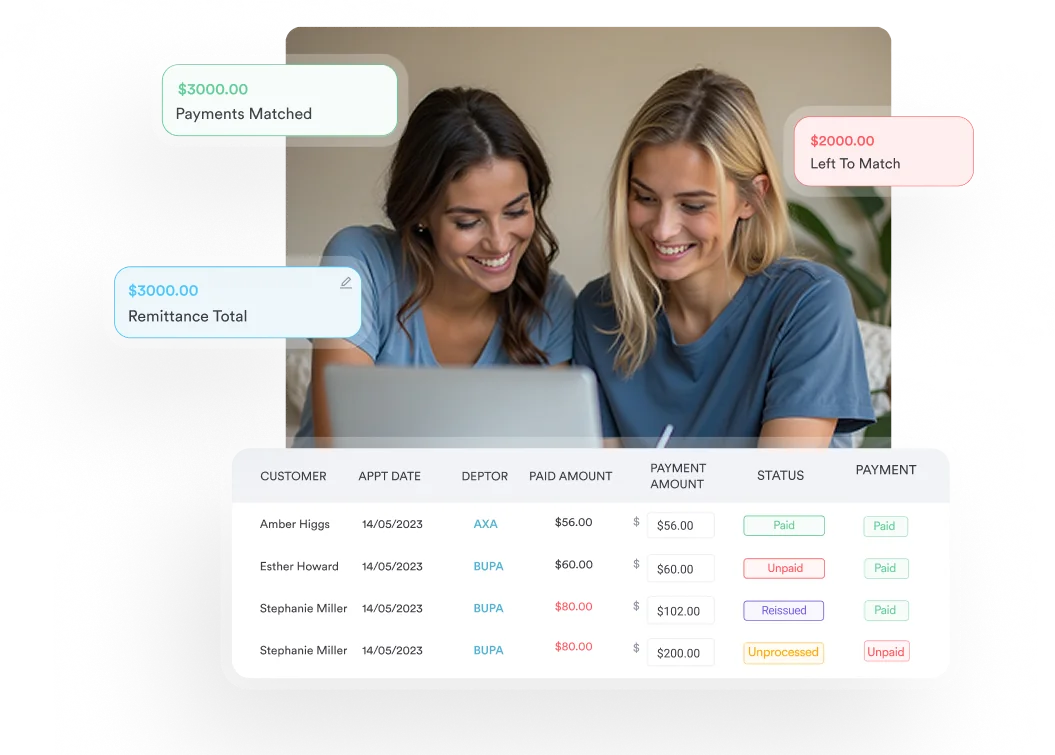

Pabau integrates with Claim.MD to scrub ICD-10 code combinations, run real-time eligibility, and flag excluded pairings at submission. See how it works for metabolic health and primary care workflows.

R73.9 holds up on a claim when the note does three jobs. It records the glucose value with the clinician’s reading of it. It stays silent on diabetes, and it names no more specific glucose disorder.
When one of those fails, recode before submission instead of appealing afterward. R73.01, R73.02, R73.03 or the E-series code the note supports will pay on the first pass, where R73.9 would be denied.
The Excludes1 clash with E08-E13 is the one error a pre-submission check should never let through. Book a demo to see how Pabau flags R73.9 conflicts before your claims reach the payer.

Need to understand how clearinghouse edits catch code errors? Submitting clean claims explains what payers check at adjudication and how pre-submission scrubbing reduces rework.
Choosing a clearinghouse for diagnosis-heavy claims? Claim.MD clearinghouse guide covers how ERA/835 remittances surface CARC denial codes and what to do next.
Comparing billing platforms for metabolic health services? Best medical billing software compares platforms that handle complex ICD-10 pairings and LCD compliance for US practices.
ICD-10 Code R73.9 is the billable ICD-10-CM code for hyperglycemia, unspecified. It is assigned when a patient has documented elevated blood glucose but no confirmed diabetes mellitus diagnosis. It falls under category R73 (Elevated blood glucose level) and applies when the record doesn’t identify the type or cause of the elevation.
Use R73.9 when the physician’s note documents elevated glucose or high blood sugar without also stating a diabetes diagnosis. Use E11.9 when the physician explicitly documents type 2 diabetes mellitus. A lab value at or above the ADA diagnostic threshold does not automatically trigger an E11.9 code. A clinician’s written diagnosis statement is required.
R73.09 (Other abnormal glucose) covers abnormal glucose findings that R73.01-R73.03 don’t describe, such as abnormal glucose NOS. R73.9 applies when the note documents elevated glucose or hyperglycemia without a specific glucose disorder label. If the note says “prediabetes,” use R73.03, and impaired glucose tolerance takes R73.02.
Yes. R73.9 is valid as a primary (first-listed) diagnosis when the elevated blood glucose finding is the chief reason for the encounter. Payer acceptance as the sole primary diagnosis depends on the service being billed and the applicable LCD. For glucose laboratory tests and routine E/M visits where elevated glucose drove the encounter, R73.9 as the primary diagnosis is generally accepted.
Not automatically, but the risk varies by payer and service. Medicare and commercial payers accept R73.9 as a primary diagnosis for glucose monitoring lab tests and E/M visits tied to the finding. Denials are more common when R73.9 supports a service that needs a confirmed diabetes diagnosis under an LCD or NCD. DSMT training (G0108/G0109) is the usual example. Always verify the current LCD for the billed service before submission.
The most commonly paired CPT codes are 82947 (blood glucose, quantitative), 83036 (HbA1c), 82951 (glucose tolerance test), and standard E/M codes (99202-99215). These pairings are generally well accepted by Medicare and commercial payers when the clinical record supports R73.9 as the reason for the service. Payer-specific LCD confirmation is recommended for specialty services.
Yes. The record must include the lab value with its reference range and the clinician’s interpretation of it. It must also show that no diabetes diagnosis has been established. Missing any of these elements creates both a coding error risk and a basis for a CO-50 medical necessity denial on audit.
Yes. R73.9 is a billable ICD-10-CM code in the official CDC tabular list. It needs no additional character and is valid for both outpatient and inpatient reporting.