ICD code M51.369 – Lumbar disc degeneration without back or leg pain
Billable Code•Specific Code
Code Definition
M51.369 is the billable ICD-10-CM code for other intervertebral disc degeneration, lumbar region without mention of lumbar back pain or lower extremity pain.
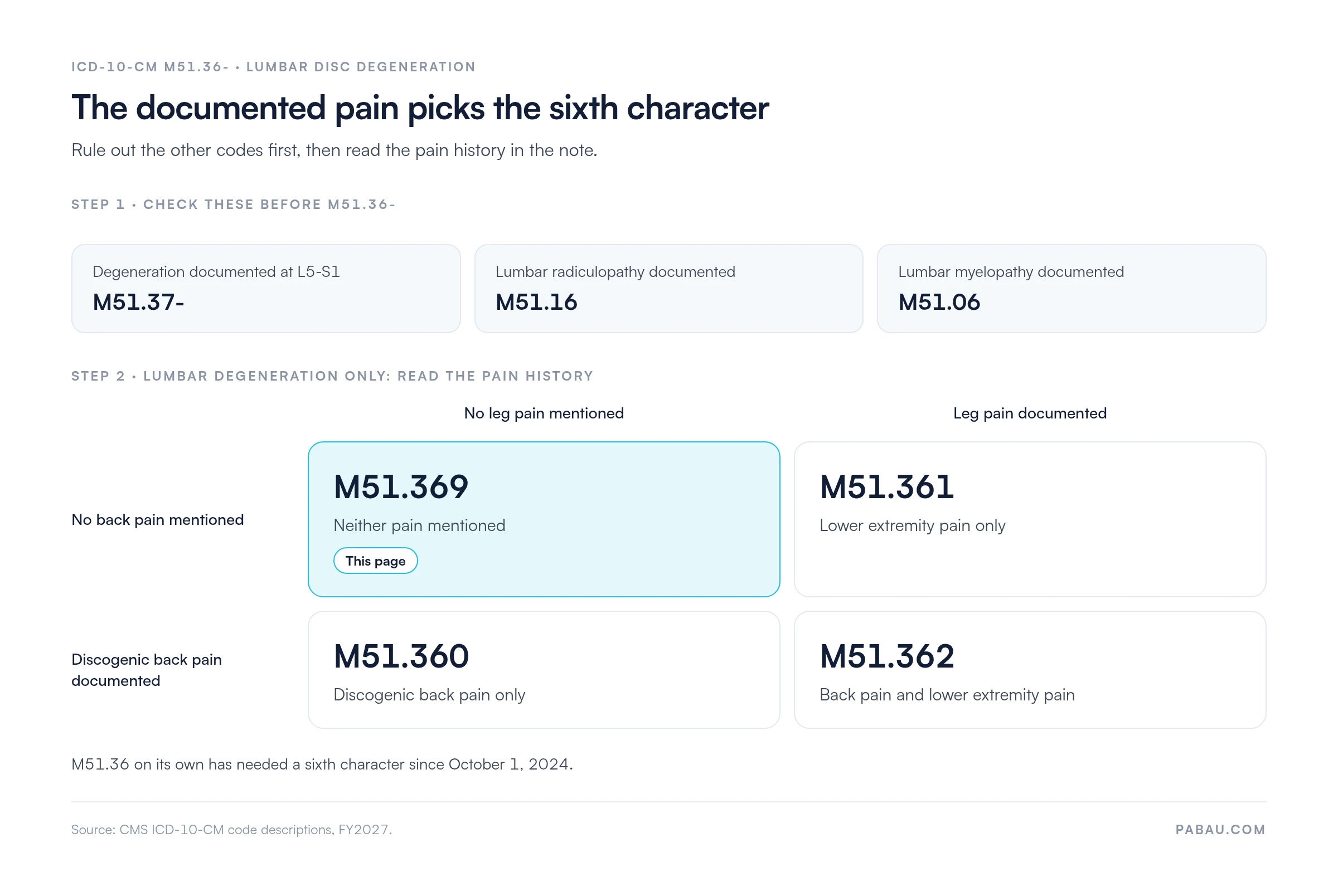
It applies when the provider documents lumbar disc degeneration and the note mentions neither back nor leg pain. When pain is documented, the sixth character changes. M51.360 covers discogenic back pain only, M51.361 leg pain only, and M51.362 both. Lumbar disc disorders with radiculopathy are coded to M51.16, and those with myelopathy to M51.06.
Related Information
Chapter
M00-M99 Diseases of the musculoskeletal system and connective tissue
Category
M51 Thoracic, thoracolumbar, and lumbosacral intervertebral disc disorders
Group
M51.36 Other intervertebral disc degeneration, lumbar region
M51.369Lumbar disc degeneration without back or leg pain
ICD Code Suggestion
AI
Suggested code
M51.369Lumbar disc degeneration without back or leg painHigh match
Confidence score
98%
Why this code?
Matches patient diagnosis
Supported by clinical notes
Commonly used for this condition
Why practices choose Pabau
Save hours every week
Automate repetitive tasks and focus on what matters most—your patients.
Improve accuracy
Reduce coding errors and ensure compliance with the latest regulations.
Get paid faster
Clean claims, fewer denials, and faster reimbursements.
Grow with confidence
Powerful insights and reporting to help your practice thrive.
HIPAA compliant•SOC 2 certified•GDPR-compliant•Trusted by 4,000+ clinics worldwide
Key takeaways
M51.369 is the billable ICD-10-CM code for lumbar disc degeneration when the record mentions neither lumbar back pain nor lower extremity pain.
Its siblings split by documented pain: M51.360 for discogenic back pain only, M51.361 for leg pain only, and M51.362 for both.
Disc disorders with nerve involvement have their own codes: M51.16 for lumbar radiculopathy and M51.06 for lumbar myelopathy.
Pabau’s claims management software submits claims through the Claim.MD clearinghouse and scrubs them for missing or invalid details first.
ICD-10 Code M51.369: Official descriptor and billable status
ICD-10 Code M51.369 is a valid, billable ICD-10-CM code for lumbar disc degeneration when the record mentions neither back nor leg pain. It took effect on October 1, 2024, and it is listed in CMS’s FY2027 code descriptions.
Its official descriptor, per the CDC/NCHS ICD-10-CM tool, is Other intervertebral disc degeneration, lumbar region without mention of lumbar back pain or lower extremity pain.
Field
Value
Code
M51.369
Official descriptor
Other intervertebral disc degeneration, lumbar region without mention of lumbar back pain or lower extremity pain
Billable
Yes
Effective date
October 1, 2024 (FY2025); still valid in FY2027
ICD-10-CM chapter
Chapter 13: Diseases of the musculoskeletal system and connective tissue (M00-M99)
Block
M50-M54: Other dorsopathies
Category
M51: Thoracic, thoracolumbar, and lumbosacral intervertebral disc disorders
Subcategory
M51.3: Other thoracic, thoracolumbar and lumbosacral intervertebral disc degeneration
Parent code
M51.36: Other intervertebral disc degeneration, lumbar region (non-billable; needs a 6th character)
Before October 1, 2024, M51.36 was itself a billable code. The FY2025 update split it into four 6-character codes, one for each pain pattern the record can document.
A claim with a date of service on or after that date is rejected if it carries M51.36 alone. Coders should still check each code against the active fiscal year files in the CMS ICD-10 coding resources.
Clinical scope of M51.369: What the code covers
M51.369 covers degeneration of one or more intervertebral discs in the lumbar region. It applies when the record mentions neither lumbar back pain nor lower extremity pain. The changes are structural: loss of nucleus pulposus hydration, wear of the annulus fibrosus, and reduced disc height.
The final character records pain. A 9 means the provider documented the degeneration without mentioning back or leg pain. That fits an incidental imaging finding, or a note that records the degeneration with no pain attached to it.
Naming a lumbar disc level, such as L3-L4, does not change the code. A disc documented at L5-S1, though, is usually coded to the lumbosacral region in M51.37-.
Included: Lumbar degenerative disc disease (DDD), disc deterioration, and age-related disc changes, with no back or leg pain mentioned in the record
Included: Lumbar disc degeneration seen on imaging and documented by the provider, at one level or several
Code a sibling instead: Degeneration with discogenic back pain only (M51.360), lower extremity pain only (M51.361), or both (M51.362)
Excluded: Lumbosacral disc degeneration, coded from M51.37- (M51.379 when no pain is mentioned)
Excluded: Disc disorders with radiculopathy (M51.16 lumbar, M51.17 lumbosacral) or with myelopathy (M51.06 lumbar)
Excluded: Cervical disc degeneration (M50.3-), and thoracic or thoracolumbar disc degeneration (M51.34, M51.35)
Excluded: Lumbar disc displacement or herniation without radiculopathy or myelopathy (M51.26)
M51.369 vs. similar ICD-10 codes: Choosing the right one
The M51.36- codes cause the most confusion in lumbar disc coding. They differ only by the pain the record documents, so a coder who skips the pain history picks the wrong one. The chart below sets out the order to work in: rule out the other codes, then read the pain history.
Two questions about the note settle the sixth character, once region and nerve involvement are ruled out. Code titles from the CMS FY2027 ICD-10-CM code descriptions.
The table adds the neighboring codes a coder weighs against M51.369.
Code
Descriptor
Documented pain
Use when
M51.369
Other intervertebral disc degeneration, lumbar region without mention of lumbar back pain or lower extremity pain
None mentioned
Lumbar degeneration is documented with no back or leg pain recorded
M51.360
Other intervertebral disc degeneration, lumbar region with discogenic back pain only
Back pain only
The provider links low back pain to the degenerated disc, with no leg pain
M51.361
Other intervertebral disc degeneration, lumbar region with lower extremity pain only
Leg pain only
Lower extremity pain is documented with the degeneration, with no back pain
M51.362
Other intervertebral disc degeneration, lumbar region with discogenic back pain and lower extremity pain
Back and leg pain
Both pain types are documented with the degeneration
M51.36
Other intervertebral disc degeneration, lumbar region (parent)
Not applicable
Never bill at this level; it needs a 6th character
M51.379
Other intervertebral disc degeneration, lumbosacral region without mention of lumbar back pain or lower extremity pain
None mentioned
The same pattern at the lumbosacral level (L5-S1)
M51.16
Intervertebral disc disorders with radiculopathy, lumbar region
Radicular
A lumbar disc disorder with documented nerve root involvement
M51.06
Intervertebral disc disorders with myelopathy, lumbar region
Myelopathic
A lumbar disc disorder with documented spinal cord involvement
M51.26
Other intervertebral disc displacement, lumbar region
Varies
Disc displacement or herniation without radiculopathy or myelopathy
M51.46
Schmorl’s nodes, lumbar region
Varies
Imaging shows Schmorl’s nodes specifically
M54.50
Low back pain, unspecified
Back pain
Back pain with no confirmed cause in the record
M51.369 vs. M54.50 for low back pain
M54.50 is the symptom code for unspecified low back pain. It replaced M54.5 on October 1, 2021, and M54.5 is no longer billable. Once the provider confirms disc degeneration, the pain history decides between M54.50 and the M51.36- codes.
Use M54.50: The record documents low back pain, and no cause has been confirmed
Use M51.360 or M51.362: The provider documents lumbar disc degeneration and links the back pain to it
Use M51.369: Lumbar disc degeneration is documented, and the note mentions no back or leg pain
Query the provider: Imaging shows degeneration and the note mentions pain, but it does not say whether the two are linked
Documentation requirements for ICD-10 Code M51.369
M51.369 is billed from the provider’s confirmed diagnosis of lumbar disc degeneration. A claim missing one of the elements below often stalls, and medical billing compliance reviews check for the same ones. Each belongs in the chart before the code is billed.
Provider diagnosis statement: The treating provider documents lumbar intervertebral disc degeneration as a confirmed diagnosis, not as a differential still under workup
Region: The note places the degeneration in the lumbar region. A lumbosacral (L5-S1) finding moves the code to M51.37-
Pain history: The note records whether the patient has lumbar back pain or lower extremity pain. M51.369 is correct only when neither is mentioned
Imaging reference: An MRI or X-ray report on file, referenced in the note, supports the diagnosis when a payer reviews the claim
Nerve or cord involvement: Radiculopathy points to M51.16 and myelopathy to M51.06. Check that the note describes neither before billing M51.369
Functional impact: How the degeneration affects the patient’s function supports medical necessity for therapy, injections, or referral
Query the provider before billing, never after a denial. A useful query asks about pain: back pain, leg pain, both, or neither, and whether the provider links it to the disc.
Common CPT codes billed with M51.369
M51.369 pairs with procedure codes across evaluation, conservative care, and diagnostic imaging. The table reflects common clinical usage, so verify each pairing against the payer’s local coverage determination (LCD).
Common first pairing; most payers do not require prior auth for the initial evaluation
97110
Therapeutic exercise
Requires documented functional impairment; visit limits may apply under payer policy
98940-98942
Chiropractic manipulative treatment
Medicare covers active treatment with a documented plan; maintenance care may not be covered
72148
MRI lumbar spine without contrast
Often the study that first records the degeneration; many commercial payers require prior auth
99213-99215
Office or outpatient visit, established patient
Level driven by the documented medical decision-making or time
62322, 62323
Interlaminar epidural injection, lumbar or sacral, without or with imaging guidance
Done to treat pain, so M51.360, M51.361, or M51.362 usually describes the indication better than M51.369
62290
Injection procedure for discography, lumbar
Part of a discogenic pain workup; the pain-code point applies, and prior auth is typical
Physical therapy evaluations raise the pain question often. When a therapy evaluation records back or leg pain, check that the referral diagnosis still matches it.
Pro Tip
Before billing an epidural steroid injection (62322 or 62323) for lumbar disc degeneration, read the pain history. Injections treat pain. Pairing one with M51.369, a code that says no pain was mentioned, invites a medical necessity denial. Code the pain-specific sibling the note supports, and confirm the chart shows the conservative care the LCD requires.
Payer requirements and prior authorization for M51.369
Prior authorization rules for procedures paired with M51.369 are payer-specific and change with LCD revisions. These thresholds reflect common policy patterns. Always verify against the active LCD or commercial payer policy before scheduling an interventional procedure.
Medicare LCD requirements: CMS has no single national coverage determination for lumbar disc degeneration treatments. Regional MACs govern coverage through local coverage determinations (LCDs). Most LCDs for lumbar epidural steroid injections require documented failure of conservative treatment, typically 4 to 6 weeks, before coverage. The CMS Physician Fee Schedule lookup confirms payment rates for the CPT codes paired with this diagnosis.
Commercial payer PA thresholds: Most commercial payers require prior authorization for lumbar MRI (72148), epidural injections (62322/62323), and surgery for lumbar disc diagnoses. PA is generally not required for a physical therapy evaluation and the first treatment visits.
Conservative treatment period: Most payers want a documented conservative treatment period before they authorize interventional procedures. Six weeks is common, though some LCDs specify 4 weeks. The start and end dates of that period must appear in the clinical record.
Submitting a clean claim: Include the PA number, the treating and referring provider NPIs, and the specific CPT code that was authorized. A PA for 62322 does not automatically cover 62323.
Common M51.369 claim denial reasons and how to fix them
M51.369 denials follow predictable patterns, and most are preventable before submission. Good denial management workflows catch them at the scrubbing stage, before a remittance arrives.
Pain documented, but M51.369 billed: M51.369 says the record mentions no back or leg pain. A note that documents either one contradicts the code. Resolution: code M51.360, M51.361, or M51.362 to match the documented pain.
M51.36 billed without a 6th character: Since October 1, 2024, M51.36 is a non-billable header. Old templates and superbills still carry it. Resolution: replace it with the 6-character code the note supports.
Wrong region: Degeneration documented at L5-S1 is usually coded to the lumbosacral region. Resolution: use M51.37- when the note places the degeneration there.
Nerve or cord involvement coded as degeneration only: When the note documents radiculopathy or myelopathy, a degeneration code alone misstates the diagnosis. Resolution: use M51.16 or M51.17 for radiculopathy, or M51.06 for lumbar myelopathy.
Missing diagnosis or imaging documentation: A payer review treats an unsupported diagnosis as a reason to deny. Resolution: make sure the note states the confirmed diagnosis and references the MRI or X-ray report.
Bundling errors with CPT codes: NCCI edits apply to procedure code pairs and ignore the diagnosis. An E/M visit on the same day as a procedure needs modifier 25 when it is significant and separately identifiable. Resolution: document the separate service and append the modifier.
Lack of medical necessity for the paired procedure: A correct diagnosis code does not justify the procedure on its own. Resolution: document functional limitation, treatment history, and response to conservative care in the note.
Modifier omission: Bilateral transforaminal injections need modifier 50, and each additional level has its own add-on code. Resolution: audit laterality and levels before submission.
Reading the denial codes in billing on your EOBs shows which of these patterns drives rejections for a specific payer.
ICD-10 M51.369 coding tips for billing teams
Run these checks before every claim that carries M51.369. They remove the most frequent denial patterns without extra provider time.
Read the pain history first: Back pain only is M51.360, leg pain only is M51.361, and both is M51.362. M51.369 is right only when neither is mentioned.
Check the region: A degenerated disc at L5-S1 usually belongs in M51.37-, not M51.36-.
Check for nerve or cord language: Search the note for radiculopathy, radicular pain, myelopathy, and cord compression. Radiculopathy points to M51.16 or M51.17, and lumbar myelopathy to M51.06.
Retire M51.36 from templates: Update every pick list, favorite, and superbill that still carries the 5-character code.
Use the AAPC ICD-10-CM lookup: The AAPC Codify ICD-10-CM lookup shows inclusion notes, exclusion notes, and code-first instructions alongside M51.369.
Review LCDs every year: LCDs change, and a conservative treatment threshold can move between revisions. Put an annual LCD review on your coding team’s calendar.
How practice management software supports accurate ICD-10 coding
M51.369 rejections usually trace back to the provider’s note. The pain history, the region, and any nerve findings all have to reach the coder intact. That is easier when the clinical record and the claim sit in one system.
Pabau’s claims management software keeps the provider’s note and the claim in one place, so the coder reads the documentation itself. US claims go out through the Claim.MD clearinghouse, with eligibility checks, claim status, and remittance posting alongside. Claim scrubbing flags missing or invalid claim details before submission, so the biller corrects them before the payer sees the claim.
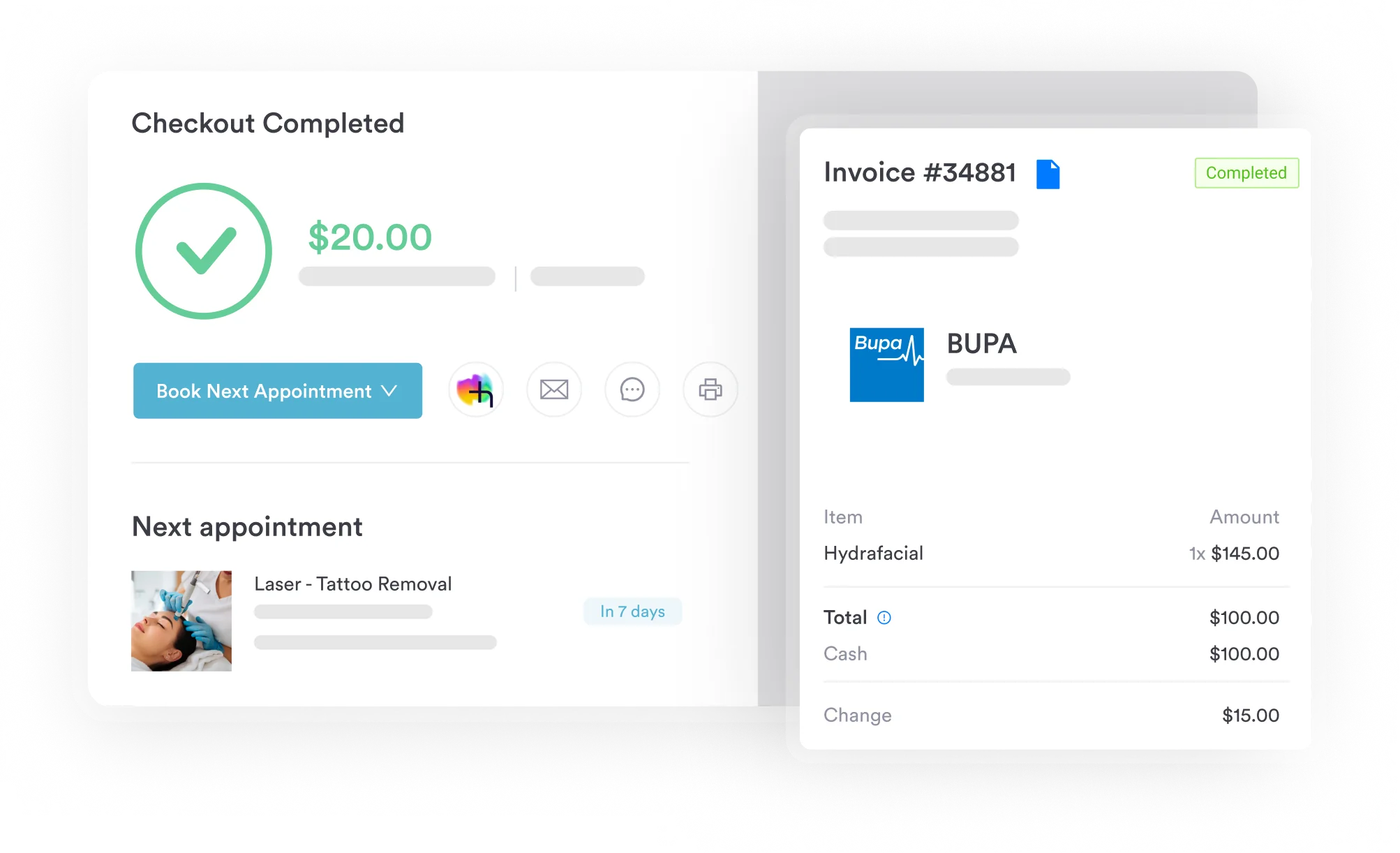
Pabau’s checkout raises the insurer invoice from the completed visit, so the claim is built from the record that holds the pain history.
For billing teams with many lumbar spine claims, the payoff is time. A rejection for a missing detail gets fixed on the day it comes back. The coding judgment, such as which pain code fits, stays with the coder and the provider.
Reduce lumbar disc denials before claims go out
Pabau’s claims management keeps the clinical note and the claim in one system. Claims go out through the Claim.MD clearinghouse, scrubbed for missing or invalid details first. See how it works for your practice.
M51.369 looks like a default code, and that is the trap. Its final character says the record mentions no back or leg pain. That is often not the case for a patient seen for lumbar disc symptoms. Read the pain history before you pick the code, and most of the rework on this family disappears.
The other checks are mechanical. Every M51.36- code needs a 6th character, L5-S1 goes to M51.37-, and nerve or cord involvement goes to M51.16 or M51.06. Book a demo to see how Pabau keeps the clinical note and the claim in one workflow.
Imaging shows a herniation instead?ICD-10 code M51.26 covers lumbar disc displacement without radiculopathy or myelopathy.
Billing an epidural injection for lumbar disc pain?CPT code 62322 explains the interlaminar lumbar injection code and its documentation.
Frequently asked questions
What does ICD-10 Code M51.369 mean?
ICD-10 Code M51.369 is the billable code for other lumbar intervertebral disc degeneration, without mention of lumbar back pain or lower extremity pain. It sits in the M51.36- subcategory in Chapter 13 of ICD-10-CM. Use it when the provider documents lumbar disc degeneration and the record mentions neither type of pain.
What is the difference between M51.36 and M51.369?
M51.36 is the non-billable parent for other intervertebral disc degeneration in the lumbar region. Since October 1, 2024, it needs a 6th character. M51.369 is the child code for degeneration with no back or leg pain mentioned. M51.360, M51.361, and M51.362 cover back pain only, leg pain only, and both.
Is M51.369 valid for Medicare billing?
Yes, M51.369 is valid for Medicare billing. Coverage for associated procedures, such as physical therapy, epidural injections, and imaging, is governed by regional MAC local coverage determinations. There is no single national policy. Document conservative treatment duration, imaging findings, and functional impairment to meet LCD medical necessity criteria.
Does M51.369 require prior authorization?
The diagnosis code itself does not trigger prior authorization, but many procedures paired with lumbar disc codes do. Epidural steroid injections (62322/62323), lumbar MRI (72148), and surgery typically require it from Medicare MACs and commercial payers. Physical therapy evaluation and initial treatment visits generally do not.
When should I use M51.369 versus M54.50 for low back pain?
Use M54.50 when the record documents low back pain with no confirmed cause. When the provider documents lumbar disc degeneration and links the back pain to it, use M51.360, or M51.362 if leg pain is also present. M51.369 applies only when the note mentions no back or leg pain at all. M54.5 itself has not been billable since October 1, 2021.
What are the most common claim denial reasons for M51.369?
Three coding patterns come up most often. The first is billing M51.369 when the note documents back or leg pain, which calls for M51.360, M51.361, or M51.362. The second is billing M51.36 without its 6th character. The third is coding degeneration alone when the note documents radiculopathy (M51.16) or myelopathy (M51.06).