ICD-10 Code R73.9: Hyperglycemia, unspecified
ICD-10 Code R73.9: Clinical definition and scope ICD-10 Code R73.9 is the billab...

Last Updated: Nov 13, 2026
Billable Code Specific Code
R63.4 is the billable ICD-10-CM code for abnormal weight loss. It covers unintentional, clinically significant weight loss that has no confirmed cause at the time of coding.
R63.4 sits in Chapter 18 of ICD-10-CM, the symptoms and signs chapter (R00-R99). Coders often confuse it with cachexia (R64), malnutrition (E40-E46) and adult failure to thrive (R62.7). Once a cause is confirmed and documented, that diagnosis replaces R63.4 as the principal code.
Let Pabau's smart automation suggest the right codes, reduce claim denials, and keep your practice compliant—effortlessly.
Automate repetitive tasks and focus on what matters most—your patients.
Reduce coding errors and ensure compliance with the latest regulations.
Clean claims, fewer denials, and faster reimbursements.
Powerful insights and reporting to help your practice thrive.
HIPAA compliant SOC 2 certified GDPR-compliant Trusted by 4,000+ clinics worldwide

R63.4 is a billable ICD-10-CM symptom code for abnormal weight loss when no confirmed diagnosis explains the finding at the time of coding.
It falls under Chapter 18 (R00-R99) and gives way to a definitive diagnosis code once the cause is confirmed.
Only cachexia (R64) carries an Excludes1 note against R63.4, so the two are never reported together. Malnutrition (E40-E46), anorexia (R63.0) and adult failure to thrive (R62.7) are separate coding decisions.
Documentation must quantify the weight loss, with the amount and the timeframe, and state that no cause has been confirmed yet.
Pabau, the practice management platform we build, charts weight trends in the patient record, so the figures a payer checks are already in the chart.
ICD-10 code R63.4 is a valid, billable ICD-10-CM code for abnormal weight loss in fiscal year 2027. It appears in CMS’s FY 2027 code files, which apply to encounters from October 1, 2026, to September 30, 2027. The table below sets out its core reference data for coders and billing staff.
R63.4 is a symptom code. It records a finding, and any confirmed condition that explains the finding outranks it. That rule drives every sequencing and documentation decision that follows.
The ICD-10-CM tabular list carries no inclusion terms for R63.4 beyond its descriptor. Its clinical scope comes from the Chapter 18 guidance and CDC/NCHS coding conventions. R63.4 applies when:
The word “abnormal” follows the ICD-10-CM convention. It means the loss falls outside what is expected for that patient, and no minimum numeric threshold applies. Payers still commonly want a quantified loss before they pay, as the medical necessity section below explains.
R63.4 does not cover intentional weight loss from diet or exercise, which typically needs no code. It also does not cover weight loss fully explained by a confirmed condition already coded at the highest specificity, or the cachexia exclusion below.
In the FY 2027 tabular list, R63.4 carries no Excludes1 note of its own. The single Excludes1 pairing sits under cachexia, R64, which lists abnormal weight loss (R63.4) as excluded.
An Excludes1 note means the two conditions are never reported together. The parent category R63 also excludes bulimia NOS (F50.2-), and that note applies to every code in the category.
A coder who assigns both R63.4 and R64 on the same claim will trigger an edit. The claim either denies outright or comes back for correction. Building that pair into your EHR’s pick-list validation rules is the fastest way to prevent it.
Anorexia (R63.0), malnutrition (E40-E46) and adult failure to thrive (R62.7) carry no Excludes1 note against R63.4. Choosing between them and R63.4 is a documentation question, covered in the next section. Check the current tabular notes in the AAPC ICD-10-CM lookup before coding.
The most common decision on a weight loss claim is telling R63.4 apart from codes that look clinically similar. Most of them describe a confirmed condition or a wider syndrome. The table below maps the key differences.
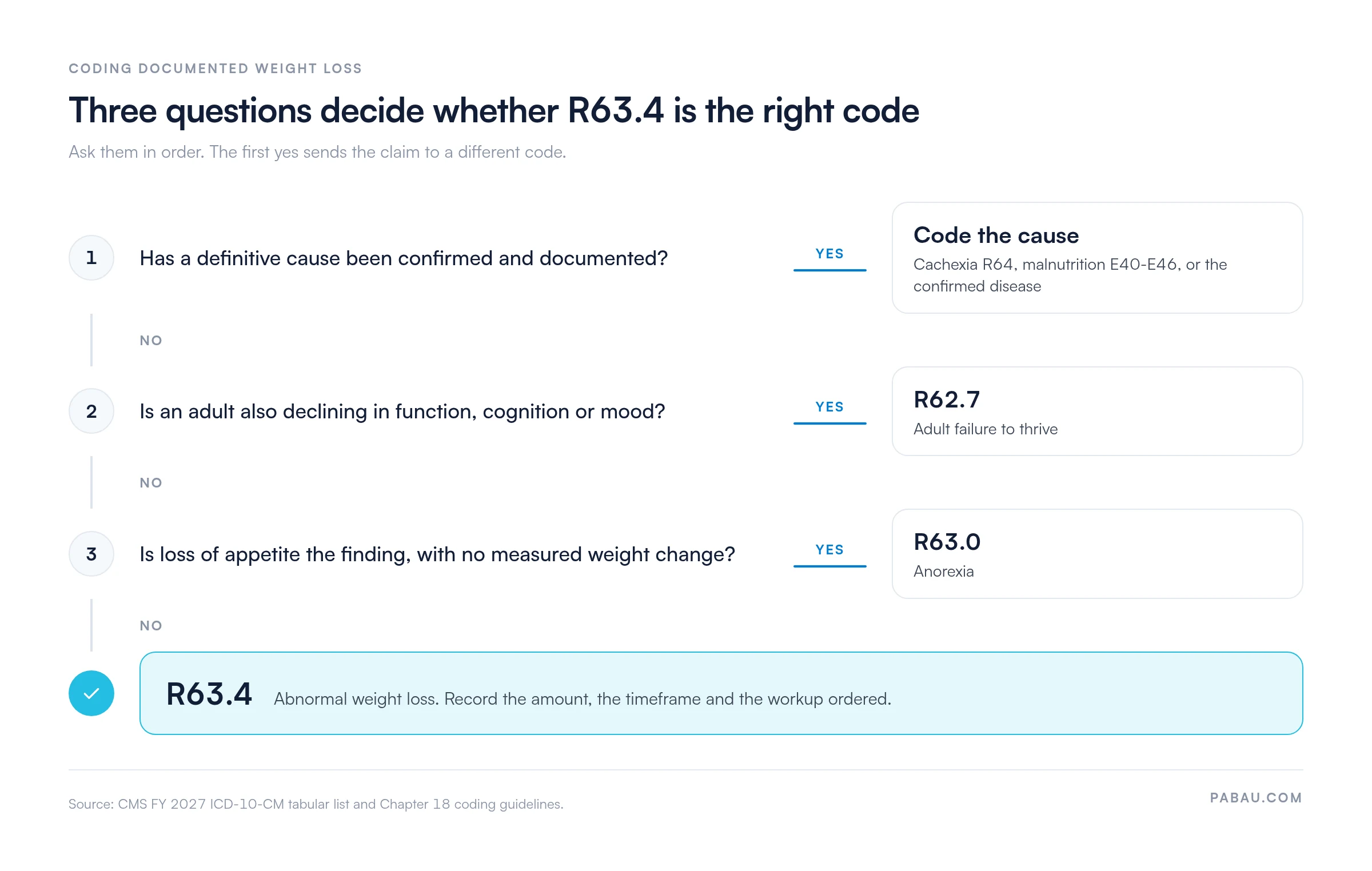
Adult failure to thrive deserves a closer look. R62.7 requires documented decline across weight, physical function, and psychosocial status. If your patient has only unexplained weight loss with no functional decline noted, R63.4 is likely correct. Document whether a functional assessment was performed and what it showed.
Taken in order, three questions settle which of these codes the note supports, as the chart below shows.
Per the CMS ICD-10-CM Official Guidelines for Coding and Reporting, Chapter 18 symptom codes like R63.4 need physician documentation that makes the clinical basis explicit. The physician note must include each of the following to withstand payer review.
Practices that record weight at every visit have an easier time here. The measurement trail documents the size of the loss as the visits happen, so the checklist above is already satisfied when an auditor asks. A clean claim for R63.4 starts with that documentation.

Chapter 18 of the ICD-10-CM Official Guidelines sets a clear sequencing rule for symptom codes. Code R63.4 as the principal or first-listed diagnosis only when no confirmed cause has been established. Once a definitive diagnosis is documented, it becomes the principal diagnosis. R63.4 then moves to secondary, or drops off entirely if it adds nothing.
Three sequencing scenarios cover most R63.4 encounters:
A practical test: If the confirmed diagnosis already implies significant weight loss, as many oncology codes do, appending R63.4 adds redundancy that payers may flag. Code it only when it adds independent clinical or billing information.
Run a weekly report of patients coded R63.4 whose workup has no follow-up visit booked. Closing that loop gets the confirmed diagnosis onto the next claim, where it belongs.
R63.4 rarely appears alone on a claim. The table below lists the codes most often submitted on the same encounter, with payer context for each. When a nutritional assessment confirms malnutrition as the cause, E46 or a more specific E40-E44 code replaces R63.4.
Medical necessity for weight loss encounters is not standardized across payers. Local Coverage Determinations (LCDs) vary by Medicare Administrative Contractor (MAC) jurisdiction, and commercial plans set their own thresholds. Our guide to how medical billing works covers how payers judge medical necessity on a symptom code.
One threshold appears frequently across LCD policies: An unintentional loss of 5% or more of baseline body weight over 6 to 12 months. This figure comes from clinical literature on cachexia and geriatric nutrition, not from a universal CMS mandate. Check the applicable MAC LCD directly before treating it as a hard rule.
What most payers consistently expect:
Weight management and metabolic health practices meet this documentation standard on nearly every R63.4 claim they submit. A system that records baseline and interval weights at each visit puts the evidence in front of MAC auditors without a manual chart search.
R63.4 claims are denied for a small set of predictable reasons, and each one maps to a specific documentation or coding fix. A structured denial management workflow closes the loop when a denial does get through.
The clinical setting changes how R63.4 is coded. Four settings come up most often.
Unexplained weight loss in older adults is one of the highest-volume settings for R63.4. The key choice here is between isolated weight loss (R63.4) and adult failure to thrive (R62.7). Failure to thrive requires a documented syndrome: Weight decline plus physical, cognitive or mood decline. When only the weight finding is documented, and functional assessment was skipped or normal, R63.4 is the more defensible code.
Weight loss that precedes a cancer diagnosis is a legitimate R63.4 scenario. The code is appropriate for the visits during which the malignancy workup is underway. Once cancer is confirmed and coded, the oncology code becomes principal. R63.4 is then dropped, unless the weight loss remains a separately managed concern beyond what the malignancy code captures.
Weight loss following a surgical procedure may be expected or abnormal depending on the procedure type and magnitude of loss. R63.4 applies when the loss exceeds expected surgical parameters and the physician documents it as clinically concerning. Expected post-bariatric weight loss, by contrast, should not be coded as R63.4 unless a complication arises.
In children, check R62.51, failure to thrive (child), before R63.4. Its inclusion terms cover failure to gain weight and faltering growth, so a child who stops gaining fits R62.51 better. R63.4 still applies to a child with measured, unexplained weight loss before a diagnosis is confirmed. Cross-reference current AHA Coding Clinic guidance for borderline cases.
For geriatric patients, build a standard assessment workflow that documents weight, functional status, and cognitive screening at every annual wellness visit. Having all three in the chart lets you code with confidence whether R63.4 or R62.7 applies, and gives auditors what they need.
Symptom codes like R63.4 carry more revenue cycle risk than confirmed-diagnosis codes. The payer has to accept medical necessity on the documentation alone, with no named condition to anchor the claim. Sound revenue cycle management for R63.4 builds the documentation standard into the visit itself, before the claim is generated.
The WHO ICD-10 browser and the AAPC ICD-10-CM lookup are useful for checking descriptors and Excludes notes during coding review. For the confirmed diagnoses that replace R63.4, our index of ICD-10-CM diagnostic codes covers each chapter.
R63.4 denials usually trace back to a note that never recorded how much weight was lost, or over what period. Others come from a symptom code left on a claim after the diagnosis was confirmed.
In Pabau, each patient’s record charts weight trends over time alongside vitals and lab results. Baseline weight and the size and pace of the loss sit in the chart before anyone builds the claim.
Pabau’s medical billing software then sends the claim through the Claim.MD clearinghouse, checks eligibility and posts the remittance against the same record. Your billing team sees a rejection when it lands and can fix it while the visit is still fresh.


Pabau charts weight trends in the patient record and submits claims through Claim.MD, so the payer evidence travels with each weight loss claim.

R63.4 earns its place on a claim for a short window, between the first visit for unexplained weight loss and the confirmed diagnosis. Code it confidently in that window, with the amount, the timeframe and the workup on record. Retire it once the cause is known.
The one hard conflict to remember is cachexia, because R64 and R63.4 never share a claim. Malnutrition, anorexia and adult failure to thrive are calls the note has to settle. Book a demo to see how Pabau keeps weight trends and claim submission in one place for your billing team.

Has a nutritional assessment confirmed malnutrition? ICD-10 code E46 explains when unspecified protein-calorie malnutrition replaces a symptom code.
Chasing a denied weight loss claim? Denial codes in medical billing walks through the most common CARC codes and how to fix each one.
Need to understand how claims reach the payer? How medical claims clearinghouses work explains the submission pipeline from your system to the payer.
ICD-10 code R63.4 is the billable ICD-10-CM diagnosis code for abnormal weight loss. It applies to clinically significant, unintentional or unexplained weight loss when no underlying cause has been confirmed at the time of coding. It sits in Chapter 18 (R00-R99), the chapter for symptoms and signs.
Yes, R63.4 is a valid, billable ICD-10-CM code at the highest level of specificity within the R63 category. It is accepted for claim submission in fiscal year 2027. Verify currency annually using the CMS ICD-10-CM code files.
R63.4 is a symptom code for unexplained weight loss with no confirmed cause. Cachexia (R64) is documented wasting, and cachexia due to an underlying condition such as cancer is coded E88.A instead. R64 carries an Excludes1 note for R63.4, so the two are never coded together. Once cachexia is documented, R63.4 is dropped.
Use R63.4 when the cause of the weight loss has not been established at the time of coding. Once a confirmed diagnosis is documented (such as a malignancy, hyperthyroidism, or inflammatory bowel disease), it becomes the principal code. R63.4 is then either secondary or dropped, per Chapter 18 sequencing guidelines.
Five reasons cover most denials. The note lacks a quantified weight loss with a timeframe, or a confirmed cause was coded alongside R63.4 instead of replacing it. An Excludes1 conflict, such as R63.4 with R64, is the third. The last two are unmet payer medical necessity criteria and unbundling errors on same-date procedures.
Adult failure to thrive (R62.7) is a syndrome requiring documented decline across weight, physical function, and psychosocial or cognitive status. R63.4 applies when weight loss is an isolated unexplained finding with no documented functional or cognitive decline. If the note documents only weight loss, R63.4 is typically correct. R62.7 requires the broader syndrome to be present and documented.