ICD-10 Code V09.01XS: Pedestrian injured in nontraffic accident involving military vehicle, sequela
ICD-10 Code V09.01XS: Code description and clinical meaning ICD-10 code V09.01XS...

Last Updated: Oct 26, 2026
Billable Code Specific Code
T31.97 is the billable ICD-10-CM code for burns involving 90% or more of body surface with 70-79% third degree burns.
The code is specific enough to submit directly on a claim without a more detailed sub-code. It belongs to the T31 category, which covers burns classified according to the extent of body surface involved. That category sits within the Injury, Poisoning and Certain Other Consequences of External Causes chapter (S00-T88) of ICD-10-CM.
Let Pabau's smart automation suggest the right codes, reduce claim denials, and keep your practice compliant—effortlessly.
Automate repetitive tasks and focus on what matters most—your patients.
Reduce coding errors and ensure compliance with the latest regulations.
Clean claims, fewer denials, and faster reimbursements.
Powerful insights and reporting to help your practice thrive.
HIPAA compliant SOC 2 certified GDPR-compliant Trusted by 4,000+ clinics worldwide

T31.97 is a billable ICD-10-CM code for burns covering 90% or more of body surface, with 70% to 79% third degree burns.
The code has been in ICD-10-CM since October 1, 2015, and it is valid in HIPAA-covered transactions.
The final digit ‘7’ means a documented range of 70% to 79% full thickness, not an exact 70%.
T31 covers thermal burns and T32 covers chemical corrosions, so the injury agent in the record decides the category.
Practice management software like Pabau submits ICD-10-CM coded claims electronically through Claim.MD, our US clearinghouse partner.
The table below captures the core reference data for ICD-10 code T31.97 in one place.
The T31 burn classification organizes diagnoses around two measurements. The first axis is total body surface area (TBSA) affected. The second axis is the share of that burned area that is full thickness, or third degree. T31.97 uses both axes at once, which is what separates the T31 family from anatomical burn codes such as T20-T25.
T31 codes are structured as T31.XY, where X is the TBSA extent range and Y is the third degree percentage range within that TBSA group. The CMS ICD-10-CM coding guidelines require both measurements to sit in the medical record before a T31 code is assigned. Each character in the code carries one of those decisions.
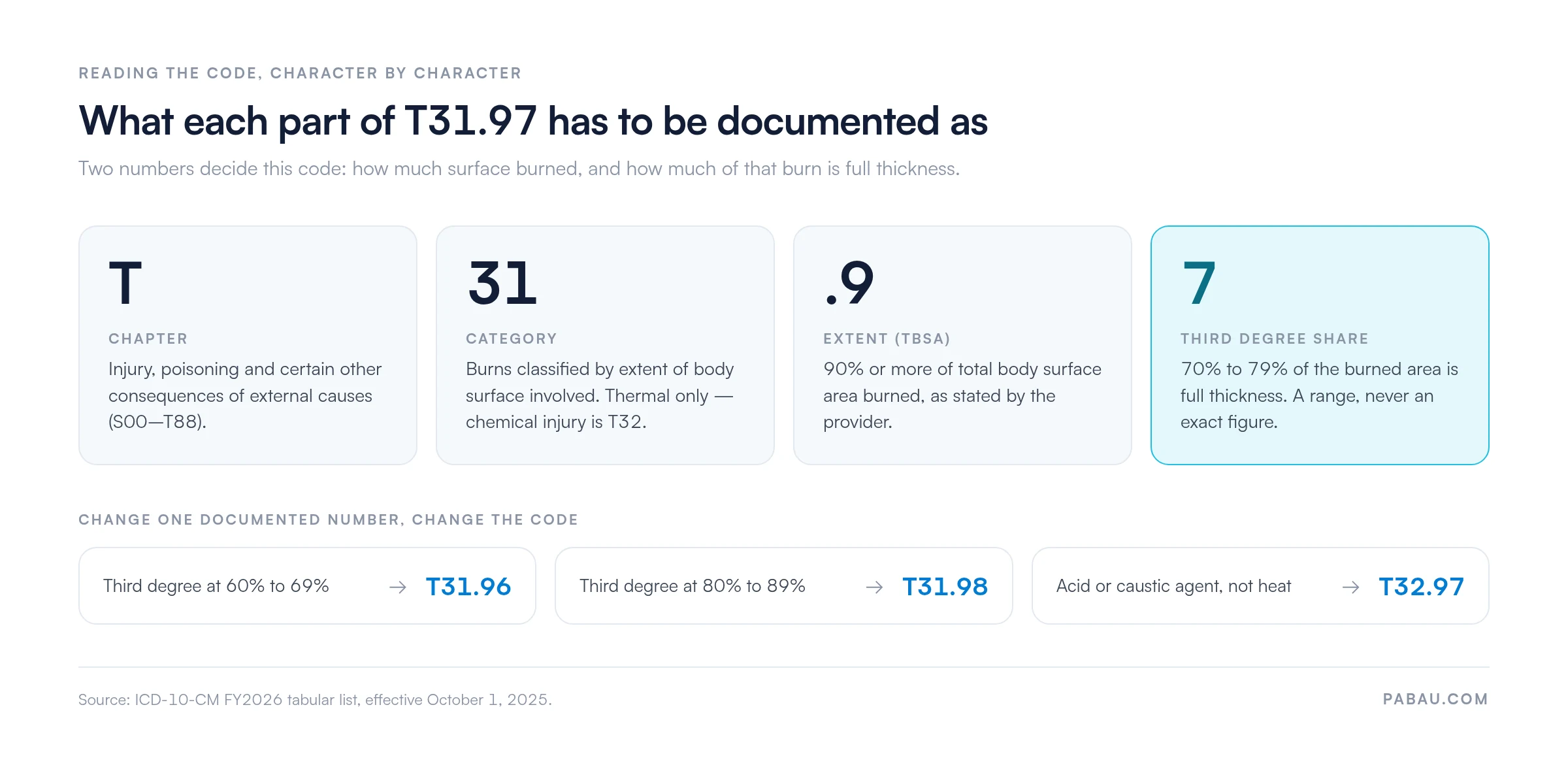
TBSA quantifies the extent of body surface affected by a burn. The T31 code set groups TBSA into ranges: less than 10%, 10-19%, 20-29%, and so on up through 90% or more. T31.97 sits in the highest TBSA tier, so it describes burns covering virtually the whole body surface.
The table below shows the T31.9X subcategory matrix, which is the relevant group for ICD-10 code T31.97.
The final digit in the T31.9X subcategory states the third degree burn percentage as a range, not an exact number. For ICD-10 code T31.97, the digit ‘7’ means 70% to 79% of the total burned area is full thickness. A patient with 91% TBSA burned, of which 75% is third degree, is coded T31.97. The same TBSA with only 65% third degree burns is coded T31.96.
Third-degree burns destroy all layers of the dermis and extend into subcutaneous tissue. Closing wounds on this scale takes debridement, skin grafting, and long inpatient stays. That surgical work is billed separately from the diagnosis. Skin substitute application falls under 15271, and a full-thickness graft add-on falls under 15221.
Burn centers and reconstructive teams log wound progression and grafting dates, and plastic surgery practice software keeps those entries against the patient record. An auditor reads them back when the extent codes are questioned.
Document the TBSA and third-degree percentage as two separate numeric findings in the clinical record. A note reading ‘90% TBSA, 70-79% third degree’ maps directly to T31.97. A note reading ‘extensive burns’ supports no specific T31.9X code.
Assigning ICD-10 code T31.97 requires documented clinical evidence for both the TBSA extent and the third degree percentage. Coders cannot infer either value from a general burn description. The ICD-10-CM Official Guidelines for Coding and Reporting, published by the National Center for Health Statistics, require the stated percentages to reflect physician documentation.
The checklist below covers the documentation elements needed to support T31.97 on a claim. Incomplete documentation is a leading cause of denials, which is why denial management work starts in the chart rather than in the billing office.
For facilities submitting claims electronically, accurate ICD-10-CM assignment is the foundation of a clean claim. Practices running integrated claims management software can validate codes against payer rules before submission, which cuts manual review on high-acuity burn cases.

Practice management software like Pabau connects to Claim.MD, our US clearinghouse partner. That Claim.MD integration carries ICD-10-CM coded diagnoses, burn injuries included, straight to the payer.
T31.97 is not typically sequenced as the principal diagnosis on its own. In most inpatient burn cases the anatomical burn code, drawn from the T20-T25 range, is the principal diagnosis. T31.97 then sits alongside it as an additional code that captures extent.
Per the ICD-10-CM Official Guidelines, a T31 or T32 code takes the principal or first-listed slot only when the burn site is unspecified. Consult the AHA Coding Clinic for formal guidance on facility-specific sequencing decisions.
T31 and T32 look structurally identical. They share the same TBSA and third degree matrix, and the same digit logic. What they describe is different. T31 covers thermal burns from heat sources such as flames, hot liquids, steam, hot objects, and radiation. T32 covers corrosions, the injuries caused by chemical agents such as acids, alkalis, and caustic substances.
T32.97 is the corrosion parallel, describing corrosions involving 90% or more of body surface with 70-79% third degree corrosions. Assigning T31.97 when the record documents a chemical burn is an error. Treatment protocols differ, and payer edits and DRG assignment algorithms read the two families differently. Anatomical corrosion codes also carry a 7th character for the encounter. Third-degree corrosion sits in the T22.7 range, while the parallel burn codes sit in T22.3. Where a payer still requires a paper claim, the practice needs the current revision of the form.
When a patient sustains both thermal and chemical injuries, a T31 code and a T32 code may both be warranted. Sequencing follows the injury that drove the admission. A medical claims clearinghouse validates both codes against payer edits before the payer ever sees the claim.
Alternate descriptions for this code turn up across clinical documentation systems and coding references. Recognizing them helps coders reach the right code when provider notes use non-standard terminology.
Any of these phrasings still needs the two percentages sitting behind it before the code is assigned. What a synonym list protects against is picking an adjacent code in the T31.9 range.
In most practices the TBSA percentage lives in the clinical note and the diagnosis code lives in the billing system. Someone re-types one into the other. That copy step is where a documented 75% full thickness turns into a code that says something else.
Pabau holds the treatment note, the coded diagnosis, and the claim against the same patient record. Coders work from the percentages the clinician actually wrote, then submit through Claim.MD without exporting a file. Eligibility checks and denial tracking run against that same record, so a rejection points back to the note that caused it.
A 90% TBSA case rarely stays with one team. The acute encounter is coded in the burn unit, the graft surgeon bills the reconstruction, and months of rehabilitation get documented in physical therapy software. Wherever the follow-up sits, every code still traces back to the percentages in the original note.

Pabau ties the treatment note, the ICD-10-CM code, and the claim to the same patient record, then submits electronically through Claim.MD. Eligibility checks and denial tracking run in the same place, so nothing gets re-typed between systems.

T31.97 is only as defensible as the two numbers behind it. If the chart says “extensive burns,” the code is a guess, and an auditor will treat it as one.
So the work belongs upstream of coding. Standardize how the burn assessment gets written down, with TBSA and the full thickness share as two separate figures, and the code assigns itself. Chasing those numbers after discharge costs far more than recording them at admission. Errors caught at admission protect billing efficiency and the practice’s broader revenue cycle performance.
Facilities that keep those figures and the claim in one system spend less time reconciling the two. Pabau covers revenue cycle management from the coded encounter through to the remittance. Book a demo to see how burn coding and claim submission look in a single record.

Coding the reconstruction that follows a major burn? CPT code 15837 sets out how forearm and hand skin excision is documented and billed.
Need the rules for an injury that has already healed? ICD-10 code S51.029S shows how sequela coding works once the acute encounter has closed.
Billing excess skin excision on the thigh? CPT code 15832 covers the documentation and the code selection for that procedure.
ICD-10 code T31.97 is a billable diagnosis code for burns covering 90% or more of the body surface. Of that burned area, 70% to 79% must be third degree, or full thickness. The code sits in the T31 category, which classifies burns by extent of body surface rather than by anatomical location.
Yes, T31.97 is a billable, specific ICD-10-CM code valid for use in HIPAA-covered transactions. It has been in the classification since October 1, 2015, and the FY2026 edition retains it unchanged. It can be submitted directly on a claim without a more granular sub-code.
Both codes apply to burns involving 90% or more of body surface, and they differ only in the third-degree percentage. T31.90 covers 0% to 9% third degree burns, which is a documented range rather than an unspecified value. T31.97 requires documented evidence that 70-79% of the burned area is full thickness.
ICD-10-CM does not mandate a specific TBSA calculation method. The coded percentage must still be supported by physician documentation in the medical record. Clinicians commonly use the Rule of Nines or the Lund-Browder chart to assess it. Note the method in the record so the documented percentage traces back to a clinical assessment.
T31.97 applies to thermal burns from heat sources such as flames, steam, or hot surfaces. The parallel T32.97 code applies to corrosions caused by chemical agents such as acids or alkalis. The TBSA and third-degree ranges are identical across both families, so the injury mechanism in the record decides which one applies.
The record needs four elements. It must state TBSA at 90% or more, and the third-degree share within the 70-79% band. It must also give the burn etiology and the encounter type for 7th-character assignment alongside anatomical codes. A description of ‘extensive burns’ with no percentages does not support T31.97.