ICD-10 Code Y76.0: Diagnostic obstetric and gynecological devices
ICD-10 Code Y76.0: Definition and billable status ICD-10 Code Y76.0 is a valid, ...

Last Updated: Oct 23, 2026
Billable Code Specific Code
S92.406G is the billable ICD-10-CM code for nondisplaced unspecified fracture of unspecified great toe, subsequent encounter for fracture with delayed healing.
Coders reach for it at a follow-up visit, when a great toe fracture is healing more slowly than expected. The code is valid for the current FY2026 ICD-10-CM code set.
The code sits within the S92 fracture category (fractures of foot and toe), which falls under the broader S90-S99 injury chapter. According to the CMS ICD-10-CM coding page, all S92 codes require a 7th character to capture encounter type and healing status.
S92.406G is the specific combination for a nondisplaced great toe fracture, side unspecified, with delayed healing on a return visit. The quick-reference table below confirms its billing properties.
Let Pabau's smart automation suggest the right codes, reduce claim denials, and keep your practice compliant—effortlessly.
Automate repetitive tasks and focus on what matters most—your patients.
Reduce coding errors and ensure compliance with the latest regulations.
Clean claims, fewer denials, and faster reimbursements.
Powerful insights and reporting to help your practice thrive.
HIPAA compliant SOC 2 certified GDPR-compliant Trusted by 4,000+ clinics worldwide

ICD-10 code S92.406G describes a nondisplaced unspecified fracture of an unspecified great toe at a follow-up visit with delayed healing.
The record has to say nondisplaced. Where documentation is silent on displacement, ICD-10-CM guidelines default to displaced, which is S92.403G.
S92.4 is the great toe category. Fractures of the lesser toes (toes 2 through 5) are coded under S92.5 instead.
S92.406 is the unspecified-side code. When the record names a side, use S92.404G for the right great toe or S92.405G for the left.
S92.406G is fully billable and valid for HIPAA-covered transactions. It is also POA exempt, because injury codes carry no Present on Admission indicator.
Pabau’s claims management software attaches ICD-10-CM code selection to clinical notes and invoicing, cutting manual transfer errors at the point of care.
Every character in S92.406G carries a specific meaning. Misreading even one of them, particularly the 7th, leads to claim rejections or downcoding at subsequent visits. Here is the character-by-character breakdown.
The parent hierarchy runs from S00-T88 (injury codes) to S90-S99 (ankle and foot injuries) and then S92 (fracture of foot and toe). From there it narrows to S92.4 (great toe), S92.40 (unspecified fracture of great toe), S92.406 (nondisplaced, side unspecified), and finally S92.406G.
The digit “6” in the sixth character position carries two facts at once: Displacement status (nondisplaced) and laterality (side not stated). That second fact is the one to watch. Payers audit laterality specificity closely, so an unspecified-side code on a chart that names the right or left great toe raises edit flags.
The 7th character reports the clinical status of the fracture at the time of the visit. Get it wrong and the code no longer reflects what the provider saw and documented.
Character G means the patient is returning for care after the initial treatment episode, with the fracture not healing at the expected rate. “Delayed healing” does not mean nonunion. The bone is still progressing toward union, only more slowly than typical.
Once union fails entirely, the appropriate 7th character shifts to K (nonunion). The full 7th character extension table for S92.406x is below.
The clinical distinction between G and D turns on documentation. If the physician’s note records that healing is progressing normally on follow-up, D is appropriate. G applies when the notes document slower-than-expected callus formation or persistent pain out of step with the timeline.
G also applies when imaging shows incomplete bridging beyond the expected window for a great toe fracture. Consult a certified medical coder or the CDC/NCHS ICD-10-CM web tool to verify coding decisions against current guidelines.
Reusing character A at every follow-up visit is a common error across ICD-10-CM fracture categories. Once the patient has received definitive treatment and is in the recovery phase, the 7th character must change. It becomes D, G, K, P, or S depending on healing status.
A nondisplaced fracture means the bone has cracked or broken but the fragments have not shifted from their anatomical position. No manipulation is required to realign the bone. This contrasts with displaced fractures, where fragments separate and often require manual reduction or surgery.
The great toe, also called the hallux, is the first digit of the foot. It carries a large share of the load at push-off during walking. A slow-healing hallux fracture therefore tends to keep a patient symptomatic longer than a lesser toe injury.
Great toe fractures are among the most common forefoot injuries seen in outpatient orthopedic and podiatric settings. The most frequent causes include:
The descriptor carries the word “unspecified” twice, and each instance means something different. The first says the fracture site within the great toe is not identified, so neither the proximal nor the distal phalanx is named. The second says the record does not state which foot.
Where documentation names the phalanx, a more specific code in the S92.41 or S92.42 subcategories applies. Review the tabular list via the AAPC ICD-10-CM code lookup for those options.
Approximate synonyms accepted for S92.406G include: Nondisplaced great toe fracture with delayed healing, nondisplaced hallux fracture at a subsequent encounter, and slow-healing great toe fracture.
S92.406G is a fully billable, specific ICD-10-CM code. It is valid for submission on HIPAA-covered electronic transactions without additional specificity. The code can appear as a principal or secondary diagnosis, depending on whether the delayed healing is the primary reason for the visit.
Injury codes in the S chapter are POA exempt. CMS requires Present on Admission (POA) indicators on inpatient claims. External cause codes and injury-related diagnosis codes are excluded from that requirement, and all S92 fracture codes fall into that group.
Coders do not need to append a POA indicator when submitting S92.406G on an inpatient claim.
One common submission error: Submitting S92.406G on the first encounter after injury. Character G is valid only when active treatment has already been initiated. Using G at the initial visit will typically result in a claim edit or a medical necessity denial.
Sound denial management processes catch this pattern quickly. Prevention at point-of-care coding still costs less than a post-submission appeal.
S92.406G belongs to a tightly grouped family of codes that share a base descriptor but differ by laterality, displacement, and 7th character. The table below covers the most commonly referenced siblings and near neighbors.
That last row is in the table as a warning rather than a sibling. Lesser toe fractures sit in the S92.5 category, so a documented right lesser toe with delayed healing is S92.504G, not S92.406G. Reaching into the S92.4 block for a lesser toe injury is one of the more common miscodes here.
The code transitions from G to P when a patient with a known great toe fracture returns for follow-up and imaging now shows malunion. Malunion means the bone has healed in a misaligned position. A lesser toe that heals in that position stays in the S92.5 category, so an unspecified lesser toe with malunion is S92.599P.
Documented laterality and phalanx sharpen the lesser toe codes the same way. A displaced distal phalanx fracture of a left lesser toe with malunion takes S92.532P.
Where the bone has failed to unite at all, character K applies instead. When the record also names the proximal phalanx of the left great toe, a nondisplaced fracture with nonunion there is S92.415K. The treating provider makes these clinical determinations and documents them before the coder selects the 7th character.
Section I.C.19 of the ICD-10-CM Official Guidelines for Coding and Reporting, maintained by CMS and NCHS, governs fracture coding. Key rules that apply directly to S92.406G:
The grid below pairs each element the record has to carry with the code you land on when it is missing. The checklist underneath spells out what to write for each one.
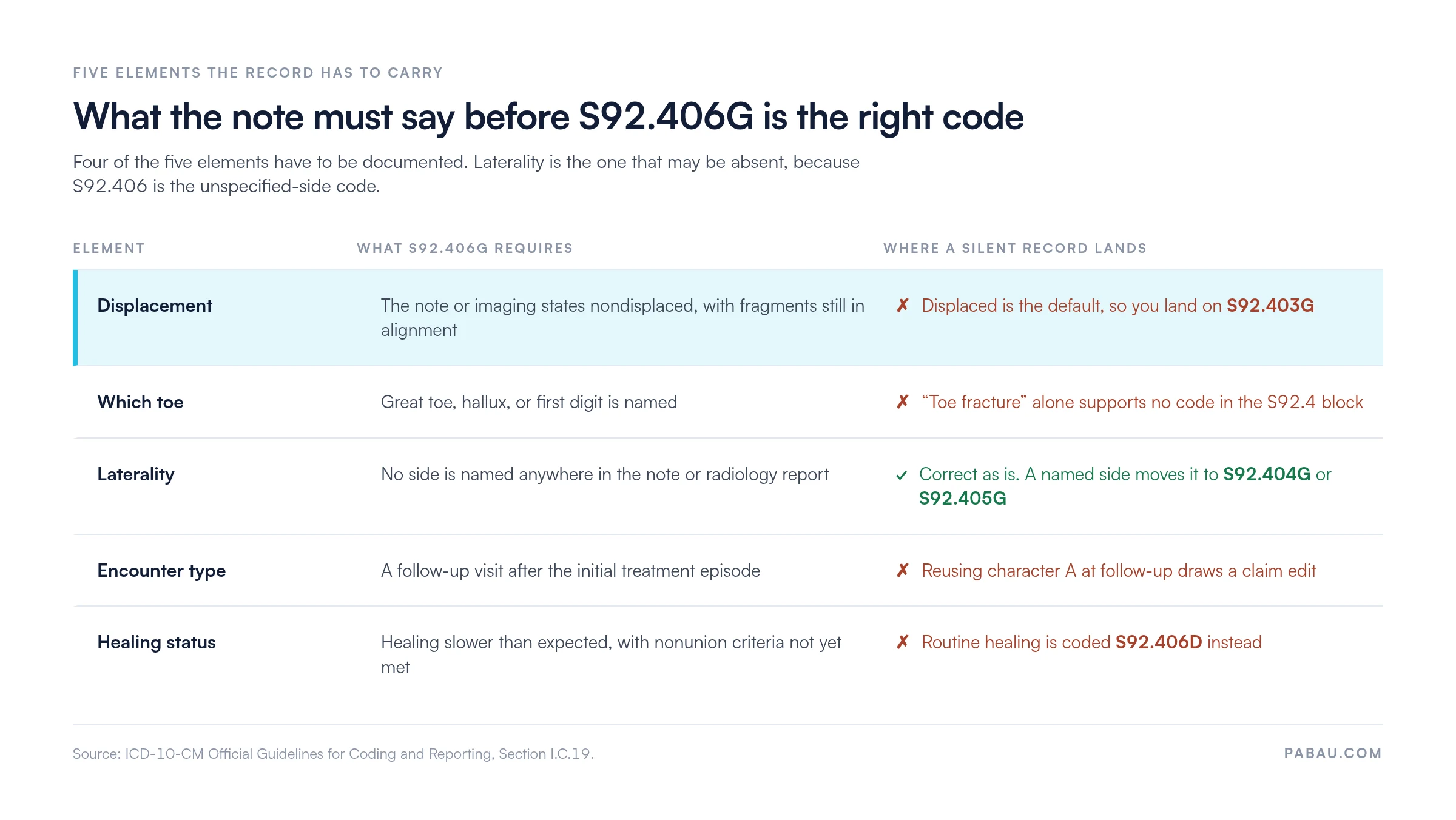
Structured note templates carry these prompts for you. A good template asks the clinician to capture each specific at every encounter, not just at the initial visit.
Flag delayed healing fractures in your scheduling system at the time of the second follow-up. If the patient is still presenting at 6 to 8 weeks without documented progression, prompt the treating provider. The note needs to state delayed healing explicitly before the encounter closes. Retroactive documentation changes create audit risk. A prompt at the point of care removes the problem upstream.
The decision table below helps coders and providers select the correct 7th character at each point in a patient’s fracture treatment. The key variable is what the physician documents about healing status at that visit.
The table holds the anatomy constant at an unspecified great toe. Once the record names the right or left side, the same 7th character logic runs against S92.404 or S92.405 instead.
Delayed healing (G) and nonunion (K) are the most frequently confused characters. A fracture with delayed healing still has biological potential to unite, while a nonunion has definitively failed to bridge.
Radiographic and clinical criteria for this distinction vary by provider and institution. The physician must make that determination explicitly in the record before the coder applies the 7th character.
S92.406G is a diagnosis code. It always pairs with a CPT procedure code describing what the provider did during the visit. Most delayed-healing follow-up visits for great toe fractures pair with evaluation and management (E/M) codes. Procedure codes may apply when an intervention occurs.
CPT separates the great toe from the other digits. A great toe diagnosis pairs with 28490 or 28495, not with the lesser toe codes 28510 and 28515. Common CPT codes used alongside S92.406G include:
CPT code selection for 28490 and 28495 depends on clinical judgment and payer-specific coverage policies. The table above is illustrative, not prescriptive. Verify current CPT descriptors with the AMA CPT code set before billing.
Payer rules around global surgery periods matter here too. They decide whether a delayed-healing follow-up can be billed separately or falls inside the original procedure’s global period.
In most practices the coder reads the follow-up note after the visit has closed. If the provider never wrote down that healing is behind schedule, the coder has two options. Either they query the provider days later, or they fall back to S92.406D and understate the visit.
Practice management software like Pabau moves that decision to the point of care. Its claims management software attaches the ICD-10-CM code to the clinical note as the provider writes it. The 7th character gets chosen while the patient is still in the room.
From there the code flows into the invoice, the superbill, and the electronic claim without a second entry. Nobody retypes it, so the diagnosis on the claim matches the diagnosis in the chart. Orthopedic and podiatric teams get a cleaner claim history behind every delayed-healing follow-up.


Pabau connects ICD-10 diagnosis codes directly to your clinical notes, invoices, and electronic claims. That cuts manual entry errors and keeps your billing and documentation in sync at every encounter.

Delayed healing after a great toe fracture is a clinical complication, and the code has to reflect it. Using S92.406D when the physician documented slow healing understates the visit for payer review.
Two other details decide whether the code holds up. The record has to name the great toe rather than a lesser toe, and it has to use the word nondisplaced.
Catching all three at the point of care costs less than appealing a denial weeks later. To see how an orthopedic or podiatric team keeps the 7th character accurate from note to claim, book a demo.

Need help managing medical billing compliance? Medical billing compliance guide covers documentation standards and claim submission requirements for outpatient practices.
Coding delayed healing across fracture categories? Clean claim submission requirements outlines what payers look for when reviewing fracture-related subsequent encounter codes.
Want to understand how claims move through the system? How a medical claims clearinghouse works explains the pathway from ICD-10 code selection to payer adjudication.
ICD-10 code S92.406G is a billable ICD-10-CM diagnosis code for a nondisplaced unspecified fracture of an unspecified great toe. It applies at a subsequent encounter where the fracture is showing delayed healing. The code is valid for the current FY2026 ICD-10-CM code set. Use it when a patient returns for follow-up after a great toe fracture and the bone is healing more slowly than expected.
S92.406G applies to the great toe, and it does not name a side. Use S92.404G for the right great toe and S92.405G for the left great toe. Lesser toe fractures of toes 2 through 5 sit in the separate S92.5 category, where the nondisplaced right lesser toe delayed-healing code is S92.504G.
The guidelines default to displaced. Section I.C.19.c.1 of the ICD-10-CM Official Guidelines directs coders to displaced where the record does not state displacement. So a silent note takes S92.403G, not S92.406G. The word nondisplaced has to appear in the physician note or the imaging report.
Yes. S92.406G is a fully billable, specific ICD-10-CM code valid for HIPAA-covered electronic transactions. It does not require additional specificity to be submitted on a claim. It is also POA exempt, meaning no Present on Admission indicator is required for inpatient submissions.
The 7th character G in ICD-10-CM fracture codes signals a subsequent encounter where the fracture has not healed within the expected timeframe. It is distinct from D (subsequent encounter with routine healing), K (nonunion), and P (malunion). Clinicians must document delayed healing explicitly in the medical record before a coder applies the G character.
S92.406A is for the initial encounter when active treatment of the fracture begins. S92.406D is for subsequent follow-up visits where healing is progressing normally. S92.406G applies when the patient returns for care and healing is slower than expected without meeting nonunion criteria. Using A at a follow-up visit is a coding error that typically results in a claim edit.
Yes. All S92 injury codes, including S92.406G, are POA (Present on Admission) exempt. Coders do not need to append a POA indicator when submitting this code on an inpatient claim. This exemption applies to the entire S injury chapter under ICD-10-CM guidelines.
The most common pairing is an E/M code (99213-99214) for the follow-up visit itself. CPT 28490 covers closed treatment of a great toe fracture without manipulation, and CPT 73660 covers toe X-rays. CPT 28495 applies when the provider performs manual reduction at the follow-up visit. Code selection depends on clinical judgment and payer-specific coverage policies, so verify against current CPT guidelines before billing.