

HCPCS Code Q4175: Billing, coverage, and documentation guide
HCPCS code Q4175: Code description and product identity HCPCS Code Q4175 is the ...

Last Updated: Nov 20, 2026
73660 is the CPT code for a radiologic examination of the toe(s), with a minimum of 2 views. It covers one or more toes on one foot, imaged in at least two projections, plus the physician's interpretation and written report.
The code sits in the lower extremity subsection of diagnostic radiology (73501-73725). Foot studies take 73620 or 73630 instead, and imaging both feet adds modifier 50 or RT and LT lines.
Let Pabau's smart automation suggest the right codes, reduce claim denials, and keep your practice compliant—effortlessly.
Automate repetitive tasks and focus on what matters most—your patients.
Reduce coding errors and ensure compliance with the latest regulations.
Clean claims, fewer denials, and faster reimbursements.
Powerful insights and reporting to help your practice thrive.
HIPAA compliant SOC 2 certified GDPR-compliant Trusted by 4,000+ clinics worldwide

CPT code 73660 covers a radiologic examination of one or more toes, with at least two views. Foot studies bill under 73620 or 73630 instead.
When both feet are imaged, add modifier 50 or bill RT and LT lines. Medicare pays each side at 100% of the fee schedule amount.
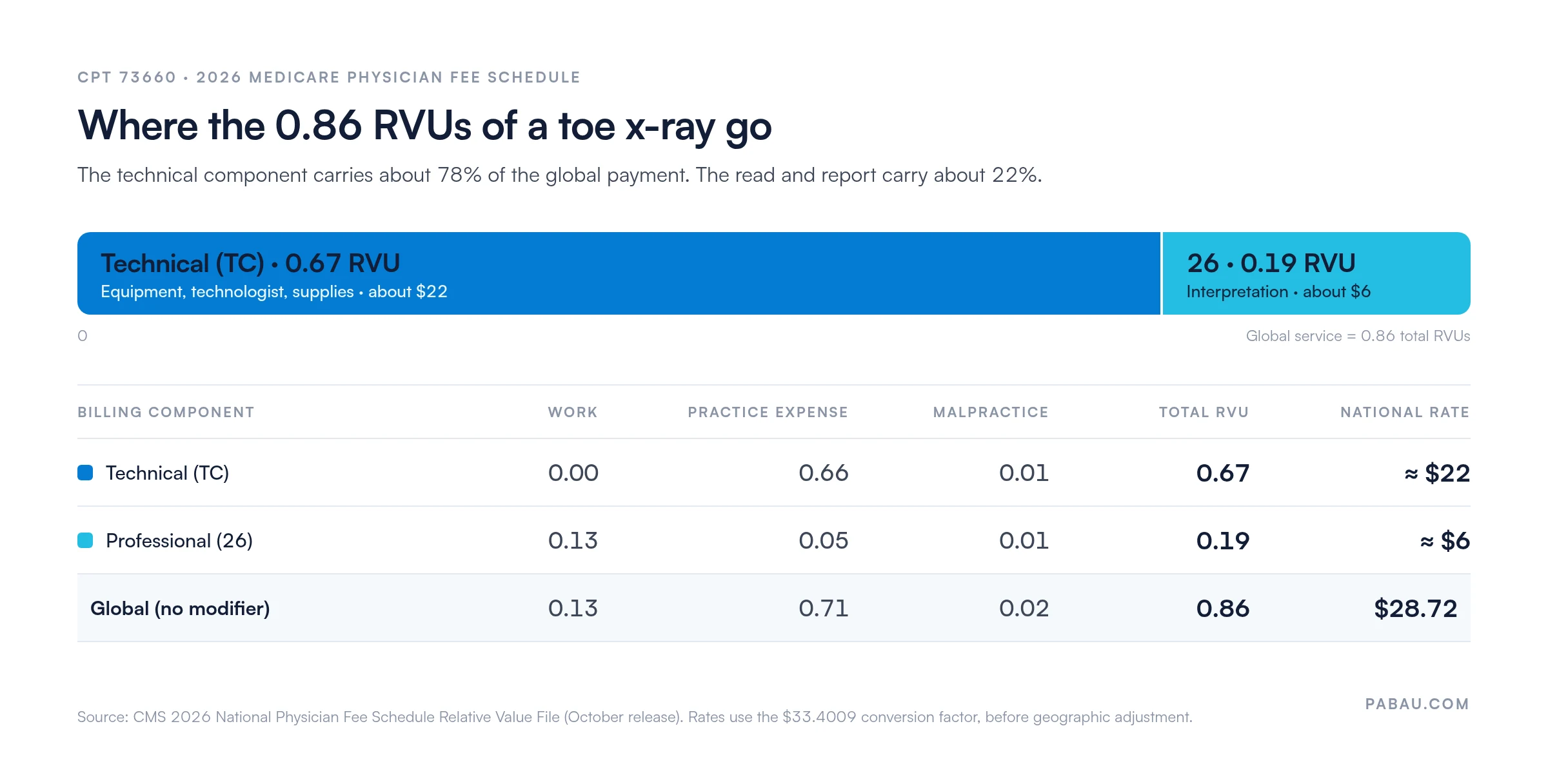
In 2026, the technical component carries 0.67 of the code’s 0.86 total RVUs, and the professional component (modifier 26) carries 0.19.
Most 73660 denials trace back to a non-specific diagnosis, views that are counted but not named, or a same-day foot code on the same foot.
Pabau, a practice management platform, sends claims through Claim.MD with an eligibility check before submission.
CPT code 73660 is the procedure code for a radiologic examination of the toe(s), minimum of 2 views. CMS’s 2026 relative value files list it as an active, payable toe x-ray with separate professional and technical components.
AAPC’s CPT range index places it in the Radiology section (70010-79999). Within that section, it sits in diagnostic radiology, lower extremity (73501-73725), next to the ankle and foot codes coders most often confuse with it.
The key term is “toe(s).” The code covers one or more toes, with at least two projections. A dorsoplantar and an oblique view make up the standard two-view series. Extra views, such as a lateral or a sesamoid axial view, do not change the code. CPT has no three-view toe code to step up to.
CPT code 73660 covers the full radiologic service for one or more toes. That means image acquisition, supervision of the study, and physician interpretation with a written radiology report. When the same physician both performs and interprets the study, the global code bills without a modifier.
Billing 73660 for a study that images the foot, including the metatarsals, midfoot or calcaneus, is a coding error. The foot has its own codes, and so does the ankle when the ankle joint is the focus.
The radiology report is the claim’s foundation. To support CPT code 73660 without a denial, the report must contain four specific elements.
Typical 73660 scenarios include a suspected toe fracture, hallux valgus assessment, a gout flare, sesamoid pathology and follow-up after toe surgery. Each scenario has its own ICD-10 codes that establish medical necessity. Matching the indication in the report to an exact ICD-10 code is what separates a clean claim from a pending or denied one.
Toe, foot and ankle x-rays are easy to mix up, because the order alone rarely shows where the toe ends and the foot begins. The table below gives the decision criteria.
The practical test is to read what the radiologist’s report describes as the primary anatomical subject. Toes get 73660. The foot gets 73620 or 73630. The ankle gets 73600 or 73610. When one order requests toe and foot imaging on the same date, check the NCCI edits for that code pair before billing both.
When a podiatrist orders a ‘foot and toe x-ray’ as a single study, review the actual images and report before coding. If the radiologist described and measured the toe phalanges separately from the metatarsals, bill both 73660 and 73620 with modifier 59 on the lower-value code. If the report treats the examination as one continuous foot study, 73630 alone is usually more accurate and defensible.
CPT code 73660 uses three modifiers in regular billing. Modifier 50 covers bilateral toe imaging, modifier TC the technical component, and modifier 26 the professional component. Each changes what the payer reimburses and who receives the payment.
Portable x-ray billing adds a layer of complexity. Under Medicare’s portable x-ray supplier rules, the supplier billing the TC for a mobile study must hold a valid CMS survey certification. When both feet are imaged during a portable study, the bilateral modifier still applies, but the TC claim must come from the certified supplier. Without that certification, the TC claim denies outright, however correctly the modifier is appended.
Medicare reimburses CPT code 73660 under the Medicare Physician Fee Schedule (MPFS). It sets separate rates for the global service, the technical component (TC) and the professional component (modifier 26).
Rates update each January and vary by geographic practice cost index (GPCI). The figures below are 2026 national amounts before geographic adjustment, at the $33.4009 conversion factor. Use the CMS Physician Fee Schedule lookup tool to get the exact rate for your locality.
At that conversion factor, the 0.86 global RVUs come to about $28.72 nationally. The technical component carries roughly 78% of that payment, as the split below shows.
RVU data updates annually. Verify current-year figures with the FastRVU lookup tool, which imports the CMS data file and applies GPCI adjustments by locality. In Pabau’s billing software, claims go out through the Claim.MD clearinghouse, which routes them to US payers and checks eligibility before submission.
Commercial payers typically reimburse at a percentage of the MPFS rate, often 100-120% for radiology codes in network contracts, though plans vary. The remittance returned after each settlement confirms the allowed amount and any contractual adjustment. Review electronic remittance advice against the contracted 73660 rate at least quarterly to catch systematic underpayments.
Every CPT code 73660 claim must include at least one ICD-10-CM diagnosis code that establishes medical necessity. The diagnosis must come from the treating provider’s order and be supported by documentation in the medical record. Use the CDC ICD-10-CM lookup tool to verify that any code you use is current for the applicable fiscal year (codes update October 1 annually).
Many payers expect a toe-specific ICD-10 code when 73660 is on the claim. Using M79.671 for a suspected toe fracture may draw a medical necessity query, because that code describes foot pain and never names the toe. Code to the highest level of specificity the documentation supports.
Denials for 73660 tend to cluster around six common causes. Most are fixable at the documentation or claim preparation stage rather than through an appeal. A strong denial management workflow catches them before submission.
Review denial codes in medical billing alongside the CARC reason codes on each ERA. That gives billing teams a faster path to root-cause analysis than reading claims one by one. A clean claim submission for 73660 passes all six checks above before it leaves the practice.
Run a quarterly audit of every 73660 claim denied for insufficient documentation. Pull the matching radiology reports and check whether the views are named or only counted. Where a report says ‘2 views’ without naming them, fix the report template so the next study records each projection.
Medicare covers CPT code 73660 when the claim includes a valid ICD-10 code, documentation of at least two named views, and physician attestation. No National Coverage Determination (NCD) restricts toe x-rays specifically. Local Coverage Determinations (LCDs) from Medicare Administrative Contractors (MACs) such as Noridian, Palmetto GBA and CGS may add documentation requirements. These usually target indications such as diabetic foot complications or recurrent gout.
Each denial pattern above can be stopped at documentation or claim preparation, well before an appeal. Integrated claims management software checks the most frequent failure points on every claim, so billers no longer review each one by hand.

Software cannot fix a report that never named its views. Pair it with a report template that records named projections, laterality and a toe-level diagnosis. Then the six denial causes above have far fewer ways onto a 73660 claim.

Pabau sends 73660 claims through Claim.MD with eligibility checks and payer edits before submission, then returns ERA remittances so you can reconcile each payment. See how it works for radiology and podiatry billing teams.

CPT code 73660 is narrow by design, so most of the billing risk sits in the steps around it. Start with the report template. Named views, laterality and a toe-level diagnosis close off the most common denial causes in a single change.
Then check how payments post against the 2026 split. The technical component now carries about 78% of the rate. A practice that only reads films should expect roughly $6 per read before geographic adjustment.
Pabau’s claims tools submit each claim through Claim.MD, check eligibility first and return ERA remittances for reconciliation. Book a demo to see a 73660 claim move from radiology report to remittance in one system.

Need to understand how clearinghouse submission works? Medical claims clearinghouse guide explains how payer routing, eligibility checks, and ERA processing reduce radiology claim denials.
Want to reduce overall billing errors across your practice? Revenue cycle management overview covers the end-to-end workflow from order entry to payment posting.
Looking for the Claim.MD integration details? Claim.MD clearinghouse integration outlines how Pabau sends claims through Claim.MD and checks eligibility before submission.
Imaging a bunion before surgery? ICD-10 code M20.12 covers acquired hallux valgus of the left foot, a common diagnosis on toe x-ray claims.
CPT code 73660 covers a radiologic examination of one or more toes, with a minimum of two views. It includes image acquisition, supervision and physician interpretation with a written report. Foot and ankle imaging use separate codes.
A minimum of two views is required. There is no step-up code for additional views, so a three-view or four-view toe study still bills under 73660. The radiology report must name each projection obtained, not just state the total number of views.
The 2026 national Medicare amount for the global service is about $28.72, before geographic adjustment. The technical component (TC) is about $22 and the professional component (modifier 26) about $6. Rates vary by geographic practice cost index and update each year. Use the CMS Physician Fee Schedule lookup tool for your locality’s current rate.
Yes. When both feet are imaged in the same session, append modifier 50 to 73660 on one line. Where the payer asks for it, bill RT and LT lines instead. Medicare pays each side at 100% of the fee schedule amount, because 73660 carries bilateral indicator 3. Check each commercial payer’s billing instructions before the first bilateral claim.
CPT 73660 covers toe imaging with a minimum of 2 views. CPT 73630 covers a complete foot study with a minimum of 3 views, including the metatarsals, midfoot and often the calcaneus. Billing both codes for the same foot on the same date triggers an NCCI bundling edit. Only use both when distinct clinical indications justify separate studies, and append modifier 59 to the lower-value code with supporting documentation.
The most common denials come from a non-specific or missing ICD-10 code, such as generic foot pain instead of a toe-specific diagnosis. Others follow from reports that count views without naming them, same-day unbundling with 73630 for the same foot, and a missing bilateral modifier. Portable x-ray claims also deny when an uncertified supplier bills the TC.
Common pairings include S92.4xxA or S92.5xxA (toe fracture, initial encounter), M20.10-M20.12 (hallux valgus) and M10.071-M10.072 (idiopathic gout of the ankle and foot). For toe pain, M79.674 and M79.675 are more specific than the foot pain codes M79.671 and M79.672. Z47.89 covers orthopedic aftercare. Code to the highest level of specificity the documentation supports.
When 73660 is performed as a portable x-ray study, the supplier billing the TC must hold a valid CMS survey certification for portable x-ray services. Claims from uncertified suppliers deny automatically and cannot be corrected retroactively. Practices that contract with mobile radiology suppliers should verify active certification before accepting portable imaging orders.





