ICD-10 Code S53.013D: Anterior subluxation of unspecified radial head
ICD-10 Code S53.013D: Quick reference summary Use the table below as your first ...

Last Updated: Nov 6, 2026
Billable Code Specific Code
S92.424S is the billable ICD-10-CM code for nondisplaced fracture of distal phalanx of right great toe, sequela. Coders use it when that fracture has healed but left a residual condition, such as chronic pain, stiffness or a nail deformity.
The treating provider must link that condition to the original injury. The residual condition is coded first, and S92.424S follows it. While the fracture itself is still being treated, the 7th character is A, B, D, G, K or P instead.
Let Pabau's smart automation suggest the right codes, reduce claim denials, and keep your practice compliant—effortlessly.
Automate repetitive tasks and focus on what matters most—your patients.
Reduce coding errors and ensure compliance with the latest regulations.
Clean claims, fewer denials, and faster reimbursements.
Powerful insights and reporting to help your practice thrive.
HIPAA compliant SOC 2 certified GDPR-compliant Trusted by 4,000+ clinics worldwide

S92.424S reports a sequela of a nondisplaced fracture of the distal phalanx of the right great toe.
It is billable and specific, and the laterality is right: the left great toe is S92.425S and an unspecified great toe is S92.426S.
The 7th character S applies only to a residual condition left by the healed fracture, never to the fracture while it is still being treated.
Sequence the residual condition first and S92.424S after it, as the sequela guideline requires.
Malunion and nonunion are not sequela codes here: report them as S92.424P and S92.424K.
ICD-10 Code S92.424S reports a nondisplaced fracture of the distal phalanx of the right great toe, sequela. Use it when that fracture has healed but left a residual condition, which is coded first.
Each character in S92.424S carries a distinct clinical meaning. Reading them in sequence tells you the injury, the bone, the side and the encounter type.
The great toe, or hallux, has two phalanges. The distal phalanx is the tip of the toe that sits under the nail, and the proximal phalanx joins the foot.
A fracture of the proximal phalanx of the great toe belongs in S92.41-, not S92.42-. The four lesser toes have their own subcategory, and a lesser toe distal phalanx fracture codes to S92.53-.
Within S92.42-, the 6th character carries both displacement and side. Codes 1 to 3 are displaced (right, left, unspecified), and codes 4 to 6 are nondisplaced in the same order.
The 7th character S marks a sequela: a condition that remains as a direct result of the injury after the fracture itself is healed. Here, that injury is the nondisplaced fracture of the right great toe distal phalanx.
The ICD-10-CM Official Guidelines for Coding and Reporting list seven 7th characters for S92 fracture codes. Picking the wrong one is one of the easier coding errors to prevent.
S92 does not split its subsequent-encounter characters by open or closed fracture. D, G, K, P and S apply to both, and only the initial encounter separates A from B.
The encounter type reflects what the clinician is treating at the visit, not how long ago the fracture happened. A patient still in the healing phase six weeks after the injury gets D.
A patient seen two years later for pain at the tip of the right great toe gets the S character. The note must link that pain to the old fracture.
S92.424S does not stand alone on the claim. The guidelines put the residual condition first, with S92.424S after it to show where that condition came from. Common residual conditions include the following.
Malunion and nonunion are not on that list. The guidelines code complications of fracture healing with the fracture code itself, so a malunion visit is S92.424P and a nonunion visit is S92.424K.
The treating provider establishes the causal link, not the coder. The note should say something like “chronic pain of the right great toe is a sequela of the prior distal phalanx fracture.” When the link is unclear, query the provider rather than infer it.
Billers often confuse fracture follow-up, personal history and sequela codes. The wrong choice produces a denial that needs a corrected claim or an appeal, and both cost more than getting it right first. Two questions about the visit settle which code applies.
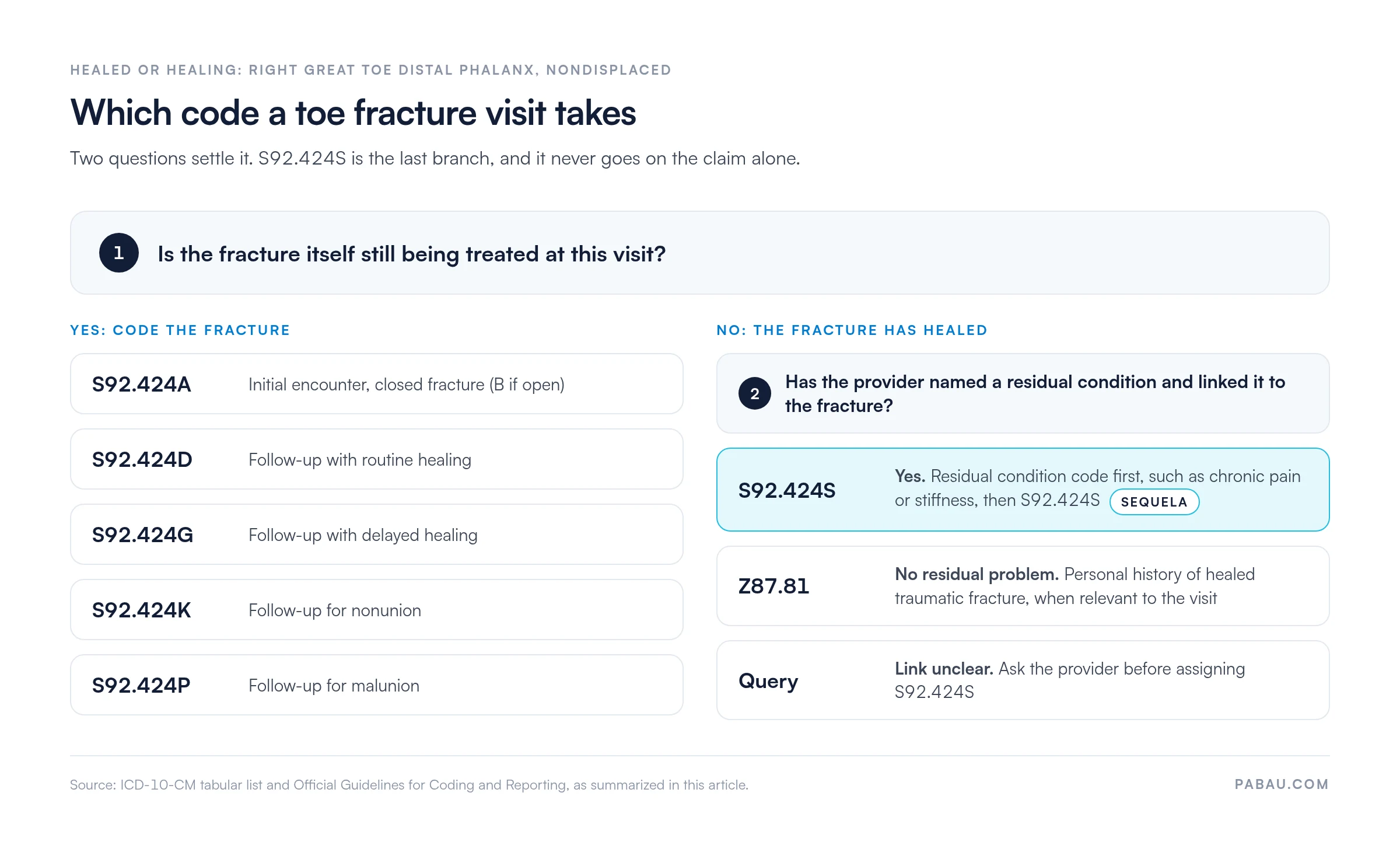
Run a quick test before choosing the code. If the fracture itself is still being treated, use A, B, D, G, K or P as the 7th character. If a healed fracture has left a named problem behind, code that problem first and add S92.424S. If the answer is unclear, query the provider.
Aftercare Z codes are not used for injuries. For fracture follow-up, the guidelines assign the injury code with the 7th character D. Complicated healing takes G, K or P instead.
The medical billing compliance point is simple. If the provider has not named a residual condition and tied it to the fracture, S92.424S does not apply.
S92.424S sits among several closely related codes. The table below shows the neighbors most easily confused with it and the clinical differentiator for each.
Displacement comes from the original injury documentation, not the current visit. The guidelines say a fracture not documented as displaced or nondisplaced is coded as displaced. Confirm with the CDC/NCHS ICD-10-CM browser tool and the original imaging before choosing S92.424S.
The CDC/NCHS ICD-10-CM tabular attaches notes at the category and subcategory levels. Sequencing comes from the Official Guidelines instead.
Four documentation elements should be present in the medical record to support S92.424S. A missing one gives the payer a reason to deny the claim.
Laterality is built into this code: the 6th character 4 means right. If the note and the claim disagree about the side, correct the record or the code before submission rather than after the denial.
Medicare and commercial payers generally follow the ICD-10-CM Official Guidelines on sequela coding. Payer-specific policies may still add requirements for the services billed alongside S92.424S.
Before submitting, check the relevant Local Coverage Determination for the procedure billed. Physical therapy, podiatric surgery and orthopedic evaluation each carry their own medical necessity rules.
Common CPT codes on sequela claims include evaluation and management codes (99202-99215), physical medicine codes for rehabilitation and podiatric procedure codes. Medical billing workflows that handle sequela claims benefit from a coder review step before submission.
S92.424S denials follow five predictable patterns, and each one has a set correction.
Systematic denial management workflows that track denials against specific ICD-10-CM codes surface these patterns quickly. The medical billing denial codes guide helps teams sort coding, documentation and payer policy issues by CARC reason.
Submitting a clean claim for a sequela encounter needs three things. List the residual condition first, S92.424S second and keep the causal-link language in the provider note.
When appealing a denial on an S92.424S claim, send the provider note with the causal-link sentence highlighted. Add the original injury encounter summary and the corrected claim form. Payers overturn sequela denials more readily when the documentation package shows each required element plainly.
Sequela claims usually fail on paperwork rather than on the code itself. The provider note, the diagnosis codes and the claim often sit in different places, so a missing causal-link sentence goes unnoticed until the denial.
Pabau, the practice management platform we build, keeps the clinical note and the billing record on the same patient file. Your coder can read the provider’s wording and confirm the sequence before the claim goes out.
Pabau’s claims management software then submits the claim electronically through its Claim.MD integration and tracks its status. Your team sees which claims came back and can work them from the same record.
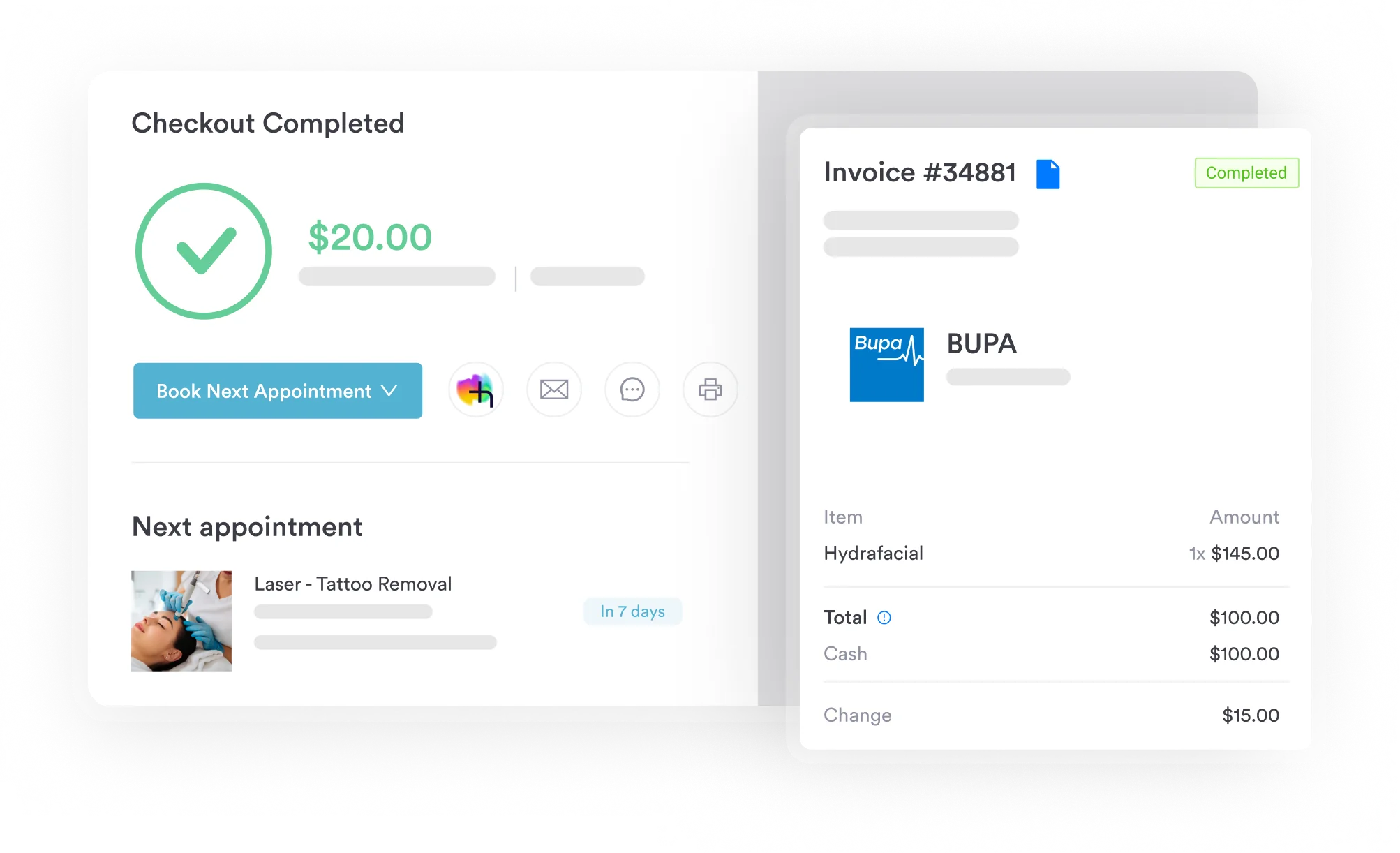

Pabau keeps the provider note and the claim on one patient record. Its claims management software submits claims through Claim.MD and tracks each one, so your team can follow up on denials quickly.

S92.424S is a narrow code: the right great toe, the distal phalanx, a nondisplaced fracture and a residual problem after healing. Each of those details has a neighboring code, so the note has to support all four.
Most errors come from the 7th character. Use D, G, K or P while the fracture is still being treated, and save S for the condition it leaves behind. When the provider has not named that condition and linked it to the fracture, query before you code.
Book a demo to see how Pabau keeps the provider note and the sequela claim on one record.

Need a broader view of how clearinghouses handle ICD-10 claim submissions? Claim.MD clearinghouse guide explains how EDI routing, payer enrollments, and 835 remittance advice work in practice.
Want to understand the full medical billing cycle behind a sequela claim? Revenue cycle management overview covers the end-to-end process from encounter to payment posting.
Looking for guidance on electronic remittance advice for denied claims? Electronic remittance advice explained shows how to read ERA files and act on CARC denial reasons efficiently.
ICD-10 code S92.424S means nondisplaced fracture of distal phalanx of right great toe, sequela. Use it when a healed fracture of the right great toe tip has left a residual condition, such as chronic pain or stiffness. The residual condition is coded first, and S92.424S follows it.
Both describe a sequela of a fracture of the distal phalanx of the right great toe. S92.421S is for a fracture that was displaced, and S92.424S is for one that was not. Displacement comes from the original injury imaging. A fracture not documented either way is coded as displaced.
Use S when the fracture has healed and the patient now has a residual condition caused by it. The provider must name that condition and link it to the fracture in the note. A fracture still being treated gets D, G, K or P as the 7th character.
Neither aftercare Z codes nor history codes replace the injury code during treatment. Aftercare Z codes are not used for injuries. Fracture follow-up uses the injury code with D, G, K or P as the 7th character. Z87.81 records a personal history of a healed traumatic fracture. S92.424S applies when a named residual condition remains.
Yes. S92.424S is a billable, specific ICD-10-CM code. Report it after the residual condition code, with provider documentation of the causal link. Check the current fiscal year code set each October, because ICD-10-CM updates annually.
The most common are submitting S92.424S as the only diagnosis, and using it while the fracture is still being treated. Others include a note without the causal link and an aftercare Z code in place of the injury code. A left-side modifier on the claim line also triggers denials.