ICD-10 Code S66.308A: Extensor muscle injury, other finger
ICD-10 Code S66.308A: Definition and code hierarchy ICD-10 Code S66.308A is the ...

Last Updated: Oct 14, 2026
Billable Code Specific Code
S92.415K is the billable ICD-10-CM code for nondisplaced fracture of proximal phalanx of left great toe, subsequent encounter for fracture with nonunion. Subcategory S92.4 covers the great toe only, so fractures of the second through fifth toes are coded under S92.5.
The 7th character K tells payers this is follow-up care for a fracture that has not healed. Laterality must be documented as left, and nonunion must be radiologically confirmed in the record before the code is assignable. Coders often reach for the adjacent characters G (delayed healing) and P (malunion), and those two swaps drive most denials on this code.
Let Pabau's smart automation suggest the right codes, reduce claim denials, and keep your practice compliant—effortlessly.
Automate repetitive tasks and focus on what matters most—your patients.
Reduce coding errors and ensure compliance with the latest regulations.
Clean claims, fewer denials, and faster reimbursements.
Powerful insights and reporting to help your practice thrive.
HIPAA compliant SOC 2 certified GDPR-compliant Trusted by 4,000+ clinics worldwide

S92.415K codes a nondisplaced proximal phalanx fracture of the left great toe at a subsequent encounter where nonunion is documented.
S92.4 is the great toe fracture category. Fractures of the second through fifth toes are coded under S92.5, so S92.415K never applies to a little toe.
The ‘K’ 7th character is valid only for subsequent encounters. The treating provider must document failed bone healing, supported by imaging such as a plain radiograph.
Denials most often follow from using K when imaging does not confirm nonunion. Submitting K on what should be an initial encounter (A) or a routine subsequent encounter (D) is the other common cause.
Pabau’s claims management software helps practices track encounter type across visits and flag 7th character mismatches before claim submission.
ICD-10 Code S92.415K is a valid, billable ICD-10-CM diagnosis code for fiscal years 2025 and 2026.
Both the CDC/NCHS ICD-10-CM web tool and AAPC Codify confirm it as active. Its full official descriptor is: Nondisplaced fracture of proximal phalanx of left great toe, subsequent encounter for fracture with nonunion.
The code sits in subcategory S92.4, which covers fractures of the great toe only. Fractures of the second through fifth toes belong to S92.5 instead. Both subcategories sit under the ICD-10-CM chapter for injuries to the ankle and foot (S90-S99). S92.415K carries no Type 1 or Type 2 Excludes notes that would restrict its use alongside other foot injury codes.
Every component of ICD-10 Code S92.415K carries a specific coding obligation. Misreading any element introduces laterality or encounter-type errors that result in denials. The table below dissects the descriptor term by term, drawing on CMS ICD-10-CM coding guidance and standard anatomical references.
The great toe has two phalanges rather than three, so its proximal phalanx sits between the first metatarsal head and the distal phalanx. Most nondisplaced fractures here follow direct trauma, such as stubbing the toe or dropping a weight onto the forefoot. Nondisplaced fractures are usually managed conservatively at first. That is why nonunion carries clinical weight on this code. A fracture that looked stable can fail to consolidate, and the great toe takes the push-off load at every step.
The ‘K’ seventh character designates a subsequent encounter for a fracture with nonunion. That definition comes from the ICD-10-CM Official Guidelines for Coding and Reporting, Section I.C.19.a. Nonunion means a fracture has failed to achieve bony union within the expected healing timeframe. Imaging usually shows absent or arrested callus formation. Two adjacent characters are easy to confuse with K: delayed healing (G) and malunion (P). The seventh character rules work the same way across every fracture category, so knowing them prevents most assignment errors here.
The full 7th character set for S92.415- is fixed by the ICD-10-CM tabular list. Each character signals a different clinical and administrative status:
K vs G: Delayed healing (G) means healing is progressing but slowly. Nonunion (K) means healing has stopped. The clinical distinction requires provider documentation, not coder interpretation. If the note says “slow healing” without confirming failed union, G is the appropriate character. K requires explicit documentation of nonunion, typically supported by radiographic evidence of no callus progression.
K vs P: Malunion (P) means the fracture has healed, but in a faulty position. Nonunion (K) means it has not healed at all. These require entirely different clinical interventions and must never be interchanged. The decision chart below runs the same choice in one pass, from what the record documents to the code it supports.
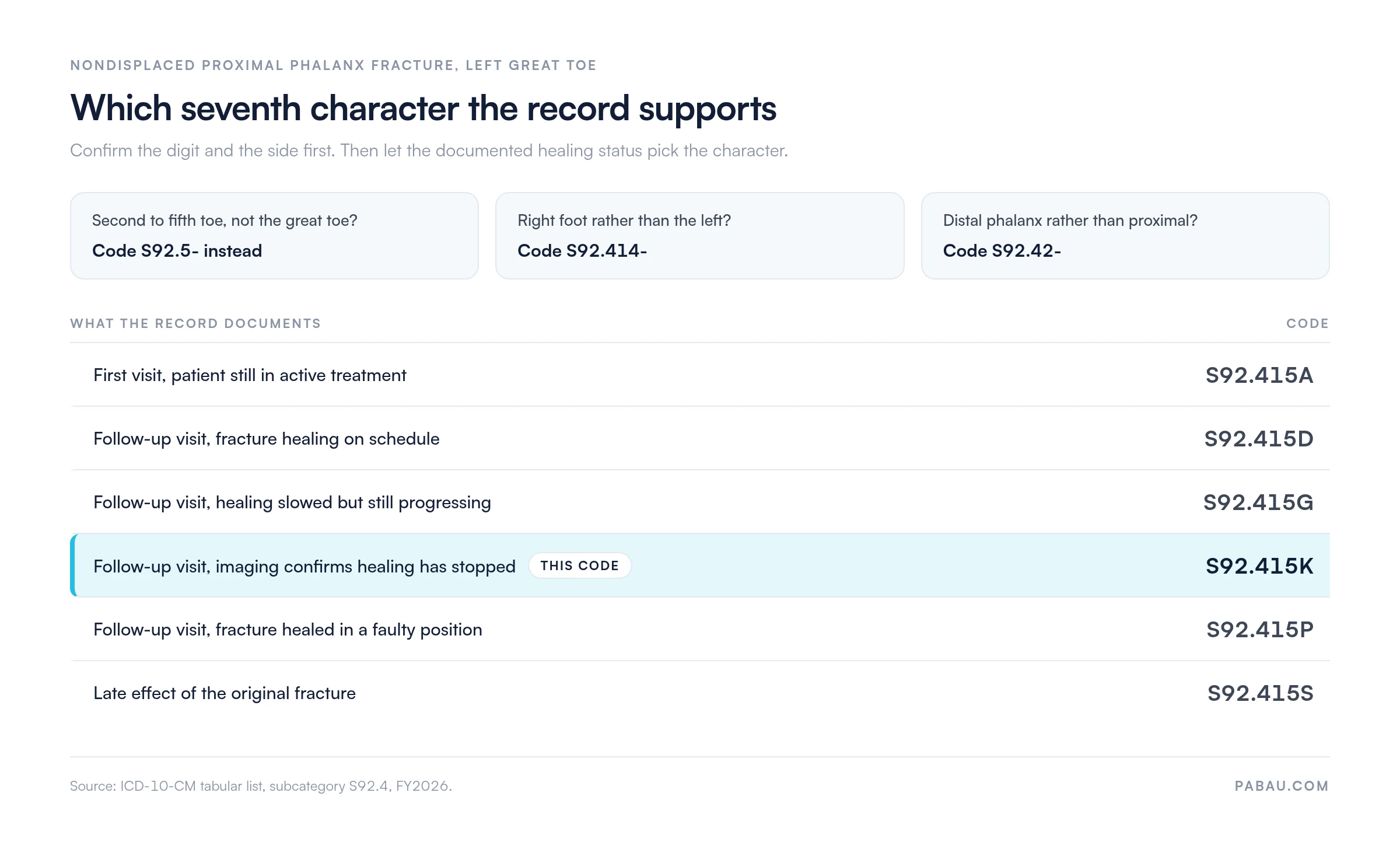
Digit and healing status are picked separately, and a lesser toe shifts only the base code. Where a second through fifth toe healed in a faulty position and no specific toe is named, the malunion code is S92.599P.
S92.414K is the direct right-side equivalent of S92.415K. It codes a nondisplaced fracture of the proximal phalanx of the right great toe at a subsequent encounter with nonunion. Laterality errors between S92.414K and S92.415K are among the top denial causes for this code family. The comparison table below covers the most commonly confused adjacent codes, informed by the AAPC Codify ICD-10-CM lookup.
Documentation requirements for S92.415K are more demanding than those for routine subsequent fracture codes (S92.415D), because nonunion requires clinical evidence beyond the provider’s note alone. Insufficient documentation is the leading cause of claim denial for this code. All six elements below belong in the record before the code is assigned. Meeting them also supports submitting a clean claim on the first pass.
Run a documentation audit before submitting any S92.415K claim. Pull the imaging report alongside the provider note and confirm both documents reference nonunion on the same date of service. A note that says ‘nonunion suspected’ without a corroborating radiology read is a denial waiting to happen.
CPT code selection for S92.415K claims depends on what intervention is performed at the subsequent encounter. Conservative management, surgical intervention, and physical therapy visits each pull from different code families. The pairings below reflect standard billing practice. Payer policies on medical necessity vary by jurisdiction, so verify coverage before submission.
CPT separates the great toe from the lesser toes, so S92.415K pairs with 28490 or 28495 rather than 28510 or 28515. The manipulation split matters too. If the procedure at the subsequent encounter involves no active reduction, 28490 is correct. Billing 28495 without documented manipulation is an audit flag. Confirm current CPT descriptor language against the AMA CPT manual for the service year, since descriptors are refined annually.
Medicare and major commercial payers treat fracture nonunion claims differently from routine subsequent encounters. The ‘K’ seventh character signals a complication of healing, which most payers classify as a higher-scrutiny claim category. Practices submitting S92.415K should route claims electronically through Claim.MD, the US clearinghouse partner used by practice management software like Pabau. Claim.MD processes over 4,000 payers and supports real-time eligibility verification before submission. The claims management software built into Pabau checks code-level pairing rules before the claim leaves the practice.

Denials on S92.415K claims follow predictable patterns. Most trace back to two root causes: incorrect 7th character selection and insufficient documentation supporting nonunion. Reading the remittance against the standard denial codes in medical billing tells a billing team which of the two it is. Catching either one before submission costs far less than appealing after the fact.
ICD-10 Code S92.415K has no direct one-to-one ICD-9-CM equivalent. ICD-9-CM lacked the 7th character system for encounter type and healing status. Nonunion, delayed healing, and sequela were not separately codeable within most injury categories. The approximate ICD-9-CM predecessor codes for this clinical scenario are shown below. These are useful for practices reconciling legacy records or historical data analysis, not for current billing. For current claim submissions, always use ICD-10-CM.
The ICD-9 crosswalk has one major limitation. Code 826.0 covered all phalanx fractures of the foot, with no distinction of toe, laterality, displacement status, or encounter type. ICD-10-CM added the 7th character precision that lets payers separate S92.415K from S92.415D. ICD-9 carried no equivalent signal. Any practice analyzing nonunion episodes from ICD-9 historical data should apply that limitation when comparing claim patterns across the transition period.
Practices billing codes like ICD-10 Code S92.415K need documentation workflows that track encounter type across multiple visits. A patient may present with S92.415A at the initial visit and progress to S92.415K at a later encounter. The billing system has to flag that shift and prompt the correct 7th character. Pabau’s claims management tools carry the coding history of a fracture episode from the first visit to the last one.
Configure a Pabau workflow automation that triggers a documentation checklist whenever a subsequent encounter (D, G, K, P) fracture code is selected. The checklist prompts staff to confirm imaging is on file, laterality is stated, and the provider note addresses healing status. A denial-prone claim becomes a clean one before it is submitted.

Pabau’s built-in claims management tools track encounter types across visits and flag 7th character mismatches before submission. They connect directly to Claim.MD for electronic claim processing across 4,000+ US payers.

ICD-10 Code S92.415K is a precise, fully billable code for the left great toe. It demands documentation specificity on six fronts: encounter type, laterality, digit, phalanx level, displacement status, and radiologically confirmed nonunion. The 7th character K is the most consequential element. Assigning it without imaging confirmation, or confusing it with G (delayed healing) or P (malunion), causes most denials on this code family.
Treat the imaging report as the gatekeeper for this code, and the rest of the descriptor takes care of itself. Pull the radiology read before the claim goes out. Those few minutes of checking trade for an appeal you never have to file. Book a demo to see how Pabau keeps encounter type, laterality and healing status aligned across a fracture episode.

Need to understand denial codes on your remittance? Pabau’s Claim.MD clearinghouse guide explains how the integration processes 837P claims and retrieves 835 ERAs for denial analysis.
Want to reduce claim rejections across all diagnosis codes? What is revenue cycle management covers the end-to-end workflow from documentation to payment posting.
Managing a multi-visit fracture episode? Pabau’s superbill guide explains how to structure encounter-level billing documentation to support ICD-10 7th character accuracy across visits.
ICD-10 Code S92.415K is the billable diagnosis code for a nondisplaced fracture of the proximal phalanx of the left great toe. It applies at a subsequent encounter where the fracture has failed to achieve union. The ‘K’ seventh character marks this as follow-up care on a bone that has not healed. That sets it apart from delayed healing (G) and malunion (P).
Yes. S92.415K is a fully billable, valid ICD-10-CM diagnosis code for fiscal years 2025 and 2026. It carries no Excludes notes that would prevent its use on a claim. The code is confirmed as active by the CDC/NCHS ICD-10-CM tabular list and AAPC Codify.
No. S92.415K is a great toe code, because subcategory S92.4 covers fractures of the great toe only. Fractures of the second through fifth toes fall under S92.5, fracture of lesser toe(s). Assigning an S92.4 code to a little toe injury produces a descriptor the medical record cannot support.
S92.415K designates nonunion, meaning the fracture has failed to heal entirely. S92.415G designates delayed healing, where healing is progressing but more slowly than expected. The documentation differs as well. G needs provider documentation that healing is occurring but slow. K needs confirmation, usually radiographic, that healing has arrested or failed. Using K when the record only supports G is a common denial cause.
The medical record must contain six documented elements. Five of them are the subsequent encounter type, left laterality stated explicitly, great toe identification, proximal phalanx specification, and nondisplaced status. The sixth is nonunion confirmed by a radiograph showing absent or arrested callus formation. Missing any element, especially the imaging evidence of nonunion, is the most frequent denial trigger.
The approximate ICD-9-CM equivalent is 826.0, fracture of one or more phalanges of foot, closed. It was often paired with 733.82, nonunion of fracture, as an additional code. ICD-9 lacked the 7th character system, so laterality, displacement status, encounter type, and healing status were not separately codeable. Any historical data comparison using these codes should account for that structural limitation.
Medicare coverage for fracture nonunion treatment depends on the Medicare Administrative Contractor (MAC) jurisdiction and the applicable Local Coverage Determination (LCD). Generally, Medicare covers medically necessary treatment for nonunion when documentation supports failed conservative management and surgical indication. Pre-authorization requirements and coverage thresholds vary by MAC. Check your jurisdiction’s current LCD before submitting surgical CPT codes paired with S92.415K.