

ICD-10 code S61.201A: Open wound of left index finger without nail damage
ICD-10 code S61.201A covers a left index finger wound of unstated type ICD-10 co...

Last Updated: Oct 16, 2026
Billable Code Specific Code
S92.532P is the billable ICD-10-CM code for displaced fracture of distal phalanx of left lesser toe(s), subsequent encounter for fracture with malunion. It covers the 2nd through 5th toes, never the big toe.
Coders assign it at orthopedic and podiatric follow-up visits where imaging shows the fracture has healed out of alignment. The 7th character P separates it from K (nonunion) and S (sequela). Character A belongs only on the first active treatment visit.
Let Pabau's smart automation suggest the right codes, reduce claim denials, and keep your practice compliant—effortlessly.
Automate repetitive tasks and focus on what matters most—your patients.
Reduce coding errors and ensure compliance with the latest regulations.
Clean claims, fewer denials, and faster reimbursements.
Powerful insights and reporting to help your practice thrive.
HIPAA compliant SOC 2 certified GDPR-compliant Trusted by 4,000+ clinics worldwide

ICD-10 Code S92.532P covers a displaced fracture of the distal phalanx (the toe-tip bone) of a left lesser toe, 2nd through 5th, not the hallux.
The 7th character P means the fracture has healed, but in malposition. That sets it apart from K (nonunion, no healing) and S (sequela, a resulting condition).
Imaging confirming malunion must appear in the medical record. A fracture diagnosis without documented malposition does not support S92.532P.
Pabau’s claims management software scrubs each claim for missing or invalid details before submission, so fewer S92.532P claims come back rejected.
ICD-10 Code S92.532P is a valid, billable ICD-10-CM code for fiscal year 2026. Each character in the alphanumeric string has a distinct meaning, and misreading any one of them produces a different code entirely.
The code is billable for FY 2026 and is valid in principal and secondary diagnosis positions. It sits in chapter 19 (injury, poisoning and certain other consequences of external causes). Verify annually after October 1 for any code-set updates from the CMS ICD-10 codes page.
The lesser toes (2nd through 5th) each contain three phalanges: proximal, middle, and distal. The distal phalanx is the small bone at the tip of the toe, beyond the distal interphalangeal (DIP) joint. It supports the toenail and the soft pulp of the toe.
Crush injuries, such as a dropped object, and stubbing are the most common mechanisms. Because the nail bed sits directly over the bone, the fracture can also involve a subungual hematoma or a nail-bed injury.
Laterality and phalanx level matter for more than billing precision. A distal phalanx that heals out of alignment can leave an angled or rotated toe tip, a nail deformity, or pressure pain in footwear. Documenting which foot and which phalanx level directly supports the medical necessity of ongoing management.
S92.532P is for a fracture that was displaced. If the original fracture was nondisplaced, the matching malunion code is S92.535P. Beyond that, what matters at the follow-up visit is the current imaging finding: healed bone in malposition, confirmed radiographically.
The 7th character in S92 fracture codes signals both the type of encounter and the healing status of the fracture. “P” specifically means the patient is presenting for a subsequent visit and the fracture has united, but in an incorrect anatomical position. This is not the same as delayed healing (G) or complete failure to heal (K).
Track the distinction between K and P at the point of documentation, not at billing. When the physician notes ‘no bridging callus on X-ray,’ that signals nonunion (K). When notes read ‘callus present but in varus angulation,’ that signals malunion (P). The difference in clinical language drives the 7th character selection, and with it the claim outcome.
Three categories of confusion appear repeatedly in S92.532P claims: laterality errors, wrong phalanx level, and wrong 7th character. The table below covers the most frequently substituted codes.
The AAPC ICD-10-CM lookup allows code-range browsing of the full S92.5 subcategory, which can help coders verify adjacent codes quickly during a billing review.
Claims for ICD-10 Code S92.532P are supported by records that go beyond noting “fracture, left toe.” Each of these elements must appear in the medical record for the visit being billed.
Orthopedic and podiatric practices benefit from structured note templates. These prompt for laterality, phalanx level, and complication type at the time of the visit rather than during billing review. A missing detail fixed in the note costs minutes, while a denial costs a resubmission and weeks of waiting.
ICD-10-CM Official Guidelines, Section I.C.19.a, establish that traumatic fracture aftercare uses the fracture code (S92.532P) with the appropriate 7th character, not Z-code aftercare.
Z47.89 (encounter for other orthopedic aftercare) should not appear on a claim while the patient is still managed for a fracture complication. The CMS ICD-10 coding guidelines reinforce this distinction annually.
Common CPT pairings with S92.532P include toe fracture treatment codes. CPT 28510 covers closed treatment of a fracture of a phalanx other than the great toe, without manipulation.
CPT 28525 covers open treatment of the same fracture, including internal fixation when performed. Either may be billed alongside this diagnosis code when the malunion is being actively treated.
Always verify payer-specific coverage determinations, as local coverage determinations (LCDs) vary by Medicare Administrative Contractor (MAC) and commercial plan.
For guidance on maintaining compliant billing workflows more broadly, medical billing compliance resources cover the documentation and coding standards that support payer audits.
Most S92.532P denials trace back to one of five documentation or coding errors. Identifying which pattern is driving denials in a given practice is the starting point for systematic reduction.
Systematic denial tracking using denial management workflows helps practices sort S92.532P rejections by reason code (CO-4, CO-16, CO-50). The highest-volume root causes then get fixed first. Reviewing common medical billing denial codes alongside the 7th character grid reduces repeat errors across the S92 fracture code family.
Clinical vignettes clarify the boundary between correct and incorrect use of ICD-10 Code S92.532P better than abstract rules alone. Each scenario below corresponds to a distinct 7th character choice, and the three questions below settle which one applies.
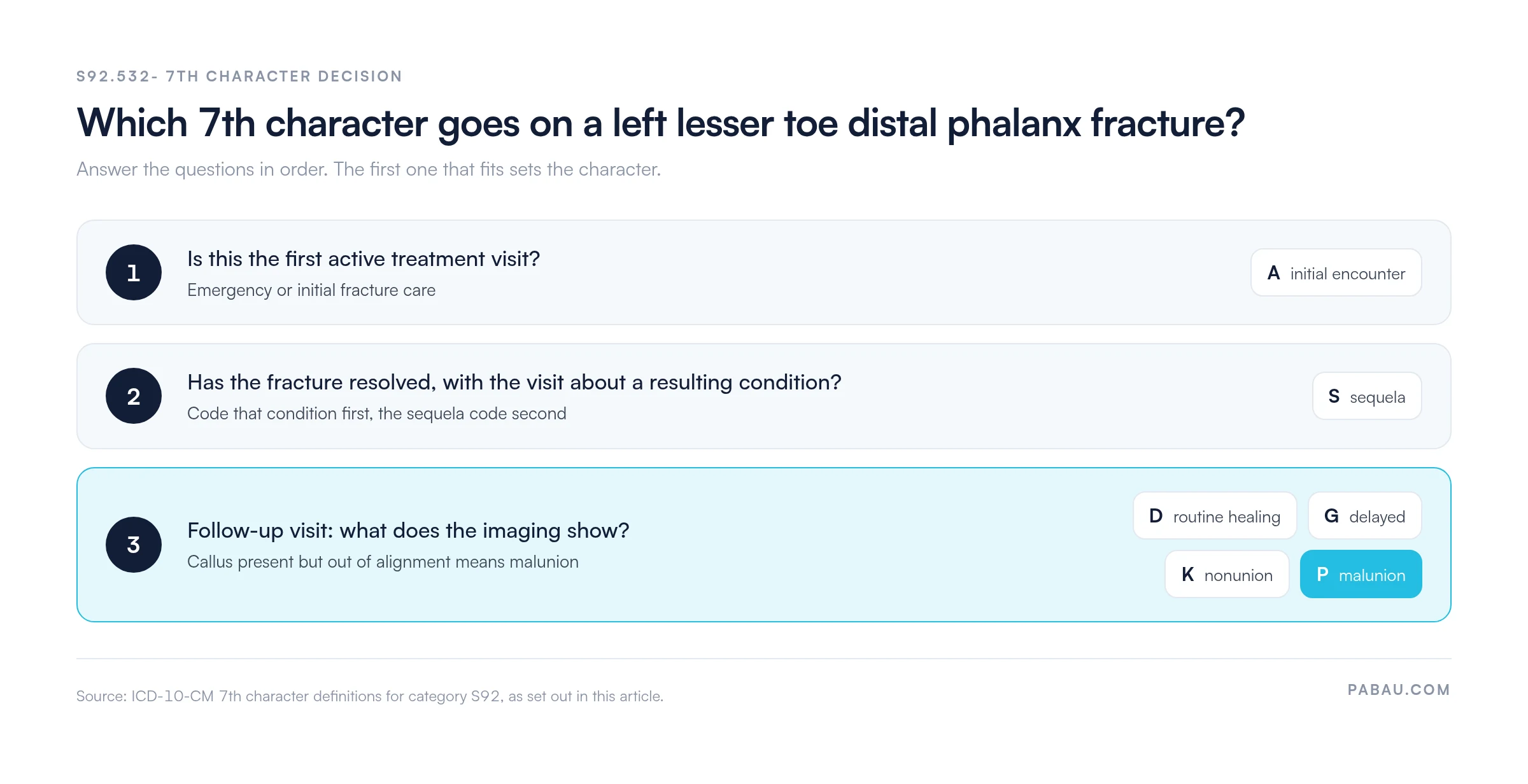
A patient returns six weeks after sustaining a left 3rd toe fracture treated with buddy taping. X-ray shows callus formation, confirming healing.
The radiologist’s report notes varus angulation at the fracture site. The physician documents “displaced fracture of distal phalanx of left 3rd toe, healing with malunion.” Use S92.532P. Healing is present (not K), malposition is confirmed (not D), and the fracture itself remains the clinical focus (not S).
Same patient, same timeline, but X-ray shows no bridging callus and the fracture gap persists. The physician documents “displaced fracture of distal phalanx of left 3rd toe, nonunion.” The fracture is not healing at all. Use S92.532K (nonunion), not S92.532P. Malunion requires evidence of healing, however misdirected.
A patient presents two years after a left lesser toe fracture. The fracture healed, but the patient now has chronic pain at the DIP joint. The visit is about the post-traumatic arthritis, not the fracture itself. Code the post-traumatic arthritis first, then add S92.532S (sequela) after it. The fracture is no longer the active clinical problem.
A patient presents to the emergency department with an acute left 4th toe injury after dropping a weight. X-ray confirms a displaced distal phalanx fracture. This is an initial encounter. Use S92.532A (initial encounter, closed fracture). S92.532P is only valid for follow-up visits after active treatment has already been initiated.
Build a one-page 7th character decision tree for your S92 fracture codes and post it in the billing workflow. Three questions close most cases: (1) Is this the first active treatment visit? Use A. (2) Is the fracture healing with a complication? Choose D (normal), G (delayed), K (nonunion), or P (malunion) based on imaging. (3) Is the fracture resolved and the visit about a resulting condition? Use S. Run through this before assigning any 7th character.
Accurate fracture aftercare coding needs regular upkeep. ICD-10-CM guidelines update on October 1 each year, and payer LCDs can shift mid-cycle. Two operational habits keep S92 malunion claims accurate.
First, build a pre-submission checklist specific to S92 malunion codes. It should confirm an imaging report in the record, laterality in the note, a 7th character that matches the imaging, and no Z-code aftercare. Running this checklist on a sample of claims monthly surfaces systematic errors before a payer audit does.
Second, audit your clean claim submission process and the underlying medical billing workflows that govern fracture care documentation. This review is most useful when practice volumes increase or new coders join the team.
The ICD List tool mirrors current CMS/NCHS data and is a quick reference for verifying S92.532P alongside adjacent codes without requiring a subscription. The official CDC/NCHS ICD-10-CM web tool is the authoritative source for current fiscal year code validity.
A wrong 7th character or a missing laterality often surfaces only when the denial arrives, weeks after the visit. By then, the coder has to pull the chart, recheck the imaging report, and resubmit.
Pabau, the practice software we build for clinical teams, moves that check to before submission. Its claim validation scrubs every claim for missing or invalid details before it leaves the system. US claims then go out through the Claim.MD clearinghouse, which applies its own real-time, payer-specific claim edits.
When a payer still rejects a claim, Pabau’s claims management software shows the reason so you can correct it and resubmit. Payments then settle straight from the electronic remittance advice file. You spend less time chasing S92.532P resubmissions and can see which documentation habits are costing the practice revenue.


Pabau scrubs every claim for missing or invalid details before it leaves the system. Any rejection comes back with its reason, so you can fix and resubmit fast.

S92.532P rewards coders who read the imaging report before they pick a character. At a follow-up visit, callus in malposition calls for P, while no callus calls for K instead. A visit about the arthritis that followed takes S, coded after that condition.
The fix starts in the clinical note. A physician who writes “left,” “distal phalanx,” “displaced,” and “malunion” into every follow-up note saves the biller from guessing. The trade-off is a few extra seconds per visit against weeks spent working a denial.
If your team still finds these errors after submission, move the check earlier. Book a demo to see how Pabau scrubs fracture claims for missing details before they reach the payer.

Working through ERA remittance data to identify S92.532P denial patterns? Electronic remittance advice guide covers how to read 835 ERA files and map CARC denial codes back to root coding errors.
Want a systematic approach to reducing all fracture code denials, not just S92? Revenue cycle management explained frames the full workflow from ICD-10 code assignment through payment posting.
ICD-10 Code S92.532P is the code for a follow-up visit for a displaced fracture of the distal phalanx of a left lesser toe with malunion. The lesser toes are the 2nd through 5th. Malunion means the fracture has healed, but in an incorrect anatomical position confirmed on imaging.
The 7th character P designates a subsequent encounter for a fracture that has healed in malposition. It differs from K (nonunion, no healing) and S (sequela, fracture resolved and a resulting condition is now the clinical focus).
S92.532P is for subsequent encounters only. The 7th character P means the patient already received active treatment for the acute fracture at a prior visit. It never belongs on the first treatment encounter, which uses 7th character A.
S92.532P applies while the malunion of the displaced distal phalanx fracture is still the active clinical problem being managed. S92.532S (sequela) applies when the fracture has resolved and the visit is about a resulting condition, such as post-traumatic arthritis. That condition is coded first, with the sequela code after it.
The medical record must include an imaging report confirming malunion (callus with malposition), an explicit physician diagnosis of malunion, and documented laterality (left). It must also place the displaced fracture in the distal phalanx of a lesser toe, not the hallux or the middle or proximal phalanx.
The most common denials come from submitting 7th character A on a follow-up visit or confusing K (nonunion) with P (malunion). Missing laterality, no imaging evidence of malunion, and Z47.89 aftercare codes in place of the S-code also cause rejections.



