

ICD-10 Code S53.013D: Anterior subluxation of unspecified radial head
ICD-10 Code S53.013D: Quick reference summary Use the table below as your first ...

Last Updated: Nov 6, 2026
Billable Code Specific Code
S92.415S is the billable ICD-10-CM code for nondisplaced fracture of proximal phalanx of left great toe, sequela. It applies once the fracture has healed and the visit treats a late effect, such as chronic hallux pain or deformity.
A common error is submitting S92.415D, the subsequent-encounter code, after the fracture has healed. The note must confirm healing and name the residual condition, which is coded first and followed by S92.415S.
Let Pabau's smart automation suggest the right codes, reduce claim denials, and keep your practice compliant—effortlessly.
Automate repetitive tasks and focus on what matters most—your patients.
Reduce coding errors and ensure compliance with the latest regulations.
Clean claims, fewer denials, and faster reimbursements.
Powerful insights and reporting to help your practice thrive.
HIPAA compliant SOC 2 certified GDPR-compliant Trusted by 4,000+ clinics worldwide

S92.415S has been valid and billable since FY 2016 and is in the current FY 2027 code set of the CMS ICD-10-CM Tabular List.
The 7th character S signals sequela, meaning the proximal phalanx fracture has healed and the visit treats a residual condition it caused.
Code the residual condition first, such as M79.672 for left foot pain, then S92.415S, and never add an aftercare Z code.
Billing software such as Pabau helps practices submit claims electronically through Claim.MD and track each claim’s status and denials.
ICD-10 Code S92.415S is a 7-character, fully specified, billable ICD-10-CM diagnosis code. It sits within category S92, fracture of foot and toe, except ankle, and carries all four specificity elements a claim needs:
S92.415S is billable because it is fully specified. The parent codes S92.41 and S92.415 have child codes and cannot be submitted. Submit ICD-10 Code S92.415S when the note documents all four elements.
The 7th character S designates sequela, a residual condition that arises as a direct result of a healed injury. Under ICD-10-CM Official Guidelines Section I.C.19.a, S applies when the visit treats a late effect of the fracture, such as pain or stiffness.
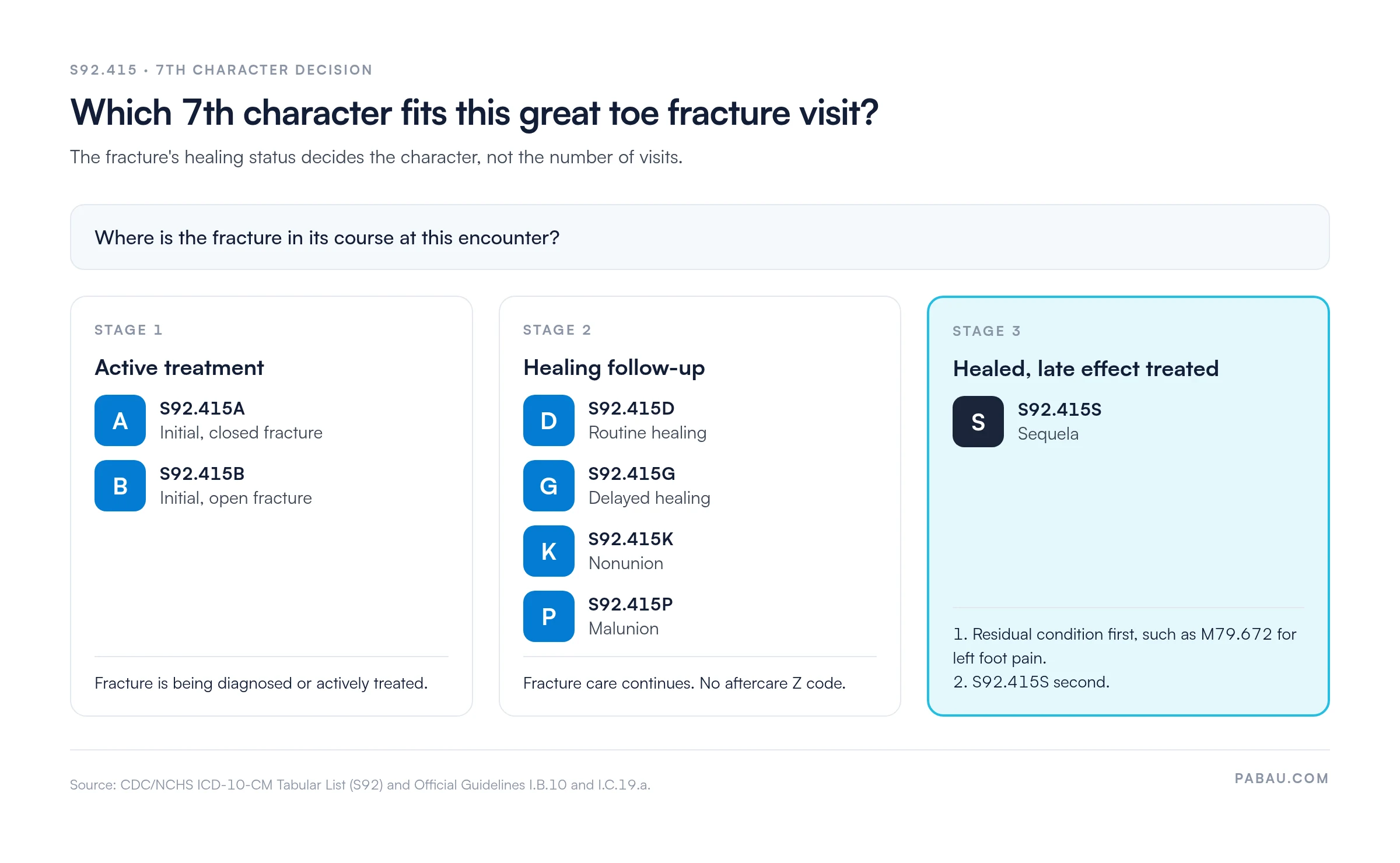
Seven 7th characters exist for S92.415 (A, B, D, G, K, P, S). Choosing the wrong one is a common, correctable cause of denials on this code family. The table compares the three that most sequela decisions turn on.
Common error to flag: Coders often keep using S92.415D after the fracture has healed on imaging, because D is familiar from follow-up visits. Once the patient returns for a residual problem such as pain, stiffness or deformity, S92.415S is the correct code. Submitting D at that point is inaccurate and creates audit risk.
Sequela coding and aftercare coding never combine on an injury encounter. Under ICD-10-CM Official Guidelines Section I.C.21.c.7, aftercare Z codes are not used for injury or fracture follow-up. Aftercare of an injury takes the injury code with 7th character D instead.
Guideline I.B.10 sets the order for a sequela encounter. The condition or nature of the sequela is coded first, and S92.415S follows it. S92.415S is never the principal or first-listed diagnosis.
Document the sequela condition by name in the clinical note, for example ‘chronic left hallux pain secondary to prior nondisplaced proximal phalanx fracture, now healed.’ The payer needs both the healed fracture history and the active residual condition to process a sequela claim without manual review.
The choice between S92.415A, S92.415D and S92.415S turns on the healing status of the fracture, not on how many visits have occurred. A patient on their tenth podiatry visit is still coded with D if the fracture has not healed. The code switches to S at the first visit where healing is confirmed and the visit addresses a residual condition.
Ask two questions before choosing the 7th character. Is the fracture healed? Is this visit for a condition caused by that healed fracture? Both answers must be yes for ICD-10 Code S92.415S to apply, and the guide below maps each stage to its character.
The S92.41 subcategory covers fractures of the proximal phalanx of the great toe. Displacement status (displaced vs nondisplaced) and laterality (right, left, unspecified) determine which 6-character base code applies before the 7th character is added.
S92.415K is the sibling code for a subsequent encounter for this fracture with nonunion. Malunion is S92.415P and delayed healing is S92.415G, while S92.415B is the initial encounter code for an open fracture. K, G and P all describe a fracture still under care, whereas sequela describes residual effects after confirmed healing. Submitting S92.415K when the fracture has healed is a coding error.
Phalanx level is the one axis the S92.41 family holds constant, because every code in it describes the proximal phalanx. A displaced fracture of the distal phalanx of the left great toe falls under S92.42, and at a routine-healing follow-up it is S92.422D.
Several exclusion notes apply at the S92 category level and higher. These notes decide which codes can be reported together.
A claim supported by ICD-10 Code S92.415S requires clinical notes that establish four distinct facts. Missing any one of them gives payers grounds for a medical necessity denial.
Good medical billing compliance practice means building these elements into every sequela encounter note template before submission.
Most denials on ICD-10 Code S92.415S are preventable. The five triggers below are common, correctable causes of rejection. Structured denial management in healthcare means knowing each one before the claim goes out, not after the remittance arrives.
Each rejection arrives with a claim adjustment reason code. A guide to claim denial codes explains what each one means. Tracking which code accompanies each rejection helps identify the root cause faster.
When ICD-10 Code S92.415S is submitted, payers evaluate medical necessity based on whether the sequela condition requires the services billed. CMS does not automatically deny sequela encounters. They need the same medical necessity documentation as any other diagnosis code.
Acceptable CPT pairings for a sequela visit include office visit E/M codes (99202-99215) for evaluation of the residual condition, and podiatry-specific evaluation codes where applicable. Prior authorization is not typically required for routine E/M visits tied to sequela diagnoses. Payers may require it for procedures that address the residual condition, such as surgical correction of a deformity.
MS-DRG assignment applies to inpatient claims and depends on the principal diagnosis and procedures. In the outpatient setting, Medicare’s Local Coverage Determinations (LCDs) for podiatry services vary by MAC jurisdiction. Check that the residual condition coded with S92.415S meets the LCD coverage criteria for the specific service billed.
Before submitting a claim with S92.415S, run an eligibility check to confirm the patient’s coverage includes the services billed. Some managed care plans require a referral for specialty podiatry care, even when the visit is for a late effect of a prior injury.
A sequela claim passes through three people. The clinician documents the healed fracture, the coder picks the 7th character and the sequence, and the biller submits it. When those steps live in separate tools, a denial on S92.415S can sit unnoticed until the remittance arrives.
Pabau, the practice management platform we build, keeps the note, the diagnosis codes your team enters and the claim in one patient record. Its claims management software lets practices submit claims electronically through Claim.MD, which supports thousands of US payers, and track their status and denials.
The outcome is a shorter loop between a rejection and its fix. When a sequela claim is denied, your team reviews the denial against the documentation in the same system, then corrects and resubmits it.

Pabau helps podiatry and multi-specialty practices submit claims electronically through Claim.MD and track their status and denials. Notes, diagnosis codes and claims stay in one patient record.

On ICD-10 Code S92.415S, the expensive mistakes are conceptual. Billing S92.415D after the fracture has healed, or listing S92.415S ahead of the residual condition, misstates what the visit treated.
Build the check into the note template. Confirm healed status, name the late effect, code it first, and leave aftercare Z codes off the claim. The cost is a few extra seconds of documentation per visit, set against a denial your team would otherwise rework after the remittance.
Book a demo to see how Pabau helps your podiatry or multi-specialty practice submit sequela claims and follow each denial to resolution.

Need to understand how claim denials are tracked and resolved? Denial management in healthcare covers the workflow from remittance code to corrected claim.
Want a clean-claim checklist before your next sequela submission? Medical billing compliance outlines the documentation and coding standards payers audit.
Submitting ICD-10 claims electronically through a clearinghouse? Medical claims clearinghouse explains how claims travel from your system to the payer.
Need one form that captures diagnoses and services at each visit? Encounter form template gives your team ICD-10 and CPT fields in a ready-to-use PDF.
ICD-10 Code S92.415S is the billable diagnosis code for a nondisplaced fracture of the proximal phalanx of the left great toe, sequela. It means the fracture has healed and the visit addresses a residual condition caused by that injury, such as chronic pain or deformity.
Yes. S92.415S has been valid and billable since FY 2016 and is in the current FY 2027 code set of the CMS ICD-10-CM Tabular List. It is billable because it is fully specified. The parent codes S92.41 and S92.415 have child codes and cannot be submitted.
Five causes come up often. Three are submitting D instead of S after the fracture heals, omitting the residual condition code, and missing documentation of the prior fracture. The other two are a laterality mismatch between claim and chart, and an aftercare Z code appended to a sequela code. Each is correctable before submission.
Traumatic amputation of the ankle and foot (S98.-) is an Excludes1 condition at the S92 category level. It cannot be coded alongside any S92 code. Fracture of the malleolus (S82.-) is an Excludes2 condition. It may be coded together with S92.415S when both are documented at the same encounter.



