ICD-10 Code Y76.0: Diagnostic obstetric and gynecological devices
ICD-10 Code Y76.0: Definition and billable status ICD-10 Code Y76.0 is a valid, ...

Last Updated: Oct 23, 2026
ICD-10 code N22 is the billable ICD-10-CM code for calculus of urinary tract in diseases classified elsewhere. It’s a manifestation code, so it applies when a urinary stone forms as a direct result of another classified disease, such as gout or schistosomiasis. N22 has no subcodes, and it can never be the principal diagnosis.
Therefore, the disease that caused the stone is coded first, and N22 follows it on the claim. In fact, listing N22 first is the error behind most rejected N22 claims. In short, this guide covers the diseases that lead to N22, the sequencing steps, how it differs from N20, and the documentation payers expect.

N22 is a manifestation-only code. It identifies urinary stones caused by a separately classified disease, not primary stone disease (N20.x).
The etiology code always comes before N22 on the claim. N22 can’t be the principal diagnosis, and a claim that lists it first is a coding error.
The tabular list names gout and schistosomiasis as its examples of underlying diseases. The physician note must state the causal link explicitly.
Unlike the WHO’s ICD-10, the US ICD-10-CM has no N22.0 or N22.8. N22 is always reported at three characters.
Practice management software like Pabau keeps the causation note on the patient record. Claims go out through Claim.MD, with eligibility checks and status tracking.
Before building a claim with N22, coders need a few basic facts, so the table below lists them. All data reflects the CMS ICD-10-CM official release for fiscal year 2026, effective October 1, 2025.
N22 applies when a urinary stone is a direct manifestation of an underlying systemic or classified condition. Idiopathic stone disease, with no identified systemic cause, is coded to N20.x instead. In addition, according to the WHO ICD-10 browser, N22 covers stones anywhere along the urinary tract when their formation is linked to a separately coded disease.
Three clinical cases drive most N22 encounters in urology practice, for example:
Overall, the stone results from another disease in all three cases. That is the test for N22: if the physician documents a causal chain from a classified disease to the stone, N22 applies. Otherwise, default to N20.x.
Each underlying disease needs its own ICD-10-CM etiology code, so sequence it before N22. For example, the tabular list’s “Code first” note at N22 names gout and schistosomiasis. The other conditions below are known clinical causes that also support N22 when the note documents them.
Physician documentation must state the causal relationship clearly. For example, a note that lists schistosomiasis and a bladder stone without linking them does not support N22. Instead, the link has to be written down, not implied.
No. In the US ICD-10-CM, N22 has no subdivisions, so N22 itself is the billable, specific code. Therefore, you report it at the three-character level every time.
However, the confusion comes from the WHO’s international ICD-10, which splits the category into N22.0 (stones in schistosomiasis) and N22.8 (stones in other diseases). Neither subcode exists in ICD-10-CM, so a US claim carrying N22.0 or N22.8 is invalid. You can confirm the current tabular list in the CDC/NCHS ICD-10-CM browser tool.
The detail lives in the etiology code instead. The disease code in position 1 carries the specificity N22 doesn’t, such as the Schistosoma species or the gout site.
The ICD-10-CM Official Guidelines for Coding and Reporting make the etiology-manifestation convention a hard sequencing rule. The underlying disease always takes the first code position, because it drives the encounter. Thus, N22 is always an additional code.
Follow these four steps for every N22 encounter:
The decision path below puts the first three checks in order, so you can see what to do when one of them fails.
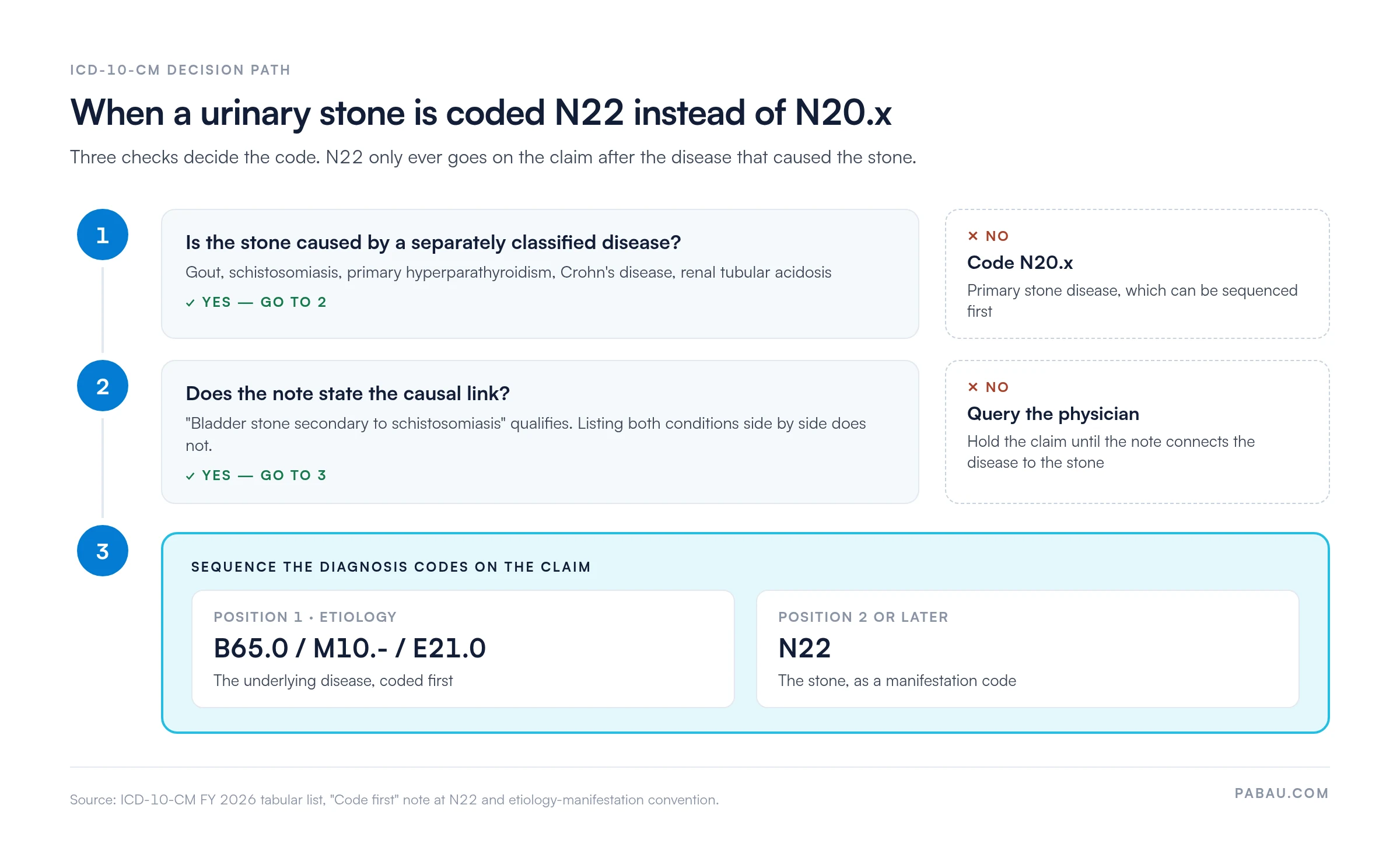
Worked example 1 – Schistosomiasis with bladder calculus:
A patient presents with bladder calculus. Pathology confirms Schistosoma haematobium infection. The physician note states “bladder stone secondary to schistosomiasis.” As a result, the correct coding is B65.0 (Schistosomiasis due to Schistosoma haematobium) sequenced first, then N22 as additional diagnosis.
Worked example 2 – Primary hyperparathyroidism with renal calculi:
A patient with known primary hyperparathyroidism presents for ureteroscopy for a calcium stone. The note documents “recurrent calcium oxalate nephrolithiasis secondary to primary hyperparathyroidism.” Therefore, the correct coding is E21.0 sequenced first, then N22 as additional diagnosis.
Flag N22 in your EHR workflow so it requires a co-diagnosis field. If a coder selects N22 without an etiology code, hold the claim for a physician query before submission. This one check stops the most common N22 error before the claim leaves your practice.
N20 and N22 describe two different clinical situations. N20 covers primary or idiopathic urinary stones with no underlying systemic cause. In contrast, N22 covers stones that are manifestations of a separately classified disease.
Using N20 when the record supports N22 misstates the patient’s condition and can lead to payer audits. Likewise, using N22 when the record shows only a stone, with no confirmed causal disease, results in denial.
The ICD-10-CM Tabular List carries instructional notes for N22 that control how and when the code may be used. Coders using the AAPC ICD-10-CM lookup will also see these notes alongside the code entry.
N22 claims fail most often because the medical record doesn’t say what the code requires. For a manifestation code, then, the note has to support two diagnoses and the link between them. A clean claim needs that documentation trail in place for every code before it leaves the practice.
The physician note must contain all of the following to support N22:
Payers often review N22 claims for medical necessity, because the code signals a chronic underlying disease. Check the patient’s eligibility before a scheduled lithotripsy or ureteroscopy. A real-time eligibility check confirms active coverage before the procedure is performed.
Standard payer expectations for N22 claims include:
N22 generates a clear denial pattern. In fact, practices tracking medical billing denial codes for their urology line will see N22 rejections cluster around five root causes.
Practices with high N22 denial rates should check whether their urology physicians use a note template with a mandatory “etiology of calculus” field. Indeed, a structured template cuts query turnaround time and improves first-pass claim rates.
Run a quarterly denial audit filtered to N22 and its paired etiology codes. When N22 denials pile up, the cause is usually the documentation rather than the code choice. Pull the top 10 denied claims, read the physician notes, and check whether the causal language is there. Bring what you find to the next provider education session, with a one-page documentation guide.
Many N22 errors start before anyone opens the code set. The causation statement sits in a dictated note, while the codes get keyed into a separate billing tool. The two are rarely checked against each other before the claim goes out.
Practice management software like Pabau keeps the physician note, the diagnosis codes, and the invoice on the same patient record. You can build a urology note template with a required “etiology of calculus” field, so the causal link is written before the encounter closes. Your coder then checks the code order against the note in one place.
Claims go out through Pabau’s claims software for specialty practices, which connects to Claim.MD for US claims. Run a real-time eligibility check before a lithotripsy, then track each claim’s status from the same screen. Fewer N22 claims come back for rework, so your billing team spends its time on new encounters.

Pabau keeps the causation note and diagnosis codes on one patient record, then submits and tracks claims through Claim.MD. Your team spends less time reworking rejected N22 claims.

In short, N22 is a simple code with one strict rule. Specifically, the underlying disease comes first, and the physician has to connect it to the stone in writing. When N22 claims keep coming back, the fix usually sits in the note template rather than the code book.
So start with the template. Add a required causation field to every stone encounter, and query the physician whenever it’s blank. That single change supports the sequencing, the documentation, and the prior authorization match at once.
Book a demo to see how Pabau keeps your urology notes, diagnosis codes, and Claim.MD claims on one record.

Submitting US claims through a clearinghouse? The Claim.MD clearinghouse guide explains how claims are submitted, checked, and tracked through Claim.MD.
Need to see where diagnosis codes sit in an electronic claim? 837 file formatting and submission covers how the claim file carries and orders diagnosis codes.
Seeing repeated N22 rejections? Denial management in healthcare walks through finding the root cause of a denial and appealing it.
Scheduling a lithotripsy or ureteroscopy? Insurance eligibility verification covers the checks to run before the procedure date.
Auditing your urology documentation? Medical billing compliance sets out what the record must support for every code you bill.
ICD-10 code N22 is the billable ICD-10-CM code for calculus of urinary tract in diseases classified elsewhere. It’s a manifestation code, used when a urinary stone is a direct result of another classified disease, such as gout or schistosomiasis. It can’t be used as the principal diagnosis.
No. In the US ICD-10-CM, N22 has no subdivisions and is reported at three characters. N22.0 and N22.8 exist only in the WHO’s international ICD-10, so they are invalid on a US claim.
The tabular list names gout (M1A.-, M10.-) and schistosomiasis (B65.0-B65.9) as examples. Other documented causes include primary hyperparathyroidism (E21.0), Crohn’s disease (K50.x), and renal tubular acidosis. The physician must name the disease and state its causal link to the stone.
The etiology code for the underlying disease takes diagnosis position 1 on the claim. N22 follows as an additional diagnosis in position 2 or later. Reversing this order is a common reason N22 claims are rejected before they reach the payer.
The five most common reasons are N22 in the principal position, no etiology code, and a note that lists both conditions without stating causation. The other two are a prior authorization filed under N20.x and missing lab or imaging evidence of the underlying disease.