ICD-10 code E55.9: Vitamin D deficiency, unspecified
ICD-10 code E55.9: Definition and official descriptor ICD-10 code E55.9 is the I...

Last Updated: Nov 10, 2026
Billable Code Specific Code
N20.0 is the billable ICD-10-CM code for calculus of kidney. It covers kidney stones, nephrolithiasis, and staghorn calculi that sit in the renal parenchyma, pelvis, or calyces.
The code turns on where the stone sits at the time of the encounter. A stone that has moved into the ureter is coded N20.1 (calculus of ureter), and stones in both locations take N20.2. Read the stone's location off the imaging report before you assign the code.
Let Pabau's smart automation suggest the right codes, reduce claim denials, and keep your practice compliant—effortlessly.
Automate repetitive tasks and focus on what matters most—your patients.
Reduce coding errors and ensure compliance with the latest regulations.
Clean claims, fewer denials, and faster reimbursements.
Powerful insights and reporting to help your practice thrive.
HIPAA compliant SOC 2 certified GDPR-compliant Trusted by 4,000+ clinics worldwide

ICD-10 Code N20.0 covers kidney stones confined to the kidney. A stone in the ureter is coded N20.1, and stones in both locations take N20.2.
Staghorn calculi still map to N20.0, because ICD-10-CM has no separate code for branched renal stones.
N20.0 has no laterality sub-codes, so one code covers left, right and bilateral stones, with the side recorded in the clinical note.
Pabau’s claims management software submits N20.0 claims to US payers through the Claim.MD clearinghouse.
ICD-10 Code N20.0 is a valid, billable ICD-10-CM code with the official descriptor “Calculus of kidney.” It belongs to Chapter XIV: Diseases of the genitourinary system (N00-N99), within the N20-N23 block covering urolithiasis.
The code has been active since ICD-10-CM replaced ICD-9-CM on October 1, 2015, and has not been revised in any subsequent fiscal year update.
According to the CDC/NCHS ICD-10-CM web tool, N20.0 carries no Excludes1 or Excludes2 notes at the code level itself. The exclusions sit at the N20 category level and apply to conditions such as obstructive uropathy with calculus (N13.2).
Coders should check the tabular list at the category and block level, not only at the individual code. Our ICD-10-CM reference for coders lists the chapters and categories around N20.0.
N20.0 applies to any renal calculus that remains in the renal parenchyma, renal pelvis, or calyces and has not yet entered the ureter. The ICD-10-CM tabular list includes the following under N20.0:
Stone composition does not change the code, whether the stone is calcium oxalate, uric acid, struvite, or cystine. ICD-10-CM N20.0 carries no sub-codes for stone type.
A struvite staghorn stone filling the entire collecting system is still coded N20.0. Additional codes for infection or obstruction will likely apply alongside it.
The N20 category contains four codes, and the anatomy of stone location determines which one applies. Assigning N20.0 when documentation shows the stone is in the ureter is a common and avoidable denial trigger for nephrolithiasis claims.
As a practical rule, review the imaging report language. “Renal calculus” or “stone in the left kidney” maps to N20.0. “Ureteral calculus” or “stone at the ureterovesical junction” maps to N20.1. When both locations appear in the same encounter note, N20.2 applies.
Per the CMS ICD-10-CM Official Guidelines, code specificity is always preferred over the unspecified option when documentation supports it. The chart below sets the four outcomes side by side.
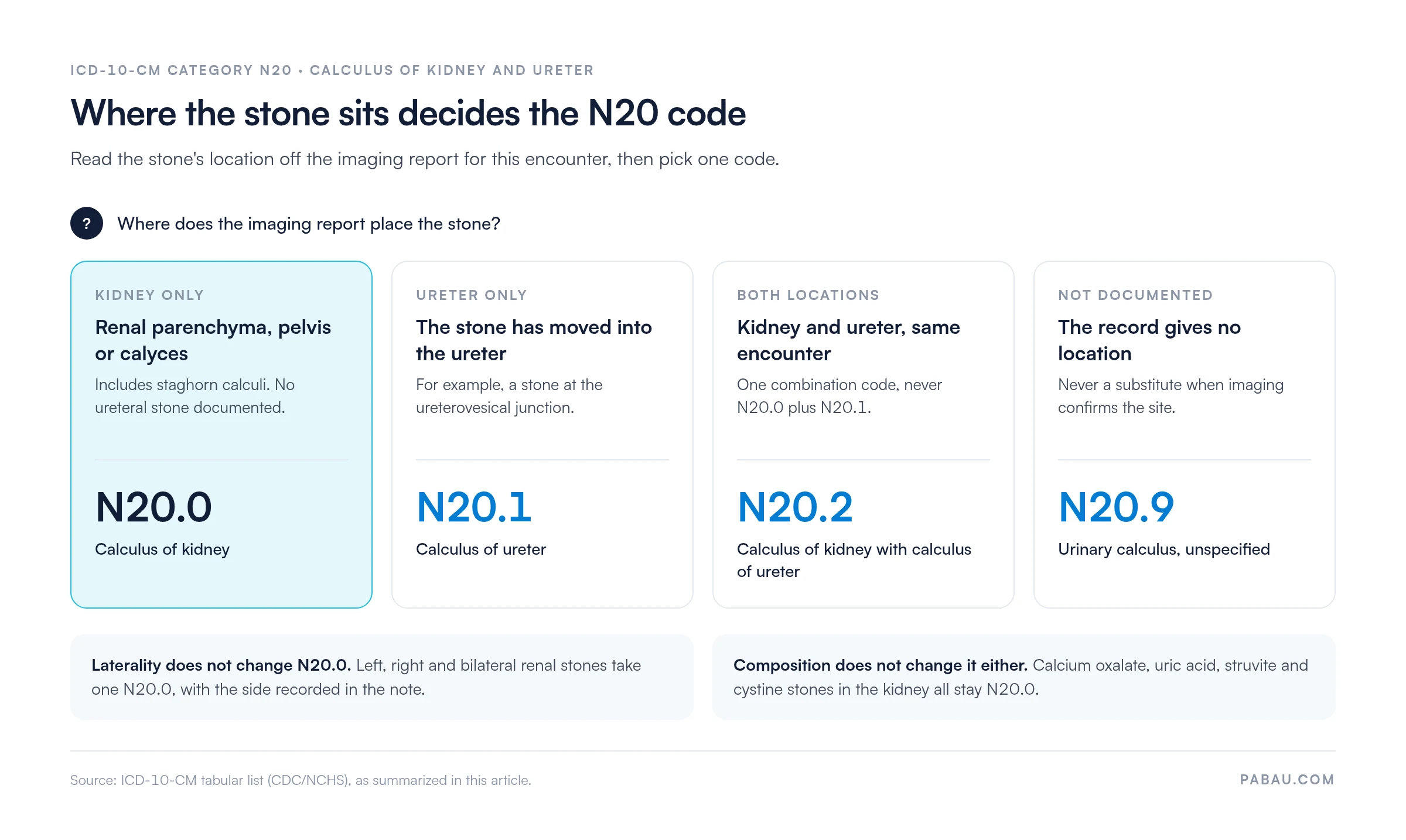
ICD-10-CM N20.0 has no separate sub-codes for left, right, or bilateral kidney stones. This surprises many coders who expect laterality granularity at the 5th or 6th character, as is common in musculoskeletal and injury codes.
The correct approach for bilateral stones is to assign N20.0 once and document laterality clearly in the clinical notes. A single N20.0 code covers all laterality presentations. Payers do not require separate code submissions for each kidney, and submitting N20.0 twice on the same claim is incorrect. A second N20.0 looks like a duplicate charge.
A staghorn calculus is a branched stone that fills the renal pelvis and extends into two or more calyceal branches. It still maps to ICD-10 Code N20.0, because ICD-10-CM has no distinct code for staghorn or coral stones.
What changes with staghorn calculi is the complexity of the accompanying codes. Struvite staghorn stones form in the presence of urease-producing bacteria, so a UTI code (N39.0) is frequently appropriate alongside N20.0.
Obstruction from a staghorn stone may warrant hydronephrosis codes from the N13 category. For inpatient admissions, the full code set affects MS-DRG grouping. DRG assignment is determined by the entire claim, including complication and comorbidity codes, not by N20.0 alone.
For staghorn calculi, document the stone’s composition (struvite, cystine) and any associated infection or hydronephrosis explicitly. The N20.0 assignment is simple. The work lies in capturing the accompanying codes that reflect resource utilization and support the MS-DRG grouping.
Kidney stone encounters rarely present with N20.0 alone. Coders should review documentation for the following frequently co-coded diagnoses:
Per ICD-10-CM Official Guidelines on symptom coding, renal colic (N23) may be coded alongside N20.0 when both are documented. Hematuria is typically an integral symptom of nephrolithiasis. Code it separately only when the provider specifically addresses it as a distinct condition or when it persists after stone passage.
The procedure codes billed alongside N20.0 depend on how the stone is managed. Conservative management (hydration, analgesics, medical expulsive therapy) generates an E&M code. Interventional management requires one of the following:
When the plan is shock wave lithotripsy, our guide to CPT code 50590 covers how that procedure is billed. Pabau, the practice management platform we build, sends CPT and ICD-10 pairings like these as electronic claims through the Claim.MD clearinghouse.
Claims go out in CMS-1500 or 837P format to thousands of US payers. Eligibility checks through the same connection confirm coverage before the procedure date.
Prior authorization thresholds for nephrolithiasis procedures vary by payer and change annually. The following general framework applies across Medicare, Medicaid, and most commercial plans. Always verify current payer policies before scheduling elective intervention.
Running insurance eligibility verification before the encounter catches a plan that has lapsed or changed its prior authorization rules. Pabau’s claims management software runs those eligibility checks from the patient record, so urology billing teams catch coverage issues before the patient arrives.
Nephrolithiasis claims are easy to get wrong, because code selection pivots on a single anatomical fact that a busy imaging report can bury. The table below covers the top denial causes and their solutions.
Structured denial management workflows help urology billing teams track patterns across N20.0 rejections. They show whether the root cause is documentation, prior auth, or code selection. Clean claim submission for nephrolithiasis starts with confirming stone location from imaging before the claim is built.
The physician note must support the code the coder assigns. For ICD-10 Code N20.0, the documentation checklist covers:
The physician note is the coder’s primary source, not the EHR problem list. A problem list may still show a historical stone that has already passed. The encounter note reflects the clinical status at the time of the visit. Our overview of medical billing fundamentals explains how that note flows into the claim.
Ask your physicians to include one sentence confirming stone location from imaging in every nephrolithiasis encounter note. ‘CT shows 8 mm calculus in the left renal pelvis’ lets the coder assign N20.0 with confidence. It also points to the imaging evidence the claim needs.
ICD-10-CM Code N20.0 is valid and active for the current fiscal year. The code has remained unchanged since ICD-10-CM was adopted on October 1, 2015. No revision or deletion notice for it appears in any later FY addendum published by CMS and NCHS.
CMS and NCHS publish code updates each October 1. Coders should verify N20.0’s status annually using the AAPC ICD-10-CM lookup or the official CDC tabular tool. For practices that bill across several specialties, a central code review each October lowers the risk of billing a code that the latest update revised.
In many urology practices, a kidney stone claim passes through several hands before it reaches a payer. The imaging report sits in one system, the eligibility check in another, and someone rekeys the claim. Each handoff is a chance to code a ureteral stone as renal or to miss an authorization.
In Pabau, the encounter note, the insurance case and the claim sit on the same patient record. The prior authorization code, dates and sessions are tracked on the case, and Pabau flags a case that is missing one. Claims then go to US payers through Claim.MD as CMS-1500 or 837P submissions.
Electronic remittance advice posts back against that same record. A denied N20.0 claim shows up next to the note that explains it. The team can correct the code and resubmit without rebuilding the history.
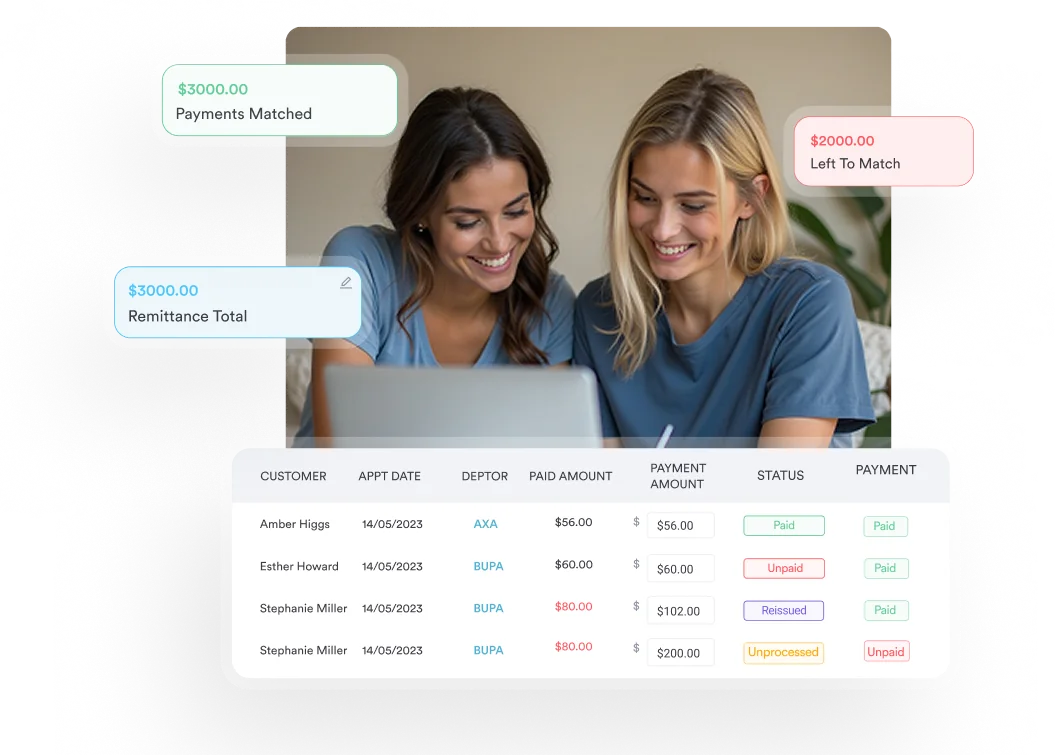

Pabau keeps the encounter note, prior authorization and claim on one patient record, then sends claims to US payers through Claim.MD. See how it works for your practice.

N20.0 itself is rarely the hard part. A kidney stone claim succeeds or fails on the stone’s documented location and on the codes and approvals that travel with it.
The most useful change a urology team can make is to stop coding from the problem list. Code from the imaging report and the encounter note, and confirm prior authorization before an ESWL or PCNL date is set. Those two habits head off the denials this guide describes.
Book a demo to see how Pabau keeps the encounter note, the eligibility check and the claim in one system for your practice.

Need a denial prevention framework for urology billing? Denial codes in medical billing explains common CARC codes and how to build a systematic denial response workflow.
Looking for the full ICD-10-CM submission and claim lifecycle? Understanding the 837 file covers how diagnosis codes like N20.0 travel from EHR to clearinghouse to payer in a standard electronic claim.
Want to understand what ERA remittances reveal about N20.0 rejections? Electronic remittance advice explained walks through 835 ERA data and how to read denial reason codes from payer responses.
ICD-10 Code N20.0 is the billable diagnosis code for calculus of kidney, which covers kidney stones (nephrolithiasis and renal calculi) confined to the kidney. It belongs to Chapter XIV of ICD-10-CM and covers any renal stone in the parenchyma, pelvis, or calyces that has not entered the ureter.
Yes, N20.0 is a valid, specific, and billable ICD-10-CM code. It is not a header or category code, so it can be assigned directly to a claim. It has been billable since October 1, 2015.
N20.0 is for a stone confined to the kidney. N20.1 is for a stone that has migrated into the ureter. The distinction is anatomical and determined by imaging. When a stone is documented in both locations at the same encounter, use N20.2 instead.
No separate laterality sub-codes exist for N20.0. A single N20.0 code covers left, right, and bilateral stones. Record laterality in the clinical note to support accurate documentation, but do not submit N20.0 twice for bilateral stones.
Yes. When renal colic is documented as a presenting symptom with a confirmed kidney stone, N23 may be coded alongside N20.0. The ICD-10-CM Official Guidelines on symptom coding allow it.
A frequent denial cause is code selection error, such as using N20.0 when the stone is documented in the ureter, where N20.1 applies. Other causes include missing imaging documentation, failure to obtain prior authorization for lithotripsy or PCNL, and using the unspecified code N20.9 when specificity is available.