HD Brows consultation form: Free template and guide
HD Brows is a seven-step brow treatment that combines consultation, tinting, wax...

2
Last Updated: Oct 13, 2026

Becoming a nurse injector in Ontario takes three steps in order, starting with CNO registration, then injection training, then a physician’s written authorization.
Injecting Botox or dermal filler is a controlled act under Ontario’s Regulated Health Professions Act, so no nurse may inject independently.
A medical directive authorizes a procedure for any patient who meets its stated criteria, while a direct order covers one named patient once.
Published training tuition runs from about $1,995 for a foundation course to $13,000 for a board certification package, before tax.
Job Bank reports registered nurse wages in Ontario between $29.00 and $55.00 an hour, with a median of $42.00.
Becoming a nurse injector in Ontario takes three steps. You register with the College of Nurses of Ontario, complete cosmetic injection training, and get a physician’s written authorization to inject. Once you start injecting, the charting behind each treatment is one of the areas our ranking of the best medical spa software compares.
Injecting Botox or dermal filler is a controlled act under Ontario’s Regulated Health Professions Act, so no nurse here injects on their own authority. Accept an authorization and the College holds you answerable for that decision.
Below is the full five-step path, plus what training costs, where injectors work and what the job pays.
Yes, an RN or RPN can inject Botox and fillers here, but only under a physician’s medical directive or direct order. Administering a substance by injection is a controlled act under the Regulated Health Professions Act, so no nurse injects independently.
If you have read American guidance on this, adjust for the border. Ontario answers to the CNO and the RHPA, not to a state board.
Ontario’s Regulated Health Professions Act sets out 14 controlled acts, the activities the province treats as risky in unqualified hands.
Two of them apply to you. Administering a substance by injection is the first. Performing a prescribed procedure below the dermis is the second, which is what a dermal filler does.
The Nursing Act, 1991 authorizes nurses to perform both acts. Enforcing that standard is the job of the College of Nurses of Ontario, known as the CNO. Its practice guidance is blunt about the limit of that authority.
Having the authority to perform a procedure does not make a nurse competent to perform it.
The RN and RPN hold the same list of authorized controlled acts under the Nursing Act. The CNO defines that as deciding independently that a procedure is needed, then performing it without an order.
Cosmetic injectables are prescription products, so initiation is closed to both classes.
The CNO’s Directives practice guideline separates the two. A medical directive names no patient, so it authorizes the listed procedure for anyone who meets its stated criteria. A direct order is written or verbal, and it covers one specific patient at one specific time.
That difference shapes an injector’s working day. A directive puts the screening on you, because you check each patient against the criteria yourself. With a direct order, you go back to the prescriber whenever a case falls outside it.
The seven elements a compliant directive carries, plus the physician’s own obligations, sit in our breakdown of how medical directives work.
The RHPA prohibits sub-delegation. A nurse working under a directive cannot hand that authority to an esthetician or a medical office assistant. The nurse who does it answers to the CNO, whatever the employer says.
Provincial rules differ too. British Columbia, Alberta and Quebec each regulate cosmetic injectables through their own instruments, so an Ontario directive stops at the provincial line.
The legal picture decides the order of the work. These five steps run in sequence, and each one gates the next. A nurse who books training before checking registration status ends up redoing work. So does one who accepts a role before reading the directive.
The diagram below maps the same five steps, with the Nurse Injector Readiness Checklist attached to step three, where the legal work happens.
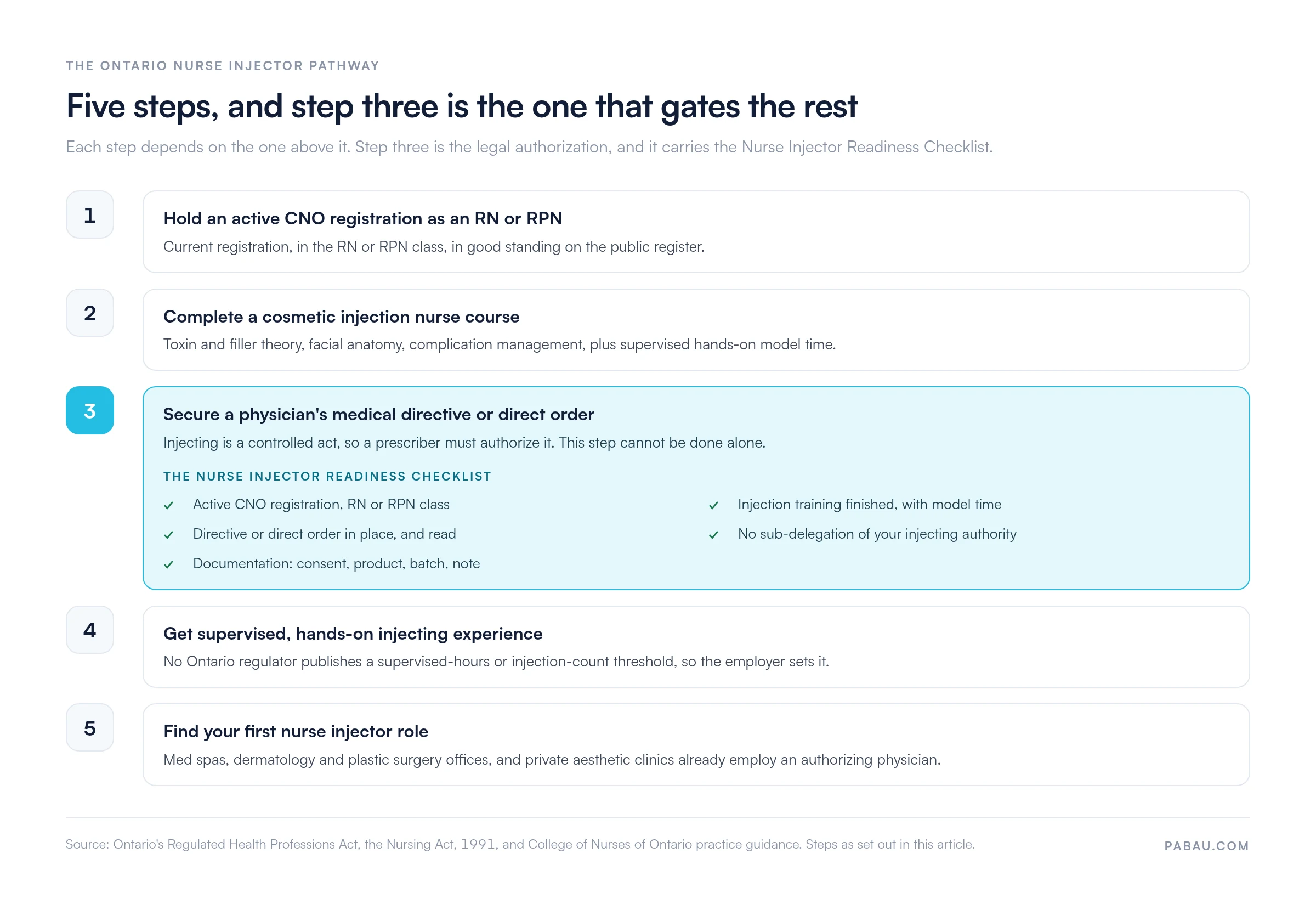
Ontario calls this registration rather than licensing, and the CNO’s public register shows a nurse’s class and standing. An expired or inactive registration will not support injecting, so check the register before you book training.
A cosmetic injection nurse course covers facial anatomy, product selection, injection technique and complication management. It then puts a needle in your hand on live models.
Formats split three ways. Fully online courses teach theory but cannot deliver supervised model time, which is the part employers ask about. In-person cohorts are the opposite. Blended programs run the theory online and reserve classroom days for hands-on practice.
Timelines come from the provider, never from a regulator. The Canadian Board of Aesthetic Medicine puts its board certification package at roughly 6 to 12 months.
That covers online study plus hands-on practice. The same provider describes diploma programs in aesthetic medicine as running from a few weeks to several months.
Step three is the one step a nurse cannot complete alone. The authorization comes from a physician or another authorized prescriber, and the employing practice usually holds it.
In the Ontario practices we onboard, the directive is often already written and filed with the medical director. Plenty of injectors have never read it.
So read it. A cosmetic injection nurse should be able to answer five questions about the arrangement before the first appointment. The checklist below turns those five into items you can confirm.
Item three is the one to insist on. A practice that cannot produce the document is asking a nurse to perform a controlled act without authorization.
The CNO holds the nurse accountable for the decision to accept an order. Meanwhile the physician carries separate obligations to the College of Physicians and Surgeons of Ontario.
No Ontario regulator publishes a supervised-hours or injection-count threshold for cosmetic work. Training bodies do not set a common one either, so anyone quoting you a number is quoting their own policy.
That leaves the employer and the directive to define it. A directive can name a competence requirement, and a medical director can set an observation period. Ask what that period looks like in numbers before you accept the role.
Career guides commonly suggest at least two years of general nursing experience before specializing, though no Ontario rule requires it. Employers weigh it because managing a complication takes judgment more than technique.
Apply where the authorization structure already exists. A practice with a named medical director and a written directive can put a new injector to work without a legal detour.
Two questions separate a ready employer from a risky one. Who signs the directive, and who supervises your first months of injecting?
Three errors show up repeatedly among new Ontario injectors.
Published tuition runs from about $1,995 for a foundation course to $13,000 for a board certification package, before tax. Ontario sets no government curriculum and no price ceiling, so the provider decides the cost, the length and the format.
Each provider below lists its prices on its own course pages, so you can compare before you inquire.
Every figure above comes from the provider’s own course pages. See Derma Institute’s foundation course, its advanced practitioner certification, APT Injection Training and the Canadian Board of Aesthetic Medicine. APT also lists a $1,000 add-on day of hands-on practice on top of its bundle.
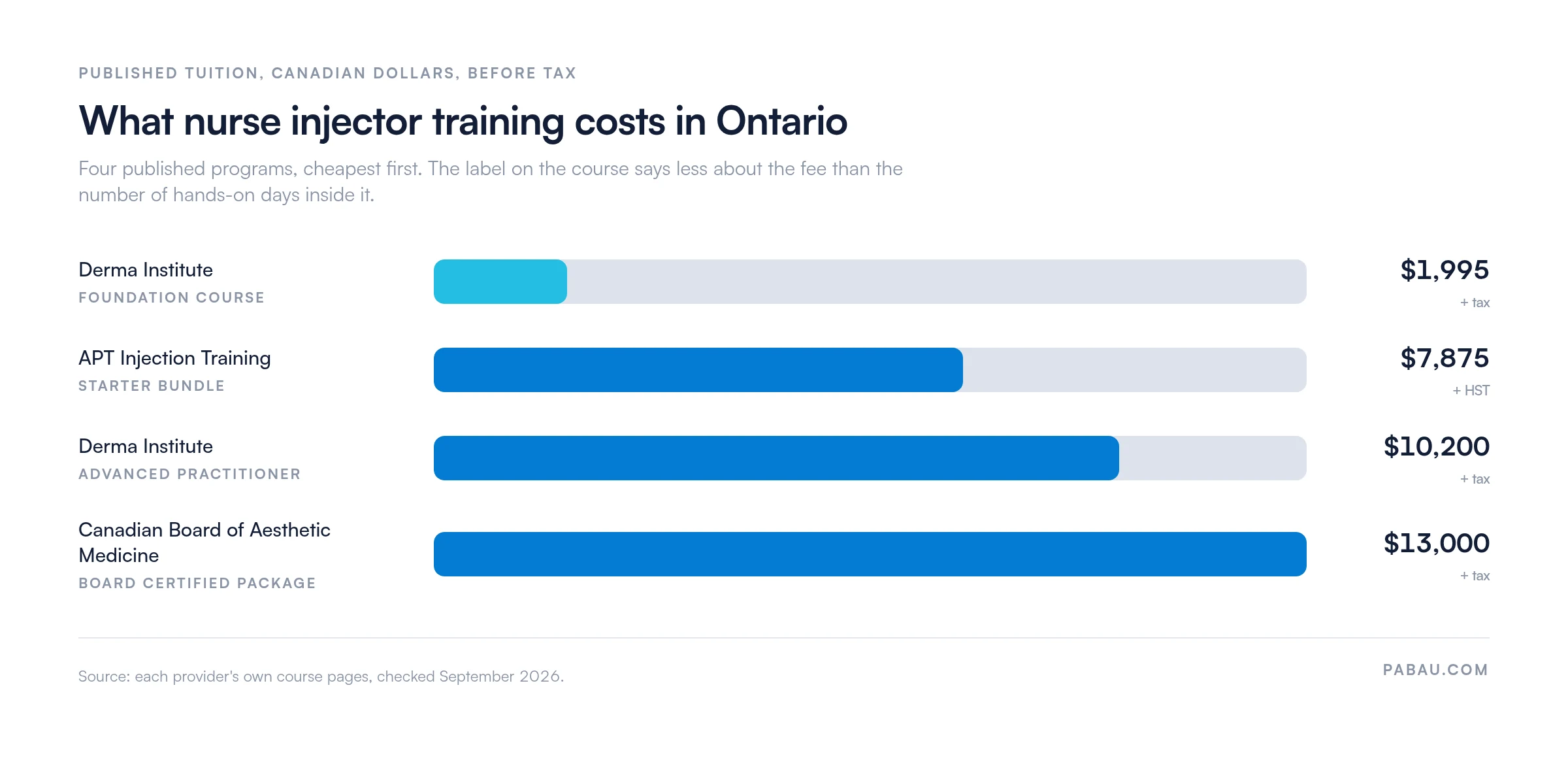
Work the total, not the sticker price. A nurse who starts with a $1,995 foundation course and adds advanced training later spreads the spend across two years. One who buys the $12,000 package pays it upfront. Add HST where the provider quotes it, then travel to the training site and the shifts you give up to attend.
Ratio matters more than brochure length. APT Injection Training’s own site lists a maximum 2:1 trainee-to-trainer ratio, taught in person at one site in Oakville, Ontario.
The Canadian Board of Aesthetic Medicine lists hands-on training centers in Toronto and North Vancouver, plus Calgary, Montréal and Edmonton. A course in Toronto is a realistic commute from across the Golden Horseshoe.
Course pages rarely answer these, and the replies tell you what the fee covers:
That third question matters because assessment varies as much as price. Derma Institute’s guide for Canadian injectors says a program may end in a practical exam and a written test.
No Ontario body sets the pass mark, so each provider writes its own.
Botox certification in Ontario is a commercial credential, not a government one. No Ontario body accredits a cosmetic nursing course as a license to inject. So treat RN aesthetic training as evidence of competence for an employer and a prescriber.
The point lands when a medical director reviews your file. That physician is deciding whether to attach a directive to your name.
That physician usually sits in one of three settings. Nurse injectors in Ontario work mainly in medical spas, dermatology and plastic surgery offices, and private aesthetic practices. Each already employs a physician who can issue the directive.
Setting decides more than the commute. A dermatology or plastic surgery office has a physician on site most days. That makes a direct order practical when a patient falls outside the directive’s criteria. Med spas often run on a directive alone, with the medical director reachable by phone.
Med spas dominate the job listings, and an esthetic nurse joining one will spend the day inside its practice management system. Most run on med spa software that ties the appointment, the consent form and the treatment note together.
Employment models vary too. Some practices pay a salary. Others pay a base plus commission on treatment revenue. That is why two Ontario injector jobs with the same title can pay very differently.
Job Bank puts registered nurse wages in Ontario between $29.00 and $55.00 an hour, with a median of $42.00. Nurse injector roles sit inside that range, and commission on treatment revenue can lift the total.
Those figures come from the Government of Canada, drawn from Statistics Canada’s Labour Force Survey. Job Bank updated them on November 19, 2025, for the 2023 to 2024 reference period. They cover NOC 31301, registered nurses, across all of Ontario rather than aesthetics alone.
The practical nurse band sits lower. Job Bank files Ontario’s RPNs under licensed practical nurses, and reports $25.32 to $37.94 an hour. The median there is $31.00, on the same survey and the same update.
Figures specific to injectors are harder to trust. Training providers commonly quote $60,000 to $120,000 a year for a cosmetic nurse in Canada. The Canadian Board of Aesthetic Medicine publishes exactly that range. No wage survey, date or sample sits behind it, so read it as an industry-reported spread.
The chart below lines up both hourly bands against the range training providers advertise.
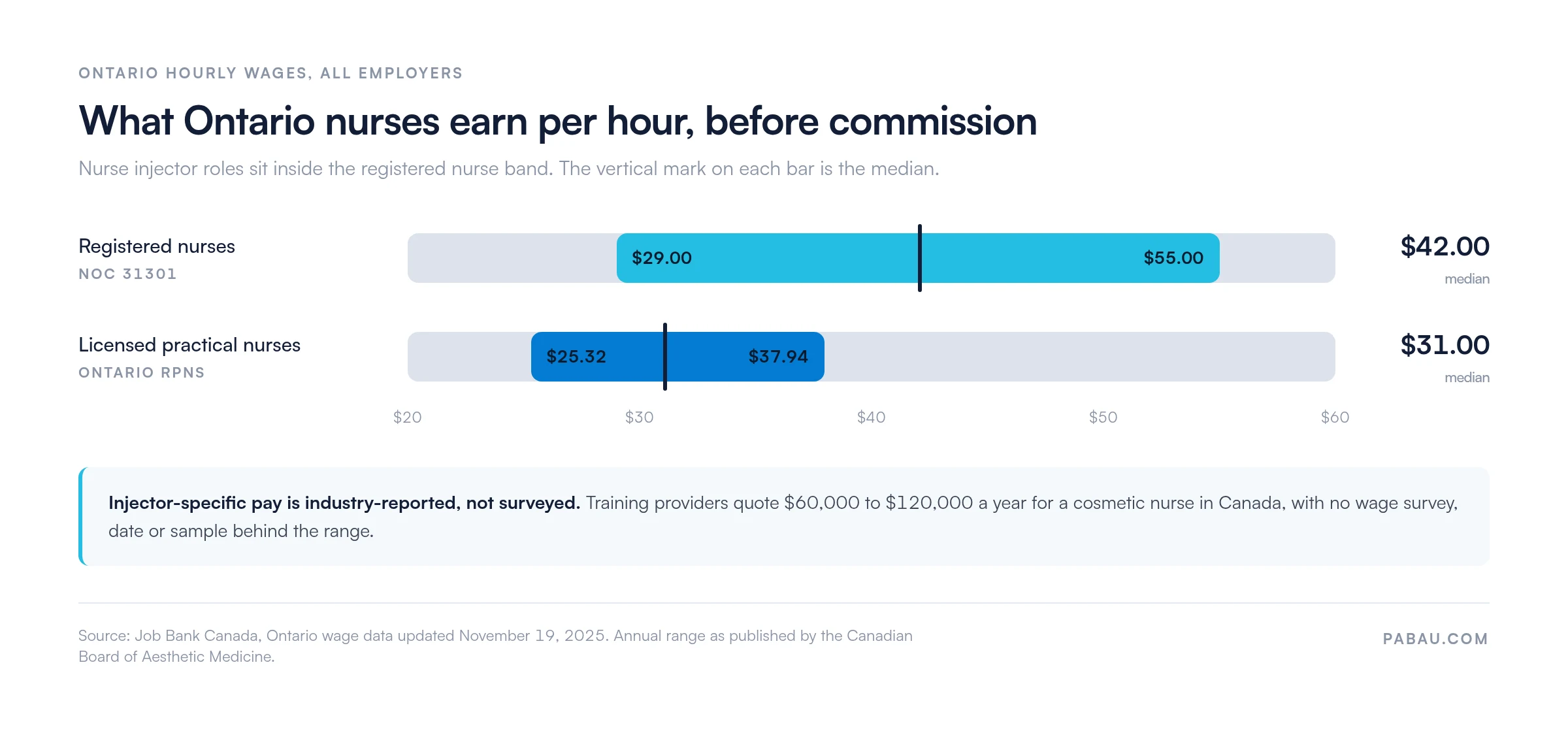
Pay structure explains most of the spread. Anyone comparing an esthetician nurse salary against a hospital post should ask how commission is calculated, and on what. A salary built partly on treatment commission rises and falls with the practice’s booking volume.
Our fuller aesthetic nurse earnings breakdown works through salary, commission and practice ownership side by side.
Pay is one reason people compare these two roles. A nurse injector performs controlled acts under a physician’s authorization. By contrast, a medical esthetician in Ontario is not a regulated health professional and cannot inject at all.
Estheticians here answer to no health college, and their work covers facials, skincare and non-injectable devices. Injectables sit outside that scope, because the RHPA reserves injection for authorized professionals. The same reservation is why a nurse cannot sub-delegate injecting to an esthetician, however experienced.
The job titles blur. Anyone searching how to become an aesthetic nurse, or how to become a cosmetic nurse, is looking at this same route. All three names describe a registered nurse working in aesthetics.
The nurse practitioner route is a different credential with different prescribing authority, and it deserves its own guide. So does the full medical esthetician program route in Ontario.
Whichever route you take, the paperwork side of a directive lands on the injector. Every treatment needs the consent, the product and batch number, the photos, and a note tied to the same patient. On paper that is four places to check before a follow-up.
Practice management software like Pabau keeps those four in one client record. An anti-wrinkle consent form goes out and comes back signed before the appointment. An injector then starts the day with a completed intake form instead of a clipboard. Before-and-after photos attach to the treatment rather than a phone camera roll.
Treatment notes and stock tracking close the loop. Each unit of toxin logs against the note that recorded it. A practice can then show what was injected, by whom, and on whose authority. Asked to evidence a year of injecting, a nurse can pull it from one timeline.
A nurse who eventually opens a practice meets the same records question from the other side. Our round-up of aesthetic EMR software compares the systems that handle consent, photos and clinical notes together.

Pabau ties the consent form, the photos, the product batch number and the treatment note to one patient timeline. Aesthetic practices stop hunting for records after the appointment.

Registration and training are the parts you control. The authorization is not, and it decides whether you treat a patient on Monday.
So run the Nurse Injector Readiness Checklist before you accept an offer, not after. A practice that can produce the directive and name the authorizing physician has done its work. One that cannot is asking you to carry a risk that belongs to the physician.
The documentation side is easier to fix than the legal side. Book a demo to see how Pabau keeps consent, photos and injectable records on one patient timeline.

Wondering how the physician’s side of the authorization works? Medical directives in Ontario sets out the seven elements a compliant directive carries.
Want the numbers behind an injector’s pay? Aesthetic nurse earnings breaks down salary, commission and practice ownership.
Looking at roles across the border instead? Botox rules by US state covers the supervision and delegation rules state by state.
Planning to run your own practice one day? Hiring a medical director explains what the role covers and how the arrangement works.
Still weighing which credential to chase? Aesthetic qualifications compares the training routes open to practitioners entering the field.
Every nurse holding a practising certificate needs professional liability protection, and the CNO sets the minimum. For RNs and RPNs it is $1 million per claim, with a $2 million annual maximum. Employer coverage can satisfy it, so check whether yours extends to cosmetic work.
Yes, once the CNO grants registration. Nurses educated outside Canada apply through the National Nursing Assessment Service first, then to the CNO. After registration, the injector path is identical to any other Ontario nurse’s.
Yes. An RN or RPN can own an aesthetic business here, but ownership does not change the RHPA. You still need a prescriber’s directive to inject, so the practice needs a medical director on file.
Private injection certificates carry no provincial renewal requirement. Your registration does. Every CNO member completes the Quality Assurance program each year, which means a self-assessment and a learning plan. Employers and prescribers may also ask for recent product training.