HD Brows consultation form: Free template and guide
HD Brows is a seven-step brow treatment that combines consultation, tinting, wax...

2
Last Updated: Oct 13, 2026

A registered nurse can own and run a UK aesthetics clinic delivering non-surgical treatments, and nurses are the largest group doing it.
The NMC treats an indemnity arrangement as a condition of registration, and the RCN scheme does not cover aesthetic practice.
Since 1 June 2025, a prescriber must assess your patient face to face before prescribing non-surgical cosmetic medicines.
Run the two-licence check. CQC registration follows the treatment you deliver, and a local special treatment licence follows the premises.
Budget roughly £7,600 to £10,700 for first-year training, insurance, registration and waste disposal, before premises or stock.
A registered nurse can legally open and own an aesthetics clinic in the UK. In fact, nurses already lead the sector. Hamilton Fraser’s annual practitioner survey puts nurses at 43.5% of respondents, well ahead of doctors at 22.5%. Nurse owners choosing their first booking and payment system can start with our ranking of the top med spa software.
Being a nurse isn’t usually what holds people back, though. Ownership means arranging your own indemnity, prescribing route and premises licence, instead of inheriting them from an employer. Get one wrong, and you may not be able to treat patients, or open your doors at all.
This guide walks through what the law actually requires, in order, with the costs at each step.
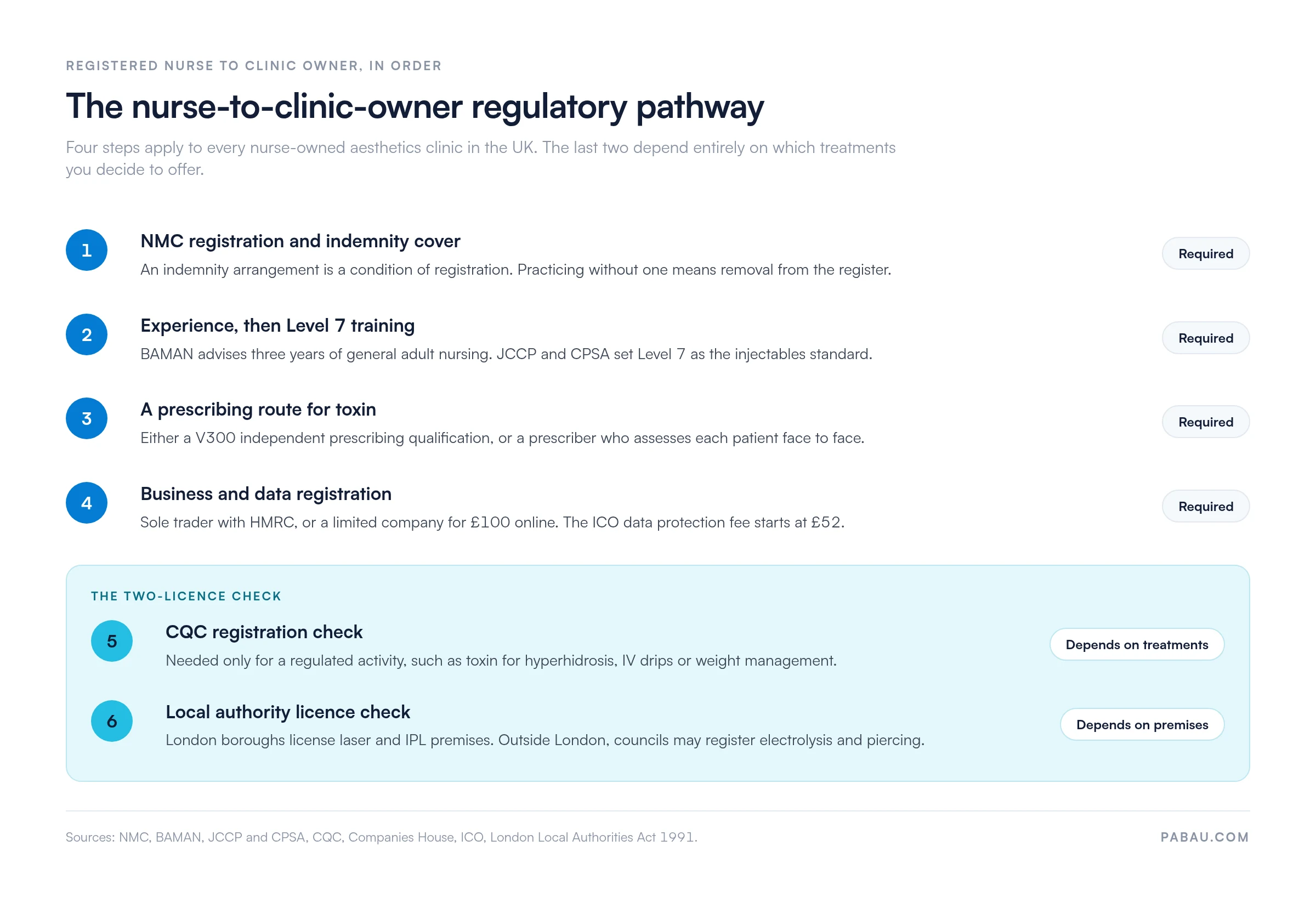
Ownership itself sits outside the rules. Regulation lands on the treatment, the prescription, the premises and the patient data. Satisfy each one and you can trade in your own name or through your own limited company.
BAMAN, the nurses’ own professional body, defines medical aesthetic nursing as minimally invasive, non-surgical work. Botulinum toxin, dermal fillers, chemical peels, microneedling, skin boosters and laser all sit inside that definition, and cosmetic surgery does not.
An aesthetic nurse and a cosmetic nurse mean the same role in UK usage. Neither is a protected title, so the qualification behind it carries the weight rather than the label on the door.
Here’s what each of those four requirements involves:
You need NMC registration in good standing, at least three years of general adult nursing experience, and Level 7 training for injectables.
BAMAN, the British Association of Medical Aesthetic Nurses, advises three years of post-qualification experience in general adult nursing before you move across.
It also reports that more than 80% of its members arrived with over 10 years of NHS experience. Older guides still call it BACN, its former name.
Some career guides put the threshold at 12 months instead. No professional body stands behind that figure, so plan around BAMAN’s recommendation.
For injectables, the JCCP and the CPSA set Level 7 as the standard. Level 7 sits at postgraduate level and covers facial anatomy, patient assessment, injection technique and patient safety. Harley Academy puts its own Level 7 diploma at roughly 175 guided learning hours over 12 to 24 months.
Registration is not a one-time hurdle either. The NMC requires 35 hours of CPD in every three-year revalidation cycle. At least 20 of those hours must be participatory learning with other professionals.
Indemnity cover belongs on the same checklist. The NMC treats an appropriate indemnity arrangement as a condition of registration, so working without one puts your PIN at risk.
The RCN’s scheme does not cover aesthetic practice, so budget for your own medical malpractice policy from day one.
One label causes confusion, so settle it early. An aesthetic practitioner can be a nurse, doctor, dentist, pharmacist or non-medical injector.
The nurse route is narrower and starts with an NMC PIN, not a training certificate. Non-medics can enter aesthetics, but prescribing stays closed to them, which limits what they can offer.
Pay moves with treatment mix more than with job title. Our breakdown of aesthetic nurse earnings works through the numbers for injectors and owners.
Only an independent prescribing qualification lets you prescribe your own toxin. Without a V300, a registered prescriber has to assess your patient face to face before writing the prescription.
Botulinum toxin is a prescription-only medicine in the UK. Administering it sits within a registered nurse’s scope of practice. Prescribing it does not, unless that nurse holds an independent prescribing qualification.
The list of people who can write that prescription is short and closed. The NMC names dentists, doctors, prescribing nurses and prescribing pharmacists, and nobody else.
On 1 June 2025 the NMC changed how you obtain that prescription. Prescribers must now hold a face-to-face consultation and document a clinical assessment before prescribing for an elective non-surgical cosmetic procedure. Remote prescribing by phone, email, online platform or a third party is no longer permitted.
The position covers botulinum toxin, local anesthetics, topical adrenaline, Kenalog and aesthetic emergency kit medicines. A breach can trigger a fitness to practise investigation.
Before June 2025, a prescriber could assess remotely and issue prescriptions between your appointments. Now the visit has to happen first, which changes the economics of working with a partner prescriber.
In practice, one appointment becomes two slots in the diary. A patient books a consultation with the prescriber, then returns for the treatment. Charge for that consultation or absorb it, but plan for the delay before you advertise same-day toxin.
The Advertising Standards Authority does not allow a prescription-only medicine to be promoted to the public under its brand name. And a prescribed product can only be used on the person it was prescribed for, which rules out buying stock and treating whoever books.
Four registrations turn a qualified injector into an aesthetics business. They cover your legal structure, your tax, your data protection and, eventually, VAT. The other three are forms to file.
Start with the structure. A sole trader registers with HMRC and files a self-assessment return each year. A limited company is a separate legal entity, which keeps your personal finances outside the business.
Fees come from the Companies House schedule on gov.uk. A separate business bank account is mandatory for a limited company and optional for a sole trader.
VAT registration follows your turnover. Once taxable turnover passes £90,000 in any rolling 12 months, HMRC requires you to register. The window rolls, so a strong summer can trigger registration mid-year.
The ICO registration is the shortest of the four. Any organization using personal information pays a data protection fee unless it is exempt. A new single-site practice normally sits in tier 1, at £52 a year, with a £5 discount for direct debit.
Patient records carry the most weight the day a complaint lands. Each treatment record needs the medical history, written informed consent, separate photography consent, and before-and-after images, tied to one patient timeline.
No aesthetics-specific retention period exists in UK law. The NHS Records Management Code of Practice sets eight years after the last entry for adult health records, and that is the usual reference point. UK GDPR then requires you to set and document your own period.
Consent has to name the specific treatment, so a general form will not carry you. Our anti-wrinkle consent form shows what a toxin consent needs to cover. Sharps and clinical waste need a licensed collection and a hazardous waste consignment note.
Most injectables-only practices need neither registration nor licence. CQC registration follows the treatment you deliver, while a local special treatment licence follows the premises and its equipment.
Call it the two-licence check. Two separate bodies can gate the same room, they ask different questions, and clearing one has no bearing on the other.
Interventions carried out purely for cosmetic purposes fall outside the regulated activity of treatment of disease, disorder or injury. So toxin for frown lines and filler for volume need no CQC registration at all.
The same needle can cross the line, though. Botulinum toxin given for hyperhidrosis or teeth grinding treats a disorder, which brings it inside the regulated activity. So do intravenous vitamin drips using prescription-only products, and weight management delivered with prescription medicines.
Procedures that insert instruments into the body for cosmetic purposes count as surgical procedures. The Department of Health and Social Care’s own licensing consultation names thread lifting in that group.
The second check is local. In London, the London Local Authorities Act 1991 governs the premises themselves. A borough special treatment licence is required before premises are used as an establishment for special treatment.
The statutory list covers massage, manicure, acupuncture, tattooing, cosmetic piercing, chiropody, and light, electric or other special treatment of a like kind. That last phrase is where boroughs diverge.
Redbridge licenses laser and IPL as its highest-risk category, at £1,100 for a new premises licence in 2026 to 2027. Bexley also treats laser and IPL as licensable, and states that botulinum toxin and fillers currently are not.
The Act exempts some practitioners from parts of the regime. Bexley’s guidance names a registered medical practitioner, a registered general nurse and members of exempt bodies of health practitioners. Ask your borough whether that exemption covers the treatments you plan to run.
One call to the licensing team settles most of it. Ask these five questions before you sign a lease:
Outside London the framework thins out. The Local Government (Miscellaneous Provisions) Act 1982 lets councils register acupuncture, tattooing, semi-permanent skin colouring, cosmetic piercing and electrolysis. It does not require them to. Nottingham, Essex and Birmingham each run a scheme under their own local Act.
Sources for the table are the CQC scope of registration guidance, the government’s licensing consultation, and the Redbridge and Bexley licensing pages. Confirm your own borough’s list, because they differ.
London itself isn’t off-limits. The two-licence check is simply why you phone the borough before signing a lease. A London room running laser carries a four-figure annual licensing cost.
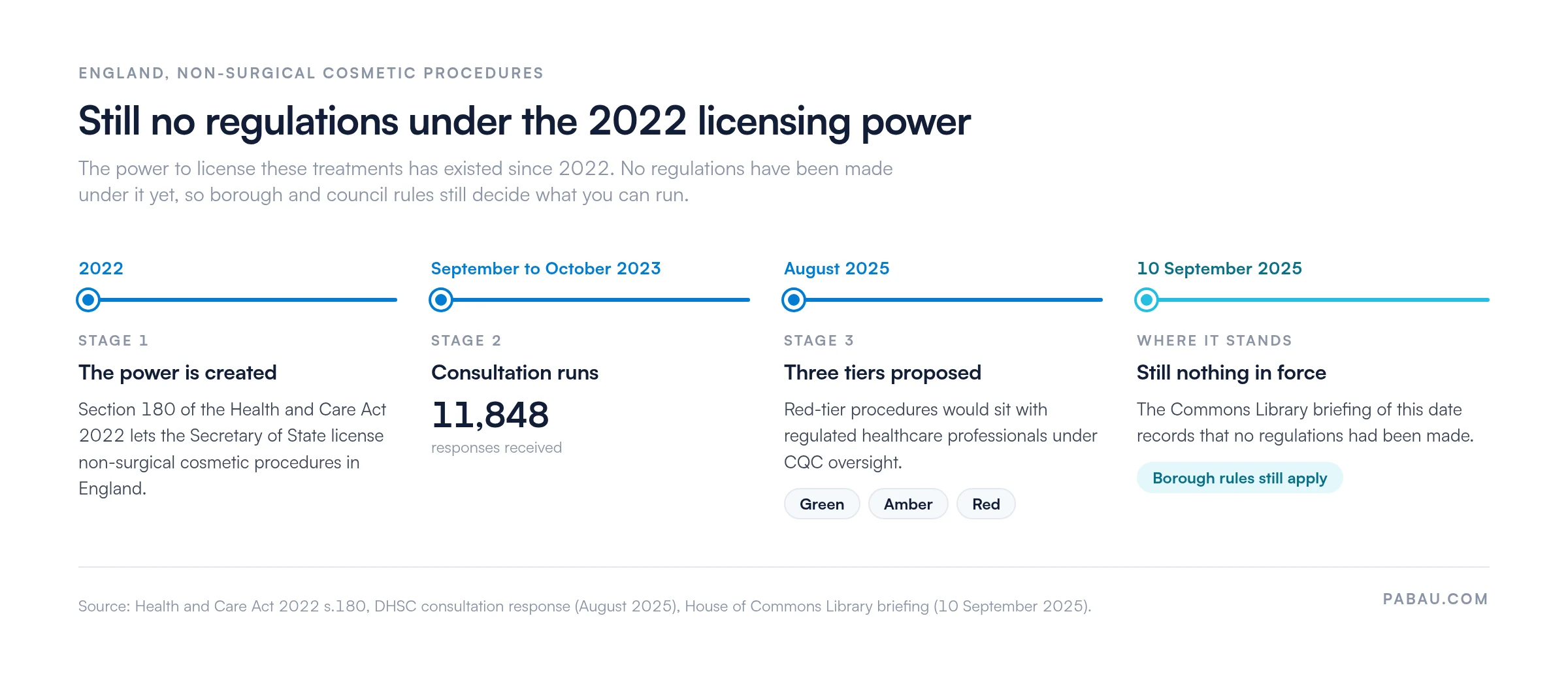
A national scheme is coming, slowly. Section 180 of the Health and Care Act 2022 gave the Secretary of State power to license non-surgical cosmetic procedures in England. A consultation ran from September to October 2023 and drew 11,848 responses.
The government’s August 2025 response proposed green, amber and red tiers. Red procedures would be restricted to regulated healthcare professionals under CQC oversight. No regulations had been made as of the Commons Library briefing dated 10 September 2025.
The timeline below tracks that delay. Until regulations arrive, the rules above stand.
Expect roughly £7,600 to £10,700 for first-year training, insurance, registration and waste disposal. A London laser licence adds about £1,100 on top.
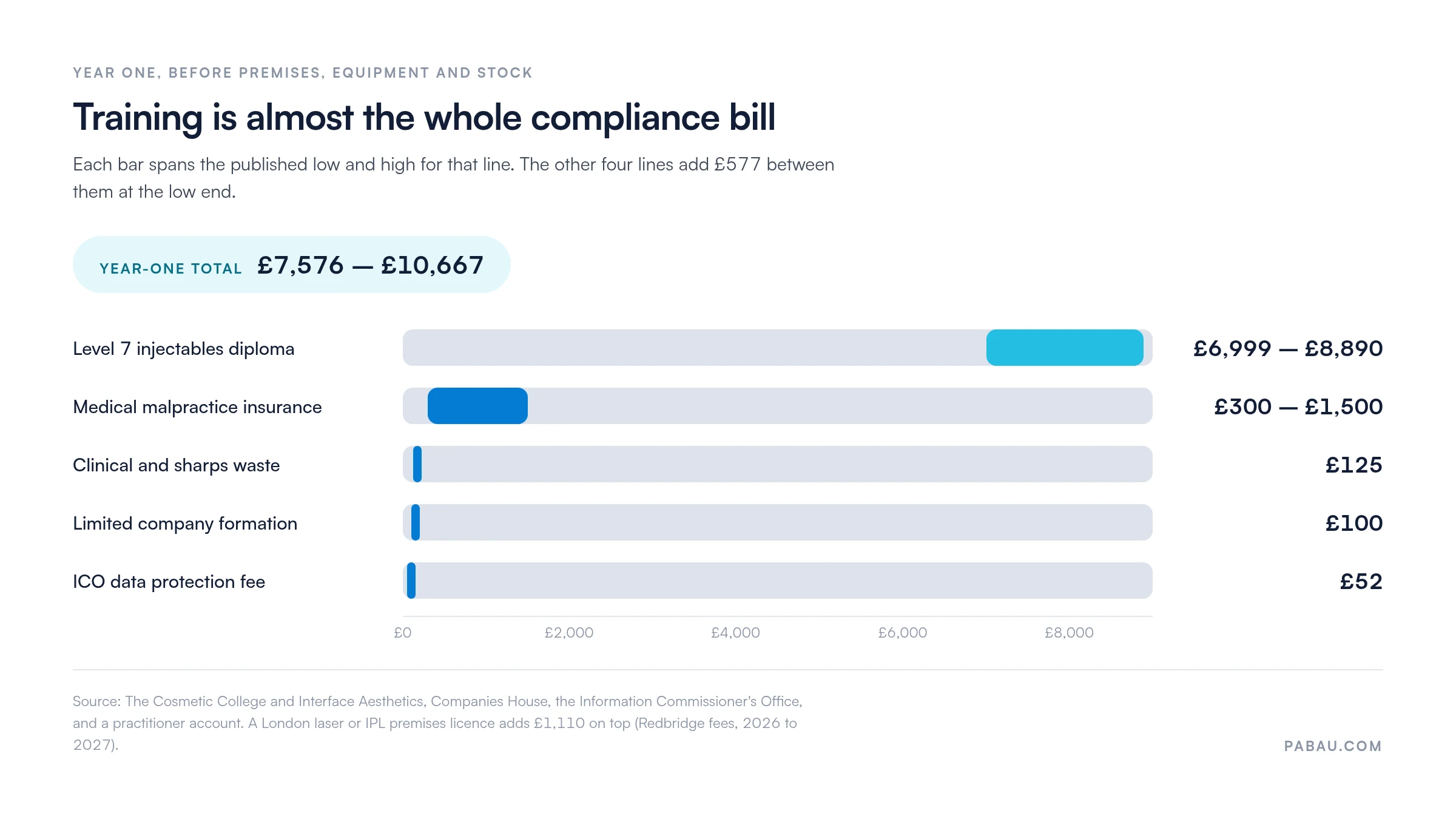
The figures below are published prices where a published price exists, and reported ranges where it does not.
Add the lines that apply to everyone and the total lands between £7,576 and £10,667. Training dominates it. A nurse who already holds Level 7 drops that line and finishes under £2,000.
Premises, equipment, stock and marketing make up the larger half of the bill. Our full breakdown of the costs of starting an aesthetics business puts a UK setup between £10,000 and £50,000 in year one.
The records requirement above is easy to write down and hard to run. In practices we onboard, the medical history is on paper, the consent form is in a drawer, and the photos are on someone’s phone.
Practice management software like Pabau puts those pieces on one patient timeline. Digital forms collect the medical history and the consent before the appointment. Before-and-after photos attach to the treatment record instead of a camera roll.
That matters most on the day a complaint arrives. The record shows what the patient consented to, what was injected, and what the skin looked like, in order. Nobody has to rebuild a timeline from a filing cabinet and a phone.
Pabau is purpose-built med spa software, so the consent, photo and stock fields match what an aesthetics practice records.

Pabau’s digital forms, before-and-after photos and treatment notes attach to a single patient timeline. Your consent trail stays complete without a filing cabinet or a camera roll.

Order matters more than eligibility here. Confirm your indemnity cover, settle the prescribing route, then phone the borough or council before you sign anything. A room you cannot license is the expensive mistake, and it is the easiest one to avoid.
The in-person prescribing rule is the change worth planning around. It adds a visit to every new patient’s path, which affects your diary, your pricing and your marketing promises. Build that visit in now and it stops being a surprise later.
Once the doors open, the paperwork carries on. Every treatment needs a consent trail, a photo record and a note that ties them together. Book a demo to see how Pabau holds all three on one patient record.

Need the consent paperwork itself? Dermal filler consent form template sets out the risks, aftercare and signature fields a filler consent has to carry.
Wondering how to handle before-and-after photos? Before and after photo consent form requirements covers what a photo authorization must say before you post anything.
Building your consultation from scratch? Why consultations matter for aesthetic practitioners explains how to structure the first appointment now that prescribers must attend in person.
Planning the patient experience? The customer journey in aesthetics walks through each stage from first inquiry to rebooking, with the admin each one creates.
Choosing a system before you open? Best aesthetic clinic software compares the platforms on records, booking and payments for a single-site practice.
Scotland runs a separate system. Independent clinics register with Healthcare Improvement Scotland rather than the CQC. The service must be run or managed by a doctor, dentist, prescribing nurse or pharmacist prescriber. A nurse without a V300 cannot hold that role. HIS asks for at least six months to process a complete application, so start it early.
Often yes, and the licensing question does not change. A special treatment licence follows the premises, so a treatment room at home is still premises. Ask your council whether a residential address qualifies before you fit the room out. Your landlord or mortgage lender may also have a view.
Not with botulinum toxin or cosmetic fillers in England. The Botulinum Toxin and Cosmetic Fillers (Children) Act 2021 made it an offence to inject either into an under-18 for cosmetic purposes. A doctor can approve an exception, and a nurse may then administer under that doctor’s direction.
Yes, and each one stays personally responsible for their own registration and indemnity cover. Employing an injector does not transfer their accountability to you. Every prescription still needs a prescriber who has assessed that patient in person, so a non-prescribing team means more prescriber visits.